

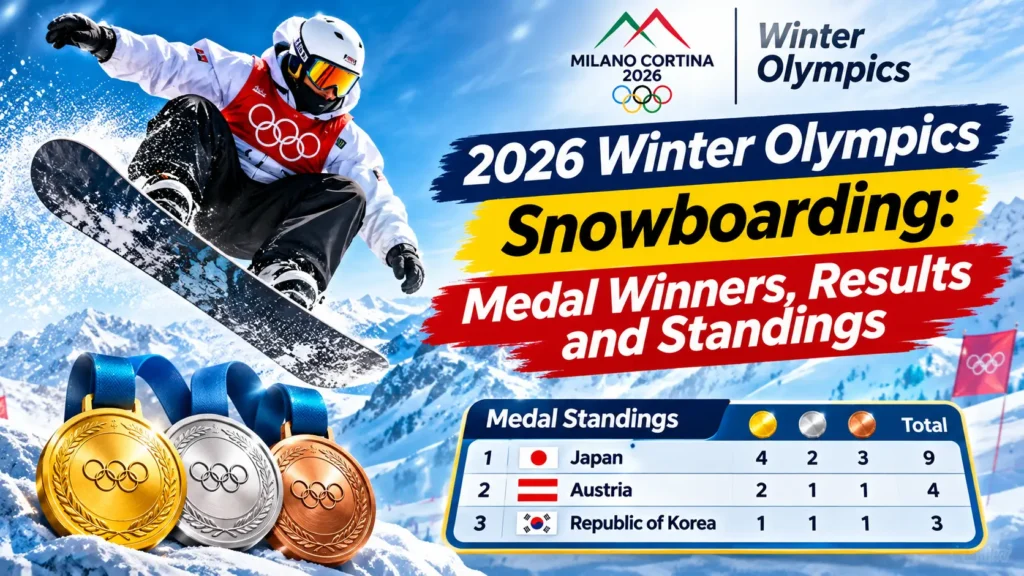
2026 Winter Olympics Snowboarding: Results at a Glance
The Milano Cortina Games brought the snowboard programme to Livigno, in northern Italy. Five individual disciplines were contested by men and women, while snowboard cross also had a mixed-team competition. Each awarded gold, silver and bronze, producing 33 medals in total. The top of the standings was shaped by Japan’s strength in judged park and pipe events, but the podiums showed a broad international field.
A full event-by-event overview appears in the Milano Cortina 2026 Olympic snowboard results. Below, each Olympic podium is presented with athlete names and countries, rather than mixing final scores with ranking points from a separate system.
Complete 2026 Snowboarding Medal Winners: Men, Women and Mixed
The men’s competition delivered two titles for Japan, two for Austria and one for China. In the women’s events, Japan collected two more golds, while South Korea, Czechia and Australia each claimed one. Great Britain took the mixed team snowboard cross title. This distribution explains why Japan led the medal count but did not win every discipline.
Men’s snowboarding medal results
| Event | Gold | Silver | Bronze |
|---|---|---|---|
| Big air | Kira Kimura | Ryoma Kimata | Su Yiming |
| Halfpipe | Yuto Totsuka | Scotty James | Ryusei Yamada |
| Slopestyle | Su Yiming | Taiga Hasegawa | Jake Canter |
| Parallel giant slalom | Benjamin Karl | Kim Sang-gyeom | Tervel Zamfirov |
| Snowboard cross | Alessandro Hämmerle | Éliot Grondin | Jakob Dusek |
Kira Kimura led a Japanese one-two in big air, finishing ahead of Ryoma Kimata. In the halfpipe, Yuto Totsuka beat Australia’s Scotty James, with Ryusei Yamada securing another Japanese medal. China’s Su Yiming took slopestyle gold, while Benjamin Karl and Alessandro Hämmerle won Austria’s two men’s titles in parallel giant slalom and snowboard cross.
Women’s snowboarding medal results
| Event | Gold | Silver | Bronze |
|---|---|---|---|
| Big air | Kokomo Murase | Zoi Sadowski-Synnott | Yu Seung-eun |
| Halfpipe | Choi Ga-on | Chloe Kim | Mitsuki Ono |
| Slopestyle | Mari Fukada | Zoi Sadowski-Synnott | Kokomo Murase |
| Parallel giant slalom | Zuzana Maděrová | Sabine Payer | Lucia Dalmasso |
| Snowboard cross | Josie Baff | Eva Adamczyková | Michela Moioli |
Kokomo Murase claimed women’s big air gold and then added slopestyle bronze. Mari Fukada topped the slopestyle final, while Zoi Sadowski-Synnott earned two silver medals for New Zealand. Choi Ga-on won the women’s halfpipe ahead of Chloe Kim. Zuzana Maděrová and Josie Baff completed the remaining women’s gold-medal results.
Mixed team snowboard cross podium
| Medal | Country | Team athletes |
|---|---|---|
| Gold | Great Britain | Huw Nightingale and Charlotte Bankes |
| Silver | Italy | Lorenzo Sommariva and Michela Moioli |
| Bronze | France | Loan Bozzolo and Léa Casta |
2026 Winter Olympics Snowboarding Medal Table by Country
Japan finished with four gold, two silver and three bronze medals, giving it nine of the 33 available medals. Austria followed with two golds. South Korea came next with one gold, one silver and one bronze, while Australia and Czechia also collected a gold and a silver each. The table uses gold medals first, then silver and bronze, which is the standard Olympic ranking approach.
| Rank | Country | Gold | Silver | Bronze | Total |
|---|---|---|---|---|---|
| 1 | Japan | 4 | 2 | 3 | 9 |
| 2 | Austria | 2 | 1 | 1 | 4 |
| 3 | South Korea | 1 | 1 | 1 | 3 |
| 4 | Australia | 1 | 1 | 0 | 2 |
| 4 | Czechia | 1 | 1 | 0 | 2 |
| 6 | China | 1 | 0 | 1 | 2 |
| 7 | Great Britain | 1 | 0 | 0 | 1 |
| 8 | New Zealand | 0 | 2 | 0 | 2 |
| 9 | Italy | 0 | 1 | 2 | 3 |
| 10 | United States | 0 | 1 | 1 | 2 |
| 11 | Canada | 0 | 1 | 0 | 1 |
| 12 | Bulgaria | 0 | 0 | 1 | 1 |
| 12 | France | 0 | 0 | 1 | 1 |
Japan’s lead was built through several athletes rather than a single champion. Its nine medals came from big air, halfpipe and slopestyle performances. Italy collected three medals without a gold, including mixed snowboard cross silver. New Zealand recorded two silvers, while the United States earned a halfpipe silver and slopestyle bronze. Thirteen countries reached at least one podium, showing how widely the medals were shared.
How Japan Dominated Snowboarding at Milano Cortina 2026
Japan’s riders were especially competitive when trick execution, consistency and landing quality determined the ranking. Kimura’s 179.50 in men’s big air gave him gold ahead of teammate Kimata on 171.50. Totsuka then won men’s halfpipe with 95.00 points, ahead of James on 93.50 and Yamada on 92.00. Each result required judges to assess different performances, but the theme was familiar: clean high-difficulty riding under final-round pressure.
The women delivered equally important results. Murase won big air with 179.00, edging Sadowski-Synnott’s 172.25 and Yu Seung-eun’s 171.00. Fukada produced an 87.83 in slopestyle to hold off Sadowski-Synnott by just 0.35 points. Those close results show how a stable landing, precise execution or one small scoring improvement can make the difference between gold and silver.
Big Air, Halfpipe and Slopestyle: The Standout Finals
Big air: Kimura and Murase win for Japan
Big air sends riders off one large jump to perform difficult aerial tricks. In the men’s final, Kimura scored 179.50 across his counting attempts to lead a Japanese one-two. In the women’s final, Murase won with 179.00. Su Yiming collected men’s bronze before taking gold in slopestyle, while Sadowski-Synnott added another major big air medal to her record.
A useful distinction is that snowboard big air uses a snowboard, whereas freestyle skiing big air uses skis. Both sports involve a large jump and judged tricks, but they have separate Olympic competitions, athlete fields and results. For the skiing event, see the 2026 Winter Olympics men’s freestyle skiing big air results, including the full standings and individual run scores. These should not be combined with snowboard results.
Halfpipe: Totsuka and Choi Ga-on emerge on top
Halfpipe riders move from wall to wall, linking aerial tricks into a complete judged run. Totsuka beat James in a close men’s contest, with Japanese teammate Yamada third. The women’s final supplied a major talking point as South Korea’s Choi Ga-on won with 90.25 points, ahead of two-time Olympic champion Chloe Kim on 88.00. Mitsuki Ono earned bronze for Japan.
Slopestyle: another Japanese medal push
Slopestyle involves jumps, rails and other course features rather than one isolated take-off. Su Yiming won the men’s competition with 82.41, just 0.28 ahead of Taiga Hasegawa on 82.13; American Jake Canter was third on 79.36. In the women’s final, Fukada’s victory over Sadowski-Synnott was similarly close. Those results made the technical, risk-versus-consistency balance a major story of the Games.
Snowboard Cross and Parallel Giant Slalom Results
Snowboard cross looks very different from the trick events. Riders race against each other around a course with turns, rollers and jumps, and position at the finish decides the medals. Austria’s Alessandro Hämmerle won the men’s race ahead of Canada’s Éliot Grondin and fellow Austrian Jakob Dusek. Australia’s Josie Baff took the women’s title ahead of Eva Adamczyková and Italy’s Michela Moioli.
Parallel giant slalom involves side-by-side racing through gates. Austria’s Benjamin Karl claimed men’s gold over South Korea’s Kim Sang-gyeom, with Bulgaria’s Tervel Zamfirov winning bronze. The women’s title went to Czechia’s Zuzana Maděrová ahead of Austria’s Sabine Payer and Italy’s Lucia Dalmasso. Race finishes and timed knockouts decide these medals, so a comparison with freestyle judging scores would not be meaningful.
When and Where Were the 2026 Snowboarding Events Held?
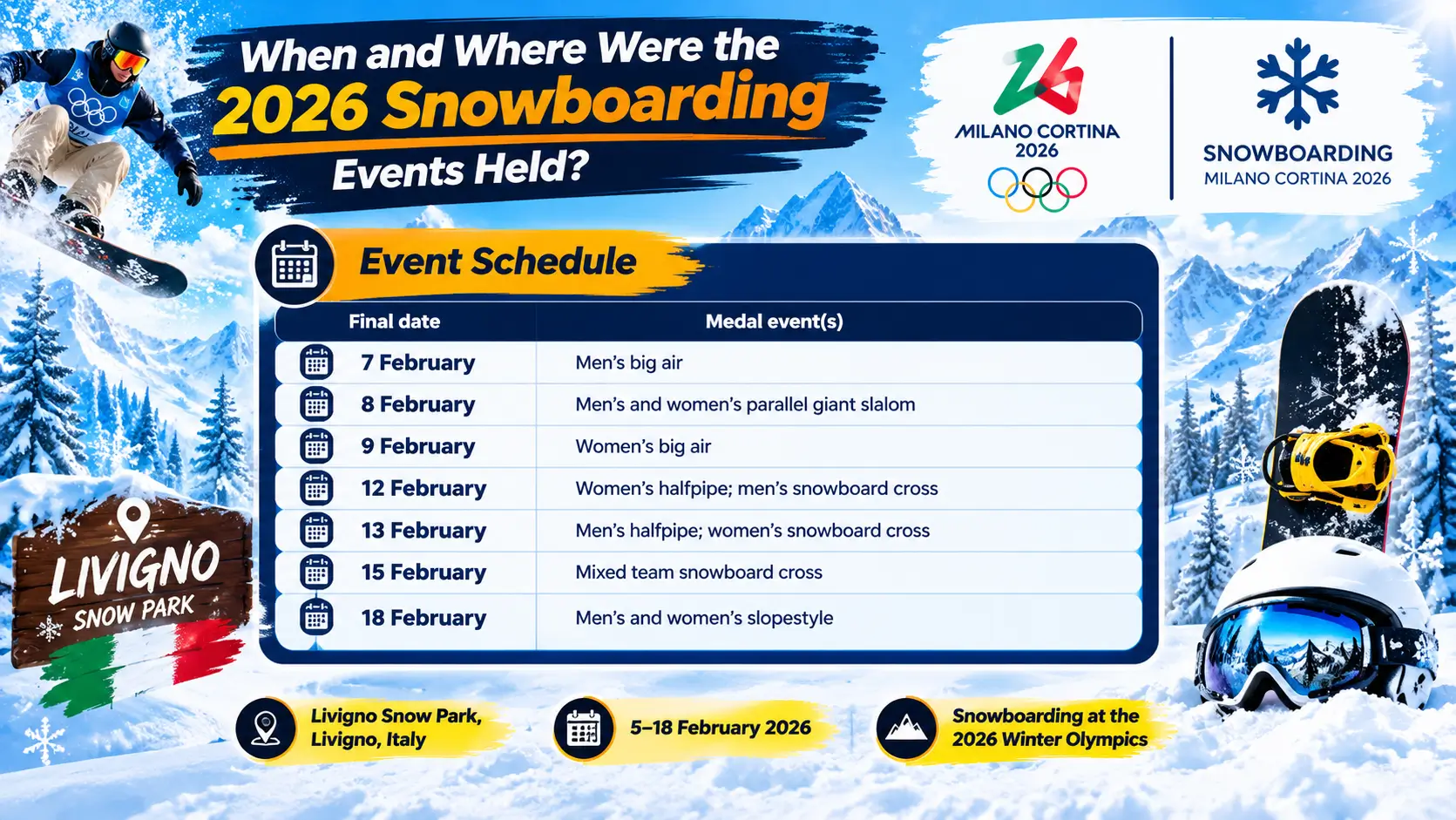
All 11 medal events were staged in the Livigno mountain area during 5–18 February 2026. The programme began with men’s big air qualification and the title was decided on 7 February. The parallel giant slalom finals came on 8 February; women’s big air finished on 9 February. Halfpipe and cross races filled the middle days, while slopestyle finals concluded the snowboard programme on 18 February.
| Final date | Medal event(s) |
|---|---|
| 7 February | Men’s big air |
| 8 February | Men’s and women’s parallel giant slalom |
| 9 February | Women’s big air |
| 12 February | Women’s halfpipe; men’s snowboard cross |
| 13 February | Men’s halfpipe; women’s snowboard cross |
| 15 February | Mixed team snowboard cross |
| 18 February | Men’s and women’s slopestyle |
What the Results Reveal About Olympic Snowboarding
The 2026 Winter Olympics snowboarding results highlight three different routes to success. Judges rewarded the most complete combinations of difficult tricks and controlled landings in big air, halfpipe and slopestyle. Parallel giant slalom required clean lines and speed through gates. Snowboard cross added tactical pressure from opponents moving on the same course. Success in one discipline did not guarantee success in another.
For an all-in-one reference, the 2026 Olympic snowboarding event overview also separates the five men’s, five women’s and mixed events. It is helpful when comparing winners, schedule dates and the medal table. Japan’s nine medals demonstrate depth in judged events, while Austria’s two men’s racing golds and Britain’s mixed cross victory show that Olympic medals were won through different specialties.
Frequently Asked Questions
Which country won the most snowboarding medals in 2026?
Japan topped the 2026 Olympic snowboard medal table with nine medals: four gold, two silver and three bronze. Austria placed second by gold medals, with two.
How many snowboard events were at the 2026 Winter Olympics?
There were 11 medal events: five men’s events, five women’s events and one mixed team snowboard cross event. They produced 33 medals in total.
Who won the 2026 men’s snowboard big air gold?
Kira Kimura of Japan won men’s snowboard big air with 179.50 points. Ryoma Kimata took silver and China’s Su Yiming earned bronze.
Who won women’s snowboard halfpipe in 2026?
South Korea’s Choi Ga-on won gold with 90.25 points. Chloe Kim of the United States finished second, and Japan’s Mitsuki Ono was third.
Where was Olympic snowboarding held in 2026?
The snowboard events were held in the Livigno area of Valtellina, Italy, as part of Milano Cortina 2026. Competition ran from 5 to 18 February.
Is snowboard big air the same as freeski big air?
No. Snowboard big air is performed on one snowboard, while freeski big air is performed on skis. They have separate athlete lists, competitions and medal results.
Final Word: 2026 Winter Olympics Snowboarding Results
The 2026 Winter Olympics snowboarding programme brought together 11 medal contests and a wide spread of national champions. Japan’s four golds and nine medals made it the clear medal-table leader, while Austria took two titles and the remaining golds were shared by South Korea, Australia, Czechia, China and Great Britain. The winners came from racing as well as the judged park-and-pipe disciplines.