


South African cricket has evolved from apartheid-era isolation to global success, highlighted by the Proteas’ 2025 World Test Championship victory.
Since their first Test in 1889, the Proteas have produced legendary players while facing World Cup setbacks, financial pressures and unequal opportunities. Their next challenge is building sustainable growth across men’s, women’s and grassroots cricket.
South African Cricket at a Glance
| Category | Details |
|---|---|
| National team nickname | Proteas |
| Governing body | Cricket South Africa (CSA) |
| First Test match | 1889 vs England |
| ICC founding membership | 1909 |
| International isolation | 1970–1991 |
| Return to international cricket | 1991 |
| Major men’s ICC titles | 1998 Champions Trophy, 2025 World Test Championship |
| Leading domestic T20 league | SA20 |
| Next major home opportunity | 2027 ODI World Cup |
History of South African Cricket: From 1808 to the Modern Era
Early beginnings and the first Test in 1889
Cricket arrived in South Africa through British colonial influence. The first recognised match took place in 1808 between teams of English officers. In 1889, South Africa played its inaugural Test against England at St George’s Park in Port Elizabeth, now Gqeberha. This established South Africa as the third Test-playing nation after England and Australia.
The country’s participation as a founding member of the Imperial Cricket Conference in 1909 further established its importance in international cricket.
Apartheid and international isolation (1970–1991)
Apartheid was a system of institutionalised racial segregation that shaped South African society, including cricket. Black South Africans were denied equal opportunities in the country’s established cricket structures. International opposition to apartheid eventually resulted in South Africa’s suspension from international cricket in 1970.
The isolation lasted until 1991. During that period, unofficial rebel tours took place, but they did not replace legitimate international competition. Exceptional cricketers lost opportunities to establish full international careers, while generations of disadvantaged players faced exclusion from resources and recognition.
Readmission and the modern Proteas
South Africa was readmitted to the ICC in July 1991. Its first official international match after returning was an ODI against India at Eden Gardens, Kolkata, on 10 November 1991. The Proteas then participated in the 1992 Cricket World Cup and resumed Test cricket against the West Indies in April that year. Readmission created a new beginning, although repairing decades of inequality required much more than reopening international fixtures.
Timeline of Major South African Cricket Milestones
| Year | Milestone | Significance |
|---|---|---|
| 1808 | First recognised cricket match | Beginning of documented cricket history |
| 1889 | First Test against England | Third Test-playing nation |
| 1909 | Founding ICC member | International recognition |
| 1970 | International suspension | Apartheid-era isolation |
| 1991 | ICC readmission | Return to international cricket |
| 1992 | First ODI World Cup appearance | Re-entry to global tournaments |
| 1998 | Champions Trophy victory | First major men’s ICC title |
| 1999 | World Cup semi-final tie | Famous elimination against Australia |
| 2012 | Top-ranked across formats | Peak of a dominant generation |
| 2024 | Men’s T20 World Cup final | Breakthrough final appearance |
| 2025 | World Test Championship victory | Historic win over Australia |
| 2027 | Scheduled co-hosting of ODI World Cup | Opportunity for long-term growth |
Legendary South African Cricketers Who Shaped the Game
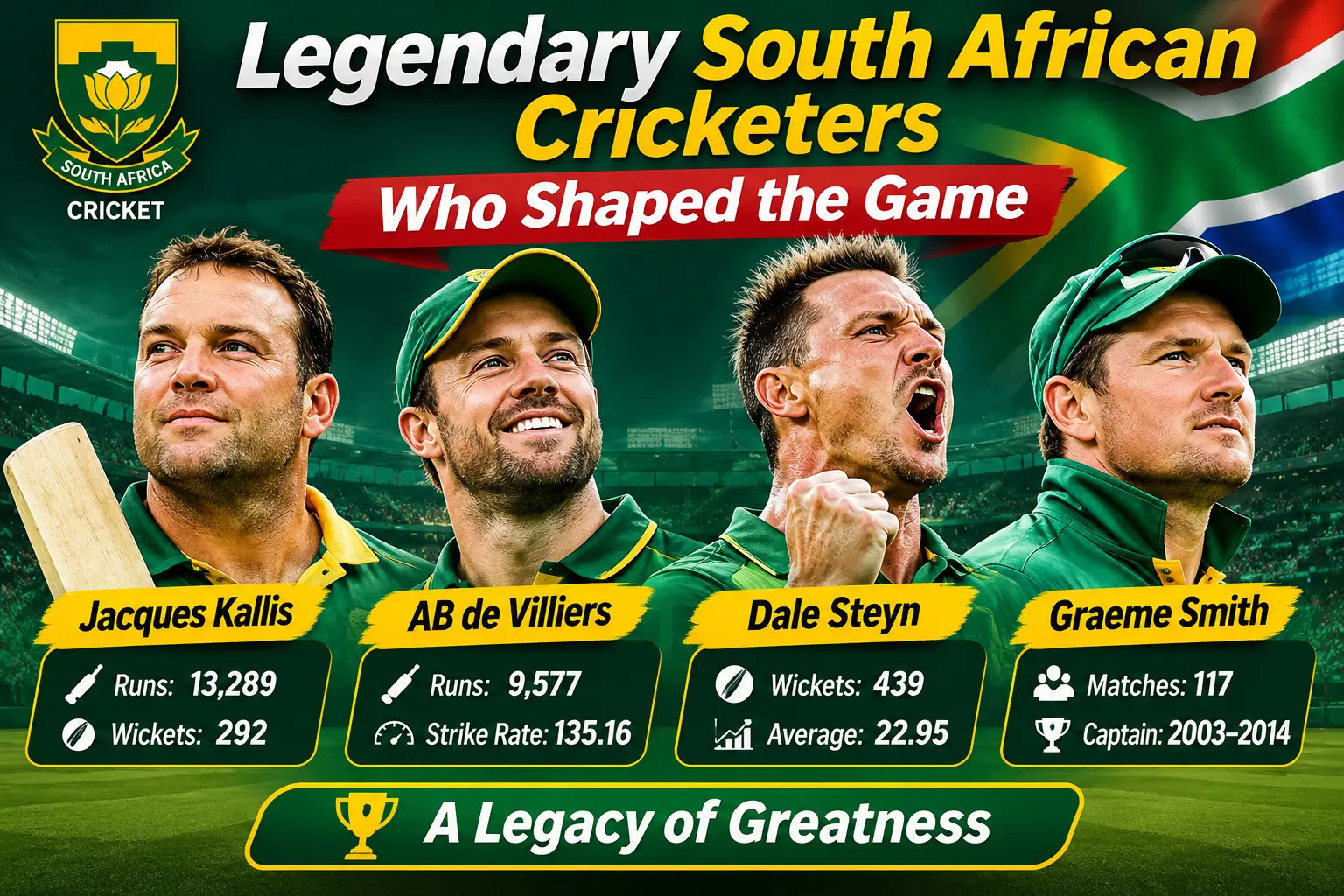
Jacques Kallis — The complete all-rounder
Kallis combined technically outstanding batting with effective seam bowling. His longevity and consistency made him one of the greatest all-rounders in cricket history.
AB de Villiers — The innovative batter
Famous for his 360-degree shot-making, de Villiers helped redefine attacking batting in limited-overs cricket.
Dale Steyn — The fast-bowling icon
Steyn’s pace, late swing and relentless aggression made him one of the most feared Test bowlers of his generation. Other important figures include Graeme Smith, Hashim Amla, Shaun Pollock, Makhaya Ntini, Allan Donald and Kagiso Rabada.
South Africa’s World Cup Challenges and the ‘Chokers’ Reputation
Despite consistently fielding competitive teams, South Africa endured several high-profile tournament disappointments. The 1992 World Cup semi-final was disrupted by rain and an unpopular revised target. In 1999, a dramatic semi-final tie against Australia eliminated South Africa because Australia had finished higher in the preceding Super Six stage.
Further knockout defeats reinforced a reputation for struggling under pressure. However, reducing decades of performances to the label chokers overlooks strong opposition, unpredictable match situations and the country’s many international achievements. The 2024 T20 World Cup final demonstrated South Africa’s progress, even though India ultimately won the title.
How South Africa Won the 2025 World Test Championship
The 2025 World Test Championship final was a defining moment in Proteas history. South Africa defeated Australia by five wickets at Lord’s after successfully chasing 282. Aiden Markram scored 136, while captain Temba Bavuma contributed 66. The victory delivered South Africa’s first major men’s ICC trophy since 1998 and showed that the Proteas could finish the biggest matches successfully.
Includes the 1998 Champions Trophy and 2025 World Test Championship.
For continuing coverage of international tournaments, Proteas performances and cricket analysis, explore the latest cricket news and updates on KhelKhabri.
Major Challenges Facing South African Cricket in 2026
South Africa’s on-field success has not eliminated the structural problems affecting the sport. Financial sustainability, player retention, unequal opportunities and domestic cricket development remain major concerns.
1. Financial pressure and declining revenue
Cricket South Africa faces significant financial challenges. September 2026 reporting indicated CSA recorded a loss of approximately R440 million for the 2025–26 financial year. Contributing factors reportedly included limited high-revenue international fixtures, preparations for the 2027 World Cup and currency movements. Concerns about future ICC distributions have increased pressure to reduce costs and develop more reliable commercial income.
2. Competition from global franchise leagues
International T20 leagues have created earning opportunities for South African players but complicated national selection, workloads and long-term international commitments. CSA must balance franchise cricket’s financial benefits with retaining experienced cricketers for Tests and major ICC tournaments.
3. Transformation and equal opportunity
Transformation remains one of South African cricket’s most important responsibilities. Although opportunities have expanded considerably since 1991, historical inequalities continue to influence access to facilities, coaching, school competitions and professional development. Meaningful transformation requires investment in disadvantaged communities, accessible pathways and greater representation in playing, coaching and administration.
4. Domestic cricket sustainability
South Africa’s provincial structure supports professional opportunities across regions, but maintaining the system is expensive. Reporting in January 2026 indicated CSA would retain its 15-team provincial structure while seeking operational savings, highlighting the difficulty of reducing costs without damaging development pathways.
South African Cricket Challenges: Impact and Solutions
| Challenge | Potential impact | Recommended response |
|---|---|---|
| Financial losses | Reduced development budgets | Diversify commercial revenue |
| Franchise league competition | International player availability | Improve scheduling and contracts |
| Unequal grassroots access | Smaller talent pipeline | Invest in community facilities |
| Domestic operating costs | Financial instability | Improve operational efficiency |
| Player workload | Injuries and fatigue | Stronger rotation planning |
| Governance concerns | Reduced stakeholder confidence | Transparency and accountability |
SA20: How Franchise Cricket Is Changing South Africa
The SA20 league, launched in January 2023, has become a major part of South Africa’s domestic cricket ecosystem. Featuring six franchises, it brings together established international players and emerging South African talent. Its combination of televised matches, commercial partnerships and large crowds provides exposure that traditional domestic competitions often struggle to generate.
According to SA20’s October 2026 anniversary announcement, the league has accumulated more than 1.6 million ticket sales and over 500 million television viewers since launch. These are organiser-reported cumulative figures, not independently audited unique audiences.
Green = direct expenditure; blue = total economic impact
Source: South African government Annual Performance Plan 2025–2026. Total economic impact includes direct, indirect and induced effects; it is not CSA revenue.
Franchise cricket can contribute to employment, tourism and commercial activity. However, economic activity generated by SA20 should not be confused with CSA’s own profitability.
Women’s Cricket: A Major Opportunity for Growth
Women’s cricket is another important component of South Africa’s sporting future. The Proteas Women have become increasingly competitive internationally, supported by prominent players such as Laura Wolvaardt, Marizanne Kapp and Ayabonga Khaka.
Improving women’s cricket requires more than international visibility. Regular domestic fixtures, professional contracts, improved training facilities and stronger school-level participation are essential for a sustainable talent pipeline. Commercial partnerships and television coverage can help build a larger audience and encourage girls to consider cricket professionally. The long-term objective should be a system in which talented players have clear opportunities regardless of gender, location or economic background.
The Future of South African Cricket: 2027 and Beyond

South Africa’s cricketing future depends on converting recent achievements into lasting improvements. The 2027 ICC Men’s Cricket World Cup, which South Africa is scheduled to co-host with Zimbabwe and Namibia, represents an opportunity to strengthen infrastructure, attract visitors and inspire young cricketers.
Expand grassroots participation
Invest in schools, community clubs and affordable facilities to widen the talent pool beyond traditional cricket centres.
Strengthen financial sustainability
Develop sponsorships, media opportunities and efficient domestic structures without sacrificing player development.
Build consistent international success
Use the 2025 Test championship triumph as a foundation for competitive performances across Tests, ODIs and T20Is.
Make cricket more inclusive
Improve opportunities for women, historically disadvantaged communities and players from underrepresented regions.
Develop modern cricket infrastructure
Expand performance analytics, coaching education, injury prevention and digital fan engagement.
What Can South Africa Achieve at the 2027 Cricket World Cup?
Home conditions could give South Africa an advantage in the 2027 ODI World Cup. South African grounds frequently reward disciplined fast bowling, although pitch characteristics vary significantly between venues. Familiarity with conditions, local support and preparation could strengthen the Proteas’ prospects.
Success will depend on assembling a balanced squad, developing reliable middle-order batting, maintaining bowling depth and managing pressure in knockout matches. For official information about international tournaments and South Africa’s cricket development, visit the International Cricket Council’s official website.
Frequently Asked Questions About South African Cricket
When did South Africa start playing international cricket?
South Africa played its first Test against England in 1889, becoming the third Test-playing nation.
Why was South Africa banned from international cricket?
South Africa was suspended in 1970 because of apartheid and its racially discriminatory sporting system. It returned to international cricket in 1991.
Has South Africa won an ICC trophy?
Yes. South Africa won the 1998 Champions Trophy and the 2025 World Test Championship in men’s international cricket.
Who is the greatest South African cricketer?
Jacques Kallis is widely regarded as one of South Africa’s greatest cricketers because of his exceptional all-round record. Other leading names include AB de Villiers, Dale Steyn, Graeme Smith and Hashim Amla.
What is the biggest challenge for South African cricket?
Financial sustainability, unequal development opportunities, domestic cricket costs and retaining international talent are among the most important concerns.
What is the future of South African cricket?
South Africa has a strong foundation through international talent, SA20 and recent Test success. Its future depends on sustained investment, effective administration and competitive performances across all formats.
Conclusion: Can South African Cricket Build a Lasting Legacy?
South African cricket has travelled an extraordinary path from colonial beginnings and apartheid-era exclusion to international readmission and global championship success. The 2025 World Test Championship victory demonstrated the country’s ability to compete and succeed at the highest level.
Nevertheless, lasting progress requires stronger finances, inclusive development, competitive domestic structures and opportunities for future generations. With the 2027 World Cup approaching, the Proteas have an opportunity to write another important chapter. The greatest measure of success will not simply be another trophy, but a cricket system capable of producing excellence for decades.