


India lost the fourth T20I against New Zealand because they conceded 259 runs and then lost four wickets inside the first six overs of the chase. Glenn Phillips smashed 107 from 49 balls, while Michael Bracewell made 65 from 25. Jacob Duffy then took four wickets for 23 runs as India finished on 172/9 at Eden Park, Auckland, on 30 October 2026.
The 87-run margin tells only part of the story. India had won the first three matches and already secured the five-match series. In Auckland, however, they failed to turn early bowling breakthroughs into control. New Zealand punished loose deliveries, built a match-changing partnership and then struck before India’s chase could settle.
New Zealand vs India 4th T20I: Match Summary
India captain Shreyas Iyer won the toss and chose to bowl. The opening overs gave India a promising chance, but the hosts recovered through powerful middle-order batting. New Zealand finished with a target of 260, leaving India needing 13 runs an over from the first ball.
| Match detail | Result |
|---|---|
| Match | New Zealand vs India, 4th T20I |
| Date and venue | 30 October 2026 • Eden Park, Auckland |
| Toss | India chose to bowl first |
| New Zealand | 259/7 in 20 overs |
| India | 172/9 in 20 overs |
| Result | New Zealand won by 87 runs |
| Player of the Match | Glenn Phillips • 107 from 49 balls |
| Series position | India led 3–1 with one T20I remaining |
New Zealand’s 259/7 was a huge score even on a ground known for short boundaries. India needed a long, powerful partnership to stay in the contest. The thrilling rivalry continues to attract fans looking for India vs New Zealand Match Tickets to experience future matches live. However, India’s chase in Auckland became a series of short attacks interrupted by wickets. That contrast explains why the result was so one-sided.
1. India Failed to Build on Their Early Bowling Breakthroughs
India’s first mistake was allowing New Zealand to escape after losing early wickets. Mayank Yadav dismissed Tim Seifert for three and Daryl Mitchell for 24. The home side were 34/2 in the third over, giving India an opening to slow the scoring. Finn Allen still attacked, and Phillips soon took charge.
New Zealand moved to 93/3 and later 112/4 after 10.4 overs. Four wickets at that point should have made the batting side think carefully about taking risks. Yet India’s bowlers could not keep the pressure on the new batters. Phillips continued finding boundaries, while Bracewell attacked immediately.
Mayank finished with three wickets for 48 runs, showing both the value and the limits of early breakthroughs. India took wickets, but they did not follow them with enough tight overs. The missed chance to control the middle phase became the first major turning point.
2. Glenn Phillips and Michael Bracewell Took the Match Away

Glenn Phillips played the innings that transformed the game. His 107 from 49 balls included six fours and ten sixes. He was aggressive without needing a long settling period. Once he found his range, India’s field settings and bowling changes offered little protection.
Michael Bracewell made the situation worse for the visitors. He scored 65 from only 25 balls, with four fours and six sixes. Phillips and Bracewell added 115 runs for the fifth wicket in just 40 balls. The stand took New Zealand from 112/4 to 227/5 and put the target almost beyond reach.
The partnership matters because the two batters shared the scoring pressure. India could not simply bowl safely to one player and attack the other. Both punished full balls, missed yorkers and anything with enough width to hit. Their combined 172 runs accounted for about two-thirds of New Zealand’s total.
Batting comparison
Who scored the most runs?
Selected leading innings from each side • bars scaled against 107 runs.
3. The 32-Run Over and Poor Death Bowling Were Costly
New Zealand were 174/4 after 15 overs. The next five produced 85 runs, lifting the total to 259/7. India struggled most when they needed to close the innings. Fuller deliveries missed their target, and the hosts used Eden Park’s short boundaries to keep hitting sixes.
The biggest blow came in the 16th over. Nitish Kumar Reddy conceded 32 runs as Phillips struck four consecutive sixes. One expensive over cannot explain an entire defeat, but this one changed the size of India’s target. A difficult chase quickly became a near-record task.
Reddy finished with 1/64 from four overs, an economy rate of 16.00. Axar Patel conceded 43 from three overs, while Prince Yadav gave away 49 from four. Arshdeep Singh was more controlled at 1/38, but India needed several bowlers to restrict the scoring. That support did not arrive.
Run-flow analysis
New Zealand added 85 in the final five overs
The two segments represent the 259 runs New Zealand scored across their 20 overs.
This late surge also changed India’s batting choices. Chasing 220 requires bold cricket, but chasing 260 leaves almost no time to recover from setbacks. India needed to score quickly from the powerplay without losing wickets. The extra runs made that balance much harder.
4. India Lost Two Wickets in the First Over
India’s reply began in the worst possible way. Jacob Duffy removed Sanju Samson for four and Ishan Kishan for a duck in the first over. The score was just 4/2 after five deliveries. From that point, the remaining batters had to attack a target of 260 while rebuilding the innings.
Abhishek Sharma briefly counterattacked with 27 from 15 balls. Captain Shreyas Iyer added 22 from 11, and the pair gave India some momentum. Neither could turn that start into a longer innings. Abhishek fell with the score on 50, followed by Iyer at 56.
India had slipped to 56/4 in the sixth over. Losing four specialist batters so early removed any realistic margin for a quiet period. A side chasing 260 needs frequent boundaries and a settled partnership. India’s top order could not provide both.
5. No Indian Batter Turned a Start into a Match-Changing Innings
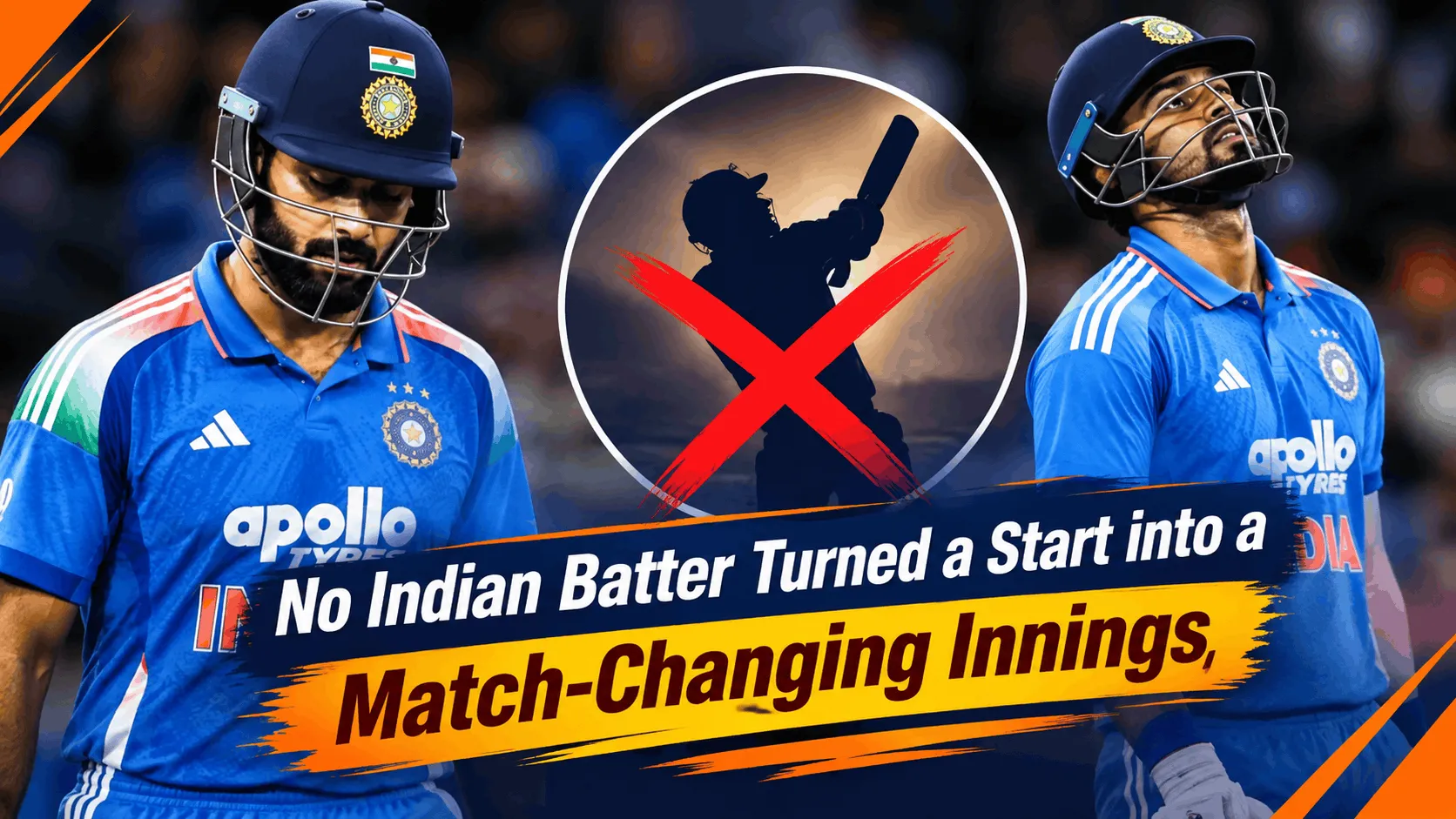
Several Indian batters scored quickly for short periods. Abhishek made 27, Iyer scored 22, and Nitish Kumar Reddy struck 21 from ten balls. Naman Dhir added 28 from 13 deliveries. These scores kept the innings moving, but none lasted long enough to alter the chase.
Tilak Varma was India’s highest scorer with 35 from 35 balls. He spent time at the crease while wickets continued to fall around him. Yet a run-a-ball innings could not match a target requiring 13 runs per over. India needed both stability and fast scoring, not one without the other.
The partnership between Abhishek and Iyer added 46 runs from 22 balls. It was India’s largest stand, but it ended too early to create a winning position. New Zealand’s Phillips and Bracewell, by contrast, stayed together long enough to change the entire match. That was a decisive difference in batting execution.
| India batter | Runs | Balls | Strike rate |
|---|---|---|---|
| Tilak Varma | 35 | 35 | 100.00 |
| Naman Dhir | 28 | 13 | 215.38 |
| Abhishek Sharma | 27 | 15 | 180.00 |
| Shreyas Iyer | 22 | 11 | 200.00 |
| Nitish Kumar Reddy | 21 | 10 | 210.00 |
| Prince Yadav | 18* | 17 | 105.88 |
6. New Zealand Bowled with Better Control Under Pressure
New Zealand did not rely only on their huge total. Their bowlers attacked the stumps, used changes of pace and kept taking wickets. Duffy’s 4/23 from four overs was the best bowling return of the match. His opening-over double strike gave the hosts immediate control.
Mitchell Santner also made an important impact. The New Zealand captain took two wickets for 24 runs from four overs. Matthew Fisher collected two for 40, while Adam Milne removed Iyer. They attacked different parts of India’s order rather than allowing one batter to settle.
India conceded runs at 12.95 per over, while New Zealand restricted them to 8.60. This difference came from both wicket-taking and better use of defensive overs. Even when India hit boundaries, New Zealand answered with wickets. The home side controlled the rhythm of the chase.
Bowling comparison
Economy rates show the difference
Runs conceded per six legal balls • shorter bars mean tighter bowling. Selected four-over spells only.
7. India Did Not Adapt Quickly Enough to Eden Park
Eden Park is a difficult ground for visiting teams because the boundary sizes are unusual. Certain hitting areas are shorter, so missing a bowling length can turn a good plan into an expensive over. Phillips and Bracewell understood the opportunities and attacked them. India’s attack could not adjust consistently as the innings progressed.
India’s coaching staff later pointed to early batting wickets and the challenge of adapting to the venue. Captain Iyer also felt the bowling had given New Zealand too much momentum. Those reactions matched what happened on the field. India made an encouraging start with the ball but could not sustain it.
There was also discussion around the team selection after Vaibhav Suryavanshi missed the match. That debate is understandable, but one selection cannot explain an 87-run defeat. The scorecard offers clearer answers: expensive bowling, four early wickets and a lack of big partnerships. Those are the areas India can act on immediately.
Key Turning Points: How the Match Changed
| Moment | Score or event | Why it mattered |
|---|---|---|
| Early NZ wickets | 34/2 in the third over | India had a chance to control the innings. |
| Partnership takes off | Phillips–Bracewell: 115 in 40 balls | New Zealand moved from danger to dominance. |
| 16th over | 32 runs off Nitish Kumar Reddy | The target climbed sharply. |
| Final five overs | 85 runs | New Zealand reached 259/7. |
| India’s first over | 4/2 after five balls | The chase suffered immediate damage. |
| India’s sixth over | 56/4 after 5.3 overs | The required rebuild became too difficult. |
The most revealing contrast came after each team lost four wickets. New Zealand found two batters who stayed together and scored quickly. India kept losing wickets just as partnerships began to develop. The difference was not simply power hitting; it was the ability to maintain pressure without losing control.
What Should India Improve Before the Fifth T20I?

India’s first task is to improve execution at the end of an innings. Bowlers must hit their chosen lengths more consistently and avoid predictable full deliveries. Even a small reduction in late runs would make the next chase more manageable. The team must also use its early wickets to create quiet overs.
The second task is to protect the powerplay without becoming passive. India can still play attacking cricket while valuing a partnership after an early wicket. The Auckland chase showed what happens when every new batter must score immediately. A stable opening spell would give the middle order far more freedom.
The third task is to adjust quickly to the next ground. The fifth T20I is scheduled for Hamilton on 1 November 2026. India already hold the series lead, but New Zealand’s win showed that the home side can respond strongly. The final match will test how quickly India learn from this defeat.
Frequently Asked Questions
Why did India lose to New Zealand in the fourth T20I?
India conceded 259/7 and then lost four wickets in the first six overs. Phillips and Bracewell dominated the first innings, while Jacob Duffy led New Zealand’s bowling with four wickets.
What was the result of the fourth NZ vs IND T20I in 2026?
New Zealand defeated India by 87 runs at Eden Park, Auckland, on 30 October 2026. The home side scored 259/7, and India finished on 172/9.
How many runs did Glenn Phillips score against India?
Glenn Phillips scored 107 runs from 49 balls. His innings included six fours and ten sixes, and he was named Player of the Match.
How many runs did India concede in the last five overs?
India conceded 85 runs in the final five overs. New Zealand went from 174/4 after 15 overs to 259/7 after 20.
Who took the most wickets for New Zealand?
Jacob Duffy was the leading wicket-taker with 4/23 from four overs. Mitchell Santner and Matthew Fisher also took two wickets each.
Who was India’s highest scorer in the match?
Tilak Varma scored 35 from 35 balls. Naman Dhir made 28, and Abhishek Sharma contributed 27.
What happened in the first over of India’s chase?
Jacob Duffy dismissed Sanju Samson and Ishan Kishan. India were 4/2 after five balls, leaving them under immediate pressure while chasing 260.
Did India lose the T20I series after this defeat?
No. India had won the opening three matches and retained an unassailable lead. The fourth result reduced their lead to 3–1, with one match remaining.
Final Verdict: India Lost the Important Moments
India’s defeat was not caused by one player or one decision. New Zealand made better use of the key moments. Phillips and Bracewell turned 112/4 into a huge score, and the final five overs pushed the target to 260. India’s early batting collapse then made the chase almost impossible.
The result should not erase India’s three earlier victories, but it does reveal clear weaknesses. Bowling plans must survive pressure, and the batting order needs partnerships when wickets fall. New Zealand won because they did both jobs better in Auckland. That is the biggest lesson India can take into the final T20I.