

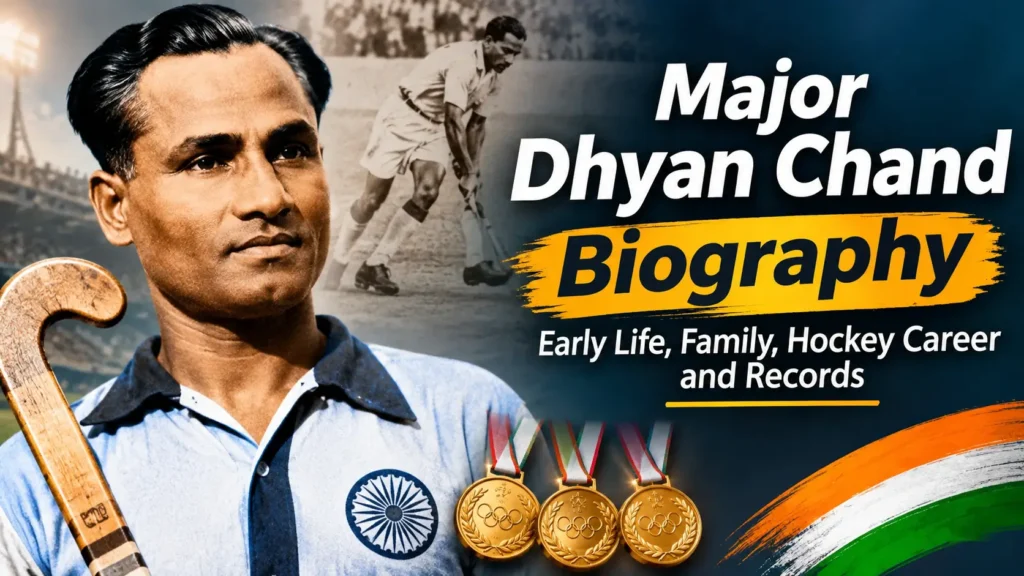
Major Dhyan Chand was one of the greatest hockey players in Indian sporting history. Known as the Hockey Wizard, he amazed fans with his ball control, dribbling and goal-scoring ability. He helped India win three consecutive Olympic gold medals in 1928, 1932 and 1936.
Born on 29 August 1905, Dhyan Chand grew up to become a symbol of Indian hockey. His journey included Army service, international tours, Olympic success and national recognition. His birthday is now celebrated as National Sports Day in India.
This biography explores Major Dhyan Chand’s early life, family, military career, Olympic achievements, records, awards and lasting legacy.
Major Dhyan Chand: Biography and Early Life
Major Dhyan Chand was an Indian field hockey player who represented India during its golden era. He played as a centre-forward and became famous for his extraordinary control over the hockey ball.
He won three Olympic gold medals with the Indian hockey team. These victories came at Amsterdam in 1928, Los Angeles in 1932 and Berlin in 1936. He also captained India during the 1936 Berlin Olympics.
His playing style earned him the names “Hockey Wizard” and “The Magician”. His quick movements and accurate finishing made him difficult for defenders to stop.
Dhyan Chand played international hockey from 1926 to 1948. According to Employment News, he represented India in 185 matches and scored more than 400 goals during this period.
Early Life and Family Background
Birth and Childhood
Major Dhyan Chand was born on 29 August 1905 in Allahabad, now known as Prayagraj, Uttar Pradesh. His birth name was Dhyan Singh, and he grew up in a family connected with the Indian Army.
His father, Sameshwar Singh, served in the British Indian Army. Because of his father’s military postings, the family moved between different places.
The family eventually settled in Jhansi, Uttar Pradesh. Dhyan Chand spent much of his childhood there and developed a strong connection with the city.
He did not become a famous hockey player during his early school years. His serious journey in hockey began after he joined the Army.
Parents and Brothers
Dhyan Chand’s parents were Sameshwar Singh and Sharadha Singh. His father served as a soldier, which influenced his decision to join military service later.
He also had brothers who became connected with hockey. His younger brother, Roop Singh, played alongside him in the Indian teams at the 1932 and 1936 Olympic Games.
Roop Singh was also a talented forward. His contribution helped India maintain its attacking strength during the country’s successful Olympic campaigns.
The sporting achievements of the family continued through later generations. Dhyan Chand’s son, Ashok Kumar, also represented India in international hockey.
Education and Early Interests
Dhyan Chand spent his early years in different towns because of his father’s Army transfers. He completed part of his schooling before the family settled in Jhansi.
Hockey was not initially his main career plan. His interest in the sport developed more seriously after he joined the military.
The Army provided him with opportunities to practise and play against other teams. These matches helped him improve his fitness, ball control and understanding of the game.
Growing Up in Jhansi
Jhansi became an important place in Dhyan Chand’s life. He developed his hockey skills there and played for the Jhansi Heroes hockey club.
The city remained closely connected with his identity throughout his career. Today, the Major Dhyan Chand Museum in Jhansi helps preserve his sporting history.
His journey from Jhansi to international hockey showed how dedication and regular practice can help a young player reach the highest level.
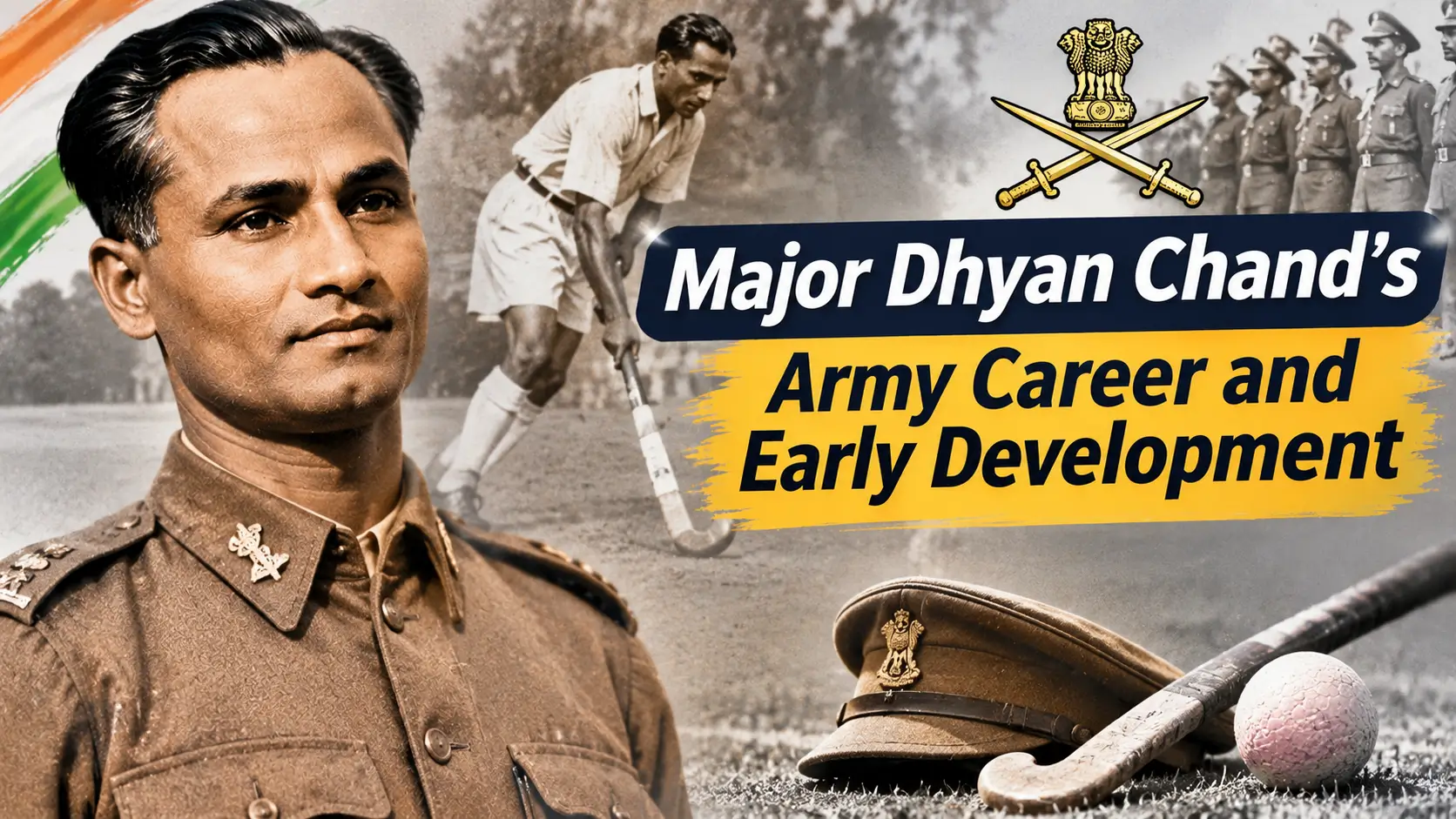
Major Dhyan Chand’s Army Career and Early Development
Joining the British Indian Army
Dhyan Chand joined the British Indian Army in 1922. He was around 16 or 17 years old, depending on how his age is reported in historical accounts.
His military service became an important turning point. He started playing hockey more regularly and took part in Army tournaments and regimental matches.
These competitions helped him understand the game at a higher level. His performances soon attracted attention from Army hockey officials.
He continued improving his skills while serving as a soldier. His discipline and commitment helped him develop into a strong player.
Early Hockey Training
Dhyan Chand became known for his close control of the ball. He could move through defenders while keeping the ball close to his stick.
His training involved regular practice and matches. He worked on his speed, passing, positioning and shooting.
Subedar Major Bale Tiwari is often credited in historical accounts with helping develop his hockey skills. The Army environment allowed Dhyan Chand to learn from experienced players.
His progress showed that talent alone was not enough. Regular training and discipline helped him turn his natural ability into consistent performances.
The 1926 Tour of New Zealand
The year 1926 became an important milestone in Dhyan Chand’s career. He was selected for an Indian Army hockey team’s overseas tour of New Zealand.
The team played 21 matches during the tour and scored 192 goals. Dhyan Chand scored more than 100 goals, according to Hockey India.
His performances brought him wider recognition. The tour helped establish him as one of India’s most promising hockey players.
It also gave him valuable experience against international opponents. His success on the tour helped prepare him for the next major step: representing India at the Olympic Games.
Major Dhyan Chand’s International Hockey Career
Dhyan Chand’s international career began during a period when Indian hockey was becoming a major force. His performances helped India build a reputation for fast attacking hockey and excellent ball control.
He played in three Olympic tournaments and won gold medals at every appearance. Each tournament added another important chapter to his sporting history.
1928 Amsterdam Olympics – First Olympic Gold
The 1928 Amsterdam Olympics marked Dhyan Chand’s first Olympic appearance. India entered the hockey competition with a strong team and delivered an outstanding performance. For more cricket news and sports updates, visit KhelKhabri.
India defeated several opponents on its way to the final. The team then beat the Netherlands 3–0 to win the gold medal.
Dhyan Chand scored 14 goals during the tournament. His attacking performances made him one of the most important players in India’s campaign.
This victory gave India its first Olympic gold medal in men’s hockey. It also helped introduce Dhyan Chand’s talent to a much wider international audience.
1932 Los Angeles Olympics – Second Olympic Gold
India travelled to Los Angeles for the 1932 Olympic Games. Dhyan Chand returned as one of the team’s leading attacking players.
India won the gold medal after defeating the United States 24–1 in the final.
One of the most famous results of the tournament was India’s 24–1 victory over the United States. Dhyan Chand scored eight goals in that match.
His brother Roop Singh also played an important role in the team’s attacking performance. Together, the brothers became a major part of India’s successful hockey side.
The second Olympic gold strengthened India’s position as a leading nation in international hockey.
1936 Berlin Olympics – Third Olympic Gold
The 1936 Berlin Olympics became one of the most memorable tournaments in Dhyan Chand’s career. He captained the Indian hockey team during this competition.
India defeated several strong teams before reaching the final. The opponents included Hungary, the United States, Japan and France.
Germany faced India in the final on 15 August 1936. India produced a brilliant performance and won the match 8–1.
Dhyan Chand scored three goals in the final. His leadership and attacking ability helped India secure its third consecutive Olympic gold medal.
The victory became an important moment in Indian sporting history. Dhyan Chand’s performance also increased his international fame.
Why Was Dhyan Chand Called the Hockey Wizard?
Dhyan Chand earned the nickname “Hockey Wizard” because of his exceptional ball control. He could move past defenders with quick changes of direction and accurate stickwork.
His playing style made difficult movements look simple. He often created scoring opportunities by finding small gaps in the opposition’s defence.
Fans and sports writers were amazed by his performances. Stories about his control of the ball became part of hockey history.
The nickname “The Magician” also became associated with him. These names reflected the impact of his skill rather than any actual magic.
Family and Personal Life
Dhyan Chand’s family remained an important part of his life. His father served in the Army, while his brother Roop Singh became a successful hockey player.
He married Janaki Devi in 1936. The couple had seven sons, including Ashok Kumar, who later became an international hockey player.
Ashok Kumar represented India at major international competitions. He was part of the Indian team that won the 1975 Men’s Hockey World Cup and scored the winning goal in the final against Pakistan.
Dhyan Chand’s family therefore contributed to Indian hockey across more than one generation. His brother and son both carried the family’s sporting connection forward.
Despite becoming an international sports star, Dhyan Chand was known for his modest lifestyle. His autobiography, Goal, offers readers a personal account of his journey and experiences.
Major Dhyan Chand’s Records and Achievements
Dhyan Chand’s achievements went beyond his three Olympic gold medals. His international performances, scoring ability and influence helped shape the history of Indian hockey.
Three Consecutive Olympic Gold Medals
Dhyan Chand won Olympic gold medals in three consecutive tournaments. These victories came in 1928, 1932 and 1936.
| Olympic Year | Host City | Indian Team Result |
|---|---|---|
| 1928 | Amsterdam | Gold Medal |
| 1932 | Los Angeles | Gold Medal |
| 1936 | Berlin | Gold Medal |
His record reflects India’s dominance in men’s hockey during that period. Dhyan Chand played an important role in all three campaigns.
Famous Olympic Goal-Scoring Performances
Dhyan Chand produced several memorable performances during the Olympic Games.
| Tournament or Match | Performance |
|---|---|
| 1928 Amsterdam Olympics | Scored 14 tournament goals |
| 1932 against the USA | Scored 8 goals in India’s 24–1 gold-medal victory |
| 1936 Berlin final | Scored 3 goals against Germany |
These performances show his ability to score against different opponents. His goals helped India maintain its attacking strength during major competitions.
International Hockey Career Statistics
Dhyan Chand’s career statistics are impressive, although historical sources sometimes use different definitions of career goals.
Employment News reports that he represented India in 185 international matches and scored more than 400 goals between 1926 and 1948.
Some biographies report more than 1,000 goals across his wider playing career. That larger figure includes a broader range of matches and should not be confused with the international total.
For news, features and updates across cricket, hockey, football, kho-kho and other sports, visit KhelKhabri
| Career Detail | Reported Information |
|---|---|
| International career period | 1926–1948 |
| International matches | 185 |
| International goals | More than 400 |
| Olympic appearances | 3 |
| Olympic gold medals | 3 |
| Playing position | Centre-forward |
These figures are based on historical reporting. Records from Dhyan Chand’s era were not maintained in the same detailed way as modern hockey statistics.
Major Awards and Honours
The Government of India recognised Dhyan Chand’s contribution to Indian sports. He received the Padma Bhushan in 1956.
The award is one of India’s highest civilian honours. It recognised his outstanding contribution to hockey and the country’s sporting history.
His birthday, 29 August, is celebrated as National Sports Day. The day honours his legacy and highlights the importance of sports and fitness.
The national lifetime achievement award in sports was also named after him. It is now known as the Dhyan Chand Award for Lifetime Achievement in Sports and Games.
Coaching Career and Life After Hockey
Dhyan Chand continued playing hockey after his major Olympic achievements. His international career lasted from 1926 to 1948.
He remained connected with the sport after stepping away from international competition. His experience made him a valuable figure for younger players.
He also travelled and took part in hockey-related activities. His reputation continued to attract attention from fans and sports organisations.
Coaching Contributions
After his playing career, Dhyan Chand contributed to hockey through coaching. He worked at coaching camps and later became associated with the National Institute of Sports in Patiala.
His knowledge of the game helped him guide younger players. He understood the importance of movement, timing, ball control and teamwork.
His coaching work allowed him to share lessons from his international career. He remained an important figure in Indian hockey even after his playing days ended.
Retirement from the Indian Army
Dhyan Chand retired from the Indian Army in 1956. He left military service with the rank of Major.
The same year, the Government of India awarded him the Padma Bhushan. This recognition honoured his contribution to Indian sport.
His military career and hockey achievements became closely linked. Both required discipline, commitment and a strong sense of responsibility.
National Sports Day and Dhyan Chand’s Legacy
Why Is National Sports Day Celebrated on 29 August?
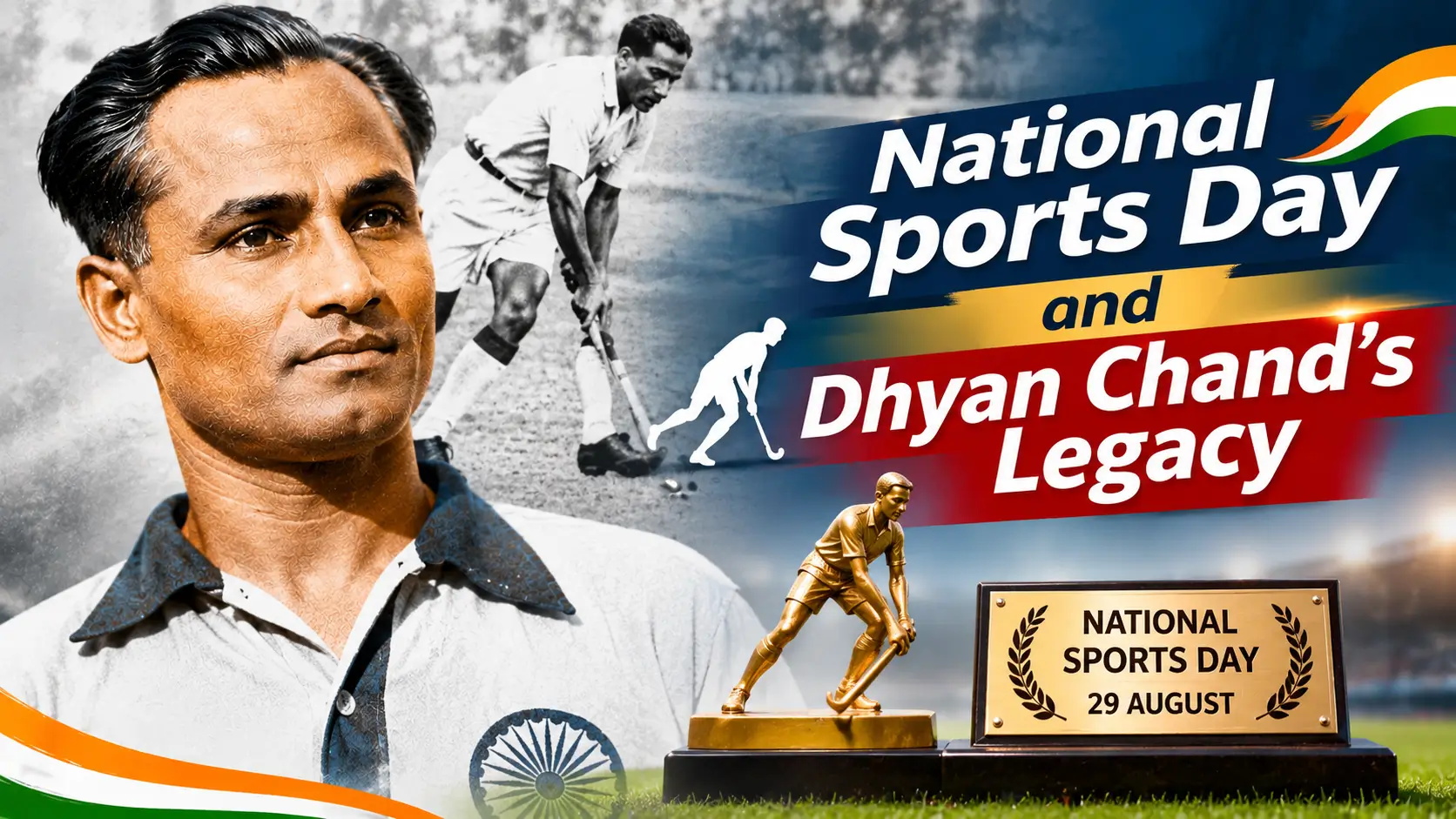
India celebrates National Sports Day every year on 29 August. The date marks the birth anniversary of Major Dhyan Chand.
The day was added to India’s national observance calendar in 2012. It recognises his contribution and encourages people to take part in sports and physical activities.
National Sports Day also provides an opportunity to honour athletes and coaches. India’s National Sports Awards are traditionally presented around this occasion.
Schools, colleges and sports organisations often arrange competitions and fitness activities. The celebration helps introduce young people to India’s sporting history.
Dhyan Chand Award and Other Tributes
Dhyan Chand’s name continues to be remembered through several national honours and sporting institutions.
The Major Dhyan Chand Award was introduced in 2002. It recognises lifetime contributions to sports, including performance and efforts to promote sporting activities.
The National Stadium in New Delhi was renamed Major Dhyan Chand National Stadium. A museum in Jhansi also preserves his memory and sporting achievements.
His autobiography, Goal, published in 1952, remains an important source for understanding his journey. It gives readers a glimpse into his experiences as a soldier and hockey player.
His Influence on Indian Hockey
Dhyan Chand helped establish India as a leading force in international hockey. His performances during the 1928, 1932 and 1936 Olympics became a source of national pride.
His playing style influenced many generations of hockey players. His focus on ball control, movement and teamwork remains relevant to the sport. For more about the sport’s history and Indian hockey, visit Hockey India.
His family also continued his connection with Indian hockey. His brother Roop Singh and son Ashok Kumar represented India at major international competitions.
Today, Dhyan Chand remains a symbol of excellence in Indian sports. His story continues to inspire young players who dream of representing their country.
National Sports Day, Death and Lasting Legacy
Major Dhyan Chand died on 3 December 1979 in Delhi. He was 74 years old.
His death marked the end of the life of one of India’s most celebrated hockey players. However, his achievements continued to receive national and international recognition.
A commemorative postage stamp was issued in his honour on the first anniversary of his death. His name also became associated with major sporting awards and institutions.
More than four decades after his passing, his Olympic achievements remain an important part of India’s sporting history.
Interesting Facts About Major Dhyan Chand
Here are some important facts about the legendary hockey player:
- Birth: He was born on 29 August 1905 in Allahabad.
- Original name: His birth name was Dhyan Singh.
- Nickname: He became famous as the Hockey Wizard and The Magician.
- Army service: He joined the British Indian Army in 1922.
- Olympic medals: He won three consecutive Olympic gold medals.
- Olympic captaincy: He captained India at the 1936 Berlin Olympics.
- International career: His international career lasted from 1926 to 1948.
- Major award: He received the Padma Bhushan in 1956.
- Family connection: His brother Roop Singh and son Ashok Kumar also played international hockey.
- Autobiography: His book is titled Goal.
- National Sports Day: India celebrates his birthday as National Sports Day.
- Death: He passed away on 3 December 1979.
Frequently Asked Questions
When was Major Dhyan Chand born?
Major Dhyan Chand was born on 29 August 1905 in Allahabad, now known as Prayagraj, Uttar Pradesh. India celebrates his birth anniversary as National Sports Day.
How many Olympic gold medals did Dhyan Chand win?
Dhyan Chand won three Olympic gold medals. He achieved these victories with India at the 1928 Amsterdam, 1932 Los Angeles and 1936 Berlin Olympics.
Why was Dhyan Chand called the Hockey Wizard?
He was called the Hockey Wizard because of his outstanding ball control and dribbling skills. His ability to move past defenders and score goals amazed hockey fans.
Who was Major Dhyan Chand’s wife?
Major Dhyan Chand married Janaki Devi in 1936. The couple had seven sons, including Indian international hockey player Ashok Kumar.
How many goals did Major Dhyan Chand score?
Employment News reports more than 400 international goals in 185 matches. Some broader career accounts report more than 1,000 goals across different competitions.
Which award did Dhyan Chand receive in 1956?
Dhyan Chand received the Padma Bhushan in 1956. It recognised his contribution to Indian hockey and sporting history.
When was Major Dhyan Chand born?
Major Dhyan Chand was born on 29 August 1905 in Allahabad, Uttar Pradesh. India celebrates his birthday as National Sports Day.
What was Major Dhyan Chand’s Army rank?
Dhyan Chand retired from the Indian Army in 1956 with the rank of Major. His military service began in 1922.
What was the name of Dhyan Chand’s autobiography?
His autobiography was titled Goal. Published in 1952, the book shares details of his hockey journey and personal experiences.
When did Major Dhyan Chand die?
Major Dhyan Chand died on 3 December 1979 in Delhi. He was 74 years old.
Conclusion
Major Dhyan Chand’s life remains one of the most inspiring stories in Indian sports. From his early years in Jhansi to Olympic success, he built a remarkable hockey career through skill and discipline.
His three consecutive Olympic gold medals made him a national sporting legend. His family, Army service, coaching work and international performances also shaped his lasting legacy.
India celebrates his birthday as National Sports Day every year. His story continues to remind young athletes that dedication, practice and teamwork can create lasting achievements.