

India tour of New Zealand · Men’s ODI series
Research verified · Pre-match analysis

NZ vs IND 3rd ODI Pitch Report: India and New Zealand meet at Seddon Park, Hamilton, on 10 November 2026 at 7:30 AM IST. Recent men’s ODIs there show that seamers can take early wickets, but substantial totals are possible. Rain is in the early forecast, and the match strip and playing XIs will be confirmed closer to play.
India arrive at the next stage of the tour with a 1–0 lead after a five-wicket DLS win at Eden Park. Wellington hosts the second ODI before the teams move to Hamilton. That order matters: the Auckland result is the latest completed ODI at the time of this report, so the series score and selection picture could change before the third match.
NZ vs IND 3rd ODI Pitch Report: How Seddon Park could play
Seddon Park’s recent ODI scorecards make a better starting point than a blanket label such as “batting pitch.” In the three most recent men’s ODIs at the ground identified for this preview, first innings ranged from 161 to 292. New Zealand won all three, twice chasing modest targets and once defending 292. The results show how differently a 50-over game can unfold at the same ground.
The stadium is the home of Northern Districts cricket. The venue lists a capacity of 10,500, grassy banks around much of the ground and four floodlights for day-night fixtures. Those details describe the venue. The grass cover, hardness and moisture of the strip selected for 10 November will need to be assessed separately when the covers come off.
Powerplay: watch the length and the carry
If the new ball moves, both attacks have a reason to pitch it up enough to bring the outside edge into play. A short, wide ball gives the batter room even on a surface offering assistance. The first few overs should tell us whether a tight channel is drawing false shots and whether the keeper is taking the ball cleanly at a comfortable height.
England lost their first three wickets for 51 here in October 2025 and were all out for 175. That innings shows the cost of losing established batters before the field spreads. For India’s openers, the useful early distinction is between deliveries they can leave on length and full balls they can drive without reaching away from the body.
Middle overs: where spin can change the innings
Seam can set the tempo, but the middle overs give both captains a different decision. Mitchell Santner and Axar Patel can use their angles to challenge batters who look to score square. Kuldeep Yadav, if selected, gives India a wrist-spin option when a partnership needs breaking. Their value depends on whether the surface grips, how wet the ball gets and which batters are at the crease.
When boundaries become difficult, turning a dot into a single matters as much as attacking a particular bowler. A batting side that keeps rotating can make a captain move a ring fielder or change a bowler before the planned end of a spell. That becomes especially valuable if there is little turn and the spinners are relying on accuracy and changes of pace.
At the toss: what the captains should weigh
Fielding first is a reasonable option if the surface looks damp and the hourly forecast suggests interruptions. It gives the bowling side first use of any early movement and the chasing side a defined target, revised if necessary. A dry, firm strip and a more settled evening forecast would strengthen the case for batting first and making the opposition take risks later.
The ground’s recent results alone offer little reason to make the toss call in advance. West Indies chose to bat in November 2025 and were bowled out for 161, while New Zealand put England in a month earlier and chased 175. Both chases followed effective bowling. How that advantage was created matters more than the fact that the team batting second won.
Seddon Park ODI records and recent first-innings scores
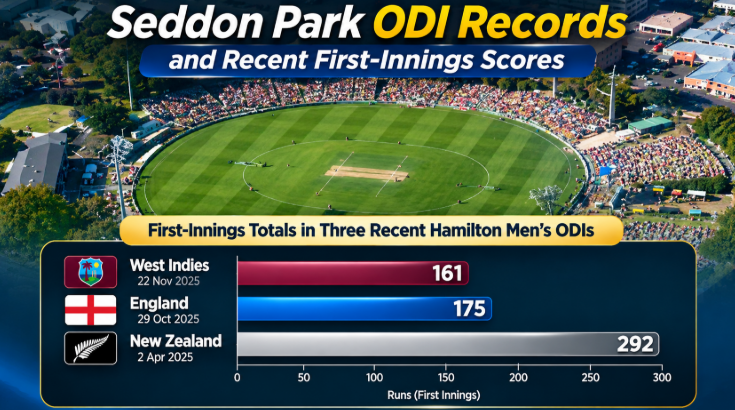
This comparison uses three completed men’s ODIs at Seddon Park in 2025. Each was scheduled for 50 overs per side. The bars show runs scored by the side batting first, with the same scale across all three matches. They capture the spread in a small recent sample and should be read alongside the scores and results.
| Match date | First innings | Second innings | Result |
|---|---|---|---|
| 22 Nov 2025 | West Indies 161 | New Zealand 162/6 | New Zealand by 4 wickets |
| 29 Oct 2025 | England 175 | New Zealand 177/5 | New Zealand by 5 wickets |
| 2 Apr 2025 | New Zealand 292/8 | Pakistan 208 | New Zealand by 84 runs |
| 27 Nov 2022 | India 89/1 in 12.5 overs | New Zealand did not bat | No result |
| 5 Feb 2020 | India 347/4 | New Zealand 348/6 | New Zealand by 4 wickets |
| 31 Jan 2019 | India 92 | New Zealand 93/2 | New Zealand by 8 wickets |
The three 2025 first innings averaged 209.3 runs. That is the arithmetic mean of 161, 175 and 292, rather than a venue-wide average or a forecast. Two low totals pull the mean down. The Pakistan match shows how a first innings changes when a team has enough wickets in hand to use its full allocation.
The India examples put even more distance between the plausible outcomes. India were dismissed for 92 in January 2019 and posted 347/4 at the same ground a year later. Shreyas Iyer made 103 in that 2020 ODI, but New Zealand reached 348/6. India’s rain-truncated 89/1 in 2022 adds context about interruptions and is excluded from the three-match average.
The teams also met here in a T20I on 1 November 2026. New Zealand’s 195/3 in reply to India’s 191/8 is recent evidence that scoring quickly was possible that night. ODI field restrictions, innings length and potentially a different strip make it a poor basis for setting a 50-over target.
Published venue guides use different match samples, so their averages and chase records answer different questions. For this preview, the clearest comparison is between named scorecards. A useful live benchmark is the batting side’s position after the first ten overs: two teams with the same score can have very different prospects if one has lost three wickets and the other has lost none.
Hamilton weather forecast for 10 November and rain impact
WeatherWatch’s Hamilton outlook checked on 5 November flagged rain and possible thunderstorms for Tuesday, with a daytime temperature around 20–21°C across the forecast snapshots reviewed. The published rain figures varied across snapshots. Treat this as an early city-level indication of interruption risk. Conditions at the ground, the timing of rain and the duration of any stoppage remain uncertain.
The scheduled first ball is at 3:00 PM local time, so the hourly outlook from mid-afternoon into the evening matters more than a daily rain probability. Rain earlier in the day can also delay a start while officials inspect the outfield. During play, a damp ball can complicate gripping slower deliveries or wrist-spin, while a slower outfield can change how reliably well-timed shots reach the rope.
If time is lost, officials may reduce the available overs and apply the Duckworth–Lewis–Stern method. Under standard men’s ODI conditions, both sides generally need the opportunity to bat for at least 20 overs for a result, with exceptions such as a successful chase completed sooner. In Auckland, India reached the revised target of 143 in 22.4 overs after their chase was allocated 32.
For a side batting second, the DLS par score during a stoppage depends on overs and wickets as well as runs. Losing a wicket shortly before rain can change where a team stands. For a side setting a target, a shorter allocation can bring its finishers into play earlier. Both scenarios favour a team that knows who will take the scoring risks if the original plan changes.
Match time in India and the full ODI schedule
The Hamilton game is the third of five ODIs on India’s 2026–27 tour of New Zealand. The scheduled 3:00 PM New Zealand daylight time start converts to 7:30 AM IST on the same date. The official BCCI match centre for the Hamilton ODI lists the venue and the equivalent 02:00 UTC start.
| Match | Date in 2026 | Venue | Start in India |
|---|---|---|---|
| 1st ODI | 4 Nov | Eden Park, Auckland | 7:30 AM IST |
| 2nd ODI | 7 Nov | Hnry Stadium (Sky Stadium), Wellington | 7:30 AM IST |
| 3rd ODI | 10 Nov | Seddon Park, Hamilton | 7:30 AM IST |
| 4th ODI | 13 Nov | Bay Oval, Mount Maunganui | 7:30 AM IST |
| 5th ODI | 15 Nov | Bay Oval, Mount Maunganui | 7:30 AM IST |
If India win in Wellington, they can clinch the series in Hamilton. If New Zealand win in Wellington, Hamilton becomes the chance for either side to take a 2–1 lead into the Bay Oval matches. Fans planning to attend can consult KhelKhabri’s India vs New Zealand match ticket guide for booking steps and venue information. Check live inventory before travelling.
India and New Zealand ODI squads and availability
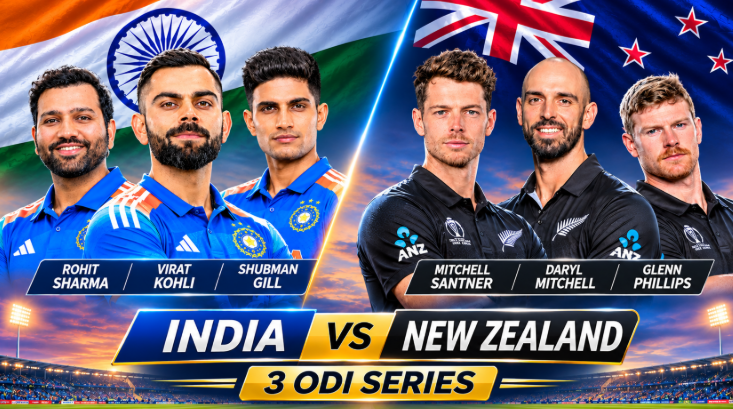
Hamilton closes the opening squad phase for both sides. Shubman Gill captains India with Shreyas Iyer as vice-captain. Iyer takes over for the last two games, with Ishan Kishan named vice-captain for that phase. Mitchell Santner captains New Zealand across both phases. The names below reflect the latest board notices reviewed on 5 November.
India squad Hamilton · ODIs 2–3
- Shubman Gill · Captain
- Rohit Sharma
- Virat Kohli
- Shreyas Iyer · Vice-captain
- KL Rahul · Wicketkeeper
- Axar Patel
- Naman Dhir
- Anshul Kamboj
- Gurnoor Brar
- Ruturaj Gaikwad
- Arshdeep Singh
- Ishan Kishan · Wicketkeeper
- Mohammed Siraj
- Kuldeep Yadav
- Auqib Nabi
New Zealand squad Hamilton · ODIs 1–3
- Mitchell Santner · Captain
- Michael Bracewell
- Devon Conway
- Jacob Duffy
- Matt Henry
- Kyle Jamieson
- Tom Latham · Wicketkeeper
- Daryl Mitchell
- Henry Nicholls
- Glenn Phillips
- Tim Seifert
- Nathan Smith
- Will Young
- Blair Tickner
- Matt Fisher · Additional bowling cover
India squad Bay Oval · ODIs 4–5
- Shreyas Iyer · Captain
- Rohit Sharma
- Virat Kohli
- Tilak Varma
- Ishan Kishan · Vice-captain, wicketkeeper
- Axar Patel
- Naman Dhir
- Auqib Nabi
- Gurnoor Brar
- Ruturaj Gaikwad
- Arshdeep Singh
- Kumar Kushagra · Wicketkeeper
- Mohammed Siraj
- Yash Thakur
- Kuldeep Yadav
New Zealand squad Bay Oval · ODIs 4–5
- Mitchell Santner · Captain
- Finn Allen
- Michael Bracewell
- Kristian Clarke
- Jacob Duffy
- Matt Fisher
- Dean Foxcroft
- Lockie Ferguson
- Mitch Hay · Wicketkeeper
- Nick Kelly
- Tim Seifert · Wicketkeeper
- Blair Tickner
- Will Young
BCCI ruled Prasidh Krishna out of the ODIs while he builds up his workload after a hamstring injury. Its 31 October notice added Auqib Nabi to the opening three matches, extending his original selection for ODIs four and five. Nitish Kumar Reddy was retained for the first ODI only before linking up with India A, so he is outside the Hamilton selection pool.
New Zealand Cricket ruled Mark Chapman and Rachin Ravindra out of the series with hamstring and shoulder injuries respectively. Henry Nicholls came in for ODIs one to three, Dean Foxcroft was called for ODIs four and five, and Tim Seifert became available for the full series. NZC listed Matt Fisher in the later squad and said he would stay with the group for the full series as an additional bowling option.
NZC also reported that Devon Conway and Matt Henry collided in training at Eden Park. Conway was ruled out of the first ODI with concussion, and the board said it would continue monitoring both players. Their squad places and their availability for the Hamilton XI are separate questions. The board update reviewed for this report did not confirm either player for the third match.
Probable playing XIs and tactical matchups
Selection projection as of 5 November: These teams use the Auckland XIs as a baseline. The Wellington game, player clearance, workload and the strip inspection can change both combinations. The names below describe one plausible selection scenario for each side.
India probable XI: Rohit Sharma, Shubman Gill (captain), Virat Kohli, Shreyas Iyer (vice-captain), KL Rahul (wicketkeeper), Axar Patel, Naman Dhir, Anshul Kamboj, Auqib Nabi, Gurnoor Brar, Arshdeep Singh.
New Zealand probable XI: Will Young, Tim Seifert, Henry Nicholls, Daryl Mitchell, Tom Latham (wicketkeeper), Glenn Phillips, Mitchell Santner (captain), Nathan Smith, Kyle Jamieson, Jacob Duffy, Blair Tickner.
India’s choice: retain the extra seamer or bring in Kuldeep
Arshdeep took 4/70, Brar 3/44 and Kamboj 2/22 in Auckland. Kamboj’s two maidens and low economy helped build pressure while the other seamers took wickets. A similar four-seamer balance would give Gill room to rotate through interruptions. If the Hamilton strip looks dry, swapping a seamer for Kuldeep would add a different wicket-taking option against New Zealand’s middle order.
New Zealand’s chance: break the top order early
Kyle Jamieson removed Rohit in the first over in Auckland, but Gill and Kohli took India from 1/1 to 114/2. Duffy finished with three wickets, including Kohli and Axar, after the chase had swung towards India. In Hamilton, New Zealand’s best chance of making that early breakthrough count is to follow it with another before Gill and Kohli can settle into their scoring areas.
If Henry is cleared and selected, Santner gains another option for the new ball. If the Auckland attack stays together, the captain can still use Jamieson’s bounce, Duffy’s seam and Smith’s control in different phases. Santner’s own overs become more valuable if India rebuild through a partnership and begin taking easy singles off the pace bowlers.
Frequently asked questions
When is the NZ vs IND 3rd ODI in 2026?
It is scheduled for Tuesday, 10 November 2026 at Seddon Park in Hamilton. The start is 7:30 AM IST, which is 3:00 PM in New Zealand.
Is Seddon Park better for batting or bowling in ODIs?
Seamers can make early inroads, but the ground has produced substantial totals too. The three 2025 men’s ODIs compared here ranged from 161 to 292 batting first.
What is a competitive first-innings score at Seddon Park?
There is no reliable fixed par before the strip and playing conditions are known. New Zealand defended 292 against Pakistan in 2025, while they chased India’s 347 here in 2020.
Will it rain during the Hamilton ODI?
The outlook checked on 5 November indicated rain and possible thunderstorms for 10 November. The timing and severity remain uncertain, so check the hourly forecast close to the start.
Should the toss winner bat or bowl first?
Bowling first is a reasonable choice if the strip is damp or interruptions look likely. A dry surface and a more settled forecast would make batting first easier to justify.
When will the NZ vs IND playing XIs be confirmed?
Expect both XIs at the toss. The lineups in this preview are projections based on the Auckland ODI and may change after Wellington.
What to watch at the Hamilton toss
The NZ vs IND 3rd ODI Pitch Report points to three things worth checking before the first ball: the grass on the selected strip, the hourly rain outlook and the balance of each attack. If the captains choose extra pace, watch how much movement survives beyond the first spell. If either adds a spinner, watch whether the middle overs offer enough grip to justify the change. Check back after Wellington and again at the toss for the updated series score and confirmed XIs.