

2026 Winter Olympics Men’s Big Air Results: Medal Winners
The medal race finished with three first-time Olympic medallists and an unusually close gap between their scores. Frostad edged Forehand by just 2.25 points, while Svancer finished another 2.00 points behind the American. Less than five points separated gold from bronze after a demanding three-run final.
These figures are the actual competition scores, calculated from qualifying tricks in the final. They are not the separate FIS ranking points that some Olympic results screens show. The difference matters: 195.50 decided the gold medal, whereas a figure such as 1,000 beside Frostad in a federation-style ranking is a points allocation for the placing.
The 2026 event belonged to the Milano Cortina Winter Games, but the competition itself was held in the mountain venue of Livigno. It was the second Olympic appearance for men’s freeski big air, following its debut in Beijing in 2022. That history made a new champion likely, but few expected such a tight, high-scoring final.
Full Men’s Freeski Big Air Final Standings and Run Scores
The final featured 12 skiers and three attempts each. The final total used the best two eligible jumps of different trick types, rather than simply adding every run. This is why a competitor can record three excellent scores yet still finish with a two-run total. The complete final rankings below show every run, not only the medal positions.
| Rank | Athlete | Country | Run 1 | Run 2 | Run 3 | Final score |
|---|---|---|---|---|---|---|
| 🥇 | Tormod Frostad | Norway | 95.25 | 97.00 | 98.50 | 195.50 |
| 🥈 | Mac Forehand | United States | 95.00 | 95.00 | 98.25 | 193.25 |
| 🥉 | Matej Svancer | Austria | 91.75 | 95.25 | 96.00 | 191.25 |
| 4 | Troy Podmilsak | United States | 90.50 | 73.75 | 94.00 | 184.50 |
| 5 | Konnor Ralph | United States | 86.50 | 16.75 | 91.50 | 178.00 |
| 6 | Luca Harrington | New Zealand | 94.00 | 25.75 | 66.50 | 160.50 |
| 7 | Dylan Deschamps | Canada | 20.75 | 91.00 | 46.50 | 137.50 |
| 8 | Birk Ruud | Norway | 95.00 | 23.25 | DNI | 118.25 |
| 9 | Ulrik Samnøy | Norway | 21.75 | 84.25 | 26.50 | 110.75 |
| 10 | Matias Roche | France | 18.75 | 85.25 | 17.75 | 103.00 |
| 11 | Timothé Sivignon | France | 46.50 | DNI | 33.75 | 80.25 |
| 12 | Martin Nordqvist | Sweden | 16.75 | 19.25 | 38.75 | 58.00 |
The five strongest totals were separated by only 17.50 points: Frostad 195.50, Forehand 193.25, Svancer 191.25, Troy Podmilsak 184.50 and Konnor Ralph 178.00. The fourth-placed American was only 6.75 points behind bronze, proof that the medals were decided by small improvements in execution and trick choice rather than large gaps in basic skill.
The chart compares official competition totals. Each total combines two eligible scoring jumps; 200 is the possible maximum.
Each blue bar shows a single judged jump out of 100 points, not the combined medal total.
Frostad’s 98.50 third run and Forehand’s 98.25 third run were the highest two individual scores in the medal contest.
How the final standings were calculated
The numbers in each run column are judging marks for individual jumps. A high score in one attempt is valuable, but the second counted jump must show a different type of rotation or direction. Frostad’s scored attempts were 95.25, 97.00 and 98.50; his counted pair was 97.00 plus 98.50. Forehand’s counted pair was 95.00 and 98.25. Svancer combined 95.25 and 96.00 for bronze.
This also helps explain the result for defending champion Birk Ruud. His opening run earned 95.00, a mark that was competitive with the medal contenders, but a later 23.25 and a third attempt without an improved score left him eighth on 118.25. Big air rewards variety and landing two complementary jumps, not one perfect moment.
How Tormod Frostad Beat Mac Forehand for Gold
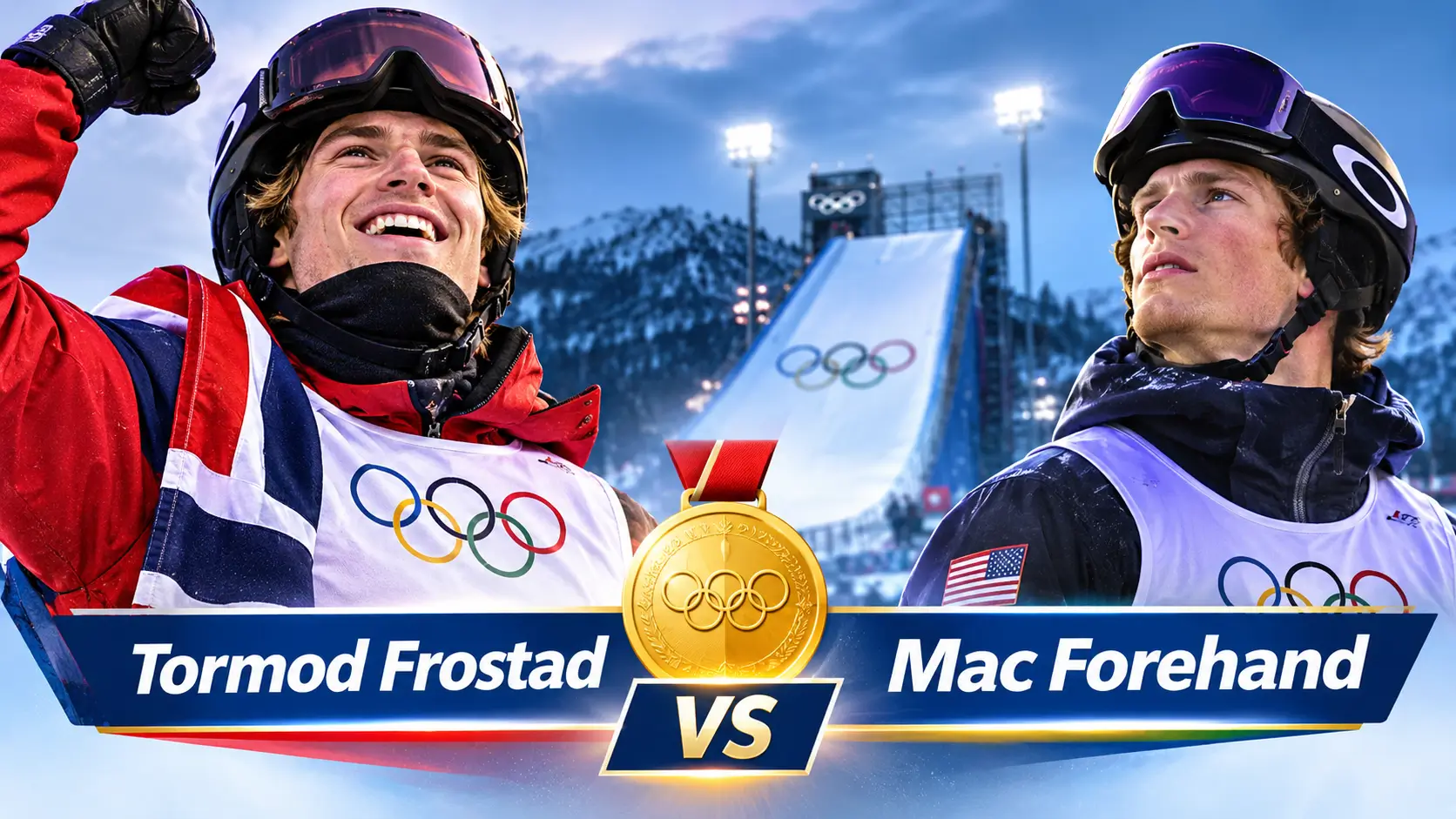
Frostad entered the final after qualifying fourth with 180.25 points. He was clearly dangerous, having earned the highest individual qualification run of 96.25, but Forehand had been the more consistent qualifier. On final night, Frostad produced three strong scoring attempts and saved his best for the last jump.
Frostad’s 98.50 final run decided the gold medal
His first run scored 95.25 and his second earned 97.00. He then landed a right nose-butter double bio 1620 safety grab on the final attempt for 98.50. That was the highest single-run score of the men’s final and, according to the international ski federation’s event reporting, a landmark mark for Olympic freeski. Combined with his 97.00, it delivered an unbeatable 195.50.
The trick name may sound complicated, but its core idea is simple: the skier begins rotation using a nose-butter movement, combines it with an off-axis aerial rotation, and must regain control before landing. The 1620 indicates four and a half full rotations. A technically difficult jump still needs a stable take-off, deliberate body shape and a clean landing to attract a very high mark.
Forehand’s silver was decided by a tiny margin
Forehand arrived as the top qualifier, with 183.00 points from his best two qualification runs. In the final, his first two attempts each received 95.00. He then landed a left nose-butter triple cork 2160 safety grab for 98.25, pushing his eligible score to 193.25 and briefly appearing to have done enough to win.
The 2160 in the trick name refers to six complete rotations, while “triple cork” describes three off-axis flips within the aerial movement. Forehand’s leap showed why difficulty alone does not decide the final ranking: Frostad’s exceptional control on his own last run brought 0.25 more single-jump points and ultimately the 2.25-point winning margin in the total.
Why Matej Svancer claimed bronze
Austria’s Matej Svancer had finished second in qualification and carried that form into the final. His scores improved from 91.75 to 95.25 and then 96.00. The two higher eligible runs gave him 191.25, enough to keep American Troy Podmilsak off the podium by 6.75 points.
Svancer’s result mattered beyond the numbers. It gave Austria a medal in a highly competitive freeski event while completing a podium in which all three athletes earned their first Olympic medals. The bronze was not a consolation for a faded performance; it came from a near-flawless effort in which each successive run produced a stronger mark.
Qualification Results: All 29 Athletes and the Top 12 Cutoff
Qualification took place on 15 February 2026 at the same Livigno venue. Twenty-nine skiers entered, and only the top 12 advanced. Each athlete had three attempts, with the best two eligible, different tricks forming the score. The last qualifying place went to Konnor Ralph at 171.75 points; Fabian Bösch was next at 170.00, just 1.75 points short.
The top five qualifiers were Mac Forehand, Matej Svancer, Birk Ruud, Tormod Frostad and Luca Harrington. Their order changed sharply once the final began. Forehand and Svancer held podium places, but Frostad climbed from fourth in qualifying to Olympic champion. Ruud dropped from third in qualification to eighth in the final.
| Qual. rank | Athlete | Country | Score | Status |
|---|---|---|---|---|
| 1 | Mac Forehand | United States | 183.00 | Finalist |
| 2 | Matej Svancer | Austria | 182.25 | Finalist |
| 3 | Birk Ruud | Norway | 181.00 | Finalist |
| 4 | Tormod Frostad | Norway | 180.25 | Finalist |
| 5 | Luca Harrington | New Zealand | 179.75 | Finalist |
| 6 | Matias Roche | France | 178.50 | Finalist |
| 7 | Timothé Sivignon | France | 178.00 | Finalist |
| 8 | Ulrik Samnøy | Norway | 176.00 | Finalist |
| 9 | Dylan Deschamps | Canada | 175.50 | Finalist |
| 10 | Troy Podmilsak | United States | 174.00 | Finalist |
| 11 | Martin Nordqvist | Sweden | 173.50 | Finalist |
| 12 | Konnor Ralph | United States | 171.75 | Finalist |
| 13 | Fabian Bösch | Switzerland | 170.00 | Eliminated |
| 14 | Kuura Koivisto | Finland | 169.00 | Eliminated |
| 15 | Elias Syrjä | Finland | 164.50 | Eliminated |
| 16 | Kim Gubser | Switzerland | 162.50 | Eliminated |
| 17 | Nils Rhyner | Switzerland | 150.25 | Eliminated |
| 18 | Julius Forer | Austria | 144.25 | Eliminated |
| 19 | Ben Barclay | New Zealand | 139.50 | Eliminated |
| 20 | Sebastian Schjerve | Norway | 131.50 | Eliminated |
| 21 | Chris McCormick | Great Britain | 127.75 | Eliminated |
| 22 | Henry Sildaru | Estonia | 122.00 | Eliminated |
| 23 | Jesper Tjäder | Sweden | 116.50 | Eliminated |
| 24 | Lucas Ball | New Zealand | 114.75 | Eliminated |
| 25 | Miro Tabanelli | Italy | 112.25 | Eliminated |
| 26 | Alex Hall | United States | 96.50 | Eliminated |
| 27 | Andri Ragettli | Switzerland | 82.00 | Eliminated |
| 28 | Evan McEachran | Canada | 52.75 | Eliminated |
| 29 | Elias Lajunen | Finland | 9.00 | Eliminated |
Positive movement means an athlete finished higher than their qualifying position.
The chart compares finishing position in the 29-person qualification with position in the 12-person final.
Notable skiers who did not make the final
Fabian Bösch of Switzerland narrowly missed progression despite scoring 170.00. Finland’s Kuura Koivisto followed with 169.00, while Italy’s Miro Tabanelli was 25th on 112.25. American Alex Hall, who had won the Olympic freeski slopestyle title in 2022 and remained one of the discipline’s most recognisable names, finished 26th in this big air qualification with 96.50.
These positions are not a direct ranking of an athlete’s entire career. Qualification measures what each skier delivered on that specific course, on that specific day. One missed landing or an unsuccessful second trick can make a major difference when fewer than half the entrants reach the final.
Men’s Freeski Big Air Rules and Scoring Explained
Freeski big air is a judged freestyle-skiing discipline. Competitors approach one large jump, launch into the air, perform a technical trick and try to land cleanly. The judges assess factors such as difficulty, execution, amplitude, variety and landing control. The Olympic format used three jumps in qualification and three more in the final.
Only two different counting tricks make up a phase total. If a skier repeats the same type of rotation or direction, the higher eligible score for that type can count, but repeating it does not automatically create another scoring contribution. That rule encourages athletes to demonstrate range instead of relying on a single trick on every attempt.
- Qualification: 29 athletes, three runs each, top 12 advance.
- Final: 12 athletes, three runs each, scores reset for medals.
- Counting total: two highest eligible tricks of different types are added.
- Maximum total: 200 points, with each jump marked out of 100.
- What “DNI” means: the attempt did not improve the athlete’s counted result.
Why the Olympics website may show 1,000 instead of 195.50
The distinction applies to the remaining finishers as well. Fourth-place Troy Podmilsak recorded 184.50 competition points while a separate ranking column can show 577.5 FIS points. For comparisons of how athletes skied on 17 February, always use the competition score. For a federation ranking-points calculation, the FIS value serves a different purpose.
Notable Performances Beyond the Olympic Podium
The final was not only a story of three medalists. Troy Podmilsak placed fourth with 184.50, posting 90.50 and 94.00 on his counted runs. That score would have been a formidable benchmark in many competitions, yet it left him behind three competitors who passed 191 points. Konnor Ralph produced 178.00 for fifth, giving the United States three athletes in the top five.
New Zealand’s Luca Harrington, the reigning world champion in the discipline, began the final strongly with a 94.00. His second-run 25.75 and third-run 66.50 meant his final total reached 160.50, leaving him sixth. The pattern underlines the pressure of recording two qualifying jumps rather than simply landing one big trick early.
Dylan Deschamps of Canada finished seventh on 137.50 after improving significantly on his second run. Ruud finished eighth despite having one of the highest opening attempts, while Norway’s Ulrik Samnøy was ninth. France placed Matias Roche tenth and Timothé Sivignon eleventh, and Sweden’s Martin Nordqvist completed the 12-man final.
Defending champion Birk Ruud and the change from Beijing 2022
Birk Ruud won the first Olympic men’s freeski big air title at Beijing 2022. Four years later, he was back in the final, and his 95.00 opening score kept him within striking distance. But the remaining attempts did not give him a competitive second contribution, leaving him well behind the leaders.
Ruud’s eighth-place finish does not erase his place in Olympic freeski history. Instead, it shows how quickly the standard moved between the event’s first two Winter Games. By 2026, nearly every medal contender needed two exceptionally clean, high-difficulty tricks, and the eventual champion finished only 4.50 points below the theoretical 200-point ceiling.
Country-by-Country Results and What the Final Tells Us
Norway won the title through Frostad and also placed two other athletes in the final: Ruud in eighth and Samnøy in ninth. The United States showed outstanding team depth, with Forehand second, Podmilsak fourth and Ralph fifth. Austria converted Svancer’s consistent jumping into bronze, while New Zealand, Canada, France and Sweden also had finalists.
This event awarded one set of medals only, so the medal count for men’s freeski big air was simple: Norway one gold, the United States one silver, Austria one bronze. A ranking of finalists is not the same thing as an overall national Winter Olympics medal table. Countries may have collected other freestyle-skiing or Winter Games medals in separate disciplines.
Across the field, 29 athletes represented a wide spread of nations. Several established names were eliminated in qualification, and the final showed how top scores now depend on both risk and precision. The strongest performances were not simply the most ambitious tricks; they were ambitious tricks that survived the landing and met the rule requiring distinct counted jumps. While freestyle skiing continues to showcase athletic skill at the Winter Games, the Olympic programme is also expanding in other sports, with cricket returning at Los Angeles 2028. Fans can learn more about the qualification process in our guide to the LA Olympics 2028 cricket qualifiers.
Norway and the United States each placed three athletes in the medal final.
Counts are taken from the official 12-athlete final field; the chart does not represent an overall Winter Olympics medal table.
Official Olympic Rankings and Historical Results
Readers who want to inspect the results themselves can use two useful references. The 2026 men’s big air competition and results summary includes both qualification and final tables, with individual runs and medalists. It is especially helpful for checking how the top-12 cutoff worked and how an athlete’s final placing changed after qualification.
For the Olympic listing, the Milano Cortina 2026 men’s freeski big air rankings page provides the official event-ranking view. When comparing its displayed points with run scores, keep the FIS ranking-points distinction in mind. Competition totals, rather than federation points, determine who earned gold, silver and bronze.
Names may vary slightly across international lists: Matej Svancer also appears as Matěj Švancer, while Ulrik Samnøy may appear without the Norwegian character. These spellings refer to the same athletes.
Frequently Asked Questions
Who won the 2026 Winter Olympics men’s freestyle skiing big air gold medal?
Tormod Frostad of Norway won with 195.50 competition points on 17 February 2026. His final attempt received 98.50, helping him beat Mac Forehand by 2.25 points.
Who won silver and bronze in the men’s freeski big air final?
Mac Forehand of the United States took silver with 193.25. Austria’s Matej Svancer claimed bronze with 191.25, two points behind Forehand.
What were the complete men’s big air final results?
The 12 finalists were led by Frostad, Forehand and Svancer. Troy Podmilsak finished fourth, Konnor Ralph fifth, Luca Harrington sixth, and the complete final table above shows every competitor and all three run scores.
When and where did the 2026 Olympic men’s big air event take place?
Qualification was held on 15 February and the final on 17 February 2026. Both stages took place at Livigno Snow Park in the Valtellina area of Italy.
How many athletes qualified for the Olympic men’s big air final?
Twelve of the 29 qualification entrants advanced. Konnor Ralph took the last final spot with 171.75, ahead of Fabian Bösch on 170.00.
Why does one Olympic results table show 1,000 points for the winner?
That figure is a FIS ranking-points allocation, not the score that decided the Olympic result. Frostad’s winning two-trick competition total was 195.50.
Final Takeaway: A Record-Setting Men’s Big Air Final
The 2026 Winter Olympics men’s freestyle skiing big air results tell the story of an exceptionally tight medal race. Tormod Frostad’s 195.50 was enough for gold, but Mac Forehand pressed him with 193.25 and Matej Svancer followed with 191.25. The three-run format gave the best competitors room to take risks, yet it still demanded two eligible, different tricks and strong landings.
For anyone comparing full standings, the simplest method is to read the qualification results separately from the medal final, use the actual run and competition totals, and treat FIS ranking points as a different statistic. That approach makes the event easier to understand and gives proper credit to the remarkable performances across all 29 entrants.