


South Africa turned an opening defeat into a 2–1 series victory through batting resilience, all-round depth and a bowling attack that delivered when the pressure was highest.
South Africa’s 2–1 Test series victory over Australia was not a straightforward march to the top. The Proteas lost the opening match in Durban by 214 runs, leaving themselves with little room for another setback. They responded with an innings-and-31-run win in Gqeberha before completing the turnaround with a 176-run victory at Newlands.
The sequence matters. South Africa did not win because every department dominated in every match. The team adapted. Temba Bavuma provided stability when the batting was under pressure, Marco Jansen delivered valuable runs and wickets, and the attack found the right balance between pace and spin. Ryan Rickelton and Wiaan Mulder then produced the decisive partnership in the final Test.
The series also carried a major ranking reward. South Africa moved above Australia to the top of the ICC Men’s Test Team Rankings for the first time since January 2016. The achievement reflected the result of the series, but the performance itself offered a more useful explanation: South Africa had several ways to recover when a match moved against them.
South Africa vs Australia 2026: How the Three-Test Series Unfolded
The SA vs AUS first Test at Kingsmead exposed South Africa’s vulnerability when Australia controlled the tempo. Australia made 390 in its first innings, with Matt Renshaw scoring 190 from 397 balls. South Africa replied with 284 and were then dismissed for 206. Australia declared its second innings at 314 for six and won by 214 runs.
That defeat placed the Proteas under immediate pressure. The second Test at St George’s Park began with South Africa in trouble at 110 for six. Bavuma held the innings together with 179 from 334 balls. Jansen added 85 and Simon Harmer made 82, helping the hosts reach 425 for nine declared. Australia were bowled out for 99 in reply, then made 295 in the follow-on innings. South Africa won by an innings and 31 runs.
The deciding Test at Newlands swung again. South Africa made 329, but Australia responded with 429 and took a 100-run first-innings lead. The hosts needed a substantial second innings. Rickelton scored 101 and Mulder made 115 in a 154-run sixth-wicket partnership, lifting South Africa to 387 and setting Australia 288 to win. Rabada and Harmer then bowled the visitors out for 111.
| Test | South Africa | Australia | Result |
|---|---|---|---|
| 1st Test, Durban | 284 & 206 | 390 & 314/6 declared | Australia won by 214 runs |
| 2nd Test, Gqeberha | 425/9 declared | 99 & 295 | South Africa won by an innings and 31 runs |
| 3rd Test, Cape Town | 329 & 387 | 429 & 111 | South Africa won by 176 runs |
South Africa’s batting output across the series
Bar lengths use 429 runs, Australia’s highest innings total in the series, as the scale maximum.
Temba Bavuma’s 179 Changed the Direction of the Series
South Africa’s comeback began with an innings that demanded patience rather than spectacle. At 110 for six in Gqeberha, the hosts were in danger of handing Australia another opportunity to dominate. Bavuma refused to let the innings collapse. His 179 from 334 deliveries gave South Africa a foundation and allowed the lower order to play with greater freedom.
The value of the innings was clear in the partnerships around him. Jansen scored 85, and Harmer contributed 82. The eighth-wicket partnership between Bavuma and Harmer added 183 runs, transforming a difficult position into a total of 425 for nine declared. It was a defining recovery because it changed both the scoreboard and the emotional balance of the series.
Leadership through decision-making
A captain’s influence cannot be measured only through runs. Bavuma had to manage a side that had just lost heavily, keep the batting group calm and make sure the team did not repeat the same mistakes. His innings gave the dressing room evidence that the series was still recoverable. The result that followed was a team response, not a one-player rescue, but the captain supplied its central platform.
South Africa also showed discipline in how it used its resources. The declaration at 425 for nine gave the bowlers time to attack, while the large first-innings lead created room to press for an innings victory. The plan worked because the batting recovery was long enough to put Australia under sustained pressure.
Marco Jansen Provided the Balance of a Genuine All-Rounder
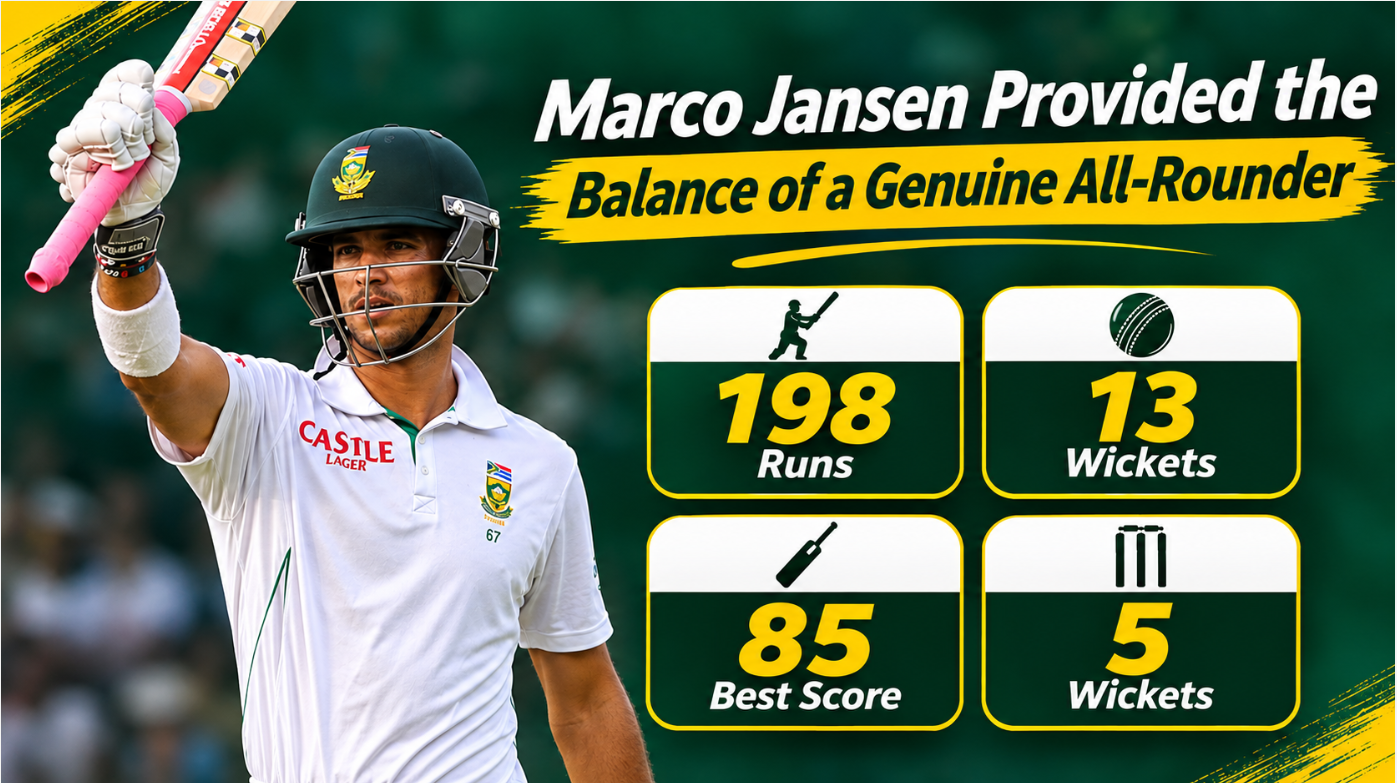
Jansen’s series was a major reason South Africa could field a balanced attack without weakening the batting order. He scored 198 runs and took 13 wickets across the three Tests, earning Player of the Series. His contribution was spread across different match situations: he made 85 in Gqeberha, claimed a five-wicket haul in Australia’s first innings there and provided useful support with the ball at Newlands.
His height and release point gave South Africa a different pace-bowling option. Jansen could attack the top of off stump, extract bounce and make batters play from uncomfortable positions. That skill mattered on surfaces where Rabada’s pace and Harmer’s spin offered different challenges. His batting also meant the side could keep a deeper order and recover after losing specialist batters.
Marco Jansen’s series contribution
Jansen was named Player of the Series for his impact with both bat and ball.
Rabada and Harmer Delivered the Decisive Newlands Combination
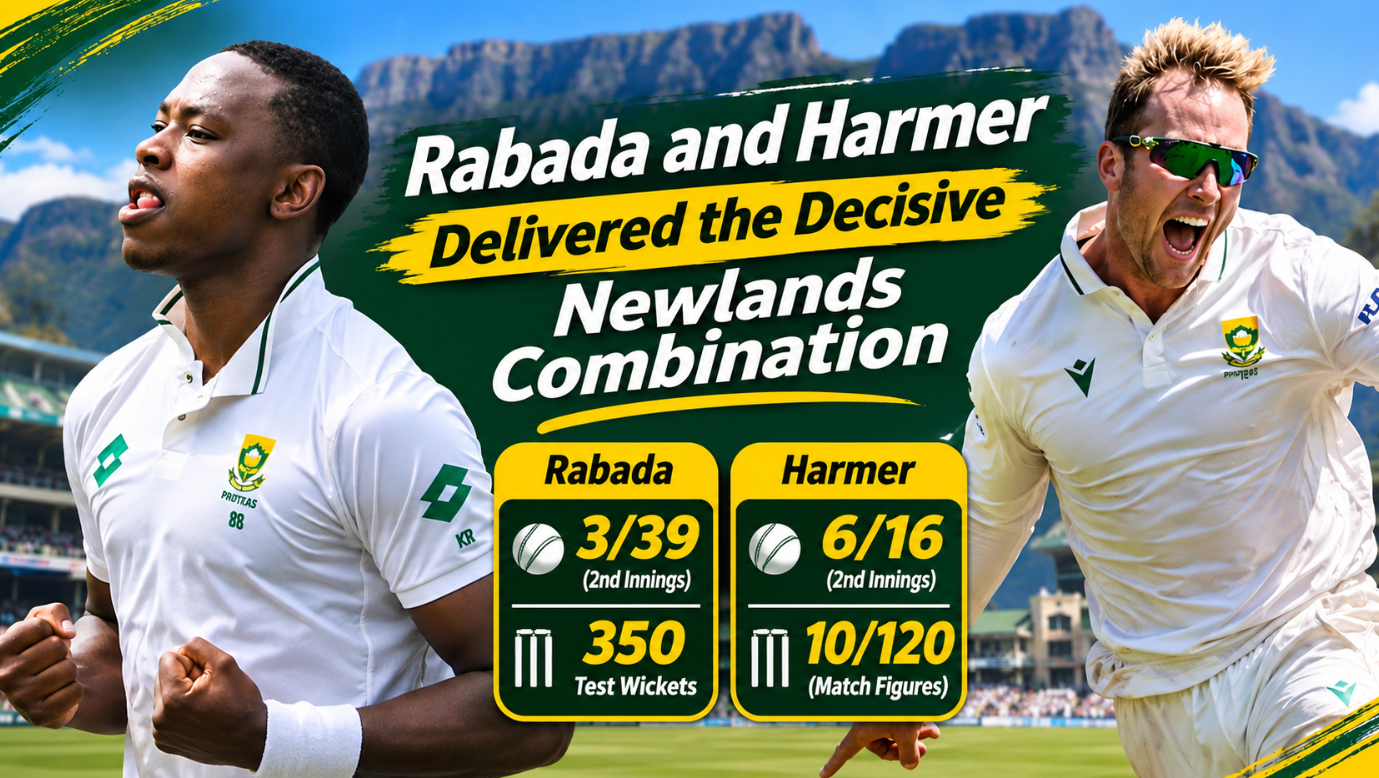
South Africa’s final-day defence of 288 was built around complementary roles. Rabada attacked with pace and made the first breakthroughs. Harmer then controlled the middle and lower order with accuracy, changes of pace and subtle variation in flight. The two bowlers did not need to use the same method; their different strengths made the chase increasingly difficult.
Rabada removed Australia’s top-order hope
Rabada dismissed Matt Renshaw for a golden duck, trapped Marnus Labuschagne for four and removed Travis Head for 14. Australia were quickly reduced to 22 for three. His final-innings figures were 3 for 39, and he reached 350 Test wickets during the spell. The early wickets changed the chase from a demanding target into a rescue operation.
Harmer turned pressure into a complete collapse
Harmer finished with 6 for 16 from 21.1 overs in the fourth innings, including 14 maidens. He had taken 4 for 104 in Australia’s first innings, giving him match figures of 10 for 120. It was his first ten-wicket haul in Test cricket. Australia were dismissed for 111 in 57.1 overs, with Nathan Lyon’s unbeaten 33 the highest score.
Harmer’s spell was not simply a matter of finding turn. He made the batters defend repeatedly, varied his pace and kept the ball in areas that limited easy scoring. Cameron Green faced 110 deliveries for 27, while Pat Cummins made 11 from 90 balls. Their resistance delayed the result, but it did not allow Australia to rebuild a winning position.
| Bowler | Fourth-innings figures | Impact |
|---|---|---|
| Simon Harmer | 21.1 overs, 14 maidens, 16 runs, 6 wickets | Controlled the innings and dismantled the middle and lower order. |
| Kagiso Rabada | 14 overs, 4 maidens, 39 runs, 3 wickets | Struck early and exposed the top order. |
Rickelton and Mulder Turned a 100-Run Deficit into a Winning Position
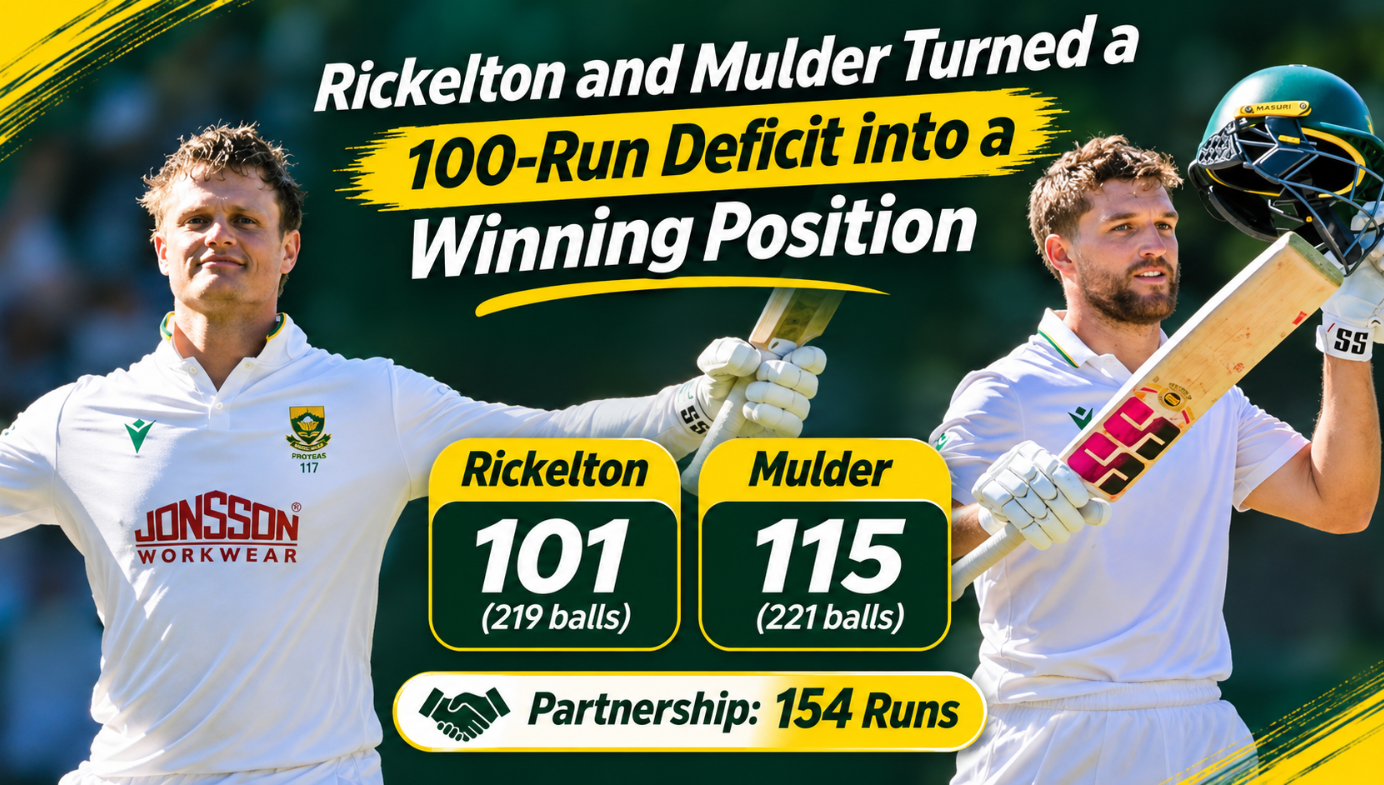
South Africa’s second innings at Newlands was the bridge between Australia’s advantage and the final-day collapse. The hosts had conceded a 100-run first-innings lead and needed to bat long enough to set a target that their bowlers could defend. Rickelton and Mulder supplied the decisive answer.
Rickelton scored 101 from 219 balls, while Mulder made 115 from 221 deliveries. Their 154-run sixth-wicket partnership prevented Australia from running through the lower order and forced the visitors to spend a long period in the field. South Africa eventually made 387, setting a target of 288.
The partnership was significant because both batters understood the match situation. They did not need to chase quick runs at every opportunity. They needed to make Australia bowl, protect their wickets and punish loose deliveries. Their centuries transformed the match and gave the attack a target that could be defended with aggression.
Why South Africa Had More Than One Route to Victory
The strongest feature of the series was the range of players who influenced the two wins. In Gqeberha, Bavuma, Jansen and Harmer built the recovery. In Cape Town, Marques Ackerman, Rickelton and Mulder supplied important runs before Rabada and Harmer finished the job. South Africa did not need the same player to rescue every match.
Batting depth beyond the specialist top order
Jansen and Harmer helped extend the Gqeberha innings after early wickets. Rickelton and Mulder did the same at Newlands, turning a deficit into a defendable total. These contributions gave the top order room to play its natural game and prevented Australia from controlling a match through one short burst of wickets.
A pace-and-spin attack with clear roles
Rabada’s pace, Jansen’s bounce and Harmer’s control gave Bavuma options for different phases. The Newlands chase showed the value of that variety. Pace unsettled the top order, while spin made scoring difficult once Australia were forced to rebuild. The support bowlers also helped maintain pressure from the other end.
A response that followed a heavy defeat
South Africa’s first Test performance was not ignored or disguised. The team had to correct its batting, make better use of partnerships and find a way to take 20 wickets. Winning the next two Tests by large margins showed that the players had responded to the challenge rather than allowing the opening result to define the series.
South Africa’s Series Leaders: Runs and Wickets
The series statistics show that the victory was built by a broad group of contributors. Renshaw was the leading run-scorer with 369, despite playing for the losing side. Bavuma finished with 218, Jansen with 198, Mulder with 187 and Rickelton with 176. In the bowling, Starc led with 15 wickets, followed by Harmer with 14 and Jansen with 13.
| Player | Team | Series contribution | Key moment |
|---|---|---|---|
| Matt Renshaw | Australia | 369 runs | Scored 190 in Durban. |
| Temba Bavuma | South Africa | 218 runs | Made 179 in Gqeberha. |
| Marco Jansen | South Africa | 198 runs, 13 wickets | Player of the Series. |
| Wiaan Mulder | South Africa | 187 runs, 10 wickets | Scored 115 at Newlands. |
| Ryan Rickelton | South Africa | 176 runs | Scored 101 in the second innings at Newlands. |
| Mitchell Starc | Australia | 15 wickets | Led the series wicket chart. |
| Simon Harmer | South Africa | 14 wickets | Took 6/16 in the final innings. |
What the No. 1 Test Ranking Means for South Africa
South Africa’s victory moved the team to No. 1 in the ICC Men’s Test Team Rankings, above Australia. It was the first time the Proteas had occupied the top position since January 2016. The ranking is a measure of results over a period, so the series win was an important part of a wider body of work rather than a reward for one match alone.
The achievement should be celebrated, but it also creates a new challenge. Staying at the top requires South Africa to keep producing performances across different conditions and against different opponents. The team must maintain batting depth, protect the fitness and workload of its fast bowlers, and continue using spin as a genuine attacking option when conditions allow.
One series cannot guarantee future dominance. What it can show is whether a team has the skills to respond to difficult situations. South Africa demonstrated that in Gqeberha and Newlands. The comeback was meaningful because the team found different solutions in two very different matches.
What Comes Next for the Proteas?
The next step is consistency. Bavuma’s side has a clear blueprint from this series: build partnerships after early setbacks, use the all-rounders to deepen the batting, and give the bowlers clear roles. Jansen’s contribution allows the attack to remain balanced, while Rabada and Harmer offer contrasting ways to take wickets.
South Africa must also avoid treating the ranking as a finish line. The opening defeat in Durban showed how quickly a Test can move away from a side that loses control of key sessions. The response showed that the team can learn, adjust and recover. Repeating those habits will matter more than the ranking itself.
Final Verdict: A Revival Built on Collective Strength
South Africa’s 2–1 victory over Australia was a comeback shaped by contributions across the team. Bavuma’s 179 rescued the Gqeberha innings, Jansen delivered with bat and ball, Rickelton and Mulder changed the Newlands match, and Rabada and Harmer finished the contest with a decisive bowling performance.
The rise to No. 1 in the Test rankings gives the series a historic dimension. But the lasting message is about adaptability. South Africa lost the first Test, corrected its approach and won the next two through different combinations of batting resilience and bowling skill. That is the foundation of a leading Test side.
South Africa vs Australia 2026 Test Series: FAQs
Who won the South Africa vs Australia Test series in 2026?
South Africa won the three-match series 2–1 after losing the first Test in Durban and winning the next two in Gqeberha and Cape Town.
Who was Player of the Series?
Marco Jansen was named Player of the Series after scoring 198 runs and taking 13 wickets.
How did South Africa win the Newlands Test?
South Africa made 329 and 387, while Australia scored 429 and 111. Chasing 288, Australia were bowled out for 111, giving South Africa a 176-run victory.
How many wickets did Simon Harmer take in the final innings?
Harmer took 6 for 16 in 21.1 overs and finished the match with figures of 10 for 120.
How many runs did Temba Bavuma score in Gqeberha?
Bavuma scored 179 from 334 balls in South Africa’s first innings of 425 for nine declared.
Who scored centuries for South Africa in the second innings at Newlands?
Ryan Rickelton scored 101 and Wiaan Mulder made 115. They shared a 154-run sixth-wicket partnership.
Who took the most wickets in the series?
Mitchell Starc led with 15 wickets. Simon Harmer took 14 and Marco Jansen claimed 13.
Did South Africa become No. 1 in the World Test Championship table?
South Africa became No. 1 in the ICC Men’s Test Team Rankings. That ranking is separate from the World Test Championship points table.