

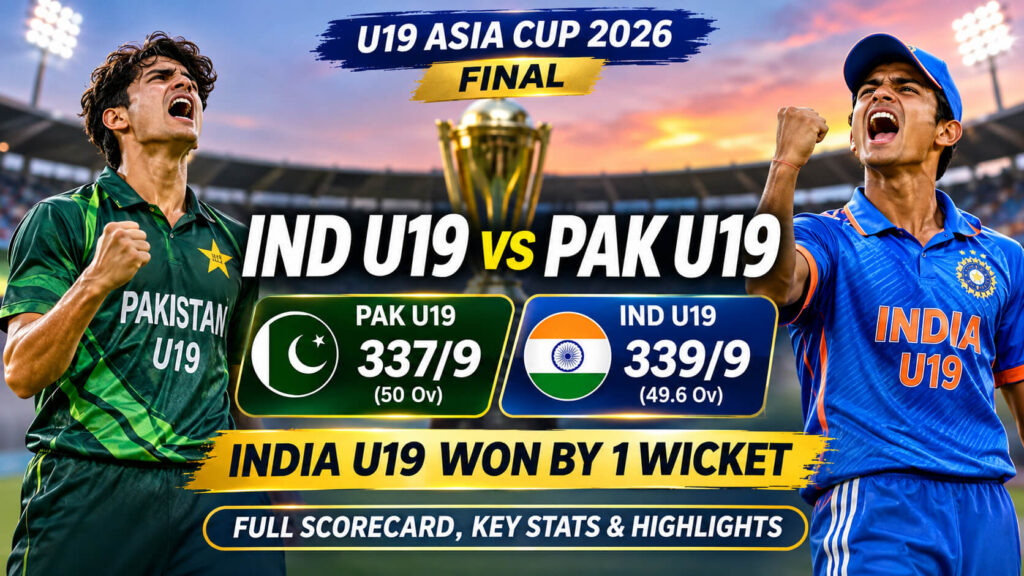
IND U19 vs PAK U19 Asia Cup Final 2026: India Win by 1 Wicket, Full Scorecard & Highlights
India Under-19 produced a breathtaking last-ball chase against Pakistan Under-19 in Al Amerat. Here is the complete scorecard, a detailed breakdown of the turning points, leading performances, verified statistics and charts from the 14 November 2026 final.
IND U19 vs PAK U19 Final 2026 Result: Who Won the Asia Cup?
India Under-19 defeated Pakistan Under-19 by one wicket in the 2026 ACC Men’s U19 Asia Cup final on Saturday, 14 November. Chasing 338, India finished at 339/9 after 50 overs, with Mohit Ulva unbeaten on 49 from 26 balls. His four off the final delivery completed the chase and secured India’s ninth Men’s U19 Asia Cup title.
The result was far from routine. Pakistan elected to bat and set a daunting 337/9 through Usman Khan’s century, Abdul Qadir’s eight-six assault and a half-century from captain Farhan Yousaf. India built a 95-run opening stand, then lost wickets through the middle overs and slipped to 252/8. The contest seemed to be moving Pakistan’s way until Manal Chauhan and Mohit Ulva delivered an extraordinary late counterattack.
At 309/9 in the 48th over, India had one wicket remaining and still needed 29 runs. Ulva and Chigurupati Venkata added the decisive 30 runs in just 16 balls. Pakistan needed one more wicket, while India required eight from the final over. Ultimately a last-ball four from Ulva took the total beyond the target and settled the title.
Date: 14 November 2026
Venue: Al Amerat Cricket Ground, Ministry Turf 2, Oman
Start: 9:00 AM local / 10:30 AM IST
Toss: Pakistan U19 chose to bat
India batting: Lakshya Raichandani 80, Aaryavir Sehwag 58, Mohit Ulva 49*
Pakistan batting: Usman Khan 107, Abdul Qadir 80
Bowling: Kavya Patel 4/68; Rizwanullah 3/53
IND U19 vs PAK U19 Final 2026 Full Scorecard
The tables below reproduce the batting and bowling figures for both innings. Runs and extras reconcile to the published team totals: Pakistan’s 322 off the bat plus 15 extras made 337; India’s 322 off the bat plus 17 extras made 339. The completed match scorecard provides a second reference for these figures.
Pakistan Under-19s batting scorecard — 337/9 (50 overs)
| Batter & dismissal | R | B | 4s | 6s | SR |
|---|---|---|---|---|---|
| Usman Khanc Arjun Rajput b Kavya Patel | 107 | 111 | 11 | 3 | 96.40 |
| Hayam Khanc Anvay Dravid b Kavya Patel | 21 | 23 | 4 | 0 | 91.30 |
| Abdul Qadirc VK Vineeth b Arjun Rajput | 80 | 54 | 3 | 8 | 148.15 |
| Farhan Yousaf (c)c Aryan Savsani b Chigurupati Venkata | 63 | 60 | 4 | 3 | 105.00 |
| Ahmed Hussainc Aaryavir Sehwag b Chigurupati Venkata | 17 | 20 | 1 | 0 | 85.00 |
| Hamza Zahoor (wk)c Mohit Ulva b Kavya Patel | 10 | 10 | 0 | 0 | 100.00 |
| Hasnain Abbas Darc Yashbardhan Chauhan b Chigurupati Venkata | 2 | 4 | 0 | 0 | 50.00 |
| Mohammad Sayyamrun out (Anvay Dravid) | 7 | 7 | 0 | 0 | 100.00 |
| Niqab Shafiqb Kavya Patel | 11 | 9 | 0 | 1 | 122.22 |
| Rizwanullahnot out | 4 | 3 | 1 | 0 | 133.33 |
| Ali Razanot out | 0 | 1 | 0 | 0 | 0.00 |
| Extras | 15 (b 1, lb 3, nb 2, w 9) | ||||
| Total | 337/9 | 50 overs | |||
India Under-19s bowling scorecard
| Bowler | O | M | R | W | Econ |
|---|---|---|---|---|---|
| Mohit Ulva | 8 | 0 | 57 | 0 | 7.12 |
| Kavya Paresh Patel | 10 | 0 | 68 | 4 | 6.80 |
| Chigurupati Venkata | 5 | 0 | 40 | 3 | 8.00 |
| Manal Chauhan | 3 | 0 | 40 | 0 | 13.33 |
| Aryan Savsani | 7 | 0 | 36 | 0 | 5.14 |
| Yashbardhan Chauhan | 6 | 0 | 35 | 0 | 5.83 |
| Arjun Rajput | 7 | 0 | 43 | 1 | 6.14 |
| VK Vineeth | 4 | 0 | 14 | 0 | 3.50 |
Pakistan Under-19s fall of wickets
| Wicket | Score | Over | Batter |
|---|---|---|---|
| 1 | 62/1 | 8.1 | Hayam Khan |
| 2 | 197/2 | 26.6 | Abdul Qadir |
| 3 | 240/3 | 36.3 | Usman Khan |
| 4 | 299/4 | 44.1 | Ahmed Hussain |
| 5 | 305/5 | 44.6 | Farhan Yousaf |
| 6 | 311/6 | 46.1 | Hasnain Abbas Dar |
| 7 | 317/7 | 47.2 | Hamza Zahoor |
| 8 | 332/8 | 49.2 | Niqab Shafiq |
| 9 | 336/9 | 49.5 | Mohammad Sayyam |
India Under-19s batting scorecard — 339/9 (50 overs)
| Batter & dismissal | R | B | 4s | 6s | SR |
|---|---|---|---|---|---|
| Lakshya Raichandani (c)c Hasnain Abbas Dar b Ali Raza | 80 | 101 | 5 | 0 | 79.21 |
| Aaryavir Sehwagc Usman Khan b Niqab Shafiq | 58 | 61 | 9 | 0 | 95.08 |
| VK Vineethc Usman Khan b Rizwanullah | 24 | 21 | 3 | 0 | 114.29 |
| Arjun Rajputc Hamza Zahoor b Rizwanullah | 16 | 18 | 0 | 2 | 88.89 |
| Yashbardhan Chauhanc Usman Khan b Hasnain Abbas Dar | 9 | 5 | 1 | 0 | 180.00 |
| Anvay Dravid (wk)run out (Farhan Yousaf) | 19 | 12 | 3 | 0 | 158.33 |
| Manal Chauhanc Usman Khan b Niqab Shafiq | 47 | 32 | 3 | 3 | 146.88 |
| Aryan Savsanic Hayam Khan b Rizwanullah | 9 | 14 | 0 | 0 | 64.29 |
| Kavya Patelc Hamza Zahoor b Mohammad Sayyam | 0 | 2 | 0 | 0 | 0.00 |
| Mohit Ulvanot out | 49 | 26 | 5 | 3 | 188.46 |
| Chigurupati Venkatanot out | 11 | 8 | 2 | 0 | 137.50 |
| Extras | 17 (lb 8, w 9) | ||||
| Total | 339/9 | 50 overs | |||
Pakistan Under-19s bowling scorecard
| Bowler | O | M | R | W | Econ |
|---|---|---|---|---|---|
| Ali Raza | 10 | 0 | 65 | 1 | 6.50 |
| Mohammad Sayyam | 10 | 0 | 79 | 1 | 7.90 |
| Rizwanullah | 10 | 0 | 53 | 3 | 5.30 |
| Niqab Shafiq | 10 | 0 | 57 | 2 | 5.70 |
| Ahmed Hussain | 5 | 0 | 38 | 0 | 7.60 |
| Hasnain Abbas Dar | 5 | 0 | 39 | 1 | 7.80 |
India Under-19s fall of wickets
| Wicket | Score | Over | Batter |
|---|---|---|---|
| 1 | 95/1 | 17.4 | Aaryavir Sehwag |
| 2 | 146/2 | 26.3 | VK Vineeth |
| 3 | 172/3 | 30.6 | Arjun Rajput |
| 4 | 186/4 | 32.4 | Yashbardhan Chauhan |
| 5 | 217/5 | 36.2 | Lakshya Raichandani |
| 6 | 217/6 | 36.3 | Anvay Dravid |
| 7 | 251/7 | 40.6 | Aryan Savsani |
| 8 | 252/8 | 41.3 | Kavya Patel |
| 9 | 309/9 | 47.2 | Manal Chauhan |
Scorekeeping note: Scorecard feeds sometimes display a completed over as “49.6” or “26.6”; in standard cricket notation, six balls complete the next over. For readability, this article records the innings duration as 50.0 overs.
Final-Over Drama: How Mohit Ulva Won the Match on the Last Ball
Pakistan entered the final over with the mathematics on their side: India were 330/9, requiring eight runs from six legal deliveries. Ahmed Hussain bowled the 50th over. The pressure was particularly intense because a single wicket would end India’s innings, whereas a boundary could rapidly transform the equation. The final-over ball-by-ball commentary documents each delivery.
The over opened with a dot, followed by a wide. The batters then collected four successive singles, bringing the requirement to three off the last ball. Ulva found the boundary from the sixth legal delivery, finishing unbeaten on 49 and triggering India’s celebrations. His strike rate of 188.46 reflected the urgency of his rescue innings.
The last over yielded nine runs in total. A detail worth preserving in the match record: “49.6 overs” is another way some feeds represent the sixth ball of the 50th over; the completed innings is recorded as 50.0 overs. India did not win with deliveries remaining—they won from the very last legitimate ball of the innings.
India’s final two wickets changed the entire match
When Kavya Patel was dismissed at 252/8 in 41.3 overs, the side still required 86. Manal Chauhan attacked the bowling with 47 from 32 deliveries, including three sixes. He and Ulva added 57 for the ninth wicket in 35 balls to take India to 309/9. Ulva then worked with Venkata, who contributed 11 from eight balls, in an unbroken 30-run last-wicket partnership.
The 57-run stand revived the chase, but the final 30 runs with the last batter required composure as much as attacking intent. In a pursuit of this size, lower-order runs can be the difference between an impressive effort and a title-winning finish.
Pakistan U19 Innings: How Usman Khan’s 107 Set Up 337/9
Pakistan won the toss and chose to bat on the Ministry Turf 2 surface. The opening partnership gave the innings its first platform: Usman Khan and Hayam Khan put on 62 before Hayam fell for 21 in the ninth over. From there, Usman joined Abdul Qadir in the defining stand of Pakistan’s batting performance.
Usman Khan’s century anchored the first 37 overs
Usman scored 107 from 111 deliveries, with 11 fours and three sixes. His innings was not purely about acceleration. He occupied the crease long enough for Pakistan to rotate the strike around an aggressive partner and avoid a sequence of early wickets. When he was dismissed at 240/3 in 36.3 overs, Pakistan had already established a powerful base.
His 135-run second-wicket partnership with Qadir took the total from 62/1 to 197/2. The combination mattered because the two batters used different scoring methods: Usman provided continuity, while Qadir created sudden jumps in the scoring rate.
Abdul Qadir’s eight sixes changed the tempo
Qadir struck 80 from just 54 balls at a strike rate of 148.15, including eight sixes and three fours. That means 60 of his 80 runs came from boundaries. He repeatedly put the Indian bowlers under pressure, turning a stable opening into a potentially match-defining total. His dismissal to Arjun Rajput at 197/2 ended a partnership that had produced 135 runs.
Farhan Yousaf added 63 before India fought back
Pakistan captain Farhan Yousaf scored 63 from 60 balls and helped the innings reach 299/4 in the 45th over. With substantial overs and wickets available earlier, a total exceeding 350 had appeared possible. India, however, took wickets in clusters late in the innings, cutting off a more destructive finish.
Chigurupati Venkata dismissed Ahmed Hussain and Farhan in the 45th over before removing Hasnain Abbas Dar. Kavya Patel completed a four-wicket return, including important late wickets. Pakistan still ended on 337/9—an imposing total—but the final overs were less productive than the earlier batting platform had suggested.
Pakistan innings in one line: Usman created the foundation, Qadir provided the power and Farhan sustained the momentum; India’s late wickets prevented the innings from accelerating indefinitely.
India U19 Chase of 338: From 95/0 to a Last-Ball Victory
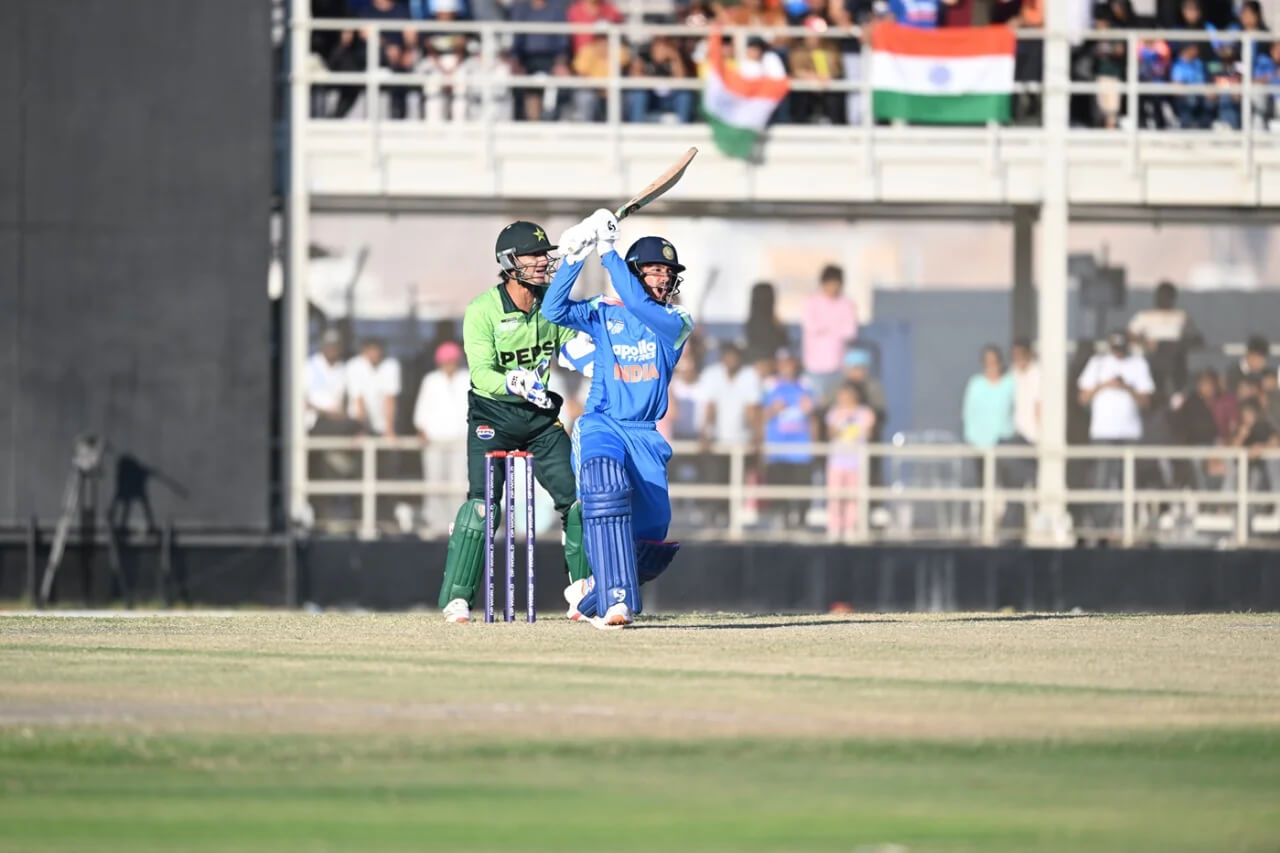
India faced a target that required 6.76 runs per over from the start. The first ten overs produced 54 without loss—slower than the eventual required rate, but still valuable against the new ball. Aaryavir Sehwag supplied the early boundaries as captain Lakshya Raichandani stayed at the crease and absorbed pressure.
95-run opening stand established a platform
Sehwag scored 58 from 61 deliveries, striking nine fours. Raichandani reached 80 from 101 balls, playing a longer anchoring role. Their opening partnership lasted 17.4 overs and provided 95 runs. After Sehwag’s dismissal, VK Vineeth added 24 off 21 balls in a 51-run second-wicket partnership, keeping the chase moving.
India reached 146/2 in the 27th over, but could not maintain a long partnership. Arjun Rajput departed for 16 at 172/3; Yashbardhan Chauhan’s brief cameo ended at 186/4. Raichandani’s dismissal at 217/5 in 36.2 overs was especially costly because he had been the main stabilizing batter. Anvay Dravid was then run out on the next ball at the same total, leaving India 217/6.
Rizwanullah’s three wickets put Pakistan in control
Pakistan’s most effective bowler by wickets and economy among the full-ten-over spells was Rizwanullah, who finished with 3/53. He removed Vineeth, Rajput and Aryan Savsani. Niqab Shafiq added 2/57, including Sehwag and the dangerous Manal Chauhan. These strikes repeatedly interrupted India’s ability to settle a partnership.
At 251/7 and then 252/8, India were in real trouble. With eight wickets gone and the required rate rising, the successful chase depended on batters who usually contribute lower down the order. The closing sequence became the defining story of the final.
Manal Chauhan and Mohit Ulva refuse to surrender
Manal responded with an attacking 47 off 32, featuring three fours and three sixes, while Ulva took calculated scoring opportunities. The pair added 57 for the ninth wicket. Even after Manal fell at 309/9 in 47.2 overs, Ulva did not abandon the pursuit. Venkata’s two boundaries mattered: the last-wicket stand left enough runs within reach for Ulva to end the match with one stroke.
Ulva’s unbeaten 49 came off only 26 balls, with five fours and three sixes. It was a pressure innings: the required runs, available wickets and limited deliveries meant that merely protecting his wicket would not have been enough. His four off the final ball converted a remarkable comeback into the championship result.
IND U19 vs PAK U19 Final 2026: Charts, Numbers and Match Analysis
Rather than drawing a simulated win-probability curve, these graphics use actual scorecard numbers: recorded wicket positions, batting contributions, wickets and boundaries. That keeps the visual analysis reproducible and avoids presenting model estimates as live-match facts.
Points mark recorded falls of wickets and the completed totals. Lines between points are visual guides, not measured ball-by-ball scoring.
Boundary comparison: same number of hits, different scoring patterns
One revealing detail is that both teams struck 39 boundaries in their innings. Pakistan’s batting relied more heavily on sixes—15 to India’s eight—while India hit 31 fours compared with Pakistan’s 24. The distribution helps explain why Pakistan’s power-hitting was spectacular, while India’s last-ball chase still produced a slightly larger total.
24 fours = 96 runs
15 sixes = 90 runs
186 boundary runs (55.2% of total)
31 fours = 124 runs
8 sixes = 48 runs
172 boundary runs (50.7% of total)
Bowling impact: who took the wickets?
India shared their eight bowler-credited wickets between three players: Kavya Patel took four, Venkata three and Arjun Rajput one. Pakistan’s bowler-credited dismissals were spread across Rizwanullah (three), Niqab Shafiq (two), Ali Raza (one), Mohammad Sayyam (one) and Hasnain Abbas Dar (one). Both innings also included one run-out.
Why India’s chase was remarkable beyond the last ball
India’s success was built across distinct phases. The opening stand meant the side did not begin its chase with a collapse. Raichandani’s 80 kept the chase alive even as wickets fell. The ninth-wicket stand then reversed the direction of the match: the 57 runs from 252/8 to 309/9 were scored in 35 deliveries, followed by a 30-run final-wicket partnership in 16 deliveries.
From the fall of the eighth wicket at 252, India accumulated 87 more runs with just two wickets in hand. These closing partnerships account for more than a quarter of the winning total. That is why Ulva’s finish belongs in the same analysis as the top-order contributions, rather than being treated as an isolated highlight.
The stands added 87 runs after India were 252/8.
Key Players of the Final: Batting, Bowling and Pressure Moments
Mohit Ulva: India’s match-finishing hero
Ulva’s 49 not out from 26 deliveries was the match’s defining final act. He arrived with India already under pressure and accelerated when the required rate and fall of wickets left little margin for error. His combination of five fours and three sixes meant that 38 of his 49 runs came in boundaries. The match-winning stroke from Ahmed Hussain on ball 49.6 was the one that determined the trophy.
Lakshya Raichandani: the innings that made the chase possible
The captain’s 80 from 101 balls supplied structure and allowed other players to attack around him. His dismissal was followed immediately by Dravid’s run out, creating a difficult position at 217/6. The fact India later recovered should not overshadow the value of the time Raichandani spent at the crease and the 95-run opening platform he helped build.
Usman Khan: Pakistan’s leading scorer in defeat
Usman’s 107 combined occupation of the crease with consistent boundary scoring. Pakistan’s second-wicket partnership with Abdul Qadir was worth 135 and drove the innings toward a formidable total. His century kept India under the pressure of a large chase even after the late-order wickets.
Kavya Patel and Rizwanullah: the bowling leaders
Patel’s 4/68 represented India’s most productive wicket-taking spell. Venkata’s 3/40 was especially important in breaking Pakistan’s late middle order. For Pakistan, Rizwanullah’s 3/53 and Niqab Shafiq’s 2/57 helped expose India’s lower order. The two teams’ bowling leaders created a contest in which a high-scoring match still hinged on the last wicket.
What the 2026 U19 Asia Cup Title Means for India
The victory was India’s ninth Men’s Under-19 Asia Cup title and came against a Pakistan side that had already beaten India during the tournament’s group stage. That context matters: the final was not just a successful chase but a reversal of a recent result, achieved with almost no room left on the scoreboard.
India had reached the final after an eight-wicket win over Afghanistan in the semifinal, while Pakistan arrived with confidence from earlier tournament performances. In the title match, both sides showed strong and fragile phases. Pakistan’s top order dominated long periods, India’s lower order found a way back and the bowlers on both teams created decisive turning points.
For youth cricket, the deeper lesson is the balance of skills involved. The win required an opening partnership, an innings of 80 from the captain, wickets from specialist bowlers and extraordinary composure from the final two batters. The result also gives future selectors and analysts concrete match evidence, rather than only a dramatic final-ball clip.
IND U19 vs PAK U19 Final 2026: Frequently Asked Questions
Who won the India U19 vs Pakistan U19 Asia Cup final 2026?
India Under-19 beat Pakistan Under-19 by one wicket on 14 November 2026, reaching 339/9 on the final ball after Pakistan made 337/9.
What was the full score in the U19 Asia Cup 2026 final?
Pakistan U19 scored 337/9 in 50 overs. India U19 scored 339/9 in 50 overs and won by one wicket.
Who hit the winning runs for India U19?
Mohit Ulva hit a four off Ahmed Hussain on the final ball. He remained unbeaten on 49 from 26 balls.
How many runs did Usman Khan score against India U19?
Usman Khan scored 107 from 111 deliveries, with 11 fours and three sixes.
Who scored the most runs for India U19 in the final?
Captain Lakshya Raichandani top-scored with 80 from 101 balls. Aaryavir Sehwag made 58, while Ulva finished 49 not out.
Who took the most wickets in the final?
Kavya Patel took four wickets for India, finishing with 4/68. Rizwanullah led Pakistan’s bowling with 3/53.
Where was the U19 Asia Cup final played?
The final was played on 14 November 2026 at Al Amerat Cricket Ground, Ministry Turf 2, Oman.
How many U19 Asia Cup titles has India won?
India’s victory in the 2026 final was its ninth Men’s Under-19 Asia Cup title.
Why does some scorecard data show India batting 49.6 overs?
Some feeds write the final delivery as 49.6, meaning the sixth ball of the 50th over. The completed innings duration is 50.0 overs.
Final Verdict: One of the Most Dramatic India U19 vs Pakistan U19 Finals
India’s IND U19 vs PAK U19 final 2026 triumph was a game of multiple reversals. Usman Khan and Abdul Qadir took Pakistan to 337/9. India’s top order laid the foundation, Pakistan’s bowlers fought back and India stood at 252/8. Then Manal Chauhan, Mohit Ulva and Chigurupati Venkata converted an apparently lost chase into a one-wicket victory from the final delivery.
The scorecard tells two stories at once: Pakistan were strong enough to post a total that wins many youth ODIs, while India’s batting depth remained capable of finding the required runs after nine wickets fell. The final-ball four deserves its place in the highlights, but the 95-run opening partnership, Patel’s 4/68 and the 87 runs added from 252/8 explain how India reached that moment.
For additional scorecards, international match results and cricket analysis, visit KhelKhabri.