

Basketball looks fast, but its main rules are easy to follow once you know what earns points, when a player must dribble and why referees stop play. This guide explains the international FIBA format first, then the major NBA differences.
Quick answer: Basketball rules for beginners start with five players per team, a basket worth one, two or three points, and a simple goal: outscore the opposition. Players move the ball by passing or dribbling. Illegal contact is usually a foul, while breaking a movement or time rule is normally a violation. FIBA games use four ten-minute quarters.
The rules here apply mainly to the standard five-a-side game. A school event, local league, 3×3 match or the NBA may use a different rulebook, so check the competition before making a call.
Basketball Rules for Beginners: The Game at a Glance
Two teams try to score through the hoop at the opposite end of the court. The ball changes hands after a made basket, a defensive rebound, a steal or a whistle that gives possession to the other team. The winner is the team with more points when the game ends, including overtime when needed.
Each side has five players on court. Substitutes can enter during suitable stoppages, following the competition’s substitution procedure. Players generally use passing to move the ball quickly, dribbling to travel with it and shooting to try to score. Defenders attempt to prevent shots without making illegal contact.
| Question | Beginner’s answer |
|---|---|
| How many players? | Five on court for each team |
| How do teams score? | Free throws, two-pointers and three-pointers |
| How long is a FIBA game? | Four quarters of 10 minutes |
| How long is a normal possession? | 24-second shot clock |
| What if the score is tied? | Five-minute overtime periods until a winner |
How Basketball Scoring Works: One, Two and Three Points
A successful free throw scores one point. A field goal made from inside the three-point line counts for two, whether it is a layup, a close-range shot or a dunk. A legal shot released from outside the three-point arc counts for three. A player’s feet and the line determine whether the attempt is worth two or three points.
| Shot | Points | Example |
|---|---|---|
| Free throw | 1 | Unopposed attempt after an awarded foul penalty |
| Two-point field goal | 2 | Layup or jump shot from inside the arc |
| Three-point field goal | 3 | Shot taken from beyond the arc |
How much is each successful shot worth?
These bars show fixed scoring values, not player statistics.
What does “and-one” mean?
Imagine a player drives to the basket, makes a two-point shot and is fouled during the shooting action. The basket may count, and the player gets one extra free throw. If that free throw goes in, the sequence produces three points. A made three-pointer with a shooting foul can become a four-point play.
A simple scoring calculation
Suppose a team makes three two-point baskets, two three-pointers and four free throws. That adds up to six plus six plus four, or 16 points. This is how a scoreboard grows: it adds successful shots, not attempts.
A common beginner mistake is thinking every shot made near the line counts for three. If a shooter’s foot touches the three-point line at release, that shot is worth two, not three.
The Court, Players and Game Clock
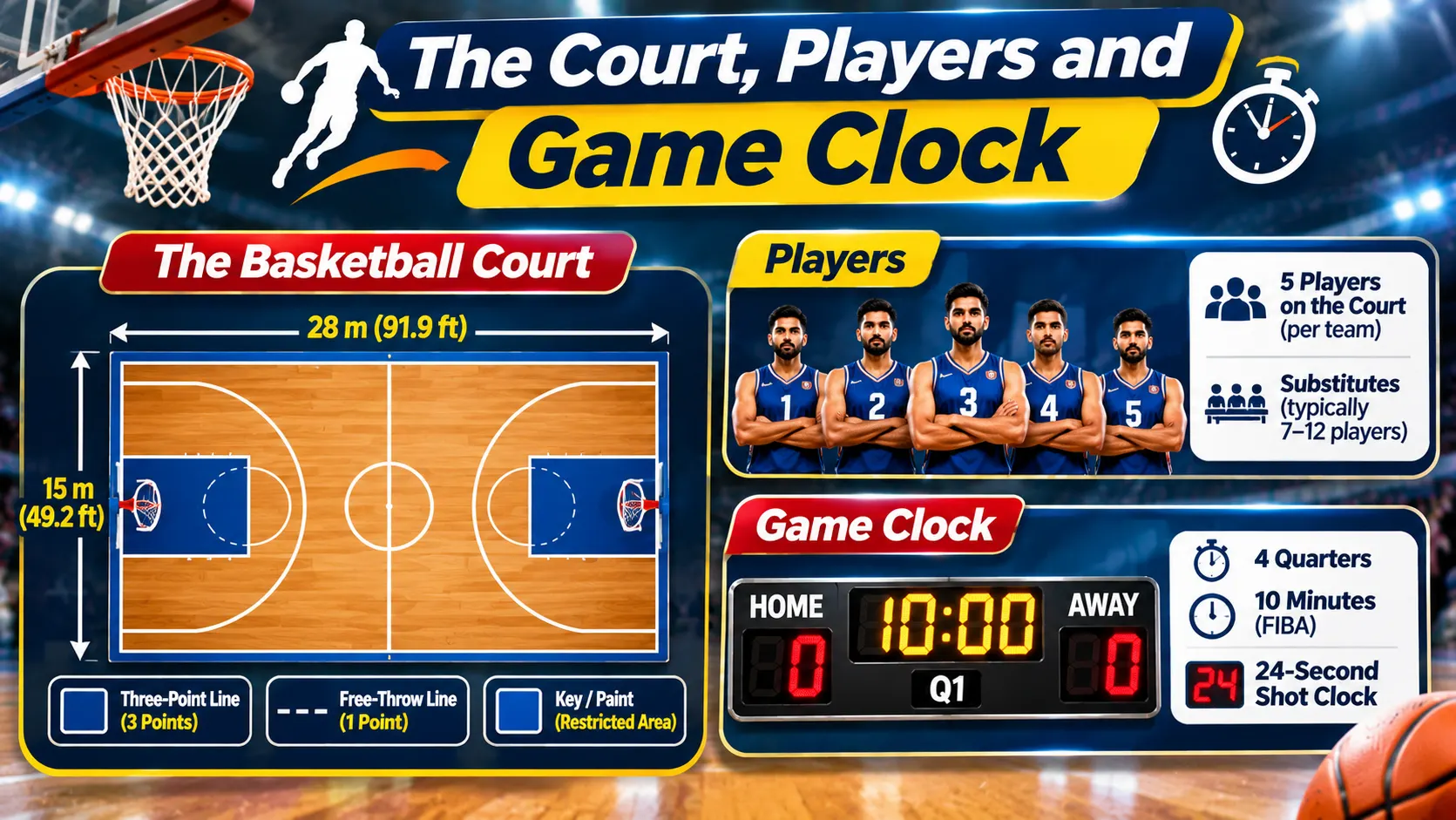
Under FIBA rules, the playing court is 28 metres long and 15 metres wide. Key areas include the centre line, sidelines, end lines, free-throw lane and three-point arc. The hoop stands at each end. Knowing the markings makes calls for out of bounds, backcourt violations and three-point shots easier to understand.
A FIBA game has four ten-minute quarters, making 40 minutes of playing time. In the NBA, quarters last 12 minutes, making 48 minutes. The clock stops for designated whistles and other situations, so a match takes much longer than its listed playing time. A tie after the final quarter leads to five-minute overtime periods.
How a game begins and restarts
The opening period typically begins with a jump ball at the centre circle. Under FIBA’s alternating-possession procedure, later jump-ball situations commonly use a possession arrow rather than another centre jump. The NBA uses jump balls in more held-ball situations. After a made field goal, the team that conceded it puts the ball back into play from behind its end line.
When you watch an online basketball broadcast, noticing both the main game clock and the smaller shot clock helps explain why a team suddenly speeds up its attack.
Dribbling, Travelling and Common Basketball Violations
A violation usually means a rule has been broken without the illegal contact that defines a personal foul. The usual result is that the other team receives the ball for a throw-in. No free throws are automatically awarded just because somebody commits a travelling or double-dribble violation.
Travelling: moving illegally with the ball
A player can move while continuously dribbling. Once the dribble ends or the player catches the ball, the permitted steps and pivot-foot rules become important. In common layup situations, a moving player can take two legal steps after gathering the ball before passing or shooting. It is wrong to say that every movement of the pivot foot is automatically travelling.
For example, a player catches a pass while stationary, establishes a pivot foot and turns to look for a teammate. That turn can be legal if the player follows the pivot-foot rule. Lifting the pivot foot to begin a dribble before releasing the ball, however, may create a travelling violation.
Double dribble and carrying
A player cannot normally stop a dribble by holding the ball and then begin dribbling again. That is a double dribble. Running while bouncing the ball using both hands together also breaks normal dribbling rules. Carrying happens when a player illegally supports or pauses the ball with a hand beneath it while dribbling.
Out of bounds and backcourt
The boundary lines themselves are out of bounds. If a player with the ball steps on a sideline, or a ball last touched by one team goes outside the court, officials normally award a throw-in to the other team. A backcourt violation can occur if a team already controlling the ball in its frontcourt illegally returns it to the backcourt and touches it first.
Three seconds and goaltending
In the standard offensive three-second rule, an attacker cannot remain in the opponents’ restricted area too long while their team has the ball in the frontcourt and the game clock is running. There are important allowances, including when a player is leaving or actively shooting. The NBA also has a separate defensive three-second rule; standard FIBA games do not use the same defensive restriction.
Goaltending generally involves illegally touching a shot on its downward flight when it has a chance to enter the basket. Basket interference covers other prohibited contact around the hoop and cylinder. The exact treatment of a ball after it hits the rim differs between FIBA and NBA play.
| Violation | Example | Usual result |
|---|---|---|
| Travelling | Illegal steps after gathering | Opponent’s throw-in |
| Double dribble | Restarting a completed dribble | Opponent’s throw-in |
| Out of bounds | Stepping on a boundary with the ball | Opponent’s throw-in |
| Backcourt | Illegal return after frontcourt control | Opponent’s possession |
| Shot clock | No legal shot before the limit | Opponent’s possession |
Basketball Fouls and Free Throws Explained
A personal foul generally involves illegal contact. Holding an opponent, pushing someone, striking an arm or moving into an established legal position can all lead to fouls, depending on the play. Basketball permits ordinary body contact; referees assess whether contact creates an unfair disadvantage under the relevant rules.
Shooting fouls
If a player is fouled while missing a two-point shot, the usual penalty is two free throws. A missed three-point attempt followed by a qualifying shooting foul generally brings three free throws. If the shot is made and counts, the shooter usually receives one additional free throw instead. Specific special-foul penalties can change that outcome.
Non-shooting and offensive fouls
Not every personal foul awards shots. Early in a quarter, a common non-shooting defensive foul may lead to a throw-in. Once a team enters the team-foul penalty situation, later qualifying defensive fouls generally result in free throws. An offensive charge or another team-control foul is treated differently: the opponents normally receive the ball rather than automatic bonus free throws.
In FIBA play, a team enters the penalty situation after four team fouls in a quarter. A fifth or later qualifying team foul brings the normal penalty, often two free throws. This is separate from the individual player’s foul count. A player must leave the game after five personal fouls under FIBA rules; the NBA limit is six.
Technical, disruptive and flagrant fouls
Technical fouls concern conduct or game administration rather than an ordinary contest for the ball. The 2026 FIBA rules introduced two categories of technical fouls according to seriousness. They also replaced the old unsportsmanlike foul classification with disruptive and flagrant foul categories. Flagrant fouls count towards certain game-disqualification thresholds, while disruptive fouls do not in the same way.
These updated FIBA names should not be copied blindly onto NBA coverage. The NBA maintains its own technical-foul and flagrant-foul system. If you are reporting a match or explaining a referee’s decision, name the competition and use the terminology from that competition’s current rulebook.
| Situation | What happened? | Possible result |
|---|---|---|
| Personal foul | Illegal contact | Throw-in or free throws |
| Shooting foul | Illegal contact during a shot | Free throws; made basket may count |
| Technical foul | Conduct or administrative issue | Rule-specific penalty |
| Travelling violation | Illegal movement without a legal dribble | Change of possession |
Shot Clock, Eight Seconds and Possession Changes
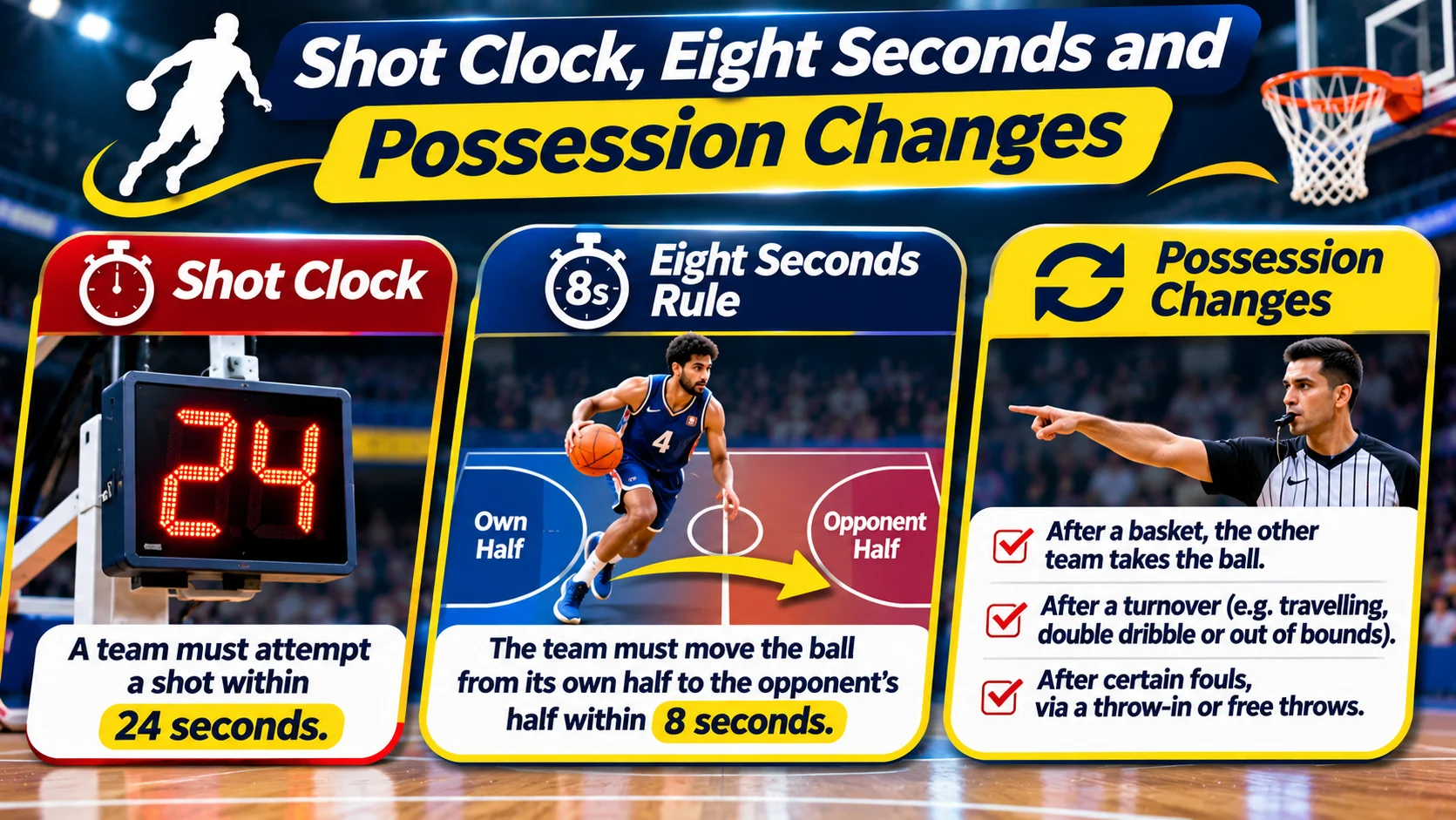
The shot clock prevents a team from holding the ball indefinitely. A new possession generally starts with 24 seconds to attempt a shot. To meet the rule, the ball must leave the shooter’s hand before the clock expires and then touch the rim or enter the basket. A shot that misses everything does not automatically satisfy the requirement.
Consider a team with five seconds remaining. A player shoots just before zero, but the ball hits only the backboard and misses the rim. Unless another rule changes the situation, the possession has not produced the legal rim contact needed to avoid the shot-clock violation. This is why referees watch the release and the ring.
Why does the clock sometimes show 14?
After an attacking team recovers the ball following a missed shot that struck the rim, the shot clock commonly resets to 14 seconds rather than the full 24. Other stoppages and changes of possession have their own reset rules. A defensive tap that does not establish new possession does not always start a fresh clock.
The eight-second rule is different. It concerns how quickly a team must move the ball from its backcourt into the frontcourt. Both standard FIBA and NBA five-a-side rules use eight seconds, although the precise counting and reset conditions matter. Crossing halfway does not give the offence a brand-new 24-second shot clock.
Understanding the difference between the clocks makes close finishes more exciting. A team leading late may use its legal possession time carefully. The side trailing may defend aggressively, seek a steal or commit a tactical foul. Whether that foul gives free throws depends on the situation and the competition rules.
Player Positions, Teamwork and Legal Defence
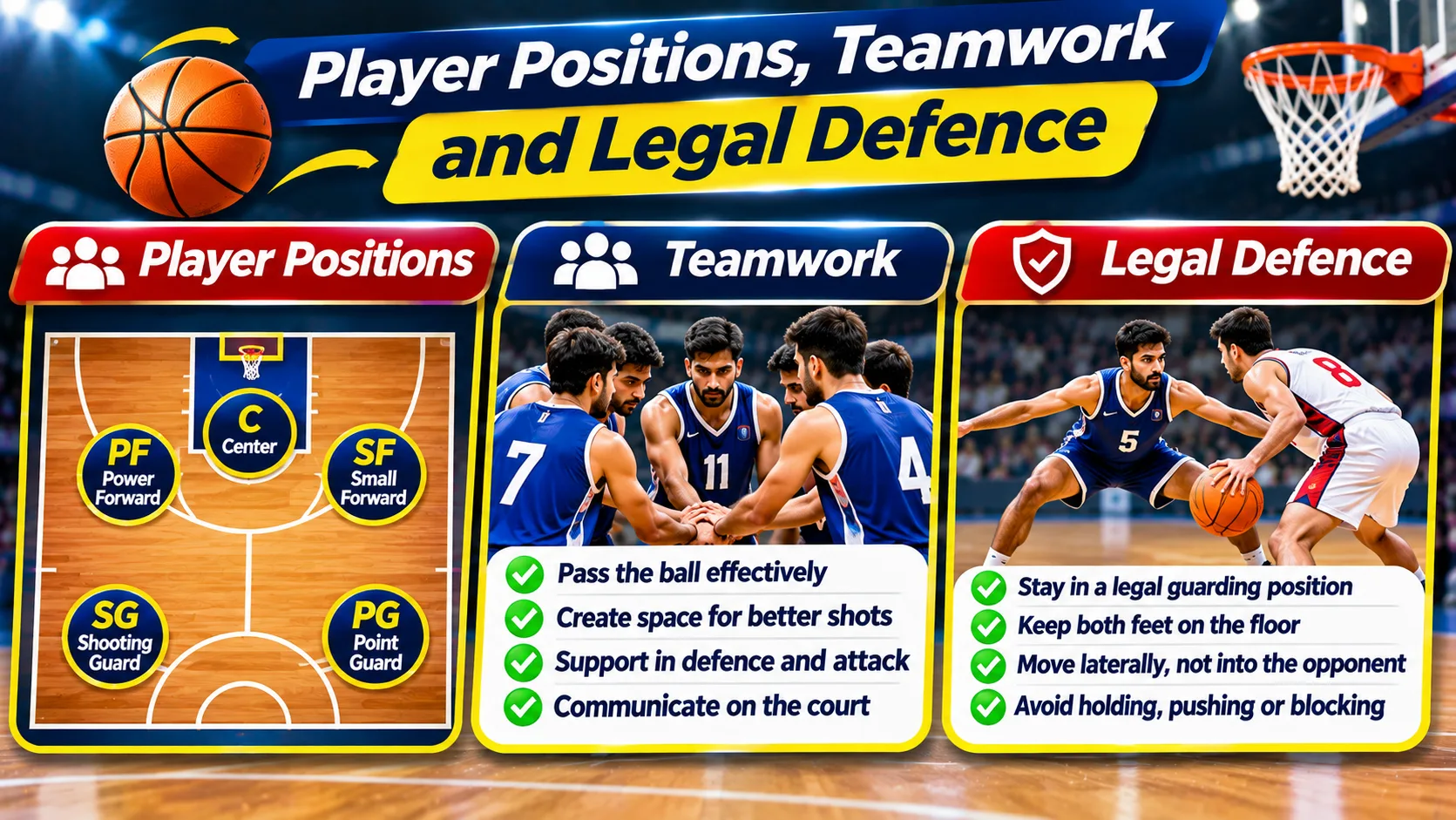
Basketball often describes five roles: point guard, shooting guard, small forward, power forward and centre. These are tactical descriptions, not five separate rule categories. A player can score from any legal position, pass, rebound or defend; the role simply suggests the jobs a coach often asks that player to perform.
The point guard commonly organises attacks. The shooting guard may look for scoring chances; the forwards blend movement, strength and shooting; and the centre often works close to the basket. A classic example of elite scoring from a guard position is found in KhelKhabri’s Michael Jordan career and scoring profile, which places that attacking role in a real NBA context.
What is a legal screen?
A screen helps a teammate get free from a defender. The screener must follow rules about position, movement and contact. An illegal moving screen can result in an offensive foul. The defender is not allowed to push or hold the ball handler simply because a screen has been set.
Rebounds, steals and turnovers
A rebound happens when a player gains the ball after a missed shot. A steal means taking possession away from an opponent by legal defensive play. A turnover is a wider term: it covers losing possession through a bad pass, an intercepted ball or a violation.
FIBA vs NBA Basketball Rules: What Changes in 2026?
Indian fans often watch both international games and the NBA, then wonder why officials make different calls. The basic scoring system is the same, but some timing, foul and defensive rules differ. The comparison below describes standard five-a-side play, not 3×3 basketball or a school competition with modified regulations.
| Feature | FIBA (2026) | NBA |
|---|---|---|
| Quarter length | 10 minutes | 12 minutes |
| Regulation game | 40 minutes | 48 minutes |
| Personal fouls before leaving | 5 | 6 |
| Initial shot clock | 24 seconds | 24 seconds |
| Advance from backcourt | 8 seconds | 8 seconds |
| Defensive three-second restriction | No NBA-style equivalent | Applies |
| Overtime period | 5 minutes | 5 minutes |
The NBA’s official rulebook is the best reference when a call in an NBA game seems different from an international match.
The FIBA rule change effective 1 October 2026
FIBA’s new edition took effect worldwide on 1 October 2026. One major change separates old unsportsmanlike-foul decisions into disruptive and flagrant categories. The technical-foul system also has two categories, with different consequences for game disqualification. That matters to commentators and readers who may still find the previous wording on older websites.
For beginners, however, the foundation has not changed: move legally, avoid illegal contact, respect the shot clock, and know whether a successful basket earns one, two or three points. When a particular disciplinary situation is unclear, use the competition’s current official interpretation rather than guessing from a replay clip.
Basketball Rules for Beginners: Frequently Asked Questions
How many points is a basket in basketball?
A free throw is worth one point, a successful shot from inside the three-point line earns two, and a made shot from beyond the line earns three. The value is determined by the legal shooting position, not the height or difficulty of the shot.
What is the difference between a foul and a violation?
A personal foul normally concerns illegal contact, such as holding or pushing. A violation breaks a rule about movement, boundaries or timing, such as travelling or exceeding the shot clock. Fouls can lead to free throws, while many violations give the other team possession.
How many fouls can a player commit?
In standard FIBA basketball, a player must leave the game after five personal fouls. The NBA allows six. Separate technical, flagrant and disqualification rules can also remove players earlier in particular circumstances.
What is the 24-second rule in basketball?
The team attacking the basket generally has 24 seconds to attempt a legal shot. The ball must be released before the shot clock expires and must then touch the rim or go in. Certain rebounds and stoppages lead to a 14-second reset instead.
Can you take two steps without dribbling?
A moving player can generally take two legal steps after gathering the ball while stopping, passing or shooting. The precise application depends on when control is gained and which foot becomes the pivot foot. Two steps are not permission to run freely with the ball.
Are FIBA and NBA basketball rules the same?
No. Both use five players per team and similar basic scoring, but FIBA has ten-minute quarters and a five-personal-foul limit, while the NBA has twelve-minute quarters and a six-foul limit. Some defensive and disciplinary rules differ too.
Final Thoughts: Learn the Rules, Then Enjoy the Game
These basketball rules for beginners are enough to follow a full match without being lost after every whistle. Start with scoring and legal ball movement, then learn how fouls, time limits and changes of possession affect each attack. The rules become easier to remember once you see them in real games.
When watching or playing in India, check whether the event follows current FIBA rules, NBA rules or an age-group variation. That small habit prevents confusing one competition’s decision with another’s and helps you understand the game on its own terms.