

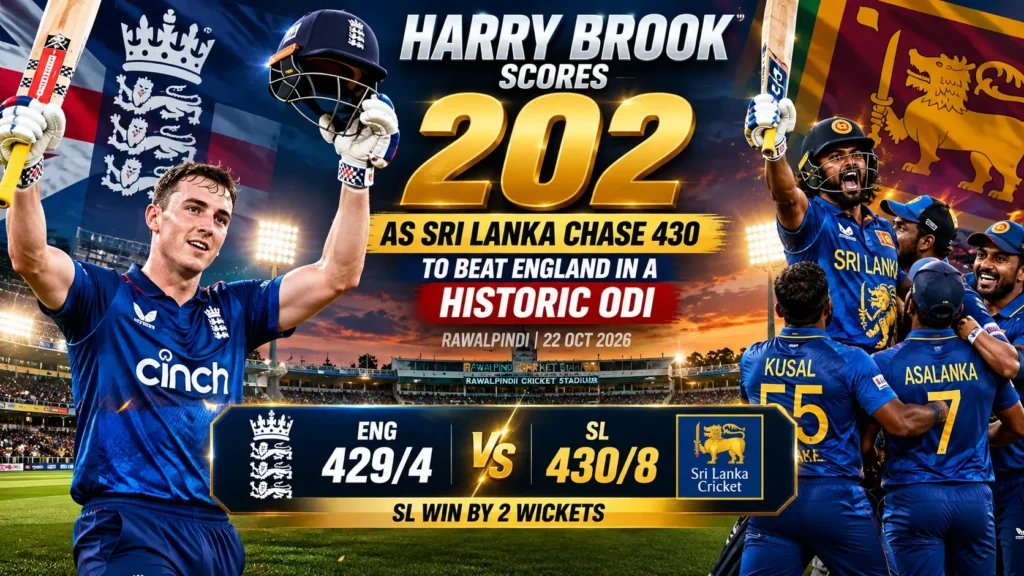
Harry Brook produced a landmark innings in Rawalpindi, becoming the first England batter to score a double century in men’s One-Day International cricket. His 202 off 116 balls powered England to 429/4, but Sri Lanka answered with a remarkable chase of 430 and won by two wickets with one ball remaining.
Full-time result
Sri Lanka won by 2 wickets
England: 429/4 in 50 overs
Sri Lanka: 430/8 in 49.5 overs
Match Overview: A Record-Breaking Knock in a Run-Fest
England and Sri Lanka delivered one of the most extraordinary batting contests in ODI cricket at Rawalpindi Cricket Stadium on 22 October 2026. England made 429/4 after batting first, setting Sri Lanka a target of 430 for victory. The chase looked daunting, yet Sri Lanka kept attacking and crossed the line at 430/8 in 49.5 overs.
The result made the game memorable for two very different reasons. Brook’s innings rewrote the record books, while Sri Lanka’s response showed how a huge total can still be chased when several batters contribute under pressure. The match produced 859 runs in total, making it one of the highest-scoring ODI contests on record.
For England, the performance was a painful mix of individual brilliance and team disappointment. Their captain delivered a historic innings and the team passed 400, but the bowling attack could not defend the target. Sri Lanka, meanwhile, demonstrated composure and depth in a chase that required sustained aggression rather than one isolated big score.
Harry Brook’s Fastest Double Century in ODI Cricket
Harry Brook scored 202 runs from 116 balls, striking 21 fours and 10 sixes. He reached 200 in only 114 deliveries, setting a new record for the fastest double century in men’s ODI cricket. His overall strike rate was approximately 174.13, reflecting the speed and consistency of his scoring. For further match details, read the Sri Lanka vs England ODI match scorecard.
The distinction between the two ball counts matters. Brook completed the double-century milestone after 114 balls, then faced two more deliveries before his innings ended on the final ball of England’s innings. That is why the milestone is recorded as 200 off 114 balls, while his final scorecard reads 202 off 116 balls.
Brook’s innings also made him the first England batter to register an ODI double hundred. Before this match, England’s highest individual ODI score was Ben Stokes’ 182 against New Zealand in 2023. Brook moved beyond that mark with a powerful blend of clean hitting, placement and acceleration through the middle and later overs.
| Statistic | Figure |
|---|---|
| Final score | 202 runs |
| Balls faced | 116 |
| Balls to reach 200 | 114 |
| Fours | 21 |
| Sixes | 10 |
| Strike rate | 174.13 |
| Dismissal | Caught off Janith Liyanage on the final ball |
How England Built Their 429/4 Total
England’s innings did not depend on Brook alone. Tom Banton gave the side a steady start with 50 from 51 balls, while Ben Duckett added 29. After the openers departed, Joe Root helped stabilise the innings and partnered Brook in a substantial stand that allowed England to build a platform for a late assault.
Root scored 69 from 66 deliveries, rotating the strike and keeping the innings moving as Brook increased the scoring rate. Their partnership helped England recover from the loss of both openers and positioned the team for a strong finish. Root also reached the milestone of 8,000 ODI runs during his innings, becoming the first England batter to achieve that mark.
Will Jacks then made an unbeaten 66 from just 30 balls, including eight fours and three sixes. His late acceleration, alongside Brook’s continued boundary hitting, helped England add 156 runs in the final 10 overs. England finished on 429/4 at a run rate of 8.58 per over.
| Batter | Runs | Balls | Key detail |
|---|---|---|---|
| Harry Brook | 202 | 116 | 21 fours, 10 sixes |
| Joe Root | 69 | 66 | Reached 8,000 ODI runs |
| Will Jacks | 66* | 30 | Unbeaten late acceleration |
| Tom Banton | 50 | 51 | Useful opening contribution |
| Ben Duckett | 29 | 39 | Helped establish the start |
| England total | 429/4 | 50 overs | Run rate: 8.58 |
Sri Lanka’s Chase: Calm Partnerships and a Dramatic Finish
Chasing 430 was always going to demand a fearless approach, and Sri Lanka had to recover from early trouble. They slipped to 24/2, placing immediate pressure on the middle order. Instead of allowing the required rate to dictate the innings, Avishka Fernando and Pavan Rathnayake formed a major partnership that brought the hosts back into contention.
Fernando scored 97 from 83 balls, while Rathnayake made 130 from 106 deliveries. Their 166-run stand gave Sri Lanka the foundation required for a historic chase. Fernando fell just short of a century, but the partnership had already shifted the momentum and reduced the scale of the task facing the batters who followed.
Dasun Shanaka added another 97, attacking the England bowlers and helping Sri Lanka maintain the pace needed. His partnership with Rathnayake added 133 runs, keeping the chase alive deep into the innings. When Shanaka was dismissed, Sri Lanka still needed significant runs, so the finishing responsibility passed to the remaining batters.
Janith Liyanage provided the decisive late contribution with an unbeaten 61 from 27 balls. He found boundaries when Sri Lanka needed them most and kept his side within reach during the final overs. With eight runs required in the last over, the finish remained tense; Liyanage struck a six off the fifth ball to seal the win with one delivery remaining.
| Batter | Runs | Balls | Contribution |
|---|---|---|---|
| Pavan Rathnayake | 130 | 106 | Top score and key partnership |
| Avishka Fernando | 97 | 83 | Built the recovery after early wickets |
| Dasun Shanaka | 97 | 50 | Accelerated through the middle overs |
| Janith Liyanage | 61* | 27 | Hit the winning six |
| Sri Lanka total | 430/8 | 49.5 overs | Won by two wickets |
Why the Result Was Historic
Sri Lanka’s successful chase of 430 was reported as the second-highest successful run chase in men’s ODI history. The result also underlined how difficult it can be to defend even a total close to 430 when the opposition can maintain partnerships and accelerate in the final overs. For more cricket news and match updates, follow the latest coverage. England had enough runs to put pressure on Sri Lanka, but not enough control to close the game out.
The combined total of 859 runs highlighted the extraordinary dominance of the batters on the day. Brook’s 202 became the headline achievement, but Sri Lanka’s collective response was equally important to the final result. Rathnayake’s century, Fernando and Shanaka’s near-centuries, and Liyanage’s quick unbeaten finish ensured that the chase did not rely on a single player.
The match also created a rare statistical contrast: Brook set a world record with the fastest ODI double century, yet his team still lost. It was a reminder that cricket records and match outcomes measure different things. A remarkable individual performance can transform a game, but the result depends on how both teams perform across the full 100 overs.
Bowling Performance and the Challenge for England
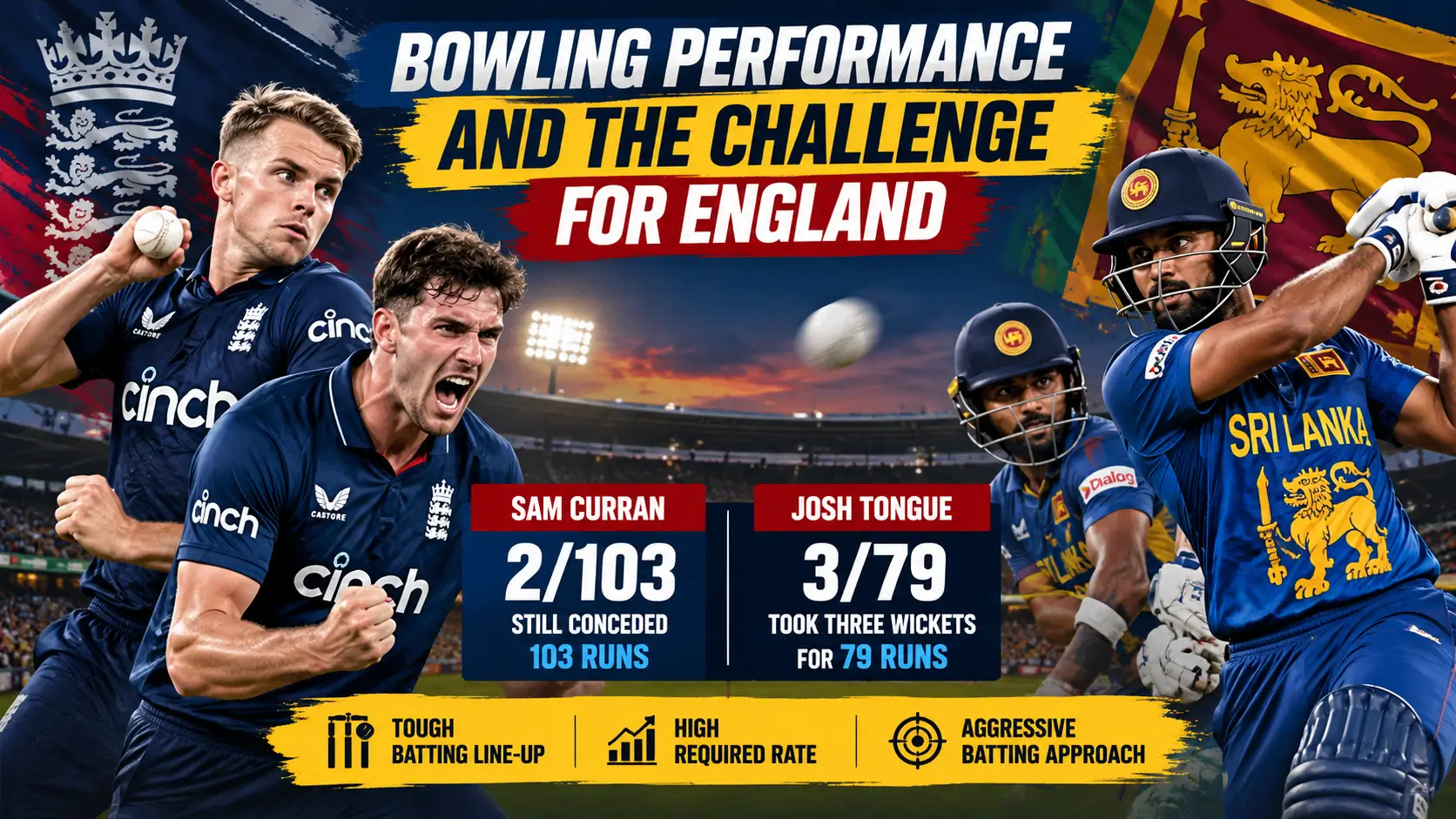
England’s bowlers faced a difficult assignment against a Sri Lankan batting line-up that continued to attack after losing early wickets. Sam Curran finished with two wickets but conceded 103 runs, while Josh Tongue took three wickets for 79. Those figures reflect the pressure created by a high required rate and batters who were willing to target scoring opportunities.
In a chase of this size, wickets alone are not always enough. Bowling sides need to combine breakthroughs with quiet overs, particularly when the opposition has several batters capable of scoring quickly. Sri Lanka’s partnerships meant England rarely enjoyed a long period of control, and the late hitting ensured the target remained achievable until the final over.
For England, the lesson is not simply that 429 was too few. The team produced an outstanding batting performance, but defending a huge total still requires disciplined lengths, smart field placements and control at the death. Sri Lanka deserve credit for executing their chase under pressure, especially after their early setbacks.
Key Match Facts at a Glance
- Venue: Rawalpindi Cricket Stadium, Pakistan.
- Date: 22 October 2026.
- England total: 429/4 in 50 overs.
- Sri Lanka total: 430/8 in 49.5 overs.
- Result: Sri Lanka won by two wickets.
- Harry Brook: 202 off 116 balls, with 21 fours and 10 sixes.
- Fastest double-century milestone: 200 reached in 114 balls.
- Sri Lanka’s leading scorer: Pavan Rathnayake with 130.
- Winning moment: Janith Liyanage struck a six in the final over.
- Combined score: 859 runs.
Frequently Asked Questions
Who scored the fastest double century in ODI cricket?
Harry Brook set the record by reaching 200 in 114 balls for England against Sri Lanka on 22 October 2026. He finished the innings with 202 runs from 116 balls.
What was Harry Brook’s scorecard against Sri Lanka?
Brook scored 202 off 116 balls, hitting 21 fours and 10 sixes at a strike rate of 174.14. He reached his double century in 114 balls and was dismissed on the final ball of England’s innings.
What was the final score of England vs Sri Lanka?
England scored 429/4 in 50 overs. Sri Lanka chased the target with 430/8 in 49.5 overs and won by two wickets.
Who was the top scorer for Sri Lanka?
Pavan Rathnayake was Sri Lanka’s top scorer with 130 runs from 106 balls. Avishka Fernando and Dasun Shanaka both scored 97, while Janith Liyanage finished unbeaten on 61.
How many runs were scored in the match?
The two teams scored 859 runs combined: England made 429 and Sri Lanka scored 430. The match became one of the highest aggregate-scoring contests in ODI cricket.
Was Brook’s double century enough to win the match?
No. England lost by two wickets despite Brook’s record-breaking innings. Sri Lanka chased the target with one ball remaining, making Brook’s 202 a historic score in a losing cause.
Conclusion
Harry Brook’s 202 against Sri Lanka was a landmark moment for England cricket and ODI history. Reaching 200 in 114 balls, then finishing on 202 from 116 deliveries, he combined a world-record milestone with England’s first ODI double century. His innings helped England reach 429/4, but the match was not over.
Sri Lanka responded with a remarkable collective effort, led by Pavan Rathnayake’s 130 and supported by major contributions from Avishka Fernando, Dasun Shanaka and Janith Liyanage. Their 430/8 chase secured a two-wicket victory and showed why cricket remains a team contest even when one player produces an unforgettable individual performance.