


India have won the first three T20Is against New Zealand and secured the series with two matches remaining. Their next challenge is Eden Park, Auckland, on Friday, 30 October 2026. Can Shreyas Iyer’s team make it four wins in four, or will Mitchell Santner’s New Zealand finally find a response?
India enter the match with confidence, momentum and a dangerous top order. New Zealand, meanwhile, have scored competitively in the series but struggled to control decisive passages of play. This preview examines the confirmed results, leading players, selection questions and conditions likely to influence the fourth contest.
IND vs NZ T20I Series 2026: Results So Far
India have approached different match situations successfully. They chased a huge score in the first match, recovered from trouble in the second and produced an extraordinary display of power-hitting in the third. The common factor has been the ability to finish ahead, even when New Zealand have posted a demanding total.
| Match | Venue | New Zealand | India | Result |
|---|---|---|---|---|
| 1st T20I, 22 Oct | Christchurch | 225/4 (20) | 230/6 (19.4) | India won by 4 wickets |
| 2nd T20I, 24 Oct | Christchurch | 180/5 (20) | 181/6 (19.5) | India won by 4 wickets |
| 3rd T20I, 27 Oct | Wellington | 198/3 (20) | 199/4 (13.2) | India won by 6 wickets |
| 4th T20I, 30 Oct | Auckland | Not played | Not played | Upcoming |
| 5th T20I, 1 Nov | Hamilton | Not played | Not played | Upcoming |
Graph 1: Team totals in the first three T20Is (runs)
Source: Cricbuzz scorecards, checked 28 October 2026. Bars compare runs scored, not batting efficiency; India used fewer overs in each chase.
Why India Have Dominated the First Three Matches
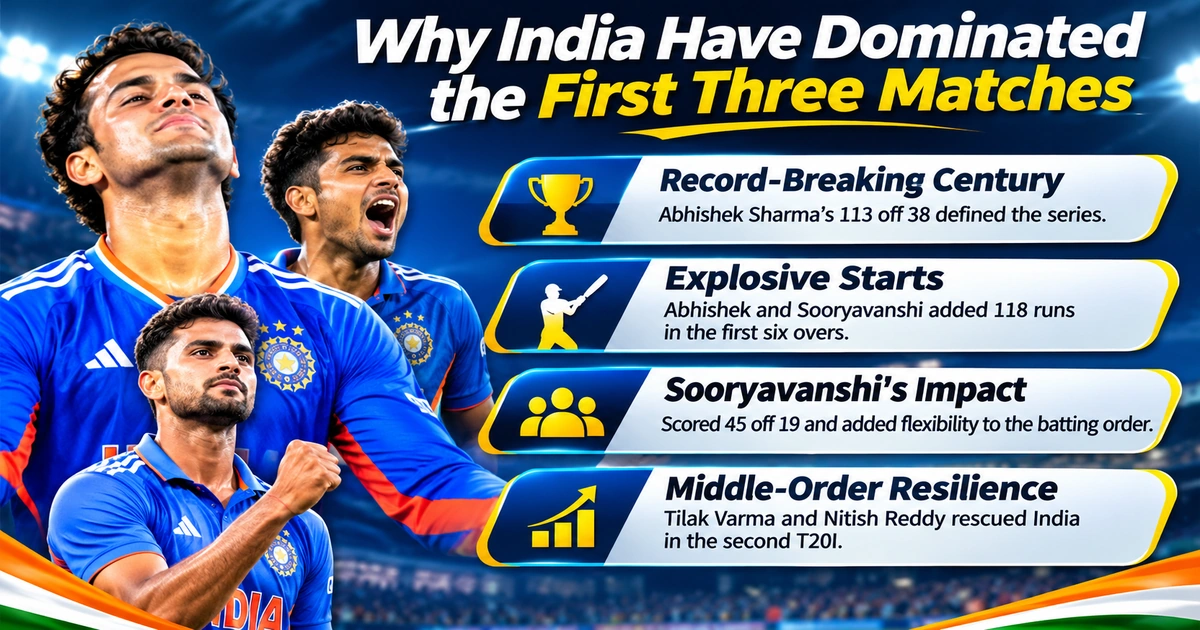
India’s attack-minded batting has been the most visible advantage, but the series is not simply a tale of six-hitting. The visitors have found different match-winners and kept believing during difficult phases. Their success reflects depth across the batting order rather than complete dependence on one experienced player.
Abhishek Sharma’s Record-Breaking Wellington Century
Abhishek Sharma supplied the defining performance of the series in the third T20I. Chasing 199, the left-hander blasted 113 from 38 balls and reached three figures in just 35 deliveries. His innings featured 13 sixes, a record for an Indian batter in a men’s T20I innings according to the ICC.
Abhishek and Vaibhav Sooryavanshi combined for 118 runs in the first six overs, with their opening partnership eventually reaching 133 from 43 deliveries. Such acceleration effectively removed the scoreboard pressure before New Zealand could settle into a defensive plan.
Vaibhav Sooryavanshi Adds Another Dimension
Sooryavanshi’s role is particularly interesting because he has already moved around the batting order during the series. In Wellington, the teenager opened and scored 45 from 19 deliveries. He complemented Abhishek by attacking early rather than playing the conventional supporting role.
Middle-Order Resilience Gives India an Escape Route
The second T20I offered a different test. India’s chase of 181 became complicated when wickets fell, but Tilak Varma and Nitish Kumar Reddy helped rescue the innings and complete a four-wicket victory with one ball remaining. That response was important because the opening pair will not dominate every match.
For further cricket coverage and related match analysis, readers can explore KhelKhabri. The immediate lesson from this series is clear: India’s strength extends beyond rapid starts to composure in tense finishes.
New Zealand’s Biggest Problems Before the Fourth T20I
New Zealand have not been short of individual quality. Glenn Phillips, Daryl Mitchell, Finn Allen and Bevon Jacobs have all contributed important runs. Yet strong batting totals have repeatedly been undermined by India’s chase management and boundary-hitting power.
Strong Scores Have Not Been Enough
Across the first three games New Zealand scored 225, 180 and 198. In most T20 series, those numbers would create opportunities to win. Against this Indian line-up, however, the hosts have been unable to string together enough quiet overs to build sustained pressure.
Mitchell played an outstanding unbeaten 89 from 52 balls in Wellington. Finn Allen added 40 and Jacobs finished on 39 not out. The total of 198/3 looked competitive until India launched their opening assault. New Zealand must now ask whether their bowling execution, rather than their overall batting approach, needs the sharper correction.
Mitchell Santner’s Tactical Challenge
Santner has been the most successful wicket-taker in the series so far, with seven wickets in three games. However, even an effective spinner cannot solve every problem when aggressive batters are consistently attacking inside the powerplay. His leadership will be tested in how he positions fielders, matches bowlers to batters and changes pace in short spells.
Graph 2: Leading series run-scorers after three T20Is
Source: Cricbuzz 2026 series statistics, through 27 October. India bar in green; New Zealand bars in blue.
Eden Park, Auckland: Pitch Report and Match Conditions
Eden Park hosts the fourth T20I on Friday, 30 October. The ground has distinctive dimensions and can reward batters who make clean contact down the ground. Nevertheless, pitch behaviour is not fixed: movement with the new ball, weather and the amount of grass left on the surface can influence the balance.
For India’s batters, the key will be selecting straight scoring opportunities without becoming predictable. For New Zealand’s seamers, full balls that miss the yorker length could disappear quickly. Using changes of pace effectively may therefore be just as important as raw speed.
Key Player Battles That Could Decide the Game
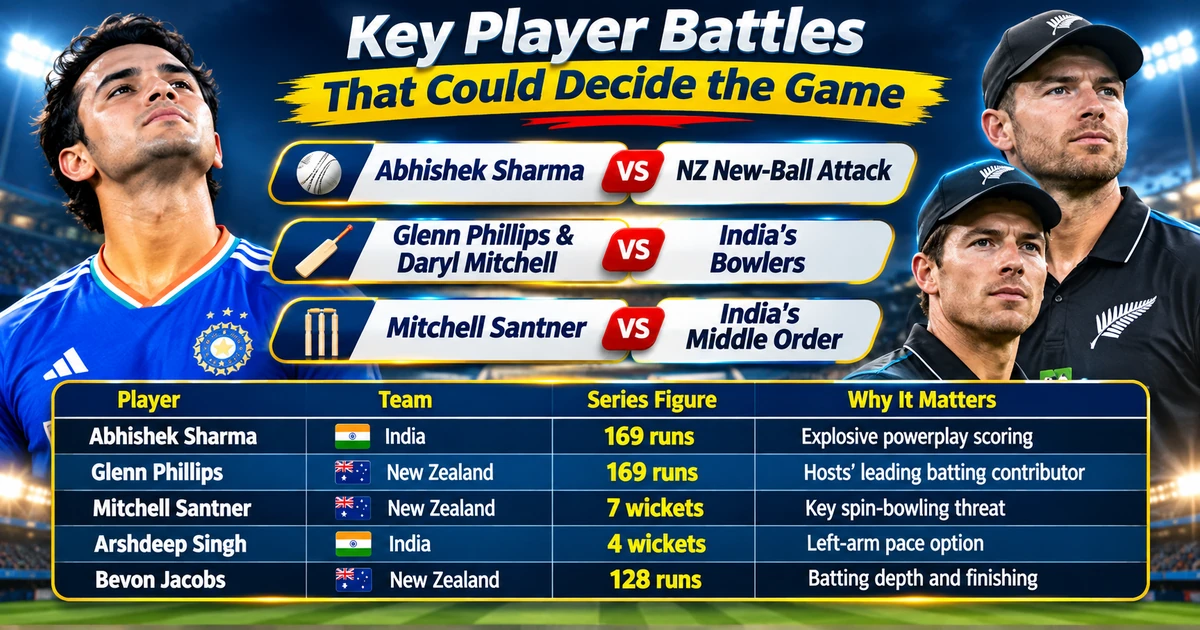
Abhishek Sharma versus New Zealand’s New-Ball Attack
Abhishek Sharma’s aggressive approach in the powerplay will be one of New Zealand’s biggest challenges in the fourth T20I. After his remarkable 113 off 38 balls in Wellington, the Indian opener enters the Auckland contest with strong momentum. New Zealand’s new-ball bowlers must find early movement, maintain disciplined lengths and avoid offering width to the left-hander. If Abhishek survives the opening overs, his ability to score quickly could once again put the hosts under pressure. However, an early wicket would give New Zealand a valuable opportunity to control India’s scoring rate.
Glenn Phillips and Daryl Mitchell versus India’s Bowlers
Phillips has accumulated 169 series runs, matching Abhishek’s total after three matches. Mitchell’s unbeaten 89 in Wellington showed that he can build an innings while still scoring rapidly. Their ability to negotiate India’s seamers and attack favourable match-ups will help determine whether New Zealand can set or chase a commanding total.
Santner versus India’s Middle Order
Santner’s seven wickets make him a serious threat, particularly if India lose early batters and need to rebuild. His pace variations and accuracy may restrict India during the middle overs. However, the Indian middle order has already demonstrated it can absorb pressure and find late boundaries.
| Player | Team | Series figure | Why it matters |
|---|---|---|---|
| Abhishek Sharma | India | 169 runs | Explosive powerplay scoring |
| Glenn Phillips | New Zealand | 169 runs | Hosts’ leading batting contributor |
| Mitchell Santner | New Zealand | 7 wickets | Key spin-bowling threat |
| Arshdeep Singh | India | 4 wickets | Left-arm pace option |
| Bevon Jacobs | New Zealand | 128 runs | Batting depth and finishing |
India Team News: Will Ishan Kishan Return?
Ishan Kishan remains an important selection question. He sustained a low-grade right adductor strain in the series opener and missed both the second and third T20Is. The BCCI stated before the Wellington game that he was recovering but had not regained full match fitness. Kumar Kushagra was added as wicketkeeping cover.
As of this article’s 28 October update, there is no verified confirmation that Kishan will be available for Auckland. India should not rush him back simply because a series victory is already secured. If he is still unavailable, the team can retain a batting combination that has delivered three consecutive wins.
India Probable Playing XI
Projected, not confirmed: Abhishek Sharma, Vaibhav Sooryavanshi, Sanju Samson (wk), Shreyas Iyer (c), Tilak Varma, Nitish Kumar Reddy, Naman Dhir, Axar Patel, Arshdeep Singh, Bhuvneshwar Kumar, Varun Chakaravarthy.
New Zealand Possible Team Composition
New Zealand are likely to keep Mitchell Santner central to their plans and build their batting around Finn Allen, Glenn Phillips, Daryl Mitchell and Bevon Jacobs. Michael Bracewell offers another all-round option. The exact XI, bowling combination and any player changes remain unconfirmed until the toss.
What Must New Zealand Do to Avoid a 4–0 Deficit?
- Take powerplay wickets: Dismissing one or both Indian openers early could prevent another damaging start.
- Protect the straight boundary: Bowlers must avoid predictable full lengths, particularly when aggressive batters are set.
- Convert starts into a decisive finish: New Zealand need to maximise the final overs rather than assume a competitive score will be sufficient.
- Use Santner tactically: His overs should target important match-ups instead of being reserved mechanically for a particular phase.
- Improve fielding: Missed chances against in-form batters carry enormous consequences, especially in short-format chases.
Statistical Comparison: What the Numbers Actually Show
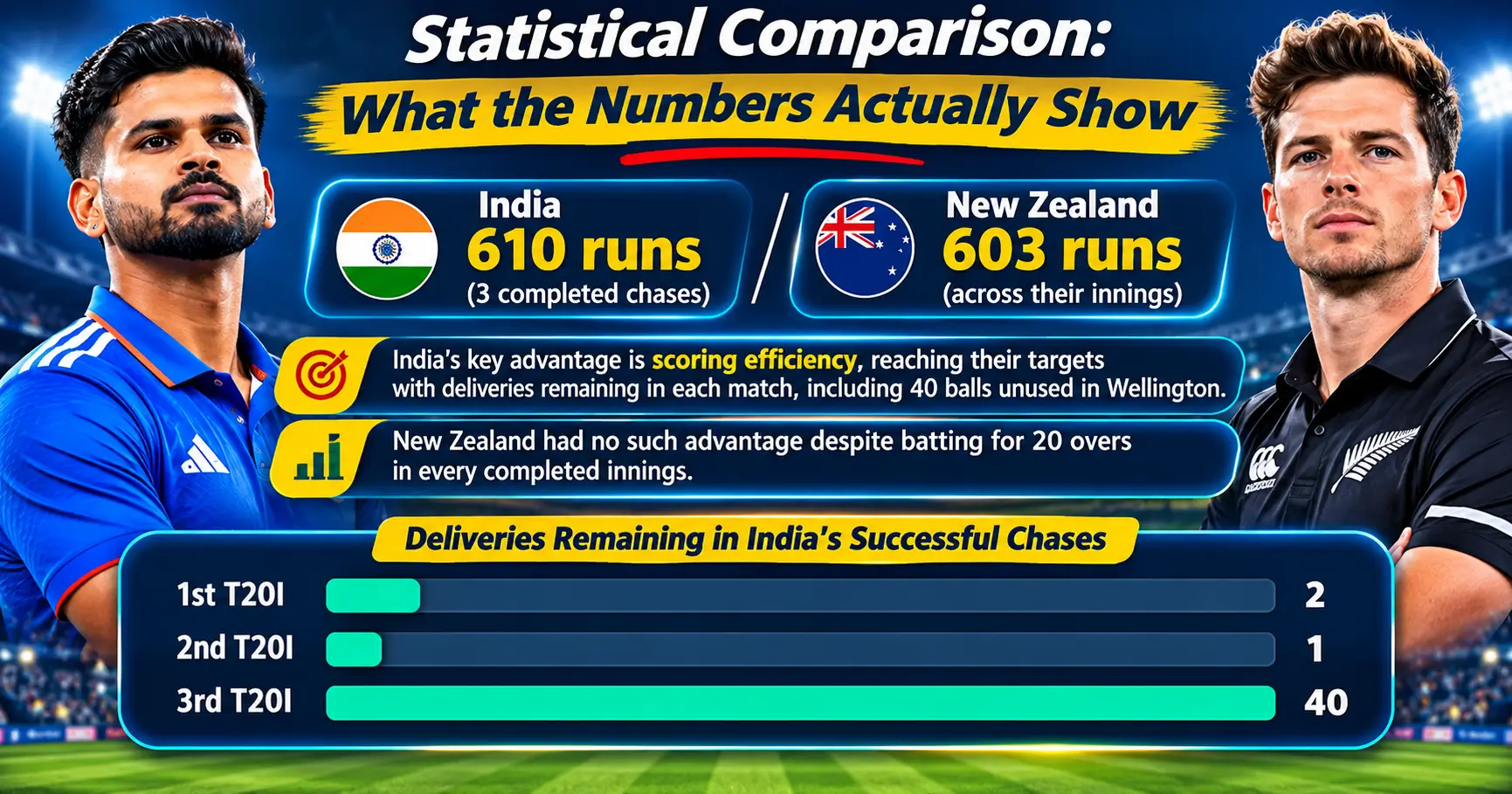
India have scored 610 runs in their three completed chases, while New Zealand have scored 603 runs across their innings. That seven-run difference is striking because India won all three matches, but it should not be mistaken for a measure of team superiority on its own.
India’s more meaningful advantage is scoring efficiency. They reached their targets with deliveries remaining in each match, including 40 balls unused in Wellington. New Zealand had no such advantage despite batting for 20 overs in every completed innings.
Graph 3: Deliveries remaining in India’s successful chases
Comparison scaled to 40 balls; not a probability or forecast. Based on completed scorecards.
Readers seeking a verified match record can consult the ICC report on India’s record chase in Wellington. The official account confirms the 3–0 series lead, Abhishek’s 113 and the speed of India’s successful pursuit.
IND vs NZ 4th T20I Prediction: Who Will Win?
India’s strongest route to victory is another productive powerplay followed by composed batting through the middle overs. If they bowl first, restricting New Zealand’s late acceleration would make the chase easier. New Zealand’s best route is to take wickets early and avoid letting one Indian batter control the match for a long period.
Frequently Asked Questions
When is the India vs New Zealand fourth T20I in 2026?
The fourth T20I is scheduled for Friday, 30 October 2026, beginning at 12:30 PM IST (8:00 PM New Zealand daylight time).
Where will IND vs NZ 4th T20I be played?
Eden Park in Auckland, New Zealand, will host the match.
What is the series score before the fourth T20I?
India lead the five-match series 3–0 after winning the first two games by four wickets and the third by six wickets.
Who scored a century in the third T20I?
Abhishek Sharma made 113 off 38 balls in Wellington and reached his century in 35 deliveries.
Will Ishan Kishan play the fourth T20I?
His participation remains unconfirmed as of 28 October. He missed the second and third matches while recovering from a right adductor strain.
Can India win the series 5–0?
Yes. Having already won the series 3–0, India can complete a 5–0 sweep by winning in Auckland and then Hamilton on 1 November.
Final Word: Auckland Is a Test of India’s Consistency
For New Zealand, Auckland represents a chance to regain confidence before the final T20I. Mitchell’s form, Phillips’ consistency and Santner’s wicket-taking offer reasons for optimism. India possess more momentum, but the hosts have enough quality to make this contest competitive.
Our pre-match verdict: India are favourites to extend their lead to 4–0; New Zealand’s opportunity rests on early wickets, tighter execution and a better defence of the powerplay. The result will be determined on the field on 30 October, not by the series score alone.