


New Zealand vs India 3rd T20I prediction: India are narrow favourites to win in Wellington on Tuesday, 27 October. They lead the five-match series 2–0 after two four-wicket victories in Christchurch, but both matches exposed vulnerabilities. The visitors have relied on remarkable recoveries, while New Zealand have failed to finish games after putting themselves in favourable positions.
This third encounter is more than a possible series-clincher. India must consider whether world No. 1 T20I batter Ishan Kishan is fit, whether Vaibhav Sooryavanshi can handle another opportunity, how much bowling value Naman Dhir provides, and what Bhuvneshwar Kumar’s expensive comeback means for future selection. New Zealand, meanwhile, need to solve their own finishing and bowling-combination problems.
NZ vs IND 3rd T20I: Match Centre
| Detail | Information |
|---|---|
| Fixture | New Zealand vs India, 3rd T20I |
| Date | Tuesday, 27 October 2026 |
| Start | 8:00 PM NZDT / 12:30 PM IST |
| Venue | Hnry Stadium, Wellington (Sky Stadium) |
| Format | Third match of five-match T20I series |
| Series position | India lead 2–0 |
| Captains | Mitchell Santner / Shreyas Iyer |
| Toss | Not yet held (as of 25 October) |
A victory would give India an unassailable 3–0 advantage, with subsequent T20Is scheduled for Auckland and Hamilton. New Zealand’s challenge is immediate: three straight wins are needed to overturn the series deficit.
Results and Momentum: How India Took a 2–0 Lead
The opening match produced a huge chase. After New Zealand posted 225/4, India reached 230/6 with two balls to spare. Sanju Samson made 67 from 33 deliveries and Naman Dhir struck a decisive 42 not out from 15. The chase showed that India have the power and depth to absorb an imposing asking rate.
The second T20I was much tighter. New Zealand made 180/5, with Glenn Phillips scoring 70 from 43 and Bevon Jacobs adding 58 from 46. India’s chase was in serious trouble at 70/5, but Tilak Varma’s unbeaten 51, Naman Dhir’s 31 and Nitish Kumar Reddy’s unbeaten 26 took the visitors home on the penultimate delivery.
Bars compare innings totals on the same 230-run scale. They are not win probabilities.
For the previous-match build-up and tactical questions, see our India vs New Zealand 2nd T20I prediction and analysis.
India’s White ball Domination: The Figures That Matter

The second-match numbers explain both sides’ selection debates. India lost five wickets for 70 before their lower middle order repaired the innings. New Zealand had one outstanding bowling spell from their captain but conceded too much in the closing overs.
| New Zealand batter | Runs | Balls | 4s | 6s | Strike rate |
|---|---|---|---|---|---|
| Glenn Phillips | 70 | 43 | 4 | 4 | 162.79 |
| Bevon Jacobs | 58 | 46 | 5 | 1 | 126.09 |
| Finn Allen | 16 | 14 | 0 | 1 | 114.29 |
| Michael Bracewell | 10* | 2 | 1 | 1 | 500.00 |
| India batter | Runs | Balls | 4s | 6s | Strike rate |
|---|---|---|---|---|---|
| Tilak Varma | 51* | 26 | 6 | 1 | 196.15 |
| Naman Dhir | 31 | 17 | 1 | 3 | 182.35 |
| Abhishek Sharma | 27 | 21 | 3 | 1 | 128.57 |
| Nitish Kumar Reddy | 26* | 13 | 1 | 1 | 200.00 |
| Vaibhav Sooryavanshi | 4 | 8 | 0 | 0 | 50.00 |
| Bowler | O | M | R | W | Econ |
|---|---|---|---|---|---|
| Mitchell Santner (NZ) | 4 | 0 | 21 | 4 | 5.25 |
| Arshdeep Singh (IND) | 4 | 0 | 33 | 2 | 8.25 |
| Prince Yadav (IND) | 4 | 0 | 30 | 1 | 7.50 |
| Bhuvneshwar Kumar (IND) | 4 | 0 | 50 | 1 | 12.50 |
| Naman Dhir (IND) | 1 | 0 | 7 | 0 | 7.00 |
The decisive contrast is striking: Santner returned 4/21, yet India still completed the chase. Arshdeep picked up two wickets while Prince Yadav used his spell effectively. The unusual selection question concerns Bhuvneshwar, whose single wicket came at the cost of 50 runs, and Naman Dhir, whose solitary over cost only seven.
Ishan Kishan: Will the No. 1 T20I Batter Miss the Rest of the Series?
Ishan Kishan is the leading batter in the ICC men’s T20I rankings as of the latest ranking update before this match. However, his fitness is more important than that ranking ahead of Wellington. He sustained a low-grade right adductor strain in the opening T20I and was ruled out of the second game. Kumar Kushagra joined the squad as wicketkeeping cover.
The confirmed absence was for the second T20I, not an official withdrawal from all five matches. Whether Kishan can return in Wellington or later in the series depends on medical clearance and the selectors’ approach. A third-match absence is possible, but it should not be reported as final before an official update or the team sheet.
Why his availability changes India’s batting balance
Kishan adds a left-handed attacking option who can challenge pace and spin early. Without him, Vaibhav Sooryavanshi has a clearer path into the batting order, while Sanju Samson remains an established wicketkeeping choice. India also have to consider the distribution of left- and right-handed batters around Shreyas Iyer and Tilak Varma.
For now, the sensible prediction is conditional: if Kishan is cleared, he returns to the selection discussion; if he remains unavailable, Sooryavanshi is a strong candidate to retain his place. The medical update should take priority over any pre-match projected XI.
Pressure on Vaibhav Sooryavanshi After a Quiet Second T20I
The second match was a difficult opportunity for Vaibhav Sooryavanshi. He managed 4 runs from 8 balls, was dismissed by Nathan Smith and recorded a strike rate of 50.00. India eventually won, but the brief innings left little room for him to demonstrate his attacking ability.
One failed innings should not define an emerging batter. Nevertheless, the immediate challenge is clear. New Zealand’s seamers will try to exploit early movement and deny him the chance to settle. Sooryavanshi must judge which balls can be attacked and avoid turning selection pressure into unnecessary risks.
What a better third-match innings would look like
Rather than chasing a specific individual total, he needs a clear role: assess the first few deliveries, rotate against good lengths and punish width when offered. A composed powerplay contribution would take pressure off Samson, Abhishek Sharma and Shreyas Iyer. If Kishan returns, Sooryavanshi could still be the player squeezed out; if Kishan sits again, this becomes an important chance to make his case.
Naman Dhir’s Role as an All-Rounder: Finisher and Bowling Option
Naman Dhir has been one of India’s most valuable players across the opening two matches. He finished the first chase with 42 not out off 15 balls and scored 31 off 17 during the second-match recovery. Together, those innings give him 73 runs off 32 balls — a combined strike rate of 228.13.
| Match | Batting | Balls | Batting SR | Bowling |
|---|---|---|---|---|
| 1st T20I | 42* | 15 | 280.00 | Not tabulated here |
| 2nd T20I | 31 | 17 | 182.35 | 1–0–7–0 |
Why the bowling matters for India’s XI
Dhir bowled one over for seven runs in the second T20I. It is a small sample, but it gives the captain a useful sixth-bowler option when a frontline bowler is having a difficult day. His all-round value is not that he must deliver four overs; it is that he can potentially cover a matchup, break the rhythm of an innings and still provide high-impact lower-order batting.
The next test is repeatability. Dhir should not be described as a proven international bowling all-rounder on the evidence of a single economical over. If India trust him with further overs at Wellington, selectors will gain a clearer picture of how much balance he offers in a side that already has Axar Patel and Nitish Kumar Reddy.
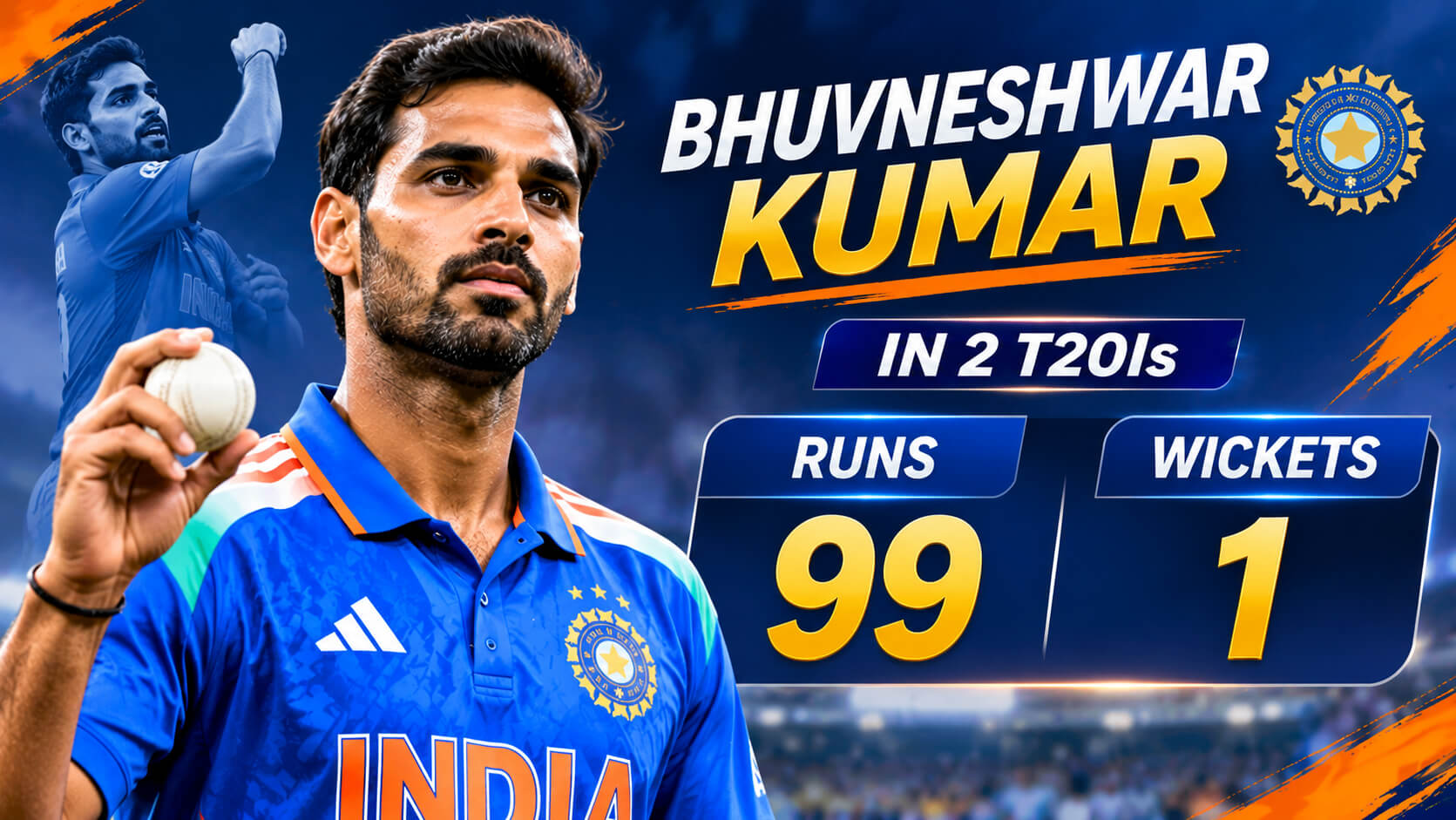
Bhuvneshwar Kumar Comeback: One Wicket, 99 Runs in Eight Overs
Bhuvneshwar Kumar’s return to the India T20I side has been tough. Across the first two matches against New Zealand, the experienced seamer has bowled eight overs, conceded 99 runs and taken one wicket. That works out to 12.38 runs per over, significantly above the economy rate a team generally wants from a new-ball specialist.
| Match | Overs | Runs | Wickets | Economy |
|---|---|---|---|---|
| 1st T20I | 4.0 | 49 | 0 | 12.25 |
| 2nd T20I | 4.0 | 50 | 1 | 12.50 |
| Series total | 8.0 | 99 | 1 | 12.38 |
Is a pace of around 130 km/h enough?
There is also a debate about his pace, often framed around deliveries near 130 km/h. The supplied scorecards record runs, wickets and overs — not ball-by-ball speed — so 130 km/h should not be presented here as a verified series average. The tactical concern is real regardless of the exact speed: without consistent swing, movement or deceptive variation, a medium-fast bowler can be vulnerable on flat New Zealand surfaces.
At his best, Bhuvneshwar does not rely on raw speed. His value lies in shaping the new ball, hitting disciplined lengths and using slower deliveries at the death. Against New Zealand, the immediate task is to restore control, reduce boundary balls and force batters to take risks. More than a single wicket, India need a reliable phase of bowling.
Should he play the third T20I?
The selection decision is finely balanced. Experience and new-ball skill favour keeping him in the discussion, but 99 runs conceded in eight overs is a substantial warning. If the Wellington pitch has movement, India may still see tactical value in his first spell. If conditions are flat, selectors could prefer another pace option and keep Bhuvneshwar out of the high-scoring phases.
Will Bhuvneshwar Kumar Return to India’s ODI Setup?
His ODI prospects should be treated separately from these T20 figures. In the 50-over format, seam control with a new ball, sustained accuracy and the ability to return for later spells matter differently. A bowler can struggle in short spells under heavy T20 attacking pressure without automatically being unsuitable for one-day cricket.
Even so, this comeback has not yet strengthened his selection case. One wicket in eight overs, at 12.38 an over, offers little recent evidence of the control India would want. An ODI recall would be more plausible after a sequence of economical spells, visible movement and evidence that he can maintain intensity through longer bowling workloads.
Wellington Pitch Report and Tactical Conditions
Wellington is a different challenge from Christchurch. The open stadium can expose both sides to wind, and the direction of the breeze may influence aerial strokes and defensive field settings. Early seam movement is possible, but any specific pitch reading should wait until the match-day inspection.
A working first-innings range of 165–185 is a sensible editorial scenario on a balanced surface, not a recorded average or guaranteed par score. If the wicket is flat, both sides have the hitting power to exceed it; if the ball grips or moves, even a lower target could become uncomfortable.
Three tactical pressure points
| Contest | Key question |
|---|---|
| Santner vs India’s middle order | Can India limit his impact after 4/21 in Christchurch? |
| Arshdeep vs Allen and Seifert | Can India take early wickets before Phillips settles? |
| NZ seamers vs Dhir and Tilak | Can the hosts defend a target in the final five overs? |
Predicted Playing XIs: Wellington
Both teams could change their combinations. India’s XI below assumes Ishan Kishan is not yet cleared to return; his availability may alter the batting order. New Zealand are reshaping their pace options, with Matt Henry unavailable for the remaining T20Is and Lockie Ferguson set to miss Wellington. The lists are editorial projections, not announced teams.
India could bring in Varun Chakaravarthy if spin is expected to matter or another quick if workload management becomes important. Bhuvneshwar’s place is especially debatable after his opening two spells. For New Zealand, Kyle Jamieson’s bounce and the final balance between seam and batting depth are worth watching.
NZ vs IND 3rd T20I Prediction: Who Wins?
The 2–0 lead, resilience under pressure and lower-middle-order hitting give India a slight edge. New Zealand can reverse the trend if Phillips maintains his form, Santner gets support and the fielders take their chances. This verdict is an opinion, not a mathematical probability.
India’s path to victory is clearer if the top order provides a platform and the seamers take wickets before Phillips enters his strongest phase. New Zealand need to turn isolated excellent overs into a complete bowling performance. They have been competitive; they have not yet delivered the finishing touches.
The most consequential selection questions are about balance: how much pressure should be placed on Sooryavanshi if Kishan is missing, whether Dhir can contribute with the ball again, and whether India trust Bhuvneshwar for another four overs. These choices may matter as much as any pre-match pitch prediction.
Frequently Asked Questions
Who is predicted to win the New Zealand vs India 3rd T20I?
India are slight editorial favourites after winning the first two games, though New Zealand have enough batting and spin threat to win in Wellington.
Is Ishan Kishan ruled out of the entire New Zealand series?
No full-series withdrawal has been established in the information available before the third match. He missed the second T20I after a right adductor strain; the team will decide on his return based on fitness.
Is Ishan Kishan the No. 1-ranked men’s T20I batter?
Yes. He occupied the top position in the latest ICC men’s T20I batting rankings available before this match.
How many runs did Vaibhav Sooryavanshi score in the second T20I?
He scored 4 from 8 balls, at a strike rate of 50.00, before being dismissed by Nathan Smith.
How many runs has Naman Dhir scored in the first two T20Is?
He has 73 runs from 32 balls: 42 not out from 15 in the opener and 31 from 17 in the second game. He also bowled one over for seven in the second match.
What are Bhuvneshwar Kumar’s comeback figures against New Zealand?
Across the opening two T20Is, he has bowled eight overs, conceded 99 runs and taken one wicket, with an economy rate of 12.38.
Is Bhuvneshwar Kumar in India’s ODI squad?
His ODI selection is not confirmed by this preview. The final call depends on official squad announcements and the selectors’ assessment of form and fitness.
When and where is the 3rd T20I?
The match is scheduled for Tuesday, 27 October 2026 at Hnry Stadium in Wellington, starting at 8:00 pm local time (12:30 pm IST).
Final Verdict
India are closer to the series trophy, but their wins have not been flawless. The top order needs greater stability, Bhuvneshwar needs better control if selected again, and the medical decision on Ishan Kishan could reshape the batting order. On the positive side, Naman Dhir’s finishing and Tilak Varma’s composure have provided outstanding insurance.
New Zealand have the means to fight back. Phillips is in strong form, Santner is capable of dismantling a batting order, and Wellington presents a fresh tactical setting. Our prediction remains India to win narrowly — provided they avoid another major collapse and execute the closing overs more reliably.
See the full New Zealand vs India 2nd T20I scorecard on ESPNcricinfo for the complete batting and bowling details.
Updated 25 October 2026. The figures cover the first two completed matches. Predicted playing XIs, pitch expectations, pace discussion, ODI selection analysis and the match verdict are editorial assessments. Team selection and player fitness can change before the toss.