

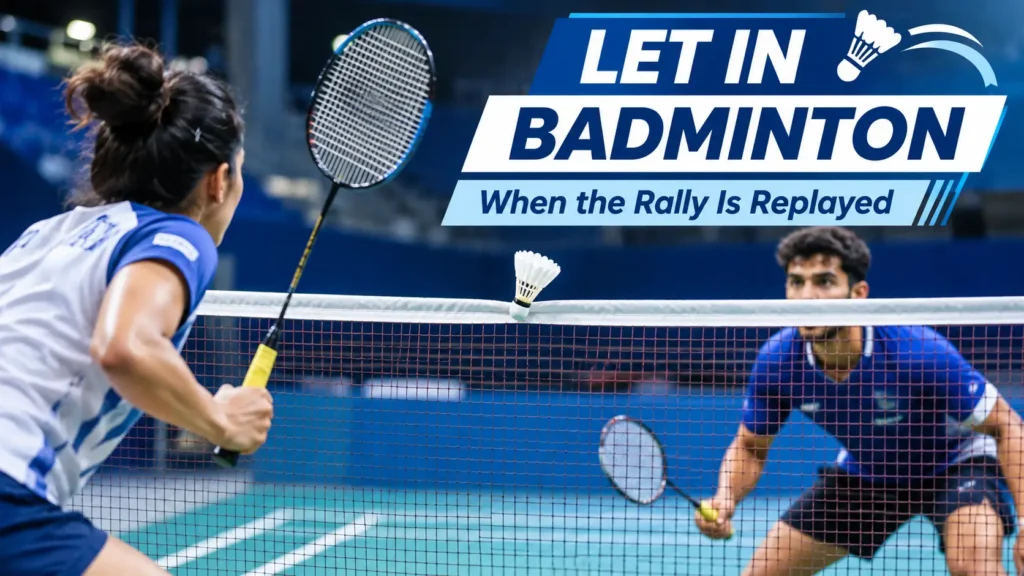
What Is a Let in Badminton? Rules, Replay Situations and Real-Match Examples
A shuttle stops on the net tape. The receiver raises a hand before the serve. A line judge cannot see where the shuttle landed. Is that a let, a fault, or an ordinary rally? This practical guide explains the difference using the official Laws of Badminton, clear examples and easy-to-follow visuals.
A let is a decision to halt play and replay the rally without awarding a point for it. The previous service does not count, the score stays as it was, and the same server serves again. It is called when a circumstance specified in BWF Law 14 interrupts a fair or determinable rally. A shuttle touching the net does not automatically mean a let.
- Let: replay the rally; no point scored.
- Fault: the side committing the fault loses that rally; the opponent scores the point.
- Legal shot: play continues if the shuttle legally passes over the net and stays in play.
What Does a Let Mean in Badminton?
In badminton, a let is a rally that must be replayed because a recognised interruption or unusual incident has prevented the rally from proceeding normally. It is different from a player making an ordinary mistake. When a let is called, the rally that began with the most recent service is discarded rather than scored.
Imagine the score is 11–9. The server begins a rally, but the receiver had not been ready and had not tried to return the shuttle. If the official calls a let, the score remains 11–9. The original server gets another serve from the same service court. Nobody has won the interrupted rally.
A let is not a free second chance for a poor shot. A player cannot demand a replay simply because a rally ended unfavourably. The incident must satisfy the applicable law, and in officiated matches the umpire decides whether the rule applies.
All 7 BWF Let Rules: When Does the Rally Get Replayed?
The Badminton World Federation (BWF) lists seven main categories of lets under Law 14.2. One category—the shuttle caught in the net after service has been returned—contains two closely related situations. The following table separates the official condition from a plain-English example.
| Law | When a let applies | Easy example |
|---|---|---|
| 14.2.1 | Serve delivered before receiver ready | The receiver is not set and does not attempt the return. |
| 14.2.2 | Server and receiver both fault during service | Officials determine both sides committed service faults in the same service. |
| 14.2.3 | After service is returned, shuttle remains suspended on top of the net or passes over then gets caught in it | A later net shot becomes lodged in the tape or mesh; wheelchair badminton exception applies. |
| 14.2.4 | Shuttle completely breaks apart during play | The cork base separates from the feather or synthetic skirt. |
| 14.2.5 | Umpire decides play was disrupted or opponent distracted by a coach | A coach’s intervention affects the rally in the umpire’s judgment. |
| 14.2.6 | Line judge unsighted and neither umpire nor review system can decide | No official or available review can resolve an in/out landing. |
| 14.2.7 | Unforeseen or accidental situation | An unexpected external incident disrupts play and the umpire deems a let appropriate. |
Counts are the number of legal categories in Law 14.2, not how frequently lets occur in professional matches.
1. The receiver was not ready
The server must wait until the receiver is ready. If the server serves too early, the umpire can call a let—but there is a vital exception: if the receiver attempts to return the serve, the receiver is considered ready under Law 9.4.
2. Both sides are faulted during service
Rarely, the server and receiver are both found to have committed service faults. Rather than awarding the rally to one side, the law provides for a let.
3. The shuttle gets trapped in the net after a return
After the service has been returned, a shuttle that remains suspended on top of the net or passes over and becomes caught in the net produces a let in ordinary badminton. It is not the same as simply brushing the net tape. Special fault provisions apply in wheelchair badminton.
4. The shuttle disintegrates in play
Badminton shuttles can become damaged over time, but routine feather damage is not automatically a let. The rule refers to the shuttle disintegrating with the base completely separating from the rest during play.
5. Coaching disrupts the rally
The umpire can call a let if play is disrupted or a player on the opposing side is distracted by a coach. The deciding factor is the umpire’s assessment, not simply whether someone on the sidelines spoke.
6. Nobody can resolve an in/out call
If a line judge could not see the shuttle land, the umpire must determine whether there is another way to make a valid decision. Law 14.2.6 permits a let when the umpire or available Instant Review System also cannot decide.
7. An unforeseen or accidental incident happens
This final category covers exceptional events that interfere with play. It prevents an unfair result when something genuinely unexpected disrupts the rally, but it does not give players permission to stop on every small distraction.
Is It a Let When the Shuttle Hits the Net?
Not necessarily. The most common misconception in badminton is that a shuttle touching the net automatically causes a replay. In fact, the outcome depends on when it happened, whether the shuttle legally passed over, and whether it became trapped.
When the shuttle touches the net and play continues
If a serve clips the tape, continues over, and lands in the correct diagonal service court, it can be a legal serve. Likewise, during a rally, a net shot can touch the tape, cross, and fall inside the opponent’s court. Neither is automatically a let. A legal net cord may be fortunate, but it still counts.
When a net incident is a fault
During service, if the shuttle becomes suspended on the top of the net or crosses and gets caught in the mesh, Law 13.2 treats it as a fault. A shuttle that fails to pass over the net is also a fault. These are not second-serve opportunities.
When a trapped shuttle becomes a let
After the service has been returned, Law 14.2.3 deals with a shuttle stranded on the net or trapped in the net on the other side after crossing. In standard badminton, this is a let. In wheelchair badminton, the relevant net-trapping situations are faults rather than lets under the specific Para badminton provisions.
| Net situation | Decision | Why? |
|---|---|---|
| Serve clips net and lands in valid service box | Legal serve | Net contact alone is not a fault or let. |
| Serve catches on top of net and stays there | Fault | Law 13.2.1: service-specific rule. |
| Serve passes over then gets caught in net | Fault | Law 13.2.2: service-specific rule. |
| Later rally shot touches net, crosses and lands in | Legal rally shot | Play continues normally. |
| After return of service, shuttle stays suspended atop net | Let* | Law 14.2.3.1. |
| After return of service, shuttle crosses and becomes caught in mesh | Let* | Law 14.2.3.2. |
| Shot strikes net and falls back on hitter’s side | Fault | Shuttle fails to pass over the net. |
* For the listed trapped-net situations, wheelchair badminton applies a fault instead of a let.
Badminton Let Decision Chart: What Happens Next?
When a strange rally occurs, use this simple decision route. The examples are practical illustrations; in a competitive match, the umpire applies the official law to the facts of the incident.
Opponent wins rally under the scoring laws, unless another simultaneous provision changes the decision.
Did a qualifying let event occur—for example, an unready receiver, trapped shuttle, or unforeseen interruption?
No point; the same server serves again.
Continue until a normal fault, winning shot or other lawful end to the rally.
Simplified learning guide, not a substitute for an umpire’s judgment or the full Laws of Badminton.
Let vs Fault vs Normal Rally: What Is the Difference?
These are scoring consequences, not percentages or estimates of how often each decision happens.
Rally is cancelled.
Score unchanged.
Same server repeats serve.
Rally is lost by offending side.
Opponent scores.
Serve follows normal rules.
No stoppage yet.
Rally continues.
Result decided by subsequent play.
A fault is an infringement, such as hitting the shuttle outside the applicable court, touching the net with the racket or body during play, or making an illegal serve. Under rally-point scoring, the opponent wins the rally and receives a point. A let is different: it effectively resets that one rally without changing the score. A normal rally is neither a let nor a fault until it ends through a lawful winning shot or an infringement.
Another important distinction is between a let and a service-court error. If a player served or received from the wrong service court, the laws call for correcting the error once the shuttle is not in play while retaining the existing score; that is not an automatic replay of all previous rallies.
What Happens to the Score and Server After a Let?
BWF Law 14.3 is straightforward: the rally since the last service does not count, and whoever last served serves again. The serving order, service side and score remain as they were before that interrupted rally.
Illustrative singles example: Player A was serving at 11–9.
For doubles, a let does not itself rotate the partners or transfer service to the opponents. The serving side retains the right to repeat that service. This detail is useful when learning complicated doubles service patterns: even if the rally looked competitive before the let was called, it does not produce a scored outcome.
Do Let Rules Change in Singles, Doubles or Para Badminton?
Singles badminton
The seven main Law 14 categories apply in singles. The typical questions concern whether the receiver was ready, whether a shuttle became lodged on the net after the service was returned, and whether an unpredictable interruption made a fair decision impossible.
Doubles badminton
The same general let framework applies in doubles, but there are two players on each side, making service readiness and receiving position particularly important. Only the designated receiver should return the serve. If the receiver’s partner strikes the serve, that is a service fault under Law 13.2.3—not a free replay merely because two players were near the shuttle.
Wheelchair badminton
There is a precise and often overlooked Para badminton exception: when a shuttle remains suspended on top of the net or gets caught in the net after crossing, the specific wheelchair rules treat those events as faults rather than the lets used in standard badminton. That is why readers should check the rule format before applying a net-trapping example universally.
For more on the court markings that determine whether a service is legal, see our badminton court dimensions, lines and service-court guide. Understanding the diagonal service boxes makes it easier to separate a valid serve, service fault and let situation.
Who Can Call a Let in Badminton?
Under Law 14.1, the umpire calls a let in an officiated match. When there is no umpire, a player may call a let to stop play. However, player calls should follow the rules rather than being used to obtain another chance after missing a shot.
What is the umpire’s role?
The umpire determines whether the facts satisfy the rules. For example, the umpire must judge whether a receiver was genuinely unready, whether coaching distracted an opponent, and whether an accidental incident made continuation unfair. A close line call is not automatically a let: the umpire or available Instant Review System may still be able to resolve the decision.
What should beginners do in an unofficiated game?
If an unfamiliar incident happens, stop immediately rather than playing several more shots and arguing later. Explain the specific event, check the appropriate rule, and agree on how to resume. In informal recreational games, players sometimes agree to replay disputed points as a courtesy. That sportsmanship arrangement should not be confused with every situation that formally qualifies as a let under BWF Law 14.
Can players ask for a let?
Players can draw an issue to the umpire’s attention, but they do not gain an automatic right to a let simply by requesting it. In a tournament, the umpire makes the decision. Attempting to misuse interruptions to escape a difficult rally may also create conduct problems.
10 Common Badminton Scenarios: Let, Fault or Play On?
Use these worked examples to test the rule. The answer applies to the facts stated, and in cases involving disruption assumes the umpire has made the indicated judgment.
Frequently Asked Questions About a Let in Badminton
1. What is a let in badminton in simple words?
A let is a stopped and cancelled rally. No point is awarded for that rally, and the player who served last serves again. The situation must qualify under the badminton let laws.
2. Does a let count as a point in badminton?
No. A let leaves the score unchanged. The previous serve is disregarded and the same server restarts the rally.
3. Can you have a let on a serve?
Yes, for example if the server serves before the receiver is ready and the receiver does not attempt a return. If the served shuttle gets stuck on the net, however, that is generally a service fault—not a let.
4. Is touching the net with the shuttle always a let?
No. A serve or rally shot that brushes the net and crosses legally can remain in play. A shuttle caught in the net may be a fault or let depending on the point in the rally and the format.
5. What happens if a shuttle gets stuck in the net?
During service, it is a fault. After the service has been returned, certain trapped-net situations are lets in ordinary badminton; wheelchair badminton has a special fault exception.
6. Does the same player serve again after a let?
Yes. BWF Law 14.3 says the player who served last serves again, with no point awarded for the interrupted rally.
7. Can both players be faulted at the same time?
Yes. If the server and receiver are both faulted during service, the law expressly provides for a let.
8. Is there a let if the receiver was not ready but hit the shuttle?
No let is due merely to the receiver being unready if the receiver attempted a return: under BWF Law 9.4, that attempt means the receiver is considered ready.
9. Can a line call result in a let?
Yes, but only where a line judge could not see the landing and the umpire or available Instant Review System cannot decide. A routine close call is not enough.
10. Does a damaged shuttle always cause a let?
No. The explicit Law 14 condition is complete separation of the shuttle’s base from the rest during play. Ordinary wear does not automatically satisfy that rule.
11. Can spectators or outside interference cause a let?
An unexpected external event that disrupts play can potentially fall under the unforeseen or accidental situation rule. Whether it qualifies in an officiated match depends on the umpire’s decision.
12. Is a let the same as a fault in badminton?
No. A let cancels the current rally without a point; a fault causes the offending side to lose the rally, with the opponent receiving a point.
Final Takeaway: Remember the Meaning of a Let
A badminton let is a fairness mechanism, not a reward for a mistake. It is used when an early serve, simultaneous service faults, an unusual net incident, a broken shuttle, coaching disruption, an unresolved line call or another unforeseen occurrence prevents the rally from being decided normally. In every true let, the score is unchanged and the same server serves again.
If you remember only one distinction, make it this: not every shuttle that touches the net produces a let. Pay attention to whether the shuttle was being served, whether it crossed or became trapped, and whether a special playing-format provision applies.
Official rule reference: This guide is based on BWF Statutes, Section 4.1, Laws of Badminton (edition in force 26 April 2025), especially Laws 9.4, 13, 14 and 15. Read the published BWF Laws of Badminton (PDF). Verified for editorial use in November 2026; check later rule changes before updating this article.