

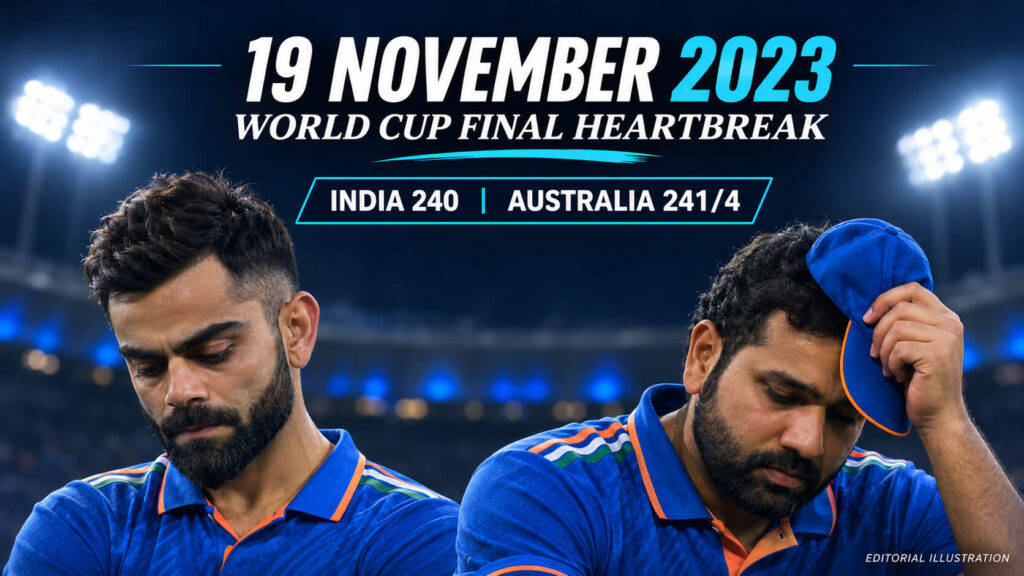
19 November 2023 World Cup Final: India’s Heartbreak, Three Years On
19 November 2023 was supposed to be the day India completed one of cricket’s most commanding World Cup campaigns. Ten straight wins had carried Rohit Sharma’s team to the final in Ahmedabad. The nation arrived at the last match expecting a celebration; it left with a result that still hurts to remember.
Three years later, on 19 November 2026, the story remains more than a scoreline. Australia defeated India by six wickets, Travis Head made 137, and the hosts’ perfect run ended one match short of the trophy. But the lasting question is not simply who won. It is how a side that had looked unbeatable for six weeks lost control of the biggest game.
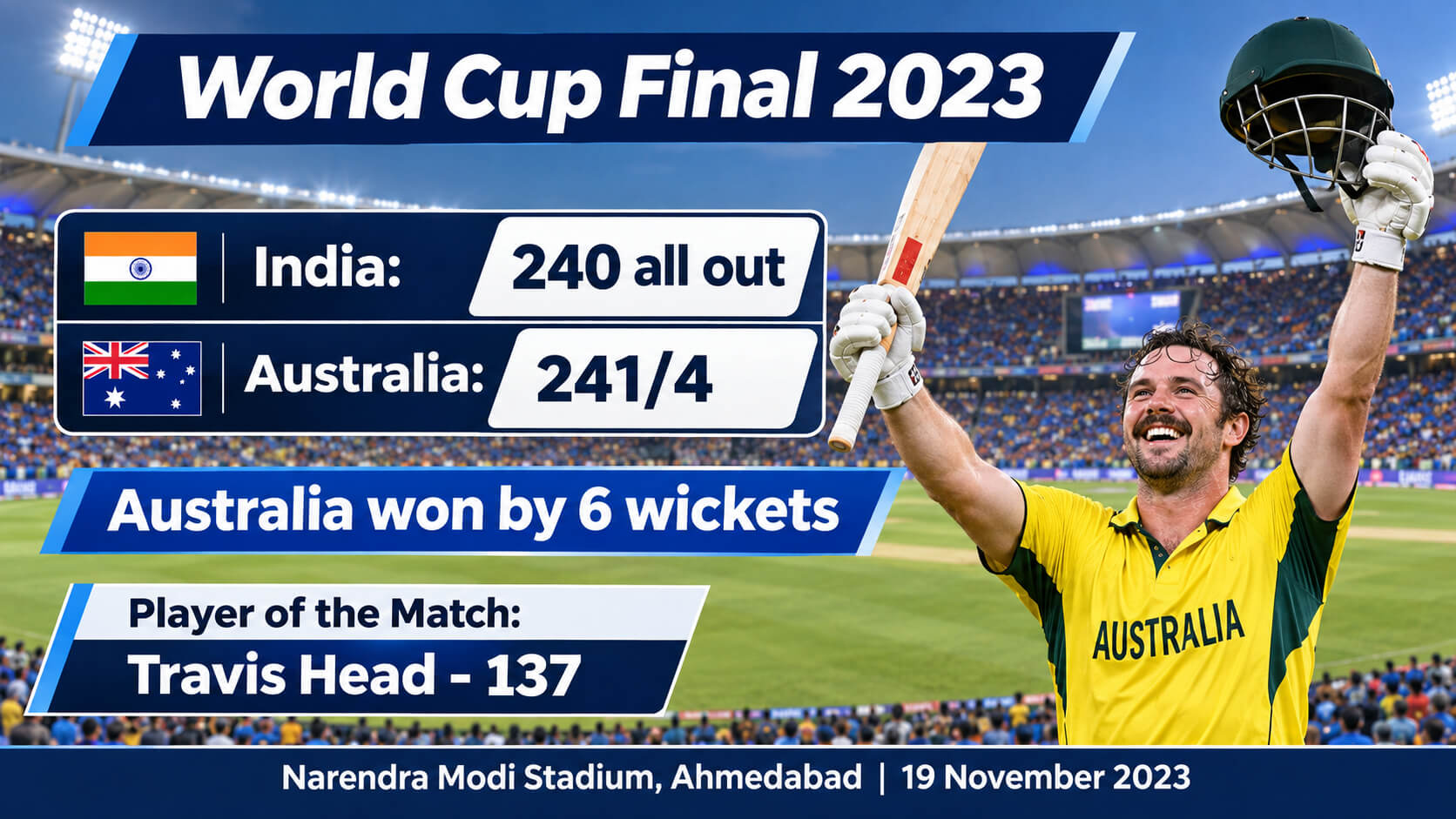
Quick answer: India scored 240 in 50 overs. Australia chased 241 in 43 overs, finishing on 241/4. Head and Marnus Labuschagne turned an early Australian collapse into a title-winning partnership. The final took place on 19 November, not 23 November.
India vs Australia World Cup 2023 Final: Match Result and Scorecard
India 240 (50 overs) | Australia 241/4 (43 overs)
19 November 2023 • Narendra Modi Stadium, Ahmedabad| Match detail | Confirmed information |
|---|---|
| Fixture | India vs Australia, World Cup final |
| Date and venue | 19 November 2023, Ahmedabad |
| Toss | Australia won and chose to bowl |
| India’s innings | 240 all out in 50 overs |
| Australia’s innings | 241/4 in 43 overs |
| Result | Australia won by 6 wickets |
| Player of the Match | Travis Head — 137 (120 balls) |
| Title | Australia’s sixth men’s ODI World Cup |
This was Australia’s sixth men’s ODI World Cup title, earned on a night when Pat Cummins’ side handled the decisive phases better than the tournament’s most consistent team. India, meanwhile, had won all nine league games and its semifinal before falling at the final hurdle.
Why 19 November 2023 Became an Unforgettable Date for Indian Fans
The pain of the final came from the journey leading into it. India had beaten every opponent in the round-robin stage. They had survived pressure, won convincingly on different surfaces and reached the knockout rounds with a lineup delivering across departments. Every victory made the possibility of a home World Cup title feel more real.
The semifinal reinforced that belief. Against New Zealand in Mumbai, India piled up 397/4 and won by 70 runs. With Virat Kohli producing a record-breaking tournament and Mohammed Shami leading the wicket-taking charts, fans had good reasons for confidence. Yet the final exposed a reality of one-day cricket: the strongest campaign does not guarantee the final 100 overs.
India’s 10 Straight Wins Before the Final
| Stage | Opponent | India’s result |
|---|---|---|
| League 1 | Australia | Won by 6 wickets |
| League 2 | Afghanistan | Won by 8 wickets |
| League 3 | Pakistan | Won by 7 wickets |
| League 4 | Bangladesh | Won by 7 wickets |
| League 5 | New Zealand | Won by 4 wickets |
| League 6 | England | Won by 100 runs |
| League 7 | Sri Lanka | Won by 302 runs |
| League 8 | South Africa | Won by 243 runs |
| League 9 | Netherlands | Won by 160 runs |
| Semifinal | New Zealand | Won by 70 runs |
| Final | Australia | Lost by 6 wickets |
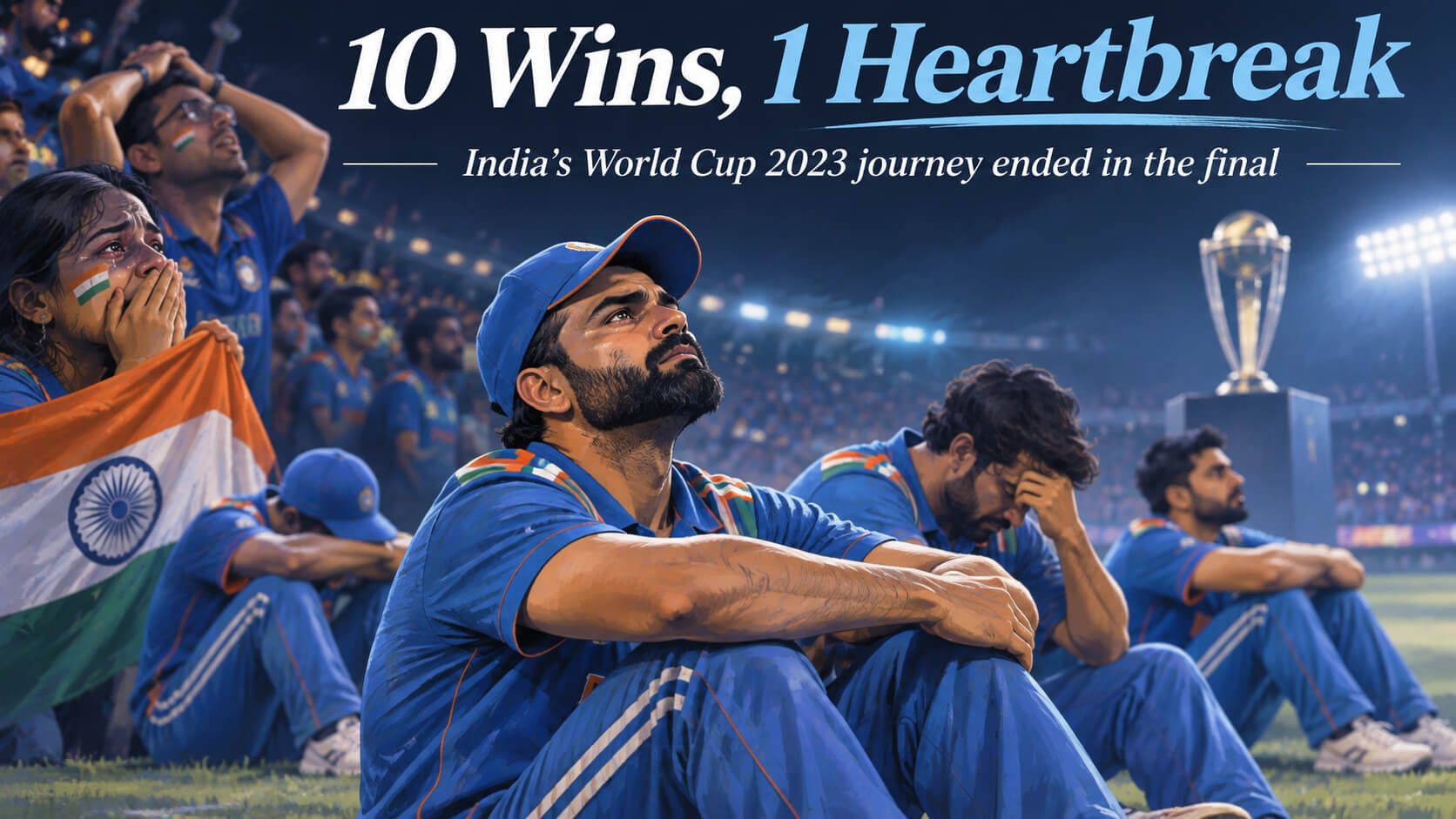
That sequence explains the enduring phrase “10 wins, one heartbreak.” India did almost everything required to dominate a World Cup, but the only loss arrived in the match that determined the champion.
How India’s Innings Changed From 80/2 to 240 All Out
Rohit Sharma Set an Aggressive Tone
Australia captain Pat Cummins chose to bowl after winning the toss. Shubman Gill departed early, but Rohit Sharma attacked the new ball and Virat Kohli joined him to keep the scoreboard moving. India reached 80/2 after the first 10 overs — a strong start against a world-class attack on the final stage.
Rohit made 47 from 31 balls, including boundaries that briefly brought the packed Ahmedabad crowd to life. His innings ended when Travis Head ran back from the cover region to take an outstanding catch off Glenn Maxwell. Shreyas Iyer then fell for four, leaving India 81/3 shortly after the powerplay.
Kohli and Rahul Rebuilt, but Boundaries Disappeared
Virat Kohli and KL Rahul needed to restore stability. They added 67 runs, but Australia’s disciplined lengths and field placements repeatedly prevented India from hitting freely. Kohli’s 54 from 63 balls ended when a Pat Cummins delivery took an inside edge onto his stumps. India were 148/4 in the 29th over.
Rahul top-scored with 66 from 107 balls, yet India’s innings never regained the momentum Rohit had created. A telling statistic from the ICC’s match report: after India struck nine fours and three sixes in the opening powerplay, there were no more sixes in the remaining 40 overs. The hosts finished on 240, with Kuldeep Yadav run out on the last delivery.
Key Indian Batting Contributions
| Player | Runs | Balls | Role in the innings |
|---|---|---|---|
| KL Rahul | 66 | 107 | Top scorer; held middle order together |
| Virat Kohli | 54 | 63 | Important recovery half-century |
| Rohit Sharma | 47 | 31 | Explosive start in powerplay |
Australia’s attack shared the work: Mitchell Starc took 3/55, Cummins returned 2/34 in ten overs and Josh Hazlewood finished with 2/60. The figures matter, but the bigger tactical success was denying India a sustained phase of acceleration after the 10th over.
Australia Were 47/3 — So How Did India Lose?
For a short spell, the chase suggested that 240 might be enough. Mohammed Shami removed David Warner for seven, while Jasprit Bumrah dismissed Mitchell Marsh for 15 and Steve Smith for four. Australia were 47/3 inside seven overs. India had three wickets, a vocal home crowd and a genuine opening to defend their total.
The match then shifted through one of the defining partnerships in World Cup final history. Travis Head played positively without treating every ball as a boundary opportunity. Marnus Labuschagne absorbed pressure, rotated strike and forced India to keep bowling for wickets rather than simply protecting a modest target. Their 192-run stand took the contest away from the hosts.
Travis Head’s 137: A Final-Winning Performance
Head made 137 from 120 deliveries, with 15 fours and four sixes. His hundred did more than chase a target: it changed the emotional direction of the evening. As the innings progressed, the pressure that had seemed to surround Australia at 47/3 gradually moved onto India. Head was dismissed with victory almost secured, and Glenn Maxwell finished the chase.
Labuschagne stayed unbeaten on 58 from 110 balls. Australia completed the chase in 43 overs with six wickets and seven overs to spare. Head earned Player of the Match for a performance that combined a decisive catch, an extraordinary century and calm execution in a final.
| Australian match-winner | Performance |
|---|---|
| Travis Head | 137 off 120 balls |
| Marnus Labuschagne | 58 not out off 110 balls |
| Head–Labuschagne partnership | 192 runs for the fourth wicket |
| Jasprit Bumrah | India’s best bowling figures: 2/43 |
Five Turning Points That Decided the 2023 World Cup Final
1. Australia’s Decision to Bowl First
Cummins backed his bowlers to control the first innings and trusted his batting unit to chase under the lights. That choice proved important as Australia’s pacers found rhythm and India struggled to rebuild scoring momentum.
2. Travis Head’s Catch to Remove Rohit
Rohit was scoring at more than 150 runs per 100 balls. Head’s running catch removed the player most likely to push India toward a substantially bigger total, immediately changing the fielding side’s energy.
3. Shreyas Iyer’s Early Exit
When Iyer fell soon after Rohit, India were three down in the 11th over. The middle order had to prioritise wicket preservation instead of maintaining the rapid early scoring rate.
4. Cummins Dismissed Virat Kohli
Kohli had passed fifty and was building toward a long innings when he played on for 54. With Rahul then left to guide the lower middle order, India missed the decisive partnership that could have lifted their target.
5. The Head–Labuschagne Stand After 47/3
India had the contest in reach with three early wickets. Australia responded with a partnership that combined contrasting roles: Head attacked scoring opportunities and Labuschagne refused to give his wicket away. That balance was the clearest difference between the two batting efforts.
Why the Defeat Still Hurts Three Years Later in 2026
Cricket supporters remember far more than statistics. They remember the quiet that followed the final wicket of India’s innings, the burst of hope after Australia lost its third wicket and the gradual realization that the target was slipping away. Some fans had followed every match in the stadium; others watched at home with families and friends. The final became a shared memory because the build-up had felt so extraordinary.
For Rohit Sharma, it was the chance to lead India to a home ODI World Cup title. For Kohli, it was an exceptional individual tournament ending without the trophy. And for a team that had produced ten wins, it was proof that tournament performance and final-day performance are not the same thing.
Ten victories took India to the final. One loss determined who took the trophy home.
Remembering the final does not mean ignoring what the team achieved. India’s World Cup 2023 campaign remains a story of elite consistency, thrilling batting performances and outstanding bowling. The heartbreak is inseparable from that success: without ten straight wins, the final defeat would not carry the same emotional weight.
What Can India Learn From That Final?
- Keep scoring options open: A strong opening powerplay matters less if the middle overs offer almost no boundary pressure.
- Build flexibility into the batting order: A final can demand both a rebuilding partnership and a late acceleration.
- Take chances in a modest chase: India’s new-ball bowlers created an opportunity at 47/3, but an extended wicketless stand ended it.
- Separate overall quality from a one-match result: A single defeat cannot erase ten wins, but a champion must still perform on the day the title is decided.
For a more recent perspective on how India approaches overseas one-day cricket, read KhelKhabri’s analysis of India’s ODI lessons from the New Zealand series. You can also explore the latest cricket news and match analysis.
19 November 2023 World Cup Final: Frequently Asked Questions
What happened on 19 November 2023 in Indian cricket?
India lost the ICC Men’s Cricket World Cup 2023 final to Australia at Narendra Modi Stadium in Ahmedabad. Australia won by six wickets after successfully chasing India’s total of 240.
Why is 19 November known as a heartbreak day for Indian cricket fans?
India entered the final with ten consecutive wins and a strong chance of winning the World Cup at home. Losing the title-deciding match after that unbeaten run made the result especially painful for supporters.
Who scored the most runs in the 2023 World Cup final?
Travis Head was the leading scorer for Australia with 137 off 120 balls. KL Rahul top-scored for India with 66 from 107 balls.
Who was Player of the Match in the 2023 World Cup final?
Travis Head won the Player of the Match for his match-winning 137 and strong fielding, including the catch that dismissed Rohit Sharma.
Did the India vs Australia 2023 World Cup final happen on 23 November?
No. The final was played on Sunday, 19 November 2023. The 2026 third anniversary falls on Thursday, 19 November 2026.
Final Reflection: The Day That Remains With Indian Cricket
The simplest way to tell the story is also the hardest to accept: India won every match on the road to the final, but Australia played the better cricket in the final itself. Starc and Cummins restricted India, Head delivered a defining hundred, and Labuschagne helped complete the chase without further drama. That is why 19 November 2023 is remembered so vividly.
Three years on, the date represents two truths at once. India produced a remarkable World Cup campaign, and Australia deserved its sixth title for executing when it mattered most. For fans, 19 November 2023 remains a reminder that sporting heartbreak often follows the moments when hope is highest.
Match verification: See the ICC’s official final report and match scorecard.