

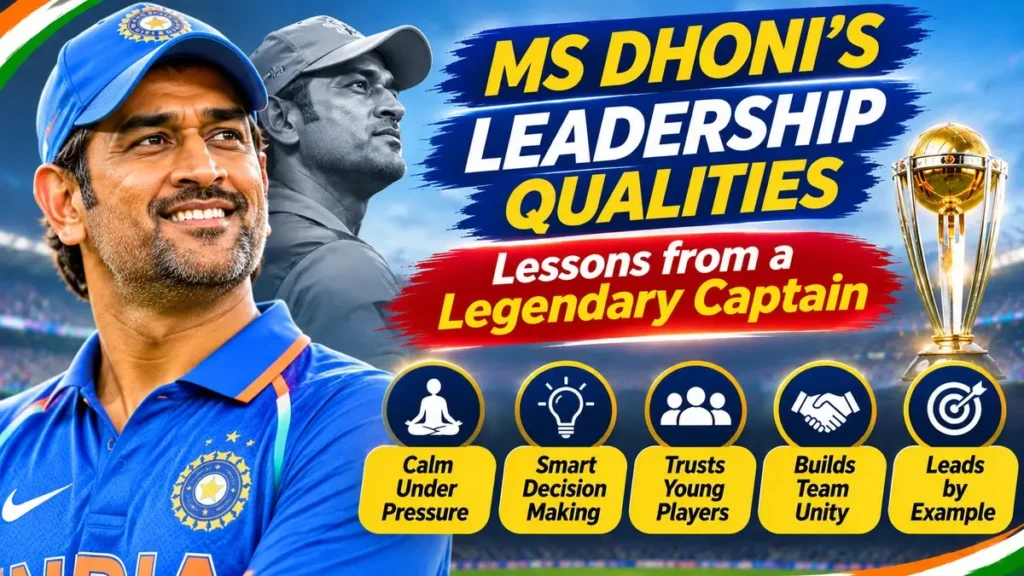
Indian Cricket • Leadership Analysis • MS Dhoni
MS Dhoni’s leadership qualities are built around calm decision-making, trust, clear communication and a strong understanding of people and match situations. MS Dhoni’s Leadership also shows how a captain can balance confidence with humility and keep the team’s needs at the centre of important decisions. His success as India’s captain came not only from winning major trophies, but also from helping different players contribute, protecting team confidence and making decisions under pressure.
Quick answer: The most valuable lessons from Dhoni’s captaincy are to stay composed, earn respect through actions, understand each teammate, give players ownership, learn from experience and accept responsibility during difficult phases. His leadership helped India win the 2007 T20 World Cup, 2011 ODI World Cup and 2013 Champions Trophy.
Dhoni did not lead India through a single fixed formula. MS Dhoni’s Leadership developed with experience and changed as the needs of the team evolved. Early in his captaincy, he was energetic and closely involved in conversations with bowlers. Over time, he became more comfortable allowing players to execute their own plans and stepping in when the situation demanded a change.
That evolution is important. Leadership is not simply about having confidence or making bold calls. It also involves recognising what a team needs at a particular stage. A young side may need clarity and encouragement; an experienced group may need trust and room to solve problems independently.
Dhoni’s record gave his style credibility. He captained India in 332 international matches and recorded 178 victories, the most by an Indian captain. Under his leadership, India won three major ICC white-ball tournaments and reached the top of the ICC Test rankings in December 2009.
| Leadership milestone | Achievement | What it illustrates |
|---|---|---|
| 2007 | ICC Men’s T20 World Cup title | Trusting a young group in a new format |
| 2011 | ICC Men’s Cricket World Cup title | Handling expectation in a major final |
| 2013 | ICC Champions Trophy title | Adapting tactics and managing a balanced side |
| December 2009 | India reached No. 1 in Test rankings | Building success across formats |
The milestones are team achievements during Dhoni’s captaincy; they should not be read as individual accomplishments by the captain alone.
1. MS Dhoni’s Leadership: Staying Calm When the Pressure Is Highest
MS Dhoni’s Leadership is often associated with calmness under pressure. This quality was visible in close finishes, tense knockout games and periods when India were struggling. Remaining composed helped him assess the match rather than react to every change in momentum.
Calmness is not passivity. A captain must still make difficult calls and change plans that are failing. Dhoni tried to keep unnecessary emotion away from the team so players could focus on the task.
The 2011 World Cup final as a pressure example
India were chasing 275 against Sri Lanka at Mumbai’s Wankhede Stadium on 2 April 2011. Dhoni promoted himself ahead of the in-form Yuvraj Singh and finished the chase with an unbeaten 91. The decision was a high-pressure call, and the result made it one of the defining moments of his captaincy.
The lesson is not to always take the biggest risk. A leader must understand the match, the players available and the responsibility of the moment. Dhoni was prepared to own the decision.
2. Trusting Players and Giving Them Ownership
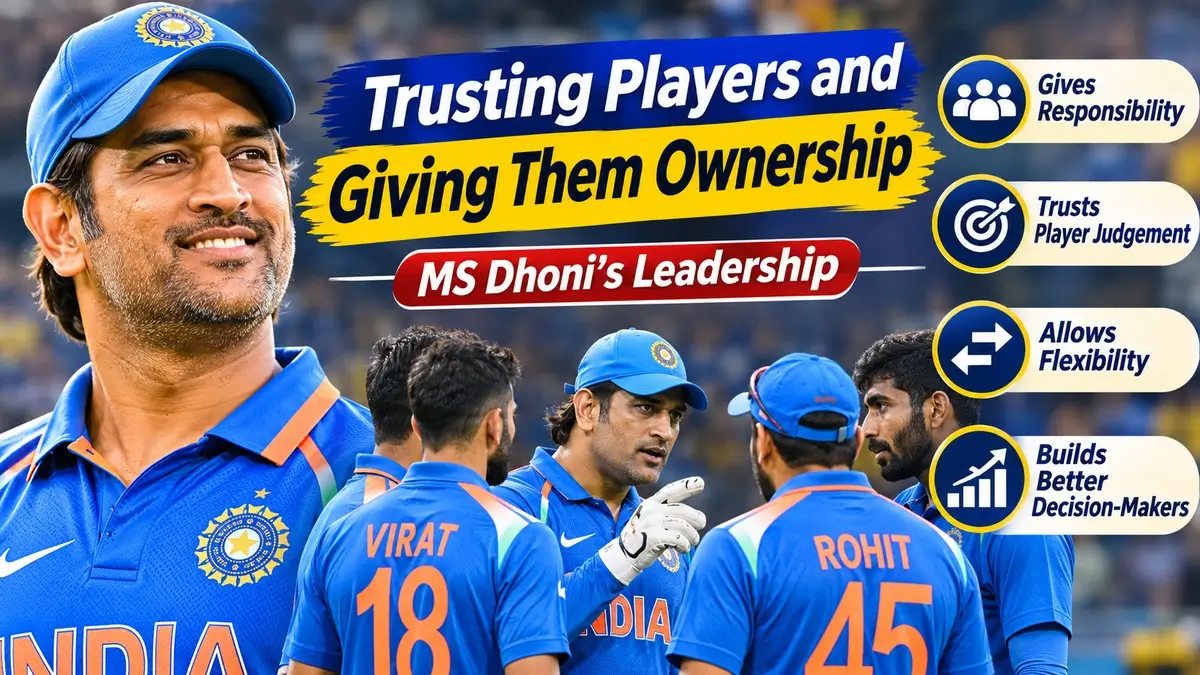
One of Dhoni’s most useful leadership habits was allowing players to take responsibility for their roles. MS Dhoni’s Leadership gave bowlers room to use their judgement while keeping the team’s objectives clear. In his BCCI interview, he explained that he did not want to give a bowler a plan that the bowler was uncomfortable executing. He preferred to let the bowler begin with a plan and field that suited him, then offer alternatives if the approach was not working.
Leadership also depends on a team’s ability to adjust when conditions change. KhelKhabri’s analysis of India’s overseas ODI adaptability offers a recent example of how observation, shared responsibility and tactical flexibility can shape results away from home.
This approach can create stronger decision-makers. Players who understand why a plan succeeds or fails can adjust independently. Trust means giving freedom while helping people learn from the outcome.
How that trust developed
Former India all-rounder Irfan Pathan observed that Dhoni’s style changed between the 2007 and 2013 tournaments. Pathan said the captain became calmer and more willing to let bowlers control their own work. That is a useful example of experience changing a leader’s behaviour rather than a leader repeating the same method forever.
The practical lesson is to define the outcome and boundaries, then let skilled people choose how to reach the goal. Constant interference can reduce confidence and slow learning.
3. Understanding Individuals and Communicating Clearly
A dressing room is made up of people with different temperaments, confidence levels and ways of handling pressure. MS Dhoni’s Leadership placed value on understanding each teammate as a person, not simply as a batter or bowler. Dhoni has spoken about this approach, and in his 2014 BCCI interview, he described communication as something that must be adjusted to the individual.
Not every player responds to the same speech or feedback. One may value a direct technical point; another may need time or a private conversation. Good communication keeps the message honest but makes it useful to the person receiving it.
Dhoni also said that a player can begin doubting his own ability before others do. A captain who recognises that moment can protect confidence while still discussing what needs to improve. This balance is especially important when a player is being judged after only a small number of opportunities.
Respect is earned through conduct
In a 2024 public discussion, Dhoni spoke about respect as something earned through behaviour rather than demanded because of a title. That principle matches the way leadership is built over time: keep commitments, apply standards fairly, listen before judging and make sure actions support the words.
4. Reading the Game and Making Informed Decisions
Dhoni is often described as an instinctive captain, but instinct in elite sport is not simply guesswork. MS Dhoni’s Leadership combined observation with preparation, allowing experience to inform quick decisions. In his BCCI interview, he explained that a useful gut feeling comes from having experienced similar situations before. Past matches, pitch conditions, the state of the ball and a batter’s behaviour all add to the information a captain uses.
This separates informed instinct from impulse. Impulse is a reaction without enough thought; informed instinct is a quick decision shaped by knowledge and experience. Preparation gives a captain a stronger base when there is little time to choose.
Dhoni’s wicketkeeping also gave him a close view of the pitch, bowlers and batters. That position allowed him to observe details that could help with fields, bowling changes and reading a batter’s intentions. His tactical identity included unconventional fields and a willingness to use spinners at important moments, but those calls still depended on the conditions of the match.
5. Taking Responsibility and Protecting Team Confidence
Leadership becomes most visible when results go against a team. MS Dhoni’s Leadership was also reflected in his willingness to face difficult periods and keep the group focused on the next task. After India suffered difficult Test defeats in 2012, Dhoni said that leaving the captaincy would be the easiest option, but that his immediate responsibility was to prepare the side for the next match. He also spoke about backing young and senior players and avoiding a blame culture.
That response did not erase the defeats or make every decision correct. It showed a willingness to face criticism and focus on the next task. Accountability means identifying what went wrong and helping the group improve.
Dhoni also spoke about the leader’s role in preventing unnecessary negativity from reaching the team. This should not mean hiding mistakes. It means separating useful feedback from noise, discussing problems honestly and keeping players focused on actions they can control.
For a captain or manager, a practical routine is to review performance without personal attacks:
- Identify the decision or execution that did not work.
- Separate individual error from a wider team problem.
- Agree on one or two changes that can be practised.
- Give the player a clear next opportunity where appropriate.
6. Building a Team That Can Succeed Beyond One Leader
Long-term leadership is not measured only by how much control a captain keeps. It is also measured by whether the team can continue to function when that captain steps aside. Dhoni handed India’s Test captaincy to Virat Kohli during the 2014–15 Australia series and later gave up the limited-overs captaincy in January 2017, giving the next leadership group time before the 2019 World Cup cycle.
His own explanation was that a successor needed enough time to prepare. MS Dhoni’s Leadership also looked beyond one captain by making room for the next generation to prepare. That is a significant lesson in succession planning: leadership transition should be treated as part of the team’s future, not as a personal loss of status. Sharing responsibility early can reduce uncertainty and help the next captain establish authority.
At Chennai Super Kings, Dhoni’s teams won five IPL titles in 2010, 2011, 2018, 2021 and 2023. The franchise’s sustained competitiveness across different squads and seasons became another part of his leadership legacy. Results alone do not prove every process was perfect, but repeated success across changing player groups suggests the value of continuity, role clarity and trust.
| Format | Matches as India captain | Wins | What the record shows |
|---|---|---|---|
| Tests | 60 | 27 | India reached No. 1 in the Test rankings in 2009 |
| ODIs | 200 | 110 | Longest-serving India captain by ODI matches |
| T20Is | 72 | 41 | Led India to the inaugural T20 World Cup title |
| All formats | 332 | 178 | Most international matches and wins as India captain |
Captaincy figures are from Dhoni’s India record across formats. Test draws, tied matches and no-results are not included in the wins column.
7. Practical Leadership Lessons From MS Dhoni
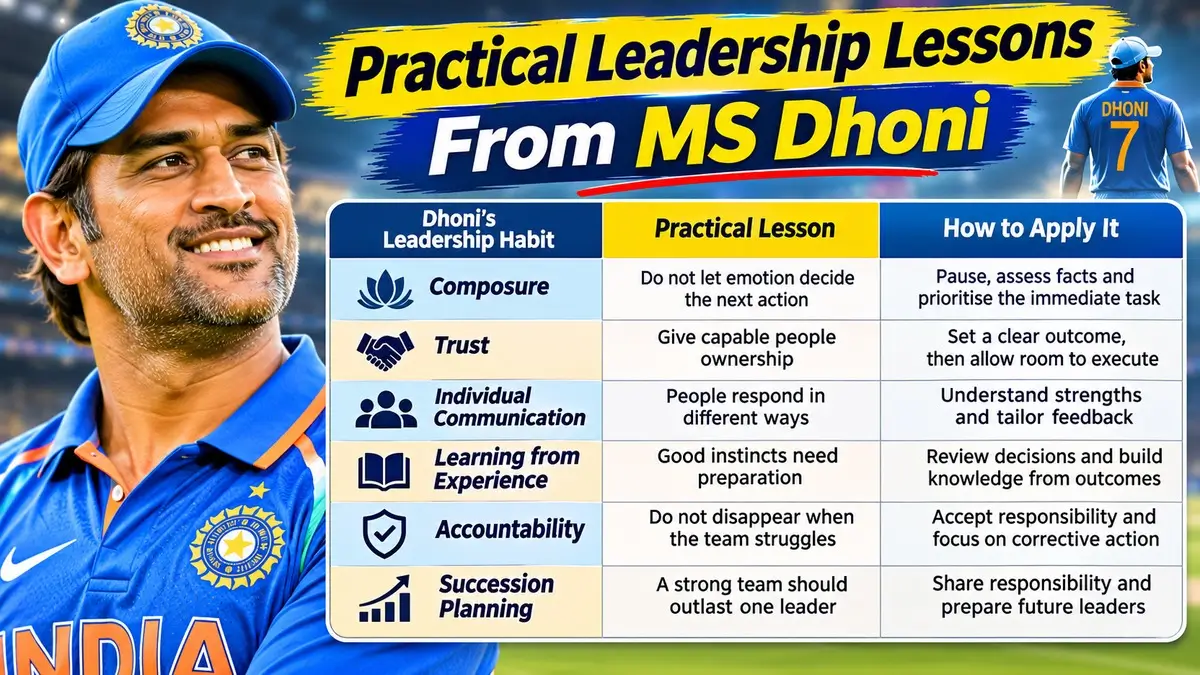
Dhoni’s career offers ideas that can be applied beyond cricket, including in classrooms, workplaces, businesses and community teams. The aim is not to copy his exact personality. It is to understand the habits behind his leadership and adapt them to a different environment.
| Dhoni’s leadership habit | Practical lesson | How to apply it |
|---|---|---|
| Composure | Do not let emotion decide the next action | Pause, assess facts and prioritise the immediate task |
| Trust | Give capable people ownership | Set a clear outcome, then allow room to execute |
| Individual communication | People respond in different ways | Understand strengths and tailor feedback |
| Learning from experience | Good instincts need preparation | Review decisions and build knowledge from outcomes |
| Accountability | Do not disappear when the team struggles | Accept responsibility and focus on corrective action |
| Succession planning | A strong team should outlast one leader | Share responsibility and prepare future leaders |
These are not guaranteed methods. Leadership depends on context and people. Dhoni’s example is useful because his own comments, teammates’ observations and his record across different teams support these lessons.
For readers who want to hear the principles in Dhoni’s own words, the BCCI interview on Dhoni’s leadership discusses communication, player confidence, decision-making and the relationship between a captain and the team.
Frequently Asked Questions
What are MS Dhoni’s main leadership qualities?
His best-known qualities include calmness under pressure, trust in players, clear communication, tactical awareness and accountability. His approach also evolved as he gained experience.
Why is MS Dhoni called Captain Cool?
The nickname reflects his composed public manner during tense matches and difficult moments. It does not mean he avoided difficult decisions; he was willing to make tactical changes and accept responsibility.
How many ICC trophies did Dhoni win as India’s captain?
He led India to three major ICC white-ball titles: the 2007 T20 World Cup, the 2011 Cricket World Cup and the 2013 Champions Trophy. He remains the only captain to have won all three men’s ICC white-ball tournaments.
How many international matches did Dhoni captain India in?
Dhoni captained India in 332 international matches and recorded 178 wins. These figures cover Tests, ODIs and T20Is.
How did Dhoni build trust among bowlers?
He explained that he preferred bowlers to begin with plans they were comfortable executing, rather than simply following instructions. He would offer alternatives when needed so they could understand and improve their decisions.
What can young leaders learn from MS Dhoni?
Young leaders can learn to earn respect through conduct, listen to individuals, remain composed and give teammates responsibility. They should also prepare future leaders instead of making the team dependent on one person.
Conclusion: Why MS Dhoni’s Leadership Qualities Still Matter
MS Dhoni’s leadership legacy rests on more than trophies. His calm approach, trust in players, individual communication, match awareness and willingness to take responsibility helped India achieve historic success across formats. Just as importantly, he understood that a team must keep developing and that leadership eventually requires giving others room to lead.