

KABADDI • 2026 CHAMPIONSHIP RESULTS • AHMEDABAD
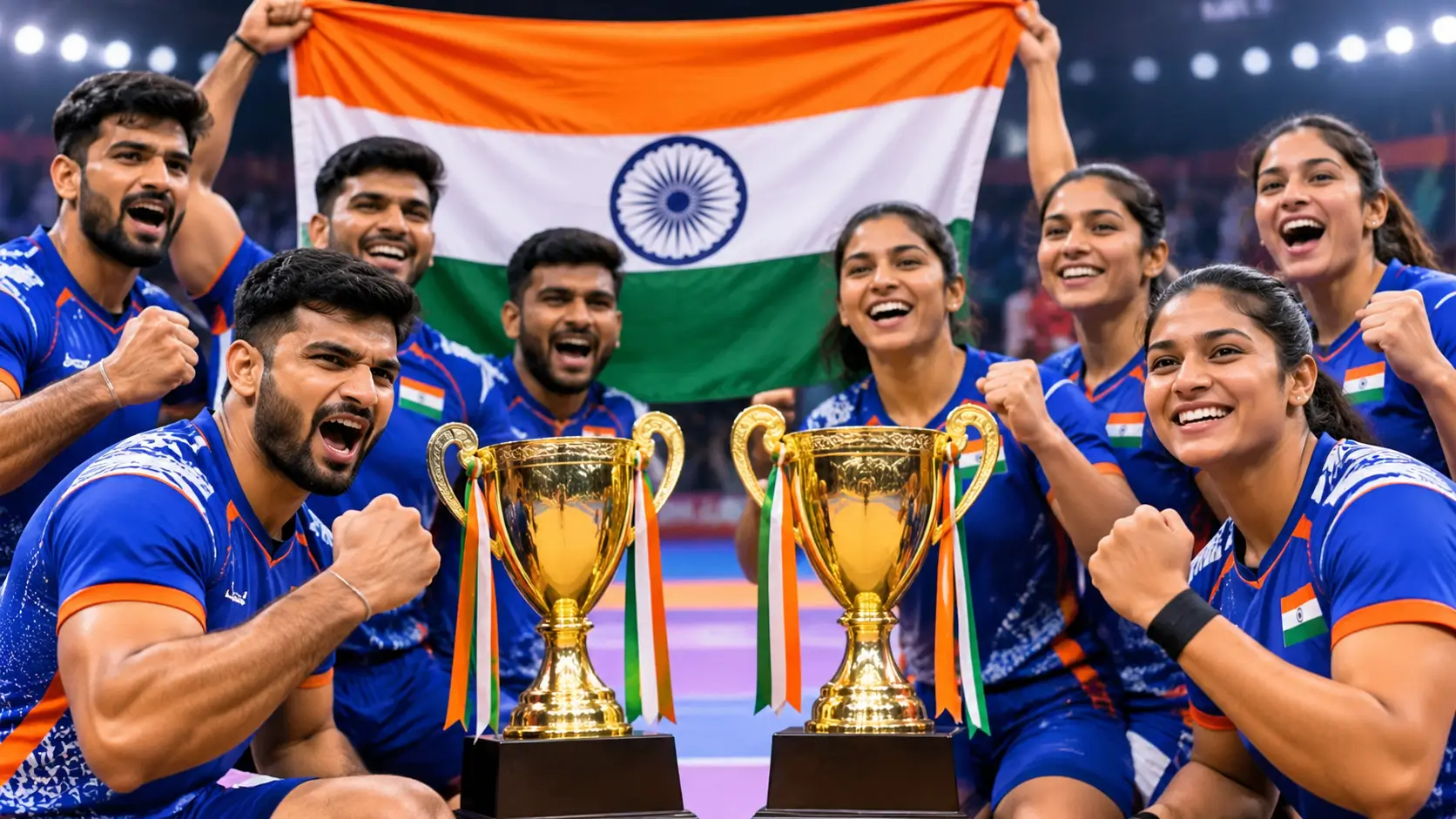
The Commonwealth Kabaddi Championship 2026 ended with a historic double celebration for India. Both the men’s and women’s national teams lifted the inaugural titles at the Veer Savarkar Sports Complex in Ahmedabad on 31 October 2026. India men beat Sri Lanka 54–20, while India women defeated Uganda 35–15.
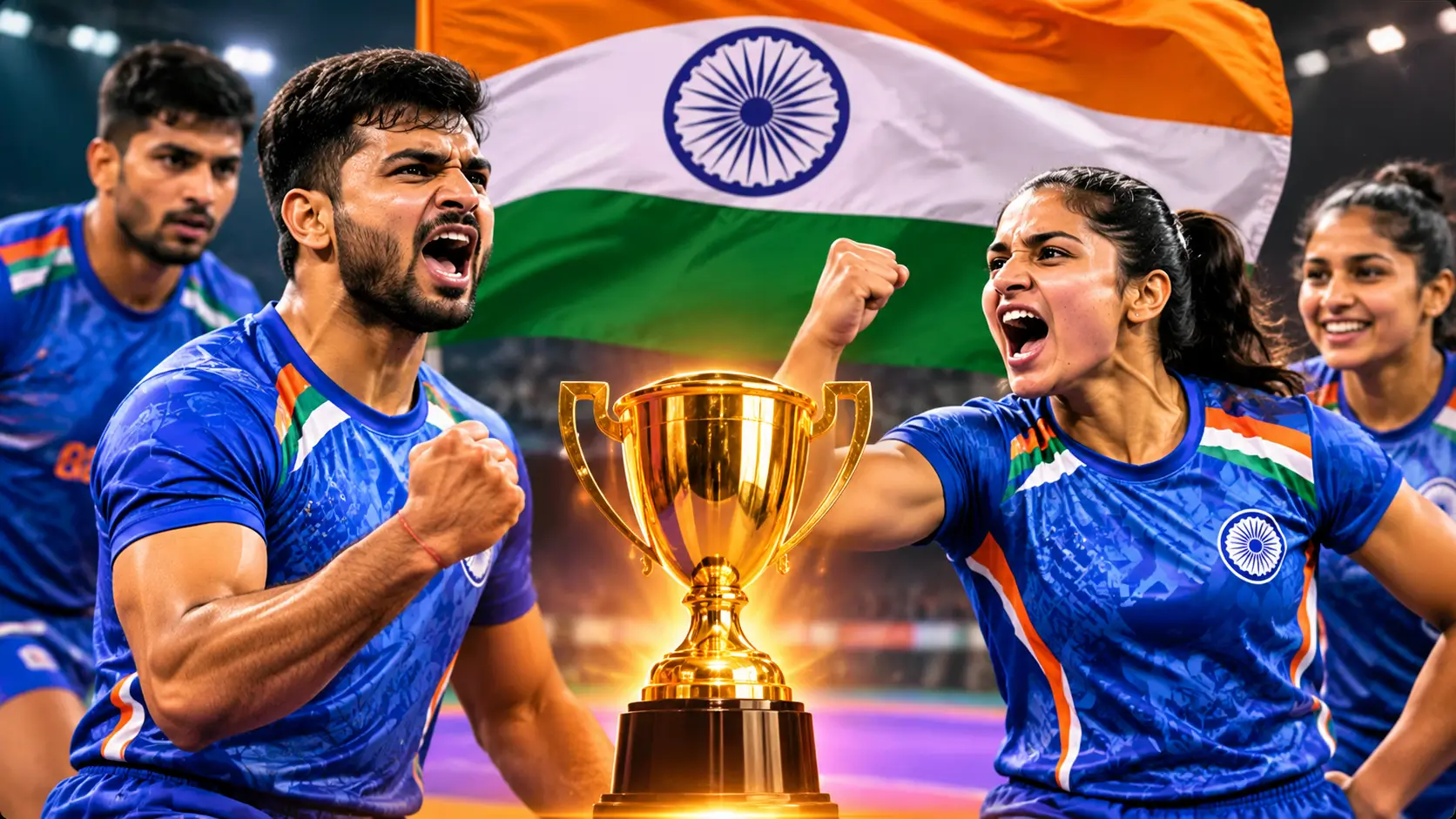
The achievements were built on exceptional consistency rather than a single final-day performance. India’s men won all eight of their matches, and the women finished with six victories from six games. Their campaigns provide an enduring record of tournament results, key players, medal winners and the growing international reach of kabaddi.
Commonwealth Kabaddi Championship 2026: Tournament Overview
The inaugural Commonwealth Kabaddi Championship brought national teams from across the Commonwealth together for nine days of competition. Held in Ahmedabad, Gujarat, the event provided separate men’s and women’s titles, with group matches determining the semi-finalists before the knockout phase concluded with two gold-medal contests.
The Amateur Kabaddi Federation of India organised the event with approval from the International Kabaddi Federation. The pre-tournament announcement identified 13 participating nations, 23 team entries and more than 400 athletes. The men’s draw contained 13 teams and the women’s draw 10, illustrating how international participation varied between the two divisions.
| Detail | Information |
|---|---|
| Edition | First / inaugural championship |
| Dates | 23–31 October 2026 |
| Venue | Veer Savarkar Sports Complex, Ahmedabad, India |
| Men’s teams | 13 |
| Women’s teams | 10 |
| Semi-finals | 30 October 2026 |
| Finals | 31 October 2026 |
| Men’s champions | India |
| Women’s champions | India |
India, Sri Lanka, Bangladesh, Nigeria, Kenya, Tanzania, Canada, Singapore, Malaysia, Uganda, England, Scotland and Australia were among the 13 represented nations. The competition enabled countries with different levels of kabaddi experience to face each other in a structured international tournament.
For readers exploring Indian and international sports results, KhelKhabri’s sports coverage follows major tournaments and the athletes behind them. This championship deserves a permanent place in that coverage because it produced the first Commonwealth kabaddi medal winners in both categories.
Commonwealth Kabaddi Championship 2026 Winners and Medal Table
India finished at the top of both podiums, but several other nations produced significant knockout performances. Sri Lanka claimed men’s silver, and Uganda earned women’s silver after reaching the respective finals. Kenya and Bangladesh shared men’s bronze honours, while Kenya and Sri Lanka were the women’s bronze medallists.
| Medal | Men | Women |
|---|---|---|
| Gold | India | India |
| Silver | Sri Lanka | Uganda |
| Bronze (joint) | Kenya, Bangladesh | Kenya, Sri Lanka |
The semi-finals show why those medal places mattered. India men beat Bangladesh 56–27, and Sri Lanka narrowly defeated Kenya 28–24. In the women’s last four, India beat Sri Lanka 39–14 while Uganda edged Kenya 23–21. The close Uganda–Kenya result, in particular, illustrated the competitive challenge awaiting India in the final.
The championship’s medal table is useful well beyond the tournament week. It records a first edition, the first champions and the emerging international teams that reached the podium. Future editions can be compared against this 2026 baseline to judge whether participation and competitiveness are growing.
India Men’s Kabaddi Team: Eight Wins from Eight Matches
Led by captain Surjeet Singh and vice-captain Naveen Kumar, India men completed an unbeaten campaign against six group-stage opponents, followed by victories in the semi-final and final. The team combined a strong raiding rotation with a defence that consistently restricted opponents’ scoring opportunities.
India scored 380 points across their eight matches and conceded 193, a positive points difference of 187. No opponent reached more than 30 points against them. The margins were impressive, but the results also show the consistency that mattered: India performed against several different styles of opposition across nine days.
| Stage | Opponent | Score (IND–OPP) | Result |
|---|---|---|---|
| Group | England | 46–26 | Won |
| Group | Uganda | 44–30 | Won |
| Group | Malaysia | 37–23 | Won |
| Group | Nigeria | 50–23 | Won |
| Group | Tanzania | 48–20 | Won |
| Group | Sri Lanka | 45–24 | Won |
| Semi-final | Bangladesh | 56–27 | Won |
| Final | Sri Lanka | 54–20 | Gold |
India vs Nigeria: A turning point in the group stage
One of the most decisive results came against Nigeria, when the Indian men won 50–23 on 26 October. India led 25–7 at the interval and maintained the advantage despite a more competitive Nigerian performance after the break. India’s raiders scored 31 points, compared with Nigeria’s 21, while the Indian defence held a 7–2 advantage in tackle points.
Sachin contributed 12 raid points, Aditya Shinde added 11, and Pankaj Mohite delivered eight raid points plus two tackle points. Surjeet Narwal made four tackles. Those contributions were spread across different roles and showed how the team could generate momentum without relying on one player to carry every raid.
Why the unbeaten group stage mattered
By winning each group fixture, India avoided entering the knockouts under pressure from a damaging earlier defeat. The 45–24 victory against Sri Lanka in the last group match was especially relevant because the same opponent would later reach the final. It gave India experience of Sri Lanka’s defensive approach before the highest-stakes meeting.
India then defeated Bangladesh 56–27 in the semi-final. The result took the men’s team into the gold-medal match with seven straight victories and growing confidence in its attacking combinations. The final would test whether that form could translate into a championship-winning performance.
India vs Sri Lanka Final 2026: How the Men’s Gold Was Won
The men’s final on 31 October began with Sri Lanka trying to resist India’s early pressure. India led 15–8 with ten minutes left in the opening half. A decisive period followed: the hosts outscored Sri Lanka 15–2, inflicted another All-Out and reached half-time 30–10 ahead.
India continued to control the contest after the interval, winning the second half 24–10 and closing the match at 54–20. Four All-Outs contributed eight points to the eventual 34-point winning margin. The scoreline was emphatic, but the underlying figures provide a clearer explanation of why the match became so one-sided.
Scale: India’s 54 points = 100%. Scores from the 31 October 2026 men’s final.
| Measure | India | Sri Lanka |
|---|---|---|
| First-half score | 30 | 10 |
| Second-half score | 24 | 10 |
| Total points | 54 | 20 |
| Raid points | 30 | 11 |
| Tackle points | 14 | 9 |
| All-Outs inflicted | 4 | 0 |
Aditya Shinde and the defensive unit delivered
Aditya Shinde scored 10 raid points from 14 raids, including four bonus points, and was India’s leading scorer in the final. Bharat Hooda added eight raid points in the second half, while Pankaj Mohite supplied six points and Naveen Kumar five. The scoring pattern shows how India’s raiding options remained effective after building an early lead.
Yogesh Dahiya made five successful tackles, all in the first half, to lead the defensive effort. Shubham Shinde, Surjeet Singh, Pravesh Malik and Deepak Sankar provided further tackling support. India recorded 14 tackle points overall, while Sri Lanka managed nine. The combination of successful raids, tackles and All-Outs explains why the visitors struggled to close the gap.
For the full statistical context of India’s performance, the men’s Commonwealth Kabaddi final match report documents the match sequence and individual contributions. The central takeaway is that India’s defence created sustained pressure while the attack converted its opportunities.
India Women’s Kabaddi Team: Six-Match Unbeaten Campaign
India women’s campaign was equally convincing. Under captain Nidhi Sharma, with Ritu as vice-captain, the team won all four group matches before defeating Sri Lanka in the semi-final and Uganda in the final. The opening 73–13 victory over Malaysia set a powerful tone, but subsequent wins required repeated discipline against changing opposition.
Across six fixtures, India women scored 258 points and conceded 86. Those figures indicate an advantage of 172 points over the championship. More importantly, the side maintained a consistent balance between prolific raiding and defensive organisation as the knockout stage approached.
| Stage | Opponent | Score (IND–OPP) | Result |
|---|---|---|---|
| Group | Malaysia | 73–13 | Won |
| Group | Singapore | 32–16 | Won |
| Group | Uganda | 41–18 | Won |
| Group | Nigeria | 38–10 | Won |
| Semi-final | Sri Lanka | 39–14 | Won |
| Final | Uganda | 35–15 | Gold |
Anu’s 11 raid points against Nigeria
The 38–10 victory over Nigeria secured India’s place in the semi-finals. India led 24–6 at half-time and kept control through the second period. Anu was the leading raider with 11 raid points from 17 attempts. Sakshi added four raid points and Nidhi Sharma two.
Defensively, Sabhai Gadhavi contributed three tackle points, while Priya and Ritu finished with two each. Nigeria struggled to find sustained answers to India’s organised raiding and tackling. For India, the match demonstrated that the team could combine a dominant scoreboard position with effective use of several contributors.
From the semi-final to a rematch with Uganda
India defeated Sri Lanka 39–14 in the women’s semi-final. Uganda, meanwhile, survived a much tighter contest, overcoming Kenya 23–21. That set up a final between teams that had already met in Group A, where India had beaten Uganda 41–18.
The earlier result offered useful context, but not a guarantee. Uganda had earned its place in the final and possessed players capable of scoring against strong opposition. India’s challenge was to bring the same raiding discipline and defensive pressure to a match in which the stakes were much higher.
India vs Uganda Women’s Final: Sakshi Stars in 35–15 Win
India defeated Uganda 35–15 on 31 October to secure the first women’s Commonwealth Kabaddi title. The match was controlled largely through a strong first half. India moved from a 7–3 lead to a 22–7 advantage by the break, using successful raids, defensive tackles and an All-Out to build separation.
Uganda made the second half more competitive, but India held firm and inflicted a second All-Out to remove any realistic chance of a comeback. The final margin was 20 points. India registered 20 raid points and 10 tackle points, while Uganda finished with 14 raid points and one tackle point.
Scale: India’s 35 points = 100%. Scores from the 31 October 2026 women’s final.
| Measure | India | Uganda |
|---|---|---|
| First-half score | 22 | 7 |
| Second-half score | 13 | 8 |
| Total points | 35 | 15 |
| Raid points | 20 | 14 |
| Tackle points | 10 | 1 |
| All-Outs inflicted | 2 | 0 |
Sakshi, Anu, Nidhi Sharma and India’s defenders
Sakshi led India’s scoring with nine raid points from 10 raids, including two bonus points. She was especially effective before half-time, when she scored seven of her points. Anu added six raid points, and captain Nidhi Sharma scored five. Ritu and Suman anchored the defensive unit with four tackle points each.
Uganda’s Nakayongo Shirat carried much of her team’s attacking workload, collecting 11 of its 15 points. The difference was in the support around each side’s main raider. India created a more balanced flow of scoring and successfully tackled Uganda’s attackers, while Uganda managed just one tackle point during the entire contest.
Sakshi finished the championship with 52 points across six matches, underlining her consistency as well as her final-day performance. The women’s Commonwealth Kabaddi final report gives the breakdown of raid points, tackles and the decisive moments in India’s victory.
Top Players and Key Statistics from India’s Double Gold
Both title-winning teams featured multiple important contributors. India’s men’s attack could turn to experienced and emerging raiders at different points, while its defenders frequently reduced the opposition’s options. The women’s title reflected an equally valuable mix of star raiding performances and dependable support in defence.
| Player | Team | Verified contribution |
|---|---|---|
| Aditya Shinde | India men | 10 raid points in final |
| Bharat Hooda | India men | 8 raid points in final |
| Yogesh Dahiya | India men | 5 successful tackles in final |
| Sachin | India men | 12 raid points against Nigeria |
| Sakshi | India women | 9 raid points in final; 52 tournament points |
| Anu | India women | 11 raid points against Nigeria |
| Nidhi Sharma | India women | 5 raid points in final; captain |
| Ritu and Suman | India women | 4 tackle points each in final |
Why raids, tackles and All-Outs all matter
Raid points measure the attacking side’s ability to beat defenders or earn bonuses; tackle points reward successful defensive stops. An All-Out occurs when one side loses all its players on the mat and provides a significant scoring advantage. Understanding these categories is essential when comparing kabaddi scorelines rather than simply looking at the final totals.
In the men’s final, India’s 30 raid points were supplemented by 14 tackle points and eight points from four All-Outs. In the women’s final, the defending was especially decisive: India recorded 10 tackle points to Uganda’s one. These figures show that the championship was won through more than individual raiding brilliance.
What the 2026 Championship Means for International Kabaddi
The Commonwealth Kabaddi Championship gave the sport an additional international stage. Teams from Africa, Europe, Asia and Oceania took part, and the podium results showed that countries beyond traditional South Asian powerhouses were capable of reaching the later stages. Uganda’s women’s silver and Kenya’s bronze medals were particularly significant examples.
For developing national teams, regular international fixtures offer practice against unfamiliar defensive patterns and raiding techniques. They also create opportunities for national federations to judge progress using real tournament results. Future editions will be able to compare performances against this inaugural championship rather than relying only on isolated fixtures.
Is this the same event as kabaddi at the Commonwealth Games?
No. The Commonwealth Kabaddi Championship is a standalone international tournament, distinct from the official Commonwealth Games competition programme. Ahmedabad’s association with the 2030 Commonwealth Games has helped focus attention on the city’s sporting infrastructure, but winning the 2026 kabaddi championship does not itself establish that kabaddi will be included in the Games.
That distinction matters for readers seeking historical records. The 2026 gold medals belong to the inaugural Commonwealth Kabaddi Championship, not to a Commonwealth Games medal table. Reporting them accurately preserves the achievement without confusing two different sporting events.
India’s results set a benchmark for future editions
India’s men’s 8–0 and women’s 6–0 records establish a high standard for teams entering later championships. Yet the event’s long-term importance will also depend on whether other countries develop stronger squads, more reliable raiding combinations and better defensive systems. The 2026 tournament is therefore both a celebration of India’s dominance and a starting reference point for the championship’s future.
Commonwealth Kabaddi Championship 2026 FAQs
Who won the Commonwealth Kabaddi Championship 2026?
India won both inaugural titles. The men beat Sri Lanka 54–20, and the women defeated Uganda 35–15 in the finals on 31 October 2026.
Where and when was the 2026 championship held?
It took place from 23 to 31 October 2026 at the Veer Savarkar Sports Complex in Ahmedabad, Gujarat, India. The semi-finals were played on 30 October and the gold-medal matches on 31 October.
How many matches did India win?
India men won eight matches from eight, including the final. India women won six matches from six, also finishing unbeaten.
Who were India’s captains?
Surjeet Singh captained the men’s side, with Naveen Kumar serving as vice-captain. Nidhi Sharma led the women’s team, with Ritu as vice-captain.
Who were the leading performers in the finals?
Aditya Shinde scored 10 raid points in the men’s final and Yogesh Dahiya made five successful tackles. Sakshi scored nine raid points in the women’s final, supported by Anu, Nidhi Sharma and India’s defensive unit.
Is the Commonwealth Kabaddi Championship part of the Commonwealth Games?
No. The championship is a separate competition and its 2026 medals are not Commonwealth Games medals. Inclusion in a future Commonwealth Games programme would require a separate official decision.
Conclusion: India’s Historic Double Gold in Ahmedabad
The Commonwealth Kabaddi Championship 2026 will be remembered for India’s clean sweep of both titles. The men’s team defeated Sri Lanka 54–20 and completed eight victories without a defeat; the women’s team beat Uganda 35–15 and won all six matches. Their success reflected skilled raiding, disciplined defence and reliable contributions from several players.
The tournament also created a new benchmark for international kabaddi, with nations across the Commonwealth competing for the first medals. India’s double gold is the headline achievement, but the complete winners list, group results, final scores and standout performances make this inaugural championship an important reference for kabaddi fans in future seasons.