

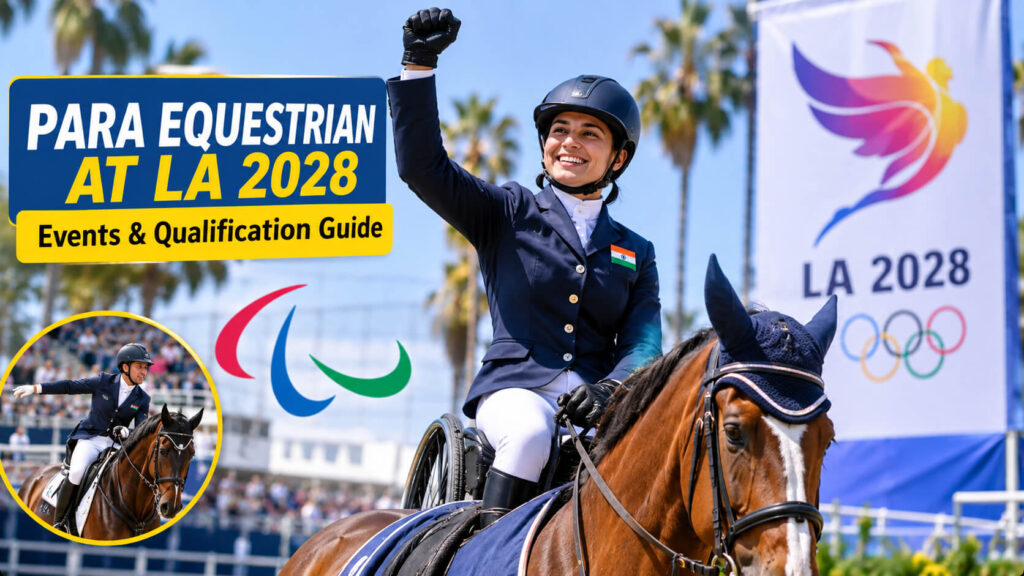
Para Equestrian at LA 2028 will bring the world’s leading Para dressage partnerships to California. The official programme includes 11 medal events and 78 athlete quota places, with the venue, dates and detailed qualification pathways now confirmed.
For riders, trainers and fans, the most useful questions are practical: which tests award medals, what do Grades I to V mean, how does a country earn a qualification slot, and what minimum scores must a rider and horse achieve? The answers are more specific than a general promise of a Paralympic place. Earning a team quota, meeting individual eligibility rules and receiving a final national selection are separate steps.
Quick answer: Para Equestrian at LA 2028 consists entirely of Para dressage, with five Individual tests, five Individual Freestyle tests and one open Team competition. It is scheduled for 16–21 August 2028 at Santa Anita Park in Arcadia. The FEI and IPC qualification system offers 78 athlete places through team, individual and invitation pathways.
Para Equestrian at LA 2028: Dates, Venue and Overview
The Los Angeles Paralympic Games run from 15 to 27 August 2028. Para dressage competition is scheduled across six days, 16–21 August, at Santa Anita Park in Arcadia, east of central Los Angeles. Santa Anita is a long-established equestrian venue, but the Paralympic format will be a regulated dressage competition in a purpose-prepared arena rather than a horse race.
Para Equestrian is the umbrella name commonly used in Paralympic coverage; the actual discipline at these Games is Para dressage. There are no Paralympic horse-jumping, cross-country or racing medal contests in the programme. The aim is to demonstrate accurate movements, balance, rhythm and harmony between a rider and a trained horse.
| Detail | Official information |
|---|---|
| Sport | Para equestrian (Para dressage) |
| Paralympic Games | 15–27 August 2028 |
| Para dressage competition | 16–21 August 2028 |
| Competition venue | Santa Anita Park, Arcadia, California, USA |
| Medal events | 11 (all mixed/open) |
| Total athlete quota | 78 gender-free places |
| Sport classes | Grades I, II, III, IV and V |
| National quota maximum | Four athletes per NPC |
The venue and schedule are published by LA28, while event and quota figures come from the IPC’s Los Angeles 2028 regulations. For any session-by-session updates, fans should use the official LA28 Paralympic competition schedule announcement, because detailed session information can still be adjusted before 2028.
Which Para Dressage Events Will Award Medals at LA 2028?
There are three types of competition but 11 separate medal events. The Individual and Freestyle formats each award a gold medal in every one of the five grades. The team competition produces a single medal set for countries, regardless of the athletes’ individual grades.
In an Individual test, riders perform a prescribed series of movements in a set order. In Individual Freestyle, the rider creates a choreographed routine set to music while meeting the grade’s required technical elements. In the Team event, three athletes from the same country perform designated tests, with their combined percentage scores deciding the result.
| Competition | Grades / class | Medal events |
|---|---|---|
| Individual championship | I, II, III, IV, V | 5 |
| Individual Freestyle | I, II, III, IV, V | 5 |
| Team championship | Open team | 1 |
| Total | All mixed/open | 11 |
Chart 1 — Medal events by format
Source: IPC LA28 qualification programme, November 2026. Bars show medal-event counts, not athlete numbers.
Open events mean eligible male and female athletes can compete under the same classification and competition rules; there are not separate women’s and men’s medal contests. This also explains the IPC’s use of a gender-free allocation for the 78 athlete places.
Para Equestrian Grades I–V: How Classification Works
Sport classification is essential to understanding Para dressage. A grade describes how an athlete’s eligible impairment affects relevant riding activities. It is not a ranking of talent and does not indicate that Grade V riders are better than Grade I riders. Athletes undergo an official classification assessment; they cannot simply choose their preferred grade.
Grade I generally includes athletes with the greatest activity limitations in this sport. Grade V encompasses athletes with comparatively smaller eligible limitations. The tests are designed around those differences, making it meaningful to award separate individual medals in each grade.
| Grade | General competition profile | Typical movements |
|---|---|---|
| Grade I | Greatest activity limitation | Mainly walk movements |
| Grade II | Significant activity limitation | Walk and selected trot work |
| Grade III | Moderate activity limitation | Walk and trot; freestyle may include additional elements |
| Grade IV | Less severe activity limitation | Walk, trot, canter and lateral work |
| Grade V | Least activity limitation within eligible classes | Advanced walk, trot, canter and lateral movements |
The medal opportunities are distributed evenly across the five individual grades. The following comparison is derived directly from the IPC event list and makes clear why the total is 11—not the three competition formats alone.
| Sport grade | Individual | Freestyle | Grade-specific total |
|---|---|---|---|
| Grade I | 1 | 1 | 2 |
| Grade II | 1 | 1 | 2 |
| Grade III | 1 | 1 | 2 |
| Grade IV | 1 | 1 | 2 |
| Grade V | 1 | 1 | 2 |
| Open Team (all eligible grades) | — | — | 1 |
| Total | 5 | 5 | 11 |
Chart 3 — Medal opportunities by grade
Each of five grades has one Individual and one Freestyle event (10 total), plus one open Team event = 11 medal events. These figures are event counts, not medal pieces awarded.
Grades also affect arena and test requirements. Some grades use a 20-by-40-metre arena and others a 20-by-60-metre arena. Tests, permitted compensating aids and the precise movements required are governed by FEI rules for the relevant grade. Riders and trainers must use the current published test, not an old generic dressage pattern.
For a deeper explanation of grades, equipment and how judges convert movement marks into percentages, see KhelKhabri’s Para equestrian rules, grades and scoring guide. Understanding classification first makes it easier to follow how qualification slots are distributed.
LA 2028 Para Equestrian Qualification Rules: What Riders Need
A rider does not qualify for LA28 merely by winning one domestic competition or appearing on a world ranking. The national Paralympic committee (NPC) must have an allocated place, and the nominated athlete–horse combination must independently satisfy FEI eligibility requirements. These are related, but different, parts of the system.
Minimum scores: two 64% performances
Chart 4 — The two-score eligibility threshold
FEI Para Equestrian 3* or higher
A different eligible FEI event
These are the official minimum thresholds, not actual rider scores. Both performances must be completed by the same eligible athlete–horse combination within the 1 January 2026–9 July 2028 window.
Under the IPC rules published in November 2026, an athlete–horse combination must achieve at least two scores of 64% or above in Grand Prix Test A or Grand Prix Test B at two different FEI Para Equestrian 3-star-or-higher competitions. The window runs from 1 January 2026 to 9 July 2028.
The threshold is a minimum eligibility requirement, not a score that guarantees a Paralympic place or a medal. A rider who meets it still needs a slot, the right sport classification, an eligible horse and confirmation through national and international entry procedures. One excellent test does not replace the requirement for scores at two different events.
Classification and documents also matter
Eligible athletes must have an international sport class of Confirmed, or Review with a fixed review date later than 31 December 2028. They must also appear in the FEI nominated entries through the FEI Certificate of Capability process. National federations should keep the athlete’s sport class status, horse combination and competition records aligned.
The qualification place normally belongs to the country, not the rider who helped earn it. The main exception concerns bipartite invitation slots, which are allocated to individual athletes. Final national selection may therefore differ from the combinations that originally secured ranking points or team qualification.
| Requirement | LA28 rule |
|---|---|
| International classification | Confirmed or qualifying Review status |
| Horse–rider minimum score | At least 64% twice |
| Separate competitions | Two different FEI Para Equestrian 3* or higher events |
| Eligible test | Grand Prix Test A or Grand Prix Test B |
| Performance window | 1 January 2026–9 July 2028 |
| Certificate of Capability | FEI/National Federation nominated-entry process |
| National selection | Needed after the country secures the relevant quota |
How Are the 78 Para Equestrian Athlete Quota Places Allocated?
The clearest way to understand LA28 qualification is to start with the full 78-place field. Sixty places are allocated through team qualification routes, fifteen through regional individual-ranking allocation, and three through bipartite invitations. Those figures are fixed programme allocations, although unused slots can be reallocated under the regulations.
For team routes, qualifying NPCs generally receive four athlete places, but only three athletes compete in the medal-scoring team. At least one team member must be in Grade I, II or III, and no more than two team members may come from the same grade. A national federation must build a compliant combination rather than select the four highest-ranked riders without considering their grades.
| Qualification route | Athlete slots | How it works |
|---|---|---|
| Host nation — United States | 4 | Automatic host allocation, subject to team eligibility |
| 2026 FEI World Championships | 28 | Seven best eligible teams × four places |
| 2027 FEI European Championships | 4 | Highest eligible unqualified team |
| 2027 FEI regional team rankings | 16 | Africa, Americas, Asia and Oceania routes |
| 2027 FEI global team ranking | 8 | Two further teams × four places |
| 2027 regional individual rankings | 15 | Three ranking places across each of five regions |
| Bipartite invitations | 3 | Selected athletes through FEI/IPC invitation process |
| Total | 78 | 60 team-route + 15 individual + 3 invitation places |
Most of the 78-place field comes through team-related qualification. The chart below separates the five team pathways, while the article’s earlier quota chart includes individual and bipartite places.
Chart 5 — How 60 team-route athlete places are distributed
These five routes add up to 60 athlete places, equivalent to 15 national team allocations of four places each. Final rider selection remains separate.
Chart 2 — LA28 athlete quota breakdown
Source: IPC LA28 para equestrian qualification regulations (version 6 November 2026). Each bar is proportional to the full 78-place quota.
The five regions used for individual-ranking distribution are Africa, the Americas, Asia, Europe and Oceania. Only countries without team-route slots are eligible for this allocation method; the three highest-ranked eligible athletes per region can earn one country place each, normally capped at two such places per NPC. If a region is unrepresented, the rules provide a redistribution mechanism.
Chart 6 — Individual ranking places by region
There are 3 regional ranking places in each of five regions (15 in total). Reallocation provisions apply if a region is not represented; normally a maximum of two such places may go to one NPC.
This structure creates two useful stories to follow. Strong teams aim to secure four places and enter a team event; developing nations with excellent individuals may still reach LA28 through regional ranking routes. Invitation places provide a separate, tightly limited channel rather than a replacement for ordinary qualification.
LA28 Para Dressage Qualification Timeline and Important Deadlines
The 2026 World Championships in Aachen, Germany, were the first major team qualification milestone. The next decisive period is 2027, when FEI team and individual rankings accumulate performances. Then, in early 2028, FEI confirms allocated slots and NPCs accept or return them.
| Date | Milestone |
|---|---|
| 15 December 2026 | FEI plans to publish the 2027 ranking-event list |
| 31 December 2027 | FEI team and individual ranking period ends |
| 28 February 2028 | FEI communicates allocated quota places |
| 13 March 2028 | NPC acceptance and bipartite invitation applications |
| 20 March 2028 | Reallocation / invitation decisions |
| 9 July 2028 | Final day for minimum eligibility performances |
| 10 July 2028 | Certificate of Capability submission deadline |
| 16–21 August 2028 | Para dressage events at LA28 |
Deadlines are operational as well as competitive. Riders may have the required percentages but miss an entry if national selection documents, horse eligibility or FEI certificates are incomplete. Likewise, the country must respond promptly to quota communications. Reallocations can change the final entry picture after initial rankings are published.
Which Countries Have Qualified Already, and What About India?
The first confirmed team allocations came from the 2026 FEI World Championships. Germany, the Netherlands, Denmark, Great Britain, Italy, France and Sweden secured team quota places. Host country United States also receives its allocated pathway. The FEI identifies these as national slots: the final rider and horse names are not determined solely by the earlier team result.
| Qualification source | National Paralympic committees |
|---|---|
| Host allocation | United States |
| 2026 World Championships | Germany, Netherlands, Denmark, Great Britain, Italy, France, Sweden |
| Remaining team routes | 2027 European Championships and FEI rankings |
Chart 7 — Team qualification picture after Aachen 2026
| Team qualification status | Nations | Equivalent athlete places |
|---|---|---|
| Host and Aachen 2026 routes | 8 | 32 |
| Remaining 2027 team routes | 7 | 28 |
| Planned total | 15 | 60 |
These counts describe team quota routes, not final nominated athletes. The 15 individual-ranking places and 3 invitation places are additional to this 60-slot team pathway.
For Indian readers, the distinction is important. An Indian Para dressage athlete would need an FEI-recognised classification, competitive rider–horse scores, the right ranking or national quota opportunity and eventual nomination by the relevant national body. The Asian regional team-ranking route and the Asia individual-ranking route are two pathways worth following.
No Indian LA28 Para dressage team qualification has been verified in the official results consulted for this guide as of 17 November 2026. That does not mean the opportunity is closed. Most ranking allocations have not yet been finalised, and the remaining competition calendar gives eligible riders a route to earn results during 2027.
How Will Para Dressage Be Judged at the 2028 Paralympics?
Para dressage is scored on quality, accuracy and partnership, not speed. Judges evaluate prescribed movements and award marks that produce a percentage. A rider with a higher score in their grade finishes ahead; small losses in accuracy, rhythm or control can decide medals at elite level.
The Individual medal test emphasises technically correct execution. Freestyle introduces music and choreography while retaining mandatory grade-specific technical components. Team scores combine the designated tests of three eligible riders, so reliable results across the whole team matter more than one exceptional performance.
What should viewers watch for?
Watch the transitions between movements: do they happen at the correct arena letters, and does the horse maintain balance? Notice the stability of the rhythm, the rider’s use of permitted aids and the horse’s response. Good riding often looks effortless because both athletes are communicating effectively.
The horse is a welfare priority as well as a sporting partner. Training, recovery, travel plans, equipment checks and veterinary assessment all affect the ability to perform. Since the qualification threshold belongs to a specific horse–rider combination, continuity and careful preparation are particularly valuable in the years before LA28.
Para Equestrian LA 2028: Frequently Asked Questions
How many Para Equestrian events will LA 2028 have?
There are 11 medal events: five grade-specific Individual contests, five grade-specific Freestyle contests and one open Team event. All belong to the Para dressage discipline.
Where and when will Para dressage take place?
Santa Anita Park in Arcadia, California, will host Para Equestrian from 16 to 21 August 2028. The wider Paralympic Games run from 15 to 27 August.
How many riders can qualify for LA28 Para dressage?
The overall athlete quota is 78, with a maximum allocation of four per national Paralympic committee. The quota is gender-free, meaning it is not divided into separate men’s and women’s allotments.
What score is required for Para dressage eligibility?
The rider–horse combination must reach 64% or higher twice at two different eligible FEI 3-star-or-above competitions during the approved window. The required performances must be in Grand Prix Test A or B, and scoring alone does not guarantee selection.
Do teams qualify with three or four riders?
Team qualification routes normally allocate four athlete places to a country, but the team medal competition uses three scoring athletes. The national entry must meet the FEI’s grade-composition rules.
Has LA28 Para Equestrian qualification already started?
Yes. Seven national teams earned places at the 2026 World Championships, with the United States included through the host route. More places will be determined through the 2027 FEI rankings and other published pathways.
Conclusion: What to Follow Before LA 2028
Para Equestrian at LA 2028 has a clearly defined schedule, event programme and qualification framework. The key figures are 11 medal events, five sport grades and 78 athlete places. Yet the story extends beyond numbers: riders and horses must meet demanding eligibility standards, countries must secure quota places and national selections must be finalised.
Watch the FEI’s 2027 team and individual rankings, the European Championship route, and early 2028 quota announcements. Anyone following qualification in detail can consult the official IPC LA28 Para Equestrian qualification regulations, which specify the scoring threshold, allocation methods and deadlines.
Editorial review: 17 November 2026. Chart source figures: IPC LA28 Para Equestrian qualification regulations (November 2026) and FEI qualification update (29 September 2026). Images are AI-generated conceptual illustrations, not documentation of real LA28 results; the second image contains superseded on-image text and the verified article figures take precedence.