

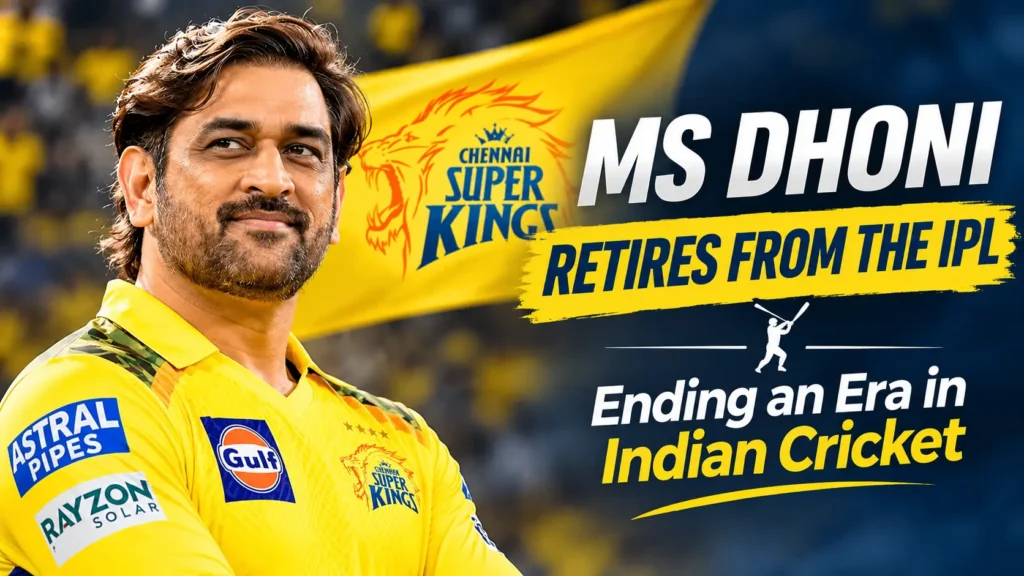
The former Chennai Super Kings captain has moved from the field to the dugout, beginning a new chapter as the franchise’s Team Mentor ahead of IPL 2027.
MS Dhoni retires from the IPL as one of the competition’s defining figures. For nearly two decades, the former India captain represented calm decision-making, sharp wicketkeeping and a distinctive finishing style. His association with Chennai Super Kings became central to the identity of the franchise and helped build one of the Indian Premier League’s most recognisable teams.
Chennai Super Kings announced on 17 November 2026 that Dhoni would become the team’s mentor from the 2027 season. The move confirms that he will no longer take the field as an IPL player. It is not a departure from Chennai: the franchise has made clear that Dhoni will remain part of its setup and help guide the next generation.
The announcement arrived after Dhoni missed the entire 2026 campaign because of a calf injury. His final IPL appearance as a player came in the 2025 season. The timing gives supporters a clear point at which to look back on his contribution, from the early years of the tournament to five title-winning campaigns as CSK captain.
MS Dhoni Retires: What CSK Announced for IPL 2027
Chennai Super Kings confirmed Dhoni’s appointment as Team Mentor on 17 November 2026. The franchise described the change as a new role for a player who has been part of its journey since the beginning. Its announcement focused on his contribution to the team and his continuing place in the CSK family.
The mentor position means Dhoni’s involvement will move away from playing duties and towards supporting the squad. A mentor can share match experience, help younger players understand pressure situations, discuss preparation and offer perspective during a long tournament. The exact day-to-day responsibilities of Dhoni’s role have not been publicly detailed, so it would be premature to assign him specific coaching or selection powers.
Cricket fans can also check the New Zealand vs India 1st Test match preview for a closer look at the team preparations and key players to watch.
| Detail | Confirmed information |
|---|---|
| Announcement date | 17 November 2026 |
| New role | Team Mentor, Chennai Super Kings |
| Role begins | IPL 2027 |
| Playing status | Retired from IPL playing career |
| Last IPL season played | 2025 |
| IPL 2026 | Did not feature; missed the season through injury |
The distinction matters for fans. Dhoni’s retirement is from playing in the IPL, not from his association with Chennai Super Kings. He is expected to remain around the team in a different capacity, and the mentor appointment gives the franchise continuity while it develops its next group of players.
A Career That Began with the IPL in 2008
Dhoni entered the IPL at its launch in 2008 and quickly became one of its most influential players. Chennai Super Kings made him their captain, and the combination of his leadership and the franchise’s competitive consistency helped shape the league’s early years. His impact was not limited to batting: he managed bowlers, set fields, read match situations and often made difficult decisions without visible panic.
CSK became Dhoni’s principal IPL home, but his league career also included two seasons with Rising Pune Supergiant in 2016 and 2017, when Chennai Super Kings were suspended from the competition. He returned to the yellow jersey when CSK re-entered the league in 2018. That return produced another title and reinforced the connection between Dhoni and Chennai supporters.
Over the years, his role changed. Earlier in his career, Dhoni often batted higher and carried a larger share of the innings. Later, he increasingly appeared as a lower-order batter, using short bursts of power and experience to influence the final overs. His workload and batting position evolved, but his presence continued to shape the team’s confidence and tactical approach.
From captain to senior guide
Dhoni handed the CSK captaincy to Ruturaj Gaikwad before the 2024 season. He remained an important senior figure in the squad, and he took over the captaincy again during IPL 2025 after Gaikwad was ruled out through injury. That return illustrated how the franchise continued to rely on his experience even as it prepared for a future beyond his playing career.
MS Dhoni IPL Career Stats and Major Records
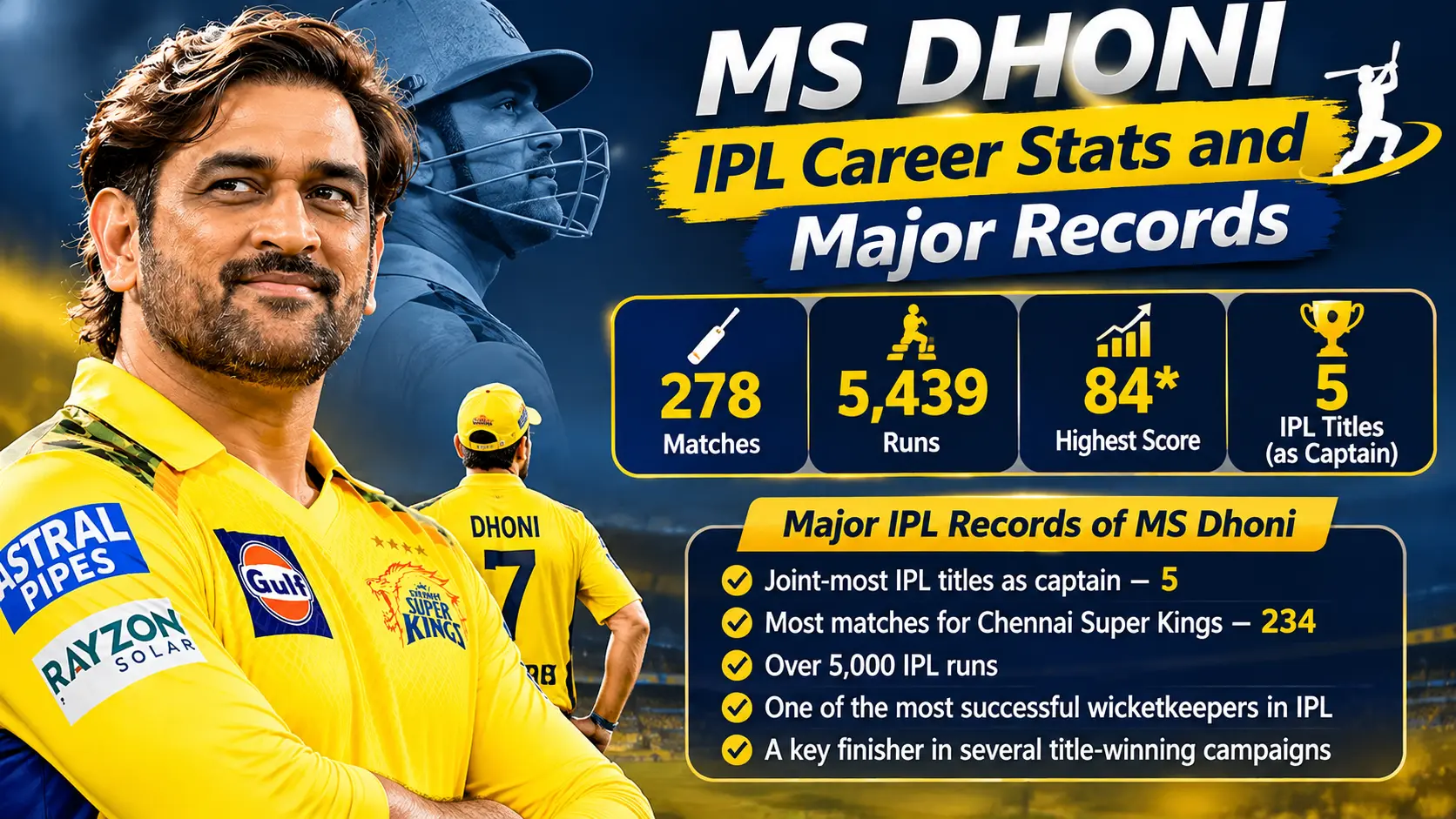
Dhoni’s numbers show the scale of his longevity. Across 278 IPL matches, he scored 5,439 runs, with a highest score of 84 not out. He finished with 24 half-centuries and a strike rate above 137. Those figures place him among the league’s most productive and durable players, particularly when his wicketkeeping and captaincy contributions are considered alongside his batting.
| Career statistic | Record |
|---|---|
| Matches | 278 |
| Runs | 5,439 |
| Batting average | 38.30 |
| Strike rate | 137.45 |
| Highest score | 84 not out |
| Half-centuries | 24 |
| Fours | 375 |
| Sixes | 264 |
| Wicketkeeping catches | 158 |
| Stumpings | 47 |
Five IPL titles as CSK captain
Dhoni led Chennai Super Kings to five IPL championships: 2010, 2011, 2018, 2021 and 2023. The titles came in different phases of the league and under changing squad combinations. The 2010 and 2011 victories established CSK as a major force, while the 2018 triumph after the franchise’s return became one of the most memorable chapters in its history.
The 2021 and 2023 wins added to that record. They also underlined a key feature of Dhoni’s captaincy: he was able to build teams that remained competitive across seasons, rather than relying on one short peak. His leadership was closely associated with role clarity, trust in experienced players and a willingness to back individuals through difficult patches.
How Dhoni Changed Chennai Super Kings
Dhoni’s influence on CSK went beyond the trophy cabinet. From the opening seasons, the team developed a reputation for consistency, calmness and a strong understanding of conditions. The captain’s own temperament became part of that identity. Supporters came to associate the yellow jersey with late recoveries, calculated chases and the belief that a match was not over until the final ball.
His handling of bowlers was an important part of the story. Dhoni often used match-ups and field placements to create pressure, particularly in the middle overs. He was also known for trusting players in defined roles. For a franchise that repeatedly reached the later stages of the competition, this continuity helped create a stable environment.
The relationship between Dhoni and Chennai supporters became distinctive in Indian sport. The nickname “Thala” reflected the affection he earned in the city, while the team’s home matches developed an atmosphere closely tied to his presence. His retirement as a player will change the match-day experience, but his mentor role means the association will continue in a new form.
Dhoni’s Wicketkeeping and Finishing Legacy
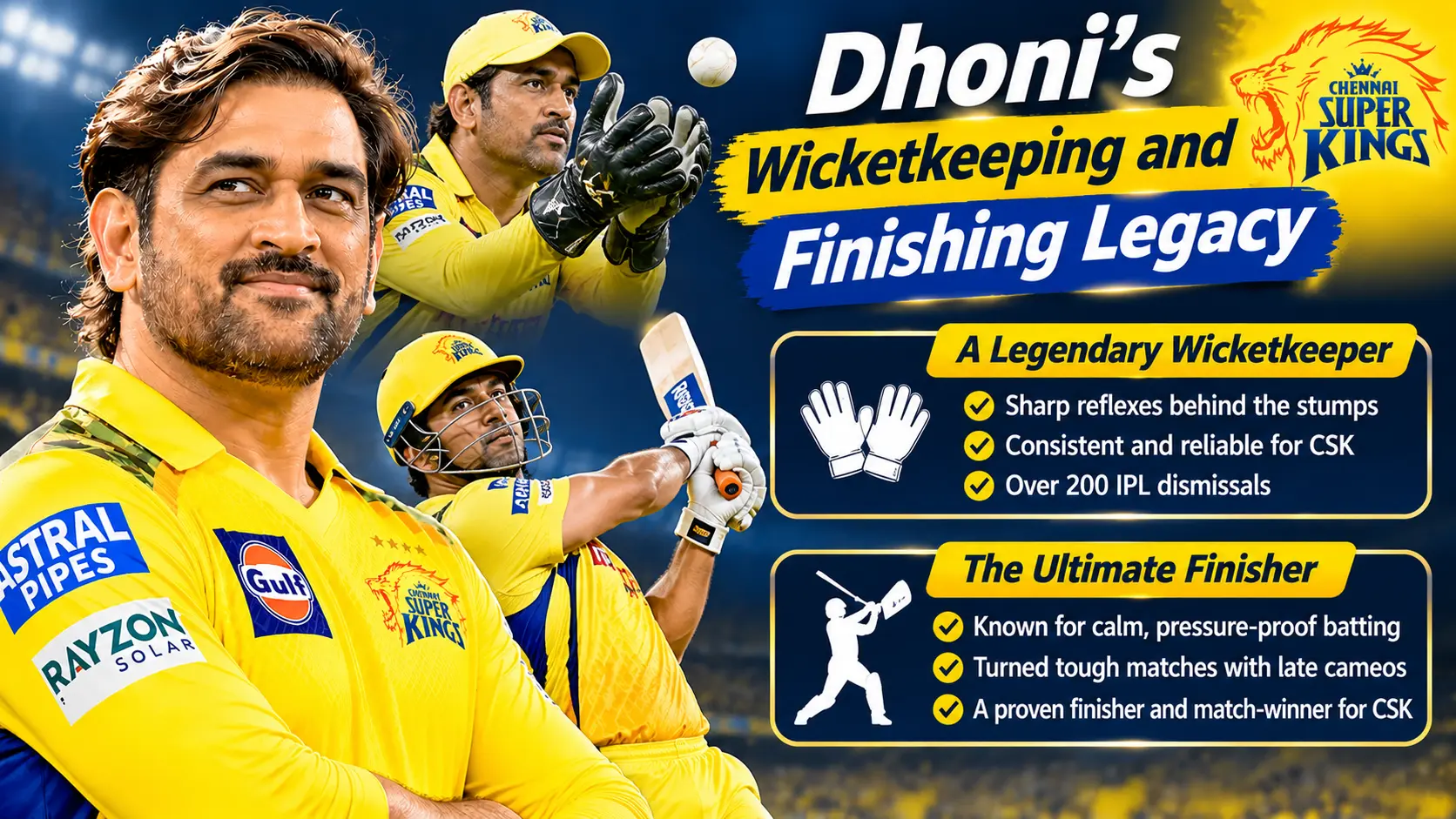
Dhoni’s wicketkeeping was a major part of his value to the team. His glovework was efficient, his collection clean and his stumpings often completed in a fraction of a second. The reported IPL tally of 158 catches and 47 stumpings illustrates how much he contributed behind the stumps over a long career.
| Category | IPL record | What it shows |
|---|---|---|
| Wicketkeeping catches | 158 | Dismissals completed through catches |
| Stumpings | 47 | Quick work behind the stumps |
| Total wicketkeeping dismissals | 205 | Catches and stumpings combined |
| Fours | 375 | Boundary runs from fours |
| Sixes | 264 | Boundary-hitting contribution |
| Highest score | 84 not out | Best individual IPL score |
| Batting strike rate | 137.45 | Scoring rate across his IPL career |
His batting legacy is equally tied to the final overs. Dhoni developed a reputation for assessing a chase before accelerating, preserving options and choosing the right moment to attack. The helicopter shot became a recognisable part of his style, but his success was built on more than one stroke. He read bowlers, used the crease effectively and understood how to manage the required rate.
Not every innings was a spectacular finish, and not every season produced the same returns. What made Dhoni unusual was his ability to influence a match in more than one way. A sharp stumping, a calm conversation with a bowler or a short late cameo could all change the outcome. That all-round influence is one reason his retirement carries significance beyond his run tally.
What MS Dhoni’s Mentor Role Could Mean for CSK
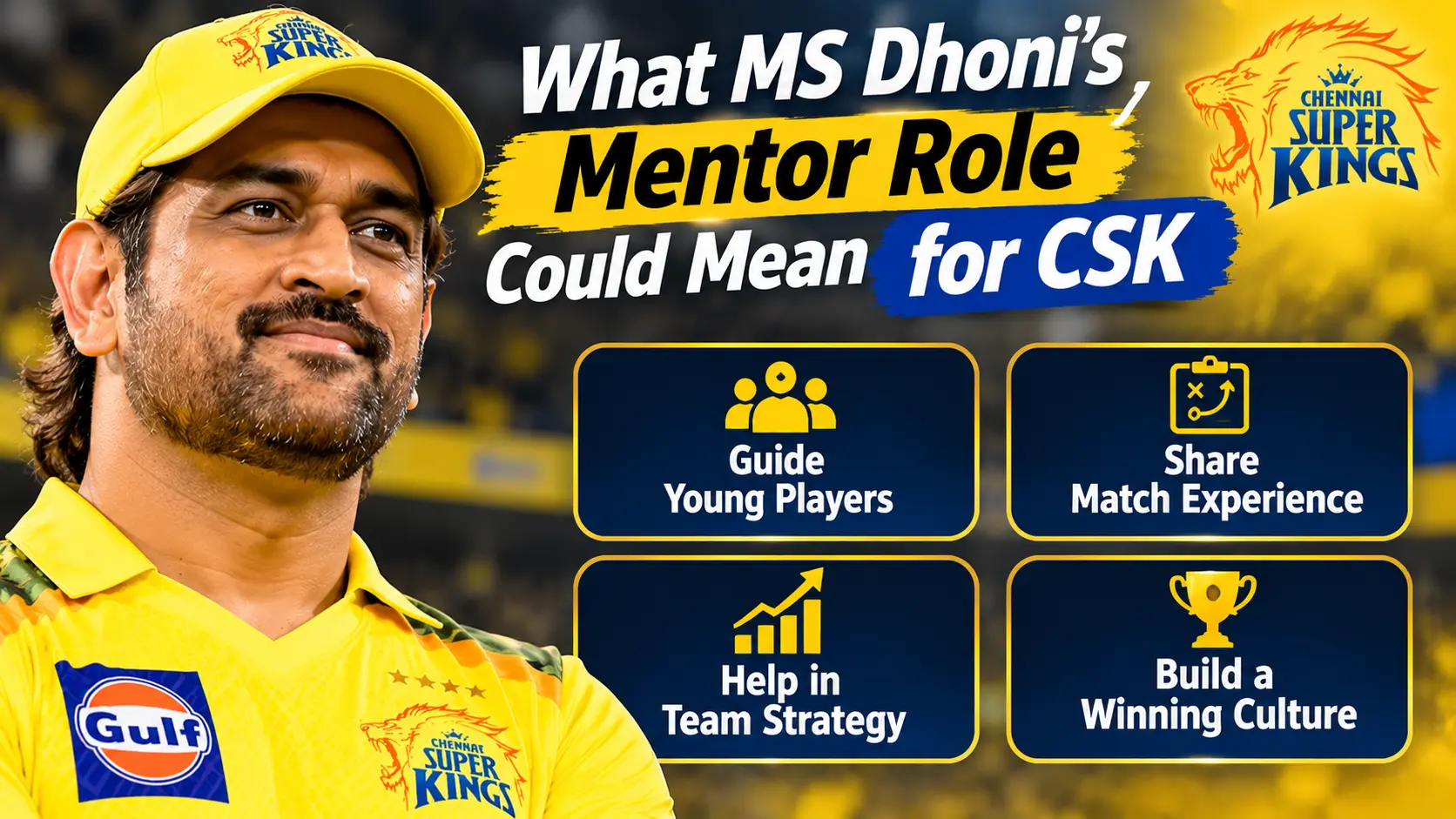
CSK’s decision to appoint Dhoni as Team Mentor gives the franchise access to his experience without requiring him to continue as a player. The team has been navigating a period of transition, and guidance from a figure who has been present since 2008 could help younger members understand the standards and habits associated with the franchise.
Guidance for younger players
Young cricketers entering the IPL face intense scrutiny, demanding travel and rapid changes in match situations. Dhoni has experienced the league through multiple formats of team-building, changing rules and different generations of players. His perspective may help younger teammates prepare mentally, respond to setbacks and understand how to contribute within a team plan.
Experience in pressure situations
Mentorship can also help players learn how to handle close finishes. Dhoni has been involved in high-pressure matches as a batter, wicketkeeper and captain. Sharing the thinking behind decisions—when to attack, when to defend and how to communicate with bowlers—could be valuable to a developing squad. These are potential benefits of the role; CSK has not published a detailed job description.
Continuity in the CSK identity
CSK’s challenge is to build for the future without losing the habits that made the franchise successful. Dhoni’s continued presence offers a bridge between the team’s established culture and its next generation. His role should not be confused with that of head coach or captain unless the franchise formally defines additional responsibilities.
Why MS Dhoni’s IPL Retirement Marks the End of an Era
Dhoni’s retirement closes a chapter that began with the first IPL season. He was one of the few players whose career ran across the league’s early identity, its expansion and its modern global profile. Fans watched him grow from a new captain entrusted with a major franchise into one of the competition’s most recognisable leaders.
His legacy is built from several connected achievements: five IPL titles as CSK captain, more than 5,400 runs, elite wicketkeeping numbers and a long record of influencing close matches. But statistics cannot fully explain why the news has resonated so widely. Dhoni represented a style of leadership that valued composure and clarity, and his connection with Chennai became part of the emotional fabric of the tournament.
There will be no more Dhoni innings in the IPL, but the story does not end with his final appearance. His new role allows him to remain close to the team, share lessons from his career and contribute to CSK’s next phase. For supporters, the yellow jersey will look different without him behind the stumps or walking out to bat. His presence in the dugout, however, will keep a link to the past.
Readers can follow more match reports, tournament coverage and cricket features in the KhelKhabri cricket section. For the franchise’s own announcement, see the official Chennai Super Kings statement on Dhoni’s Team Mentor appointment.
The Seasons That Defined Dhoni’s IPL Journey
Dhoni’s IPL story can be understood through a sequence of turning points rather than one defining innings. In 2008, he took charge of a new Chennai side and helped it reach the final in the competition’s first season. The following years brought back-to-back titles in 2010 and 2011, giving CSK an early reputation for being one of the league’s most dependable teams. Those victories established the foundation for a relationship between captain and franchise that would last well beyond a decade.
| Season / year | Milestone | Significance |
|---|---|---|
| 2008 | Joined Chennai Super Kings as captain | Started his IPL journey |
| 2010 | Won the IPL with CSK | First IPL title as captain |
| 2011 | Won the IPL with CSK | Back-to-back championships |
| 2016–2017 | Played for Rising Pune Supergiant | CSK was suspended from the league |
| 2018 | Returned to CSK and won the title | Champions in the comeback season |
| 2021 | Won another IPL title with CSK | Fourth title as captain |
| 2023 | Led CSK to the championship | Fifth title as captain |
| 2025 | Last IPL season as a player | Final playing campaign |
| 2026 | Missed the season through injury | Did not feature as a player |
| 2027 | Set to become CSK Team Mentor | Begins a new role with the franchise |
The 2013 and 2015 seasons also showed how consistently CSK reached the business end of the tournament, even when the final result did not go their way. The franchise’s two-year suspension then forced Dhoni into a different environment with Rising Pune Supergiant. That period was a reminder that his leadership was not tied only to one set of teammates or one dressing room. When CSK returned in 2018, the team won the title in its comeback season, a result that became one of the most celebrated moments of Dhoni’s captaincy.
Why His Retirement Is Bigger Than a Change in the Playing XI
For a franchise, the retirement of a long-serving player can affect more than team selection. It changes the way supporters relate to match days, how the dressing room distributes responsibility and how younger players understand the club’s history. Dhoni was not simply one name in the CSK squad list. He was the player most closely associated with its identity, and his decisions often became a reference point for the team’s approach.
His absence from the field will also shift the practical responsibilities of the wicketkeeper and senior players. The wicketkeeper is involved in almost every delivery and has a close view of the pitch, batter movement and bowler rhythm. Dhoni used that vantage point to communicate with bowlers and adjust fields. CSK will need its current leadership group to build those habits collectively rather than relying on one experienced voice behind the stumps.
What Fans Should Expect Next
Supporters should expect to see Dhoni connected to CSK in a different way from IPL 2027. The confirmed information is that he will serve as Team Mentor. Beyond that, details about his involvement in training sessions, match preparation, player development or tactical discussions should be treated as matters for the franchise to clarify. A mentor title does not automatically mean that he will be the head coach, team director or final decision-maker on selection.
For CSK, the immediate priority will be to create a clear structure around its captain, coaching staff and senior players. Dhoni’s experience can complement that structure, particularly when the team faces pressure or needs to help younger members settle into the competition. The most effective use of a mentor is often quiet and consistent: asking the right questions, sharing practical lessons and helping players learn from both wins and losses.
For fans, the emotional adjustment may take longer. The familiar image of Dhoni walking out in yellow, setting the field or finishing an innings will no longer be part of the playing season. Yet his continued presence means the connection does not have to disappear. The mentor role gives supporters a new way to see his relationship with the franchise, while allowing the team to move forward with its own leaders.
Frequently Asked Questions About MS Dhoni’s IPL Retirement
1. Has MS Dhoni officially retired from the IPL?
Yes. Chennai Super Kings announced on 17 November 2026 that Dhoni would become the team’s mentor from IPL 2027, confirming the end of his playing career in the tournament.
2. What is MS Dhoni’s new role at Chennai Super Kings?
Dhoni has been appointed Team Mentor of Chennai Super Kings. The role begins from IPL 2027, although the franchise has not publicly detailed every responsibility attached to the position.
3. When did MS Dhoni play his last IPL season?
His last IPL season as a player was 2025. He missed the entire 2026 campaign because of a calf injury before CSK announced his move into the mentor role.
4. How many IPL runs did MS Dhoni score?
Dhoni finished with 5,439 IPL runs in 278 matches, with a highest score of 84 not out and 24 half-centuries, according to the final career figures reported after his retirement.
5. How many IPL trophies did MS Dhoni win as CSK captain?
Dhoni led Chennai Super Kings to five IPL titles, in 2010, 2011, 2018, 2021 and 2023. Those victories made him one of the most successful captains in the league.
6. Will MS Dhoni still be associated with CSK?
Yes. His retirement is from playing in the IPL. He will remain with Chennai Super Kings as Team Mentor from the 2027 season.
Conclusion
MS Dhoni retires from the IPL with a record that reflects longevity, leadership and influence. His five titles with Chennai Super Kings, more than 5,400 runs and outstanding work behind the stumps made him one of the league’s defining players. The move to Team Mentor marks a new chapter rather than a complete goodbye to Chennai. As CSK prepares for IPL 2027, Dhoni’s experience will remain part of the franchise’s journey—and his playing legacy will continue to shape how fans remember the tournament.