

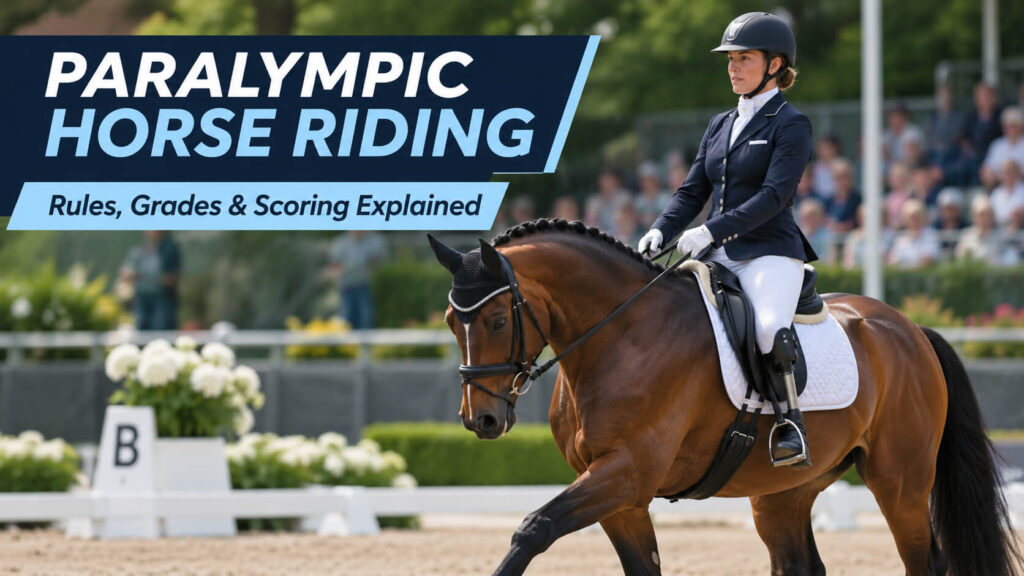
PARALYMPIC SPORT EXPLAINED • UPDATED NOVEMBER 2026
Para equestrian is one of the most precise sports at the Paralympic Games. A rider and horse enter a rectangular arena and perform a planned set of movements. There is no race to the finish line. Instead, judges reward accuracy, balance, rhythm, and the quality of the partnership.
Paralympic horse riding is also called Para dressage. Athletes compete in five grades, so riders with different levels of physical or visual impairment can take part fairly. Each grade has its own technical demands. The sport rewards strong riding, patient training, and excellent communication with the horse.
This guide explains the Para equestrian rules in simple English. You will learn how grades work, what judges look for, and why scores appear as percentages. We will also examine the Paris 2024 medal results, famous partnerships, equipment, and the sport’s history. The facts and statistics are based on official Paralympic and FEI records.
What Is Para Equestrian?
Para equestrian is competitive horse riding for eligible athletes with physical or visual impairments. At the Paralympic Games, the only equestrian discipline on the programme is Para dressage. Riders guide a horse through specific movements in a marked arena. A panel of judges assesses the performance against established standards.
The word dressage comes from a tradition of training horses to move calmly and precisely. In a test, the rider may ask the horse to walk, trot, canter, turn, halt, or move sideways. The exact movements depend on the rider’s grade and the test being performed. Every action should look controlled and natural.
Para dressage shares its basic principles with Olympic dressage. Both disciplines value a relaxed horse, accurate lines, steady rhythm, and clear riding aids. Para dressage adds a classification system and approved adaptive equipment where needed. These adjustments allow athletes to show their riding skill fairly.
It is important not to confuse Paralympic dressage with horse racing or showjumping. Neither racing nor jumping is a medal event within Paralympic equestrian sport. The rider is judged for a dressage test, not speed or the height of an obstacle. This difference is central to understanding the sport.
Para Equestrian at a Glance
The main facts are easy to remember. There are five competition grades and three medal-event formats. At Paris 2024, 76 athletes represented 30 countries across 11 medal events. The event programme included ten individual medal contests and one team contest.
A judge awards marks for movements, and those marks become a final percentage. A higher percentage normally means a better result. The rider’s grade determines which test and arena are used. The horse remains a full athletic partner throughout the routine.
Para Equestrian Classification: Grades I to V Explained
Grades I to V group riders by how an eligible impairment affects their ability to ride. Grade I covers athletes with the greatest activity limitation in this sport. Grade V covers eligible athletes with a comparatively smaller activity limitation. The grade is not a measure of talent, courage, or effort.
Qualified classifiers assess an athlete’s eligible impairment and its effect on riding tasks. Riders do not simply select the grade they prefer. Two riders with different medical conditions may enter the same grade when their functional impact is comparable. This keeps the competition focused on sport performance.
Source: International Paralympic Committee (IPC)
The tests become more technically demanding as the grades rise. Grades I and II focus on movements suited to their classification. Grades IV and V perform more complex work, including canter and lateral movements. Grade III provides a useful bridge between the lower and higher grades.
| Grade | Broad competition profile | Typical test work | Paralympic arena |
|---|---|---|---|
| Grade I | Greatest activity limitation | Walk movements | 20 × 40 metres |
| Grade II | Significant activity limitation | Walk and trot | 20 × 40 metres |
| Grade III | Moderate activity limitation | Walk and trot in set tests; canter may appear in freestyle | 20 × 40 metres |
| Grade IV | Less severe activity limitation | Walk, trot, canter, lateral work | 20 × 60 metres |
| Grade V | Least activity limitation among the five eligible grades | More advanced walk, trot, canter, lateral work | 20 × 60 metres |
This table is a quick guide, not an athlete classification test. Actual eligibility and approved aids are decided through the formal classification process. The movements also depend on the specific published test. National introductory classes may have different requirements from Paralympic competitions.
Does Grade V Mean the Best Riders?
No. Grade V does not identify the strongest rider or the highest ranking. It describes a particular functional classification. A brilliant Grade I rider may be a world champion in Grade I. Results should be compared within the correct grade and event.
Can Men and Women Compete Together?
Yes. Para dressage is an open competition in which men and women compete within the same grade. The relevant factor is the athlete’s classification and performance. Riders with different eligible impairment types may also share a grade. This is one of the sport’s defining features.
What Movements Do Para Dressage Riders Perform?
A Para dressage test is a sequence of movements performed at marked places in the arena. The rider follows a route given in an official test sheet. Judges watch how accurately the horse follows that route. They also assess rhythm, balance, suppleness, and the quality of each movement.
A walk is a four-beat pace and is the main movement in Grade I. A trot is a two-beat pace, with diagonal legs moving together. A canter is a three-beat pace, which appears in higher-grade tests. The horse must stay relaxed and responsive throughout each pace.
Transitions are changes between paces or movements. A horse may walk, halt, and then move forward again. Circles test accuracy, bending, and even rhythm. Lateral work asks the horse to travel partly sideways while keeping an organised movement.
Not every rider performs every movement. The test should match the grade’s approved requirements. Grade III canter is associated with freestyle rather than its standard prescribed tests. Spectators should therefore judge a performance against its grade-specific test, not against another grade’s difficulty.
The Three Para Equestrian Events
At the Paralympics, Para dressage has three competition formats. Two award individual medals, while one awards a single team medal. The Individual and Team tests use set patterns. The Freestyle allows music and a rider-designed routine containing required elements.
1. Individual Championship
In the Individual event, each rider completes a published test for their grade. The route and required movements are known in advance. Judges mark the quality and accuracy of the performance. The highest final percentage wins that grade’s gold medal.
2. Team Championship
A national team has three scoring riders in the Paralympic medal contest. They perform designated team tests, and their percentages are added together. Riders may come from different grades, as permitted by competition rules. The country with the highest combined total wins the single team gold.
3. Individual Freestyle
Freestyle adds choreography and music to the technical challenge. The rider chooses how to arrange compulsory movements within the rules. Judges assess technical execution alongside artistic qualities such as harmony and musical interpretation. Each of the five grades has its own Freestyle medal event.
| Event | What riders perform | How medals are awarded | Medal events at Paris 2024 |
|---|---|---|---|
| Individual | Prescribed grade-specific test | Highest percentage within each grade | 5 |
| Team | Set team tests by three scoring riders | Highest combined team score | 1 |
| Freestyle | Required movements in a choreographed routine with music | Highest percentage within each grade | 5 |
Chart 2 — How the 11 Medal Events Are Divided
Five Individual events, five Freestyle events, and one Team event.
The Individual and Freestyle events each produce five gold medallists. The Team event produces one gold-medal country. That is why the full Paralympic Para dressage programme offers 11 medal events. It also explains why one rider can win more than one medal at the same Games.
How Is Para Dressage Scored?
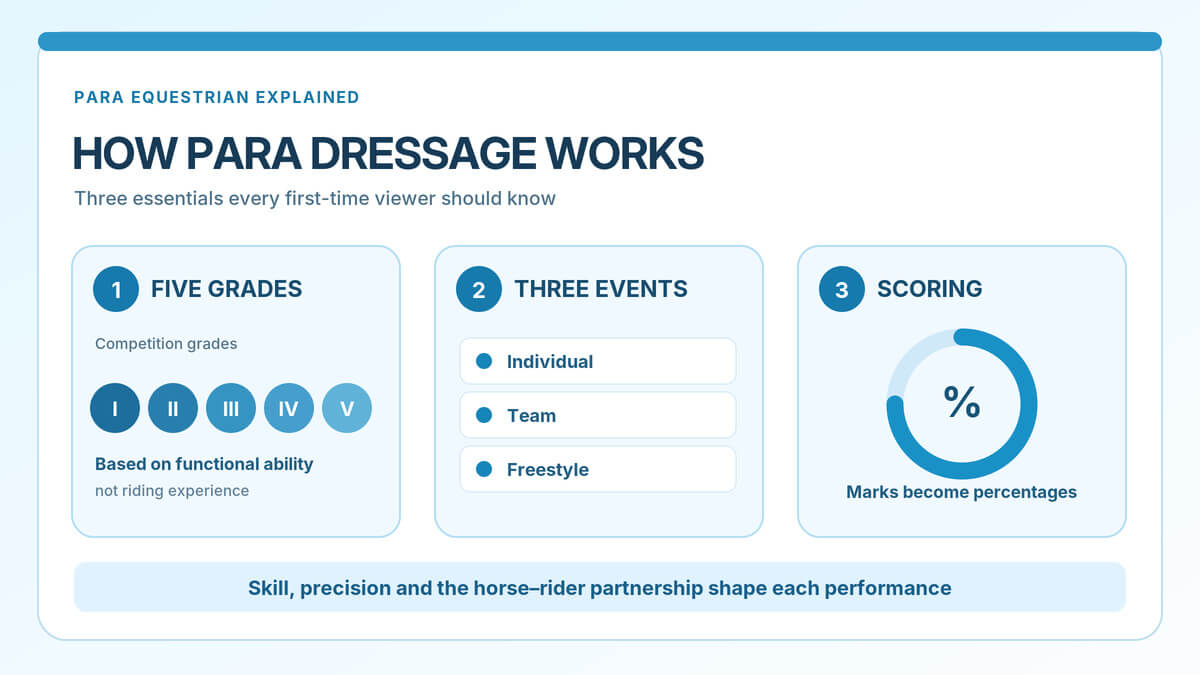
Judges score each required movement and convert the marks into a percentage. Dressage movements are generally marked on a scale from zero to ten. Ten represents excellent execution, while zero means a required movement was not performed. Penalties and test-specific rules can affect the final result.
The basic aim is to earn more points out of the total available. A percentage makes results easier to read. For example, a score of 75% means the rider earned three-quarters of the maximum available marks after the applicable scoring process. It does not mean the horse completed 75% of the course.
Judges assess more than whether a horse reaches the right letter. They consider quality of movement, rhythm, balance, accuracy, and the partnership. In Freestyle, artistic marks also matter. A beautiful routine can lose points if key compulsory movements are missing or poorly performed.
What Does a Good Para Dressage Score Look Like?
A higher percentage is better, but there is no single score that guarantees a medal. The winning mark changes with the event, grade, and strength of the competition. Two scores from different tests should not be treated as identical achievements. Always compare riders within the same competition and grade.
Paris 2024 provides a real example. Rebecca Hart and Floratina won the Grade III Individual gold with 77.900%. Rixt van der Horst placed second with 76.433%. Natasha Baker took bronze with 73.167%, according to FEI records.
| Grade III Individual — Paris 2024 | Country | Horse | Official score |
|---|---|---|---|
| Rebecca Hart | United States | Floratina | 77.900% |
| Rixt van der Horst | Netherlands | Royal Fonq | 76.433% |
| Natasha Baker | Great Britain | Keystone Dawn Chorus | 73.167% |
Chart 3 — Paris 2024 Grade III Individual Scores
Official final scores for the three medallists. Each bar uses a 0–100% scale.
These results show how narrow the margins can be near the top. Hart finished 1.467 percentage points ahead of silver. The gap between silver and bronze was 3.266 points. Small differences in technical quality can change a medal result.
Para Equestrian Arena Size and Markings
Dressage takes place in a rectangular arena surrounded by visible boundary boards. Letters placed around the arena help riders follow the test. The letters act as reference points for turns, circles, transitions, and halts. Judges use them to assess accuracy.
Chart 4 — Arena Sizes: Grades I–III vs IV–V
The larger arena has 50% more area than the smaller one.
At Paralympic level, Grades I, II, and III use a 20 × 40-metre arena. Grades IV and V use a 20 × 60-metre arena. Both are 20 metres wide, but the larger arena is 20 metres longer. The two areas are 800 and 1,200 square metres respectively.
This means the larger arena offers 50% more floor space. It supports the longer lines and movements used in higher-grade tests. A larger arena is not an advantage that every grade needs. The dimensions are part of the sport’s grade-specific requirements.
Why Are Arena Letters Important?
A rider must perform movements at the correct place. A change of pace that starts too early may lose accuracy marks. An uneven circle can also reduce the score. Knowing the arena letters is therefore a basic skill for competitive riders.
For viewers, these letters are a useful way to follow a routine. Watch how a rider approaches each marker and prepares the horse. Smooth preparation often makes difficult movements appear simple. That quiet control is part of the skill being judged.
Adaptive Equipment and Riding Aids
Some Para dressage athletes use approved compensating aids. These can help a rider communicate with the horse or maintain a secure riding position. Equipment needs vary greatly between athletes. Officials check permitted aids against the athlete’s classification and the event rules.
Examples may include modified reins, specially designed stirrup arrangements, or other approved assistance. A rider with a visual impairment may use permitted orientation support. Some riders communicate through subtle seat, weight, or rein signals. The exact aids must match the rider’s approved profile.
These aids do not remove the need for excellent riding. They create an appropriate way to demonstrate the athlete’s skill. The horse still needs clear, consistent training. Safe equipment use and horse welfare remain essential throughout the sport.
How Do Riders Control a Horse Without Standard Leg Aids?
Horses learn to respond to several kinds of signals. These include shifts in the rider’s weight, rein contact, voice where allowed, and other approved aids. A rider and horse practise those signals repeatedly. The aim is to make communication light, clear, and reliable.
The same signal may not work for every partnership. Trainers adapt the horse’s education to the rider’s needs. Consistency is more important than force. Over time, the pair can complete precise routines with very small cues.
Why the Horse-Rider Partnership Matters So Much
In Para equestrian, the horse is not simply equipment. It is an athlete that must understand a particular rider’s cues. That relationship can take months or years to develop. Trust, health, temperament, and regular training all affect performance.
A suitable horse should be willing to learn and comfortable with the rider’s methods. It must also have the movement quality required for competitive dressage. A calm response to crowds and an unfamiliar arena is valuable. The best match depends on the individual rider, not only the horse’s talent.
Training works in both directions. The rider learns the horse’s rhythm and reactions. The horse learns how the rider gives instructions. This shared understanding can help a pair stay accurate even under competition pressure.
Paris 2024 offered memorable examples. American riders Rebecca Hart with Floratina and Fiona Howard with Diamond Dunes each secured Individual and Freestyle gold in their grades. Both were also members of the United States team that won gold. Their success shows the value of high-quality partnerships and consistent preparation.
Para Equestrian vs Olympic Dressage: What’s Different?
The two sports have much in common. Both use a rectangular arena, prescribed movements, trained horses, and judges’ percentages. Both aim for harmony between horse and rider. The clearest difference is the classification system used in Para dressage.
Paralympic athletes compete in grades linked to eligible impairments. Their tests are matched to those grades, and approved adaptations may be available. Olympic dressage does not use the same Paralympic grade structure. Both remain elite sporting competitions requiring technical skill.
| Feature | Paralympic Para dressage | Olympic dressage |
|---|---|---|
| Classification | Five sport grades | No Paralympic grade system |
| Medal programme | Individual, Freestyle, Team | Individual and Team |
| Arena | 20 × 40 or 20 × 60 m, depending on grade | 20 × 60 m at Olympic level |
| Scoring | Dressage marks converted to percentages | Dressage marks converted to percentages |
| Equipment | Approved compensating aids where permitted | Standard dressage equipment rules |
| Main aim | Accurate, harmonious movements | Accurate, harmonious movements |
This comparison is not about deciding which sport is harder. Different tests create different challenges. Each rider competes under the rules of their discipline. The common standard is excellent communication with the horse.
Paris 2024 Para Equestrian: The Numbers Behind the Medals
Paris 2024 was an important event for Para dressage. The competition took place at the Palace of Versailles from 3 to 7 September. Official Paralympic records show 76 competitors from 30 countries. Across the five grades, organisers awarded 11 sets of medals.
The United States topped the sport’s medal table with five golds, one silver, and one bronze. The Netherlands won two golds and four silvers. Belgium and Latvia each won two gold medals. The results reflected a growing spread of success across nations.
| Nation | Gold | Silver | Bronze | Total medals |
|---|---|---|---|---|
| United States | 5 | 1 | 1 | 7 |
| Netherlands | 2 | 4 | 0 | 6 |
| Belgium | 2 | 0 | 0 | 2 |
| Latvia | 2 | 0 | 0 | 2 |
| Germany | 0 | 3 | 3 | 6 |
| Great Britain | 0 | 1 | 6 | 7 |
| Italy | 0 | 1 | 1 | 2 |
| Denmark | 0 | 1 | 0 | 1 |
Chart 1 — Paris 2024 Gold Medals by Country
All 11 gold medals. United States earned five; Netherlands, Belgium and Latvia earned two each.
The gold-medal chart below uses the official medal-table totals. The leading four nations shared all 11 golds. The chart does not compare total medals or overall team quality. It answers one clear question: which countries won Para equestrian gold at Paris 2024?
A Historic Team Victory for the United States
The United States won its first Paralympic Para dressage team title in Paris. Its three scoring riders were Fiona Howard, Rebecca Hart, and Roxanne Trunnell. Their combined team result was 235.567 percentage points. The Netherlands took silver with 232.850, and Germany won bronze with 223.751.
Chart 5 — Team Championship: Paris 2024
The USA topped the overall team score, followed by the Netherlands and Germany.
The result ended Great Britain’s run of Paralympic team titles since the sport joined the Games in 1996. It also showed the strength of the American programme across more than one grade. Team events reward consistency from three riders. One excellent ride alone cannot win the team medal.
The Five Individual Gold-Medal Partnerships
Each competition grade has a separate Individual champion. The gold medallists at Paris 2024 came from four nations. These combinations also went on to win Freestyle gold in their respective grades. That rare sweep was a defining story of the competition.
| Grade | Individual gold medallist | Nation | Horse |
|---|---|---|---|
| I | Rihards Snikus | Latvia | King of the Dance |
| II | Fiona Howard | United States | Diamond Dunes |
| III | Rebecca Hart | United States | Floratina |
| IV | Demi Haerkens | Netherlands | Daula |
| V | Michèle George | Belgium | Best of 8 |
Two riders stand out for their three gold medals. Fiona Howard won Grade II Individual and Freestyle gold, plus Team gold. Rebecca Hart achieved the same treble in Grade III. These are specific Paris 2024 achievements, not claims about every Paralympic Games.
How Para Equestrian Developed: A Short History
Para dressage developed through riding programmes and competitions for people with disabilities. Its competitive roots grew in Europe during the 1970s. International events became more established in later decades. The biggest milestone came when the sport joined the Paralympic programme.
Chart 6 — Four Milestones in Para Dressage
A short timeline of changes that shaped modern Paralympic horse riding.
1996: Paralympic Debut in Atlanta
Para dressage first appeared at the Paralympic Games in Atlanta in 1996. Official FEI historical records list 61 athletes from 16 countries. Riders used borrowed horses at those Games. The event marked the start of a regular Paralympic tradition.
2004: Riders Bring Their Own Horses
The Athens 2004 Games allowed athletes to compete with their own horses. This was an important change for a sport built on close partnerships. Riders could now compete with horses they knew and trained. It helped raise the quality and consistency of performance.
2017: Five Modern Grade Names
The grade names changed in 2017. The old Grade Ia and Grade Ib became Grades I and II. The other grades moved to the modern I-to-V structure. This change matters when comparing old results with modern records.
2024: New Champions at Versailles
At Paris 2024, the sport delivered another important milestone. The United States won its first team gold and topped the medal table. All five Individual champions also won their Freestyle events. The results highlighted the depth of the competition and the importance of the horse-rider partnership.
What Makes a Great Para Dressage Horse?
A top Para dressage horse needs more than impressive movement. It must be fit, trainable, patient, and responsive. The horse should understand the rider’s particular signals. It also needs confidence in loud and unfamiliar competition environments.
Some horses are naturally calm, while others need time to adjust. Trainers develop balance, strength, flexibility, and steady paces. Horses also need suitable rest, feeding, veterinary care, and recovery. Welfare is not separate from performance; it supports long-term soundness and trust.
A rider may try several horses before choosing a partner. Height, movement, temperament, and responsiveness can all influence the decision. A powerful horse may not suit every rider’s needs. The best partnership is one where both athletes can perform safely and confidently.
How Do Athletes Start Para Equestrian?
A beginner usually starts by finding an appropriate riding centre or coach. The first lessons focus on safety, balance, and communication. Riding sessions may be adapted to the athlete’s physical needs. Professional advice is important before beginning training.
As skills develop, a rider can explore local Para dressage competitions. A national federation can explain classification and entry requirements. Athletes seeking international competition must follow the relevant FEI classification and registration procedures. The route to elite sport takes time and regular practice.
Horse riding also has recreational and therapeutic settings, but these are not the same as Paralympic sport. Therapeutic riding may focus on personal goals or wellbeing. Para dressage is a judged competitive discipline with formal tests. Understanding the difference helps beginners find the right programme.
How to Watch Para Equestrian Like an Expert
Start by checking the rider’s grade and which test is being performed. A Grade I walk test has different requirements from a Grade V Freestyle. Watch whether the horse keeps an even rhythm. Look for smooth turns, clean transitions, and accurate lines.
Then watch the rider’s communication. Strong performances often look quiet and effortless. The horse should appear willing, balanced, and attentive. In Freestyle, notice whether the music and movement fit naturally together.
Finally, read the percentage score rather than relying on crowd reaction. A lively routine is not automatically the highest-scoring one. The judges assess defined technical and artistic criteria. Knowing those criteria makes the medal contest easier to follow.
Common Misunderstandings About Paralympic Horse Riding
One common mistake is assuming Para equestrian is less technical than Olympic dressage. The sport requires excellent timing, balance, and horse training. Another mistake is assuming all athletes ride the same test. Classification changes both the technical demands and arena size.
Some viewers think approved adaptive aids give a rider an unfair advantage. In reality, equipment must follow strict rules and an athlete’s approved needs. The goal is equitable access to competition, not an easier standard of judging. The horse’s response and the quality of riding still decide the result.
A final mistake is thinking the horse earns a medal through its own performance alone. The rider and horse compete as one partnership. The rider plans, communicates, and adjusts throughout the test. The horse contributes its training, movement, focus, and athletic ability.
Frequently Asked Questions About Para Equestrian
What is Para equestrian in the Paralympics?
Para equestrian is a Paralympic horse-riding sport featuring Para dressage. Riders perform set movements in an arena, and judges award percentage scores. Athletes compete within five classification grades. The sport has Individual, Team, and Freestyle events.
Is Para equestrian the same as Para dressage?
At the Paralympics, Para dressage is the equestrian discipline contested. The wider term Para equestrian may also describe other adapted equestrian activities. For Paralympic medal events, Para dressage is the correct discipline name. Horse racing and showjumping are not on the Paralympic equestrian programme.
How many grades are there in Para dressage?
There are five modern grades, numbered I to V. They group eligible athletes by the functional impact of their impairment. Grade I represents the greatest activity limitation in this sport. The tests are designed to suit each grade.
How are Para equestrian riders judged?
Judges mark the technical movements, then calculate a final percentage. Each required movement generally receives a mark from zero to ten. Freestyle also includes artistic assessment. The highest percentage wins within the relevant grade and event.
Can blind or visually impaired athletes compete?
Yes. Eligible vision impairments are included within Para dressage classification. Riders may use approved aids and support methods according to their needs. The exact rules depend on the athlete’s classification and competition. Classifiers and officials determine the appropriate arrangements.
Do horses win medals in Para equestrian?
The official medals are awarded to the athlete or national team. However, horses are vital partners and are named in results. A horse’s training and performance strongly influence the final score. Many successful riders publicly recognise the horse as a fellow athlete.
Do Para equestrian riders jump fences?
No. Paralympic Para dressage does not include a jumping medal competition. Riders perform movements on the flat inside a marked arena. The test emphasises control, balance, rhythm, and precision. Jumping is a separate equestrian discipline.
What size is a Para dressage arena?
Grades I to III use a 20 × 40-metre arena at Paralympic level. Grades IV and V use a 20 × 60-metre arena. Both have a width of 20 metres. Published national introductory tests may use different arrangements.
Who won the most Para equestrian gold medals at Paris 2024?
The United States led the Para equestrian medal table with five gold medals. The Netherlands, Belgium, and Latvia each won two. The American team also took its first Paralympic team gold. These totals come from the official Paris 2024 results archive.
When did Para equestrian join the Paralympic Games?
Para dressage made its Paralympic debut at Atlanta 1996. Its early competitions included riders using borrowed horses. By Athens 2004, riders could compete with their own horses. The modern five-grade naming system was introduced in 2017.
Final Thoughts: A Sport Built on Precision and Trust
Para equestrian shows how much communication can happen without dramatic movement. A small change in balance can become a clear signal. A well-trained horse responds with calm, accurate action. The result is sport built on skill, trust, and patient preparation.
Learning the rules makes Para dressage more enjoyable to watch. The five grades explain why the tests differ. The percentage scores reveal how close the medal battles can be. The history and Paris 2024 results show how the sport continues to develop.