

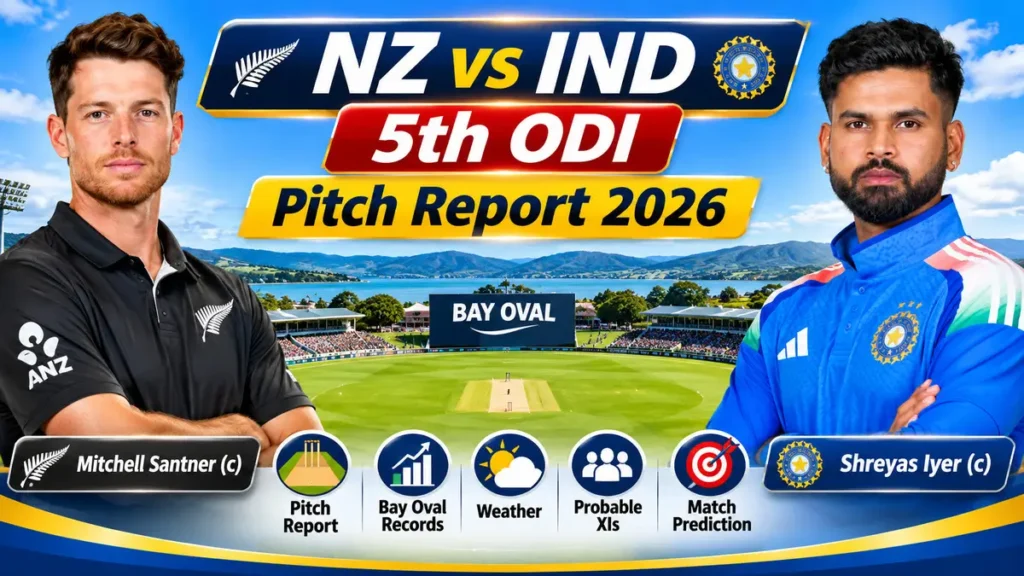
India tour of New Zealand · Men’s ODI series
Updated 14 November 2026 · Fifth ODI pre-match preview · Playing XIs unconfirmed
The NZ vs IND 5th ODI Pitch Report now has a fresh warning for both batting sides: New Zealand made 333 at Bay Oval on 13 November, then dismissed India for 89. The finale is scheduled for 15 November at 7:30 AM IST. India lead the series 2–1, but a New Zealand win would draw it 2–2.
India’s ODI campaign in New Zealand ends with a second match at Bay Oval, Mount Maunganui. The first fixture there ended in a 244-run New Zealand victory, underlining how quickly the balance can shift between the two innings. Sunday’s fifth ODI gives India a chance to clinch the series outright and New Zealand the chance to share it.
After four ODIs, India have two victories, New Zealand have one, and the third match was abandoned without a ball being bowled. India won the first ODI by five wickets under DLS and the second by four runs under DLS, before the washout in Hamilton and the defeat at Bay Oval. That makes the fifth ODI more than a routine finale: the series outcome is still undecided.
Match date, IST timing and Bay Oval stadium details
The fifth ODI is scheduled for Sunday, 15 November 2026, at Bay Oval, Mount Maunganui. The 3:00 PM New Zealand daylight time start corresponds to 7:30 AM IST and 02:00 UTC on the same date. The official BCCI fifth ODI match centre lists the match details.
Bay Oval sits within Blake Park in Mount Maunganui, part of Tauranga. The venue’s own information lists a capacity of 12,000 and describes it as the home of Bay of Plenty cricket since 2007. Its banks and floodlights give it an open-ground setting for an afternoon start that can extend into the evening.
| ODI | Date | Venue | Result |
|---|---|---|---|
| 1st | 4 November | Eden Park, Auckland | India won by 5 wickets (DLS) |
| 2nd | 7 November | Hnry Stadium, Wellington | India won by 4 runs (DLS) |
| 3rd | 10 November | Seddon Park, Hamilton | No result · rain |
| 4th | 13 November | Bay Oval, Mount Maunganui | NZ won by 244 runs |
| 5th | 15 November | Bay Oval, Mount Maunganui | 7:30 AM IST · upcoming |
Fans travelling to either Bay Oval game can use our India vs New Zealand match ticket guide for booking steps and venue information. Check the individual fixture’s live availability and entry instructions before making travel plans.
Can the India vs New Zealand ODI series end in a draw?
Yes, a 2–2 series draw is still possible. India lead 2–1 after four matches because the rain-hit third ODI produced no result. Only one match remains, so New Zealand can level the win count by winning at Bay Oval on Sunday. India, however, cannot lose the series from their present position.
A no-result or tied fifth match would not give either side an extra victory, leaving India ahead 2–1. A completed India win would make the final score 3–1. This is a draw in the bilateral series, not a tied match: the two terms describe different things.
The third ODI’s washout is the reason New Zealand can only draw. After India won the first two fixtures, the abandoned game in Hamilton removed one chance for the hosts to recover. The 244-run fourth-ODI victory returned the contest to life, but it could not reverse India’s two-win lead on its own.
Why did India lose the fourth ODI against New Zealand?
India lost by 244 runs on 13 November 2026 because their 334-run chase collapsed immediately against the moving new ball. Matt Henry dismissed Rohit Sharma, Virat Kohli and captain Shreyas Iyer for ducks in the first over — a triple-wicket maiden that left the chase in ruins before India scored. India were 0/3, fell to 9/4 in the sixth over and eventually made only 89 in 26.4 overs.
Runs scored · New Zealand’s total set as 100% scale. Victory margin: 244 runs.
The opening-over collapse left no recovery room
A chase of 334 needs a platform, especially against an attack that can move the ball early. Henry removed three experienced batters before India scored a run. Kyle Jamieson then dismissed Ruturaj Gaikwad for five, turning an already difficult chase into one that required a near-perfect rescue. As explained in the New Zealand vs India 4th ODI 2026 match analysis, these early wickets left India with almost no room for recovery. India could no longer build through the normal stages of a 50-over innings.
Henry and Fisher took nine wickets between them
Henry finished with a career-best 6/27 from 9.4 overs, as confirmed in the ICC fourth-ODI report. Matthew Fisher took 3/31, while Jamieson claimed 1/12. Ishan Kishan top-scored with 27 from 53 balls, and Axar Patel and Naman Dhir contributed 21 each. Kishan and Axar briefly added 44 for the fifth wicket, but that stand could not make up for the missing top order.
Fourth ODI wickets: Henry 6/27, Fisher 3/31, Jamieson 1/12.
Young’s century made the target unforgiving
New Zealand had already reached 333 all out after Will Young scored 125 off 108 balls, Tim Seifert made 58 off 48 and Finn Allen struck 41 off 30. India did take wickets in the middle and late overs, but the runs scored by the hosts meant the reply needed steady partnerships from the start. Axar’s 2/39 was India’s most economical major spell, yet it was not enough to contain the full innings.
The lesson for the fifth ODI is not simply to bat more cautiously. India need to survive the first movement, communicate better between batters and avoid forcing strokes before understanding the pitch. New Zealand must also replace Henry and Jamieson in the fifth-ODI attack, so the same collapse cannot be assumed to repeat automatically.
NZ vs IND 5th ODI Pitch Report and toss factors
Bay Oval’s scorecards support a conditional reading. India defended 324 here in January 2019, while New Zealand successfully chased a target of 297 in February 2020. England suffered a rapid top-order collapse in October 2025. On 13 November 2026, the hosts scored 333 before bowling India out for 89. That contrast shows why a good batting surface in one innings need not be easy after the break.
New-ball movement and the first ten overs
The opening spell will reveal whether the surface offers seam movement, uneven pace or reliable carry. A bowler hitting a full enough length can bring the outside edge into play. Batters should identify that threatening length early and avoid turning a manageable spell into a collapse by driving away from the body.
For the fielding captain, an attacking slip is useful while edges remain a realistic chance. Once the movement fades, maintaining that field has a cost if the batting side can collect easy singles. The change from wicket hunting to controlling the rate should follow what the ball is doing, rather than a fixed over number.
Middle overs and the spin contest
India can pair Axar Patel’s left-arm orthodox bowling with Kuldeep Yadav’s wrist-spin. New Zealand have Mitchell Santner and Michael Bracewell available. These combinations let the captains change the direction of turn and challenge different scoring areas, particularly if the surface becomes slower as the ball softens.
The batting response should begin with strike rotation. Repeated singles prevent a spinner from settling into one matchup and make the captain defend more areas. A batter who attacks only after several dots may have to manufacture a risky shot, especially if the longer boundary is protected and the bowler can vary the pace.
Should the toss winner bat or bowl?
Bowling first becomes attractive if the strip retains moisture or the hourly forecast suggests interruptions. Batting first has a stronger case on a firm surface where a side expects to score freely and then use scoreboard pressure. The selected strip and boundary layout will help decide which approach suits each attack.
The fourth ODI has now provided a direct reference: New Zealand made 333, but India could not withstand the early seam movement in reply. Sunday may use a different strip, and even a reused pitch could behave differently with changes in weather, moisture or surface wear. Captains should inspect the fifth-ODI wicket rather than assuming the 244-run margin guarantees another one-sided contest.
Bay Oval ODI records, average score and India’s history
Published Bay Oval averages differ because databases can include different time periods and shortened games. A transparent way to view the venue is to calculate the mean of named match scores rather than present one disputed number as universal. The five first innings shown below total 1,419 runs, giving an average of 283.8 for this selected sample only.
The table below uses five identifiable men’s ODI scorecards, including the 13 November match. They span seasons with different teams and playing conditions, and each innings is shown with its actual completed score. The sample gives useful context for a possible competitive total, but it does not predict the fifth ODI’s first-innings score.
| Date | First innings | Chase | Result |
|---|---|---|---|
| 26 Jan 2019 | India 324/4 | New Zealand 234 | India by 90 runs |
| 28 Jan 2019 | New Zealand 243 | India 245/3 | India by 7 wickets |
| 11 Feb 2020 | India 296/7 | New Zealand 300/5 | New Zealand by 5 wickets |
| 26 Oct 2025 | England 223 | New Zealand 224/6 | New Zealand by 4 wickets |
| 13 Nov 2026 | New Zealand 333 | India 89 | New Zealand by 244 runs |
Sample first-innings average: 283.8 (1,419 total runs ÷ 5 matches).
The five selected first innings average 283.8 runs, calculated from 333, 324, 296, 243 and 223. The range is 110 runs, showing that Bay Oval can produce notably different totals. This is not a venue-wide career average; it is a reproducible snapshot of the named matches above.
Rohit Sharma made 87 in India’s 324/4 in 2019. In the 2020 meeting, KL Rahul scored 112 and Shreyas Iyer added 62, yet New Zealand reached 300/5 in 47.1 overs. Iyer therefore brings experience of rebuilding an innings at this ground, while the result shows how much work remains after posting a substantial total.
England’s 2025 innings offers another lesson. Harry Brook made 135, but his team finished on 223 after losing its first five wickets for 33. New Zealand also had to recover from early losses to complete the chase. A standout innings can keep a side competitive, although protecting partnerships gives it more ways to control the later stages.
Mount Maunganui weather forecast for 15 November
Forecasts checked on 14 November 2026 suggest a mild Sunday in the Mount Maunganui area, with afternoon temperatures near 20–22°C. Some services show a chance of passing showers or drizzle, while others expect longer dry spells. That difference is important: neither a complete washout nor an uninterrupted match should be treated as certain.
A city-level forecast cannot establish the playing conditions at Bay Oval minute by minute. The most useful check will be the hourly outlook around the 3:00 PM local start and into the evening. A brief shower could delay the first ball or change the surface, while a mostly dry afternoon would give both sides more predictable 50-over planning.
Dew remains an unconfirmed factor. If moisture develops later, gripping slower balls may become harder; if the surface retains seam movement, the new ball can still matter more than the toss. Friday’s fourth ODI showed how dramatically the first few overs can shape a chase, but Sunday’s boundary positions and pitch preparation still require inspection.
If rain interrupts play, revised overs and a DLS target may affect both the match and the series outcome. The first two ODIs were decided under DLS, and the third produced no result. With India leading 2–1, even an abandoned final match would be enough for the visitors to finish ahead in the series.
India squad for the fifth ODI and Iyer’s selection options
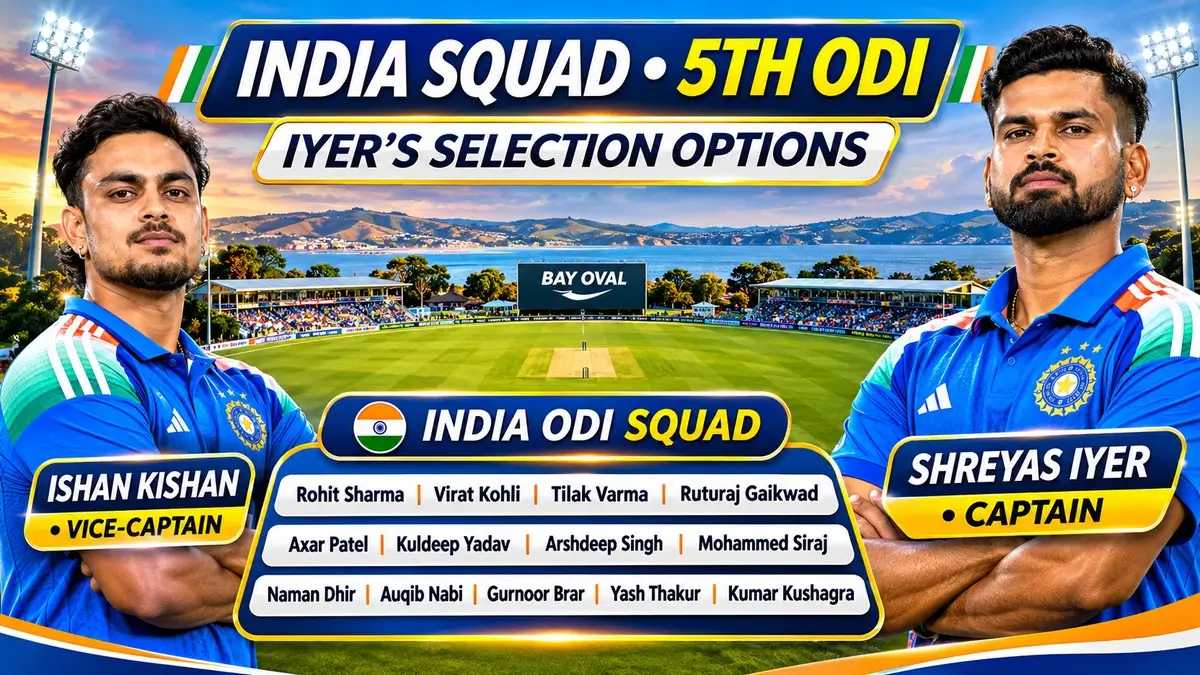
India’s fifth-ODI squad has Shreyas Iyer as captain and Ishan Kishan as vice-captain and wicketkeeper. Rohit Sharma and Virat Kohli remain in the group. In the fourth ODI, India used Ruturaj Gaikwad at the top and lost Rohit, Kohli and Iyer in the opening over. Selection for the fifth match must address the new-ball problem without assuming a complete reshuffle is the answer.
India squad Updated by BCCI on 14 November for ODI 5
- Shreyas Iyer · Captain
- Rohit Sharma
- Virat Kohli
- Tilak Varma
- Ishan Kishan · Vice-captain, wicketkeeper
- Axar Patel
- Naman Dhir
- Auqib Nabi
- Ruturaj Gaikwad
- Arshdeep Singh
- Kumar Kushagra · Wicketkeeper
- Mohammed Siraj
- Yash Thakur
- Kuldeep Yadav
Latest squad update, 14 November: The BCCI confirmed Gurnoor Brar has joined India’s Test squad and will not be available for the fifth ODI. No replacement was named. He played in the fourth ODI, but must not appear in Sunday’s projected XI. India can consider Mohammed Siraj or Yash Thakur in the remaining pace options.
BCCI’s October updates removed Nitish Kumar Reddy from the later ODI group as he moved towards India A preparation. Prasidh Krishna was ruled out of the ODI series following his hamstring injury. Auqib Nabi remains in the Bay Oval squad; Kuldeep Yadav is also listed among the fifth-ODI players in the BCCI’s November 14 update.
Ishan offers a left-handed opening option, but India used Ruturaj Gaikwad alongside Rohit in the fourth ODI. Tilak Varma and Naman Dhir remain batting alternatives, while Kumar Kushagra is the other designated keeper. The question now is whether India retain the same top order for one more game or change the batting sequence to better manage movement.
India can use Auqib Nabi, Arshdeep Singh and an additional seamer alongside Axar and Kuldeep, but the fourth match showed the cost of letting New Zealand build 333. Axar took 2/39, while Kuldeep went wicketless for 73 runs in eight overs. With Gurnoor unavailable, Mohammed Siraj and Yash Thakur provide alternative seam options for the finale.
New Zealand squad, replacements and fitness watch
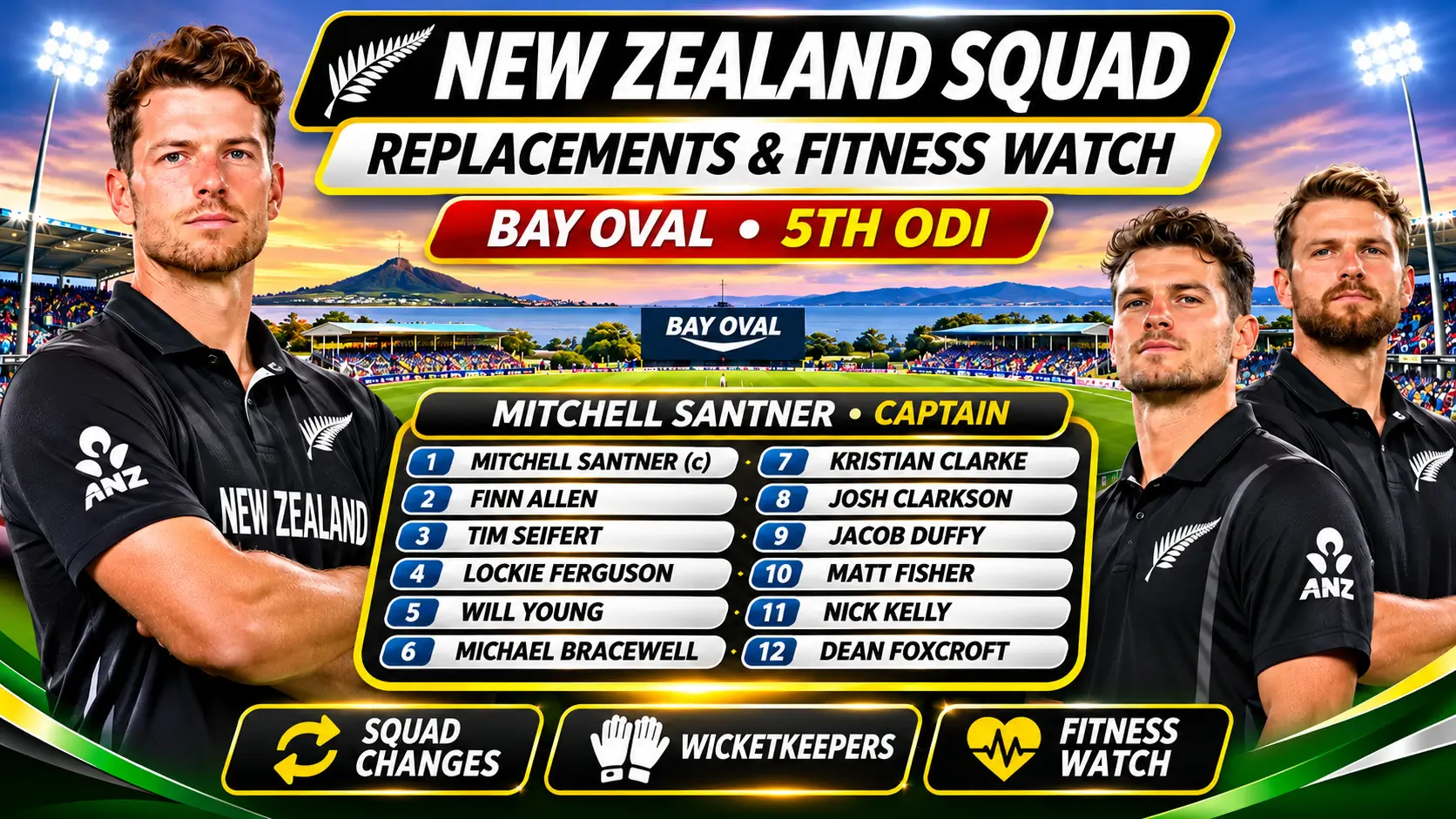
Mitchell Santner leads New Zealand’s updated and confirmed fifth-ODI squad. The hosts have made several changes as players switch to Test preparation. Matt Henry and Kyle Jamieson, decisive bowlers in the fourth ODI, are not in the fifth-match squad. Josh Clarkson and uncapped seamer Brett Randell have been added, while Blair Tickner is named again.
New Zealand squad Confirmed for ODI 5 · NZC update 12 November
- Mitchell Santner · Captain
- Finn Allen
- Michael Bracewell
- Kristian Clarke
- Josh Clarkson
- Jacob Duffy
- Matt Fisher
- Dean Foxcroft
- Mitch Hay · Wicketkeeper
- Nick Kelly
- Brett Randell · Uncapped
- Tim Seifert · Wicketkeeper
- Blair Tickner
- Will Young
New Zealand Cricket’s 12 November update confirmed Brett Randell and Josh Clarkson among the available fifth-ODI players. Lockie Ferguson has been ruled out of the rest of the ODI series, while Matt Henry and Kyle Jamieson return to Test preparations rather than playing the finale. Dean Foxcroft, who featured in the fourth ODI, remains an option for the middle order.
Henry’s six-wicket performance will be difficult to replace directly. Jacob Duffy, Matt Fisher, Kristian Clarke, Blair Tickner and Brett Randell form the available specialist seam choices, with Clarkson adding all-round depth. Tickner’s fitness and availability have been updated since his second-ODI concussion substitution; the final XI still requires confirmation at the toss.
Michael Bracewell’s off-spin complements Santner’s left-arm bowling, while both can contribute with the bat. New Zealand can use those overs to balance a refreshed pace attack. With Randell uncapped and Henry unavailable, the hosts must decide whether to introduce a new bowler immediately or rely on experience from Duffy and Fisher.
Probable XIs, key players and match prediction
Editorial projections updated after the fourth ODI: These teams use players from the confirmed fifth-match squads, but the final XIs are not yet announced. India may make changes after the 89 all-out collapse; New Zealand must replace Henry and Jamieson. Fitness, surface conditions and the toss can still alter the balance.
India probable XI:Rohit Sharma, Ruturaj Gaikwad, Virat Kohli, Shreyas Iyer (Captain), Ishan Kishan (Vice-Captain, Wicketkeeper), Axar Patel, Naman Dhir, Auqib Nabi, Kuldeep Yadav, Mohammed Siraj, Arshdeep Singh.
New Zealand probable XI: Will Young, Tim Seifert (Wicketkeeper), Nick Kelly, Dean Foxcroft, Finn Allen, Michael Bracewell, Mitchell Santner (Captain), Josh Clarkson, Jacob Duffy, Matt Fisher, Kristian Clarke.
New Zealand’s probable XI must not include Henry, Jamieson or Ferguson, who are absent from the final-ODI squad. Brett Randell could make his international debut, while Josh Clarkson offers another all-round option. India must review the pace selection because Gurnoor Brar has been released to the Test squad; any starting-XI change remains unconfirmed until the toss.
The three contests that can shape the match
India’s top order against the new ball. Friday exposed a weakness when Rohit, Kohli and Iyer fell for ducks in the first over. New Zealand no longer have Henry for the fifth ODI, but Duffy and Fisher can still test the batters’ outside edges. India need a stable first ten overs rather than an early scoring rush.
Iyer against Santner and Bracewell. Iyer must first survive the pace attack before taking charge of the middle overs. Finding singles between boundaries can prevent New Zealand from building pressure, but India will also need supporting runs from Kishan and the lower middle order after Friday’s collapse.
India’s spin versus Young and New Zealand’s middle order. Will Young’s 125 in the fourth ODI showed how valuable a settled batter can be. Axar’s 2/39 stood out among India’s spells, while Kuldeep had a difficult outing. Brar’s absence also makes the selection of a replacement seamer important. Better control in the middle overs could reduce the size of a target before India face the new ball again.
Who will win the fifth ODI?
Updated prediction: the match looks closely balanced. India retain the two-win series advantage and the experience of Rohit, Kohli and Iyer, but the 244-run defeat makes a confident favourite difficult to name. New Zealand showed how to use Bay Oval conditions, although Henry and Jamieson will be unavailable for the final match.
New Zealand’s strongest route is another disciplined new-ball spell, followed by enough batting depth to reach a competitive total. India must protect their opening wickets and make fuller use of Axar’s control. Pitch selection, weather and the revised New Zealand attack remain important uncertainties behind any estimated win chances.
These percentages are illustrative editorial predictions, not official odds or measured probabilities. A tied ODI or a rain-related no-result is not the same as a drawn series. If New Zealand win the match, the five-game series finishes 2–2; India cannot lose the series outright.
India vs New Zealand series probability: who takes the trophy?
Because India already lead 2–1, the fifth ODI and the series have different outcomes. Using the illustrative match estimates above, India retain the series if they win (47%) or the final match finishes tied or without a result (7%). That gives India a 54% illustrative chance of finishing as series winners, compared with a 46% illustrative chance of a 2–2 series draw if New Zealand win.
How reliable are these percentages? They are subjective editorial scenarios to help readers compare possibilities. They are not computed from a validated forecasting model, current market prices, or a measured weather probability. After the toss, surface inspection, revised forecast and confirmed teams could make the contest more favourable to either side.
Frequently asked questions
When and where is the NZ vs IND 5th ODI?
The match is scheduled for Sunday, 15 November 2026 at Bay Oval, Mount Maunganui. It starts at 7:30 AM IST (3:00 PM New Zealand daylight time).
Can the India vs New Zealand ODI series end in a draw?
Yes. India lead 2–1 after the fourth match, with the third ODI washed out. New Zealand can win the fifth ODI to level the series at 2–2. A fifth-match tie or no-result would leave India ahead 2–1.
Why did India lose the fourth ODI?
New Zealand made 333 and India were dismissed for 89, losing by 244 runs. Matt Henry removed three Indian batters in the first over and finished with 6/27.
Is Bay Oval a batting or bowling pitch?
Bay Oval can produce substantial totals but still offer early seam movement. New Zealand scored 333 in the fourth ODI before India lost three wickets without scoring in the first over of its reply.
What is the average first-innings score at Bay Oval?
Published venue-wide averages vary. The five named men’s ODIs in this article have an average first-innings score of 283.8; that is a selected-match sample, not a universal venue average.
Will rain affect the fifth ODI?
Forecasts checked on 14 November differ on the amount and timing of any showers. A passing shower is possible, but match-day hourly conditions will be more reliable.
Who captains India, and when are the XIs confirmed?
Shreyas Iyer is captain for the final two ODIs, with Ishan Kishan as vice-captain. Playing XIs are confirmed at the toss; the teams here remain projections.
Who is predicted to win the fifth ODI?
The match is closely balanced after New Zealand’s fourth-ODI win. Illustrative editorial estimates give India 47%, New Zealand 46% and a tie/no-result 7%; these are not official odds. India lead the series 2–1, while New Zealand must replace Matt Henry and Kyle Jamieson for the finale.
Final assessment before the series finale
The NZ vs IND 5th ODI Pitch Report must now be read alongside the fourth ODI’s extreme contrast: New Zealand scored 333 and India made 89. The big question is whether a fresh pitch and a new-look home pace attack change how the first ten overs unfold. With India leading 2–1, Sunday’s winner will decide whether the series ends 3–1 or 2–2.
The fourth ODI has sharpened this preview, but Sunday’s strip, weather and confirmed XIs will make the final difference. BCCI’s November 14 update rules Gurnoor Brar out of the final ODI, while New Zealand must replace Henry and Jamieson. India have the series advantage; New Zealand can still force a draw. The teams should be assessed on the bowling attacks actually available for the fifth ODI rather than those who played on Friday.