

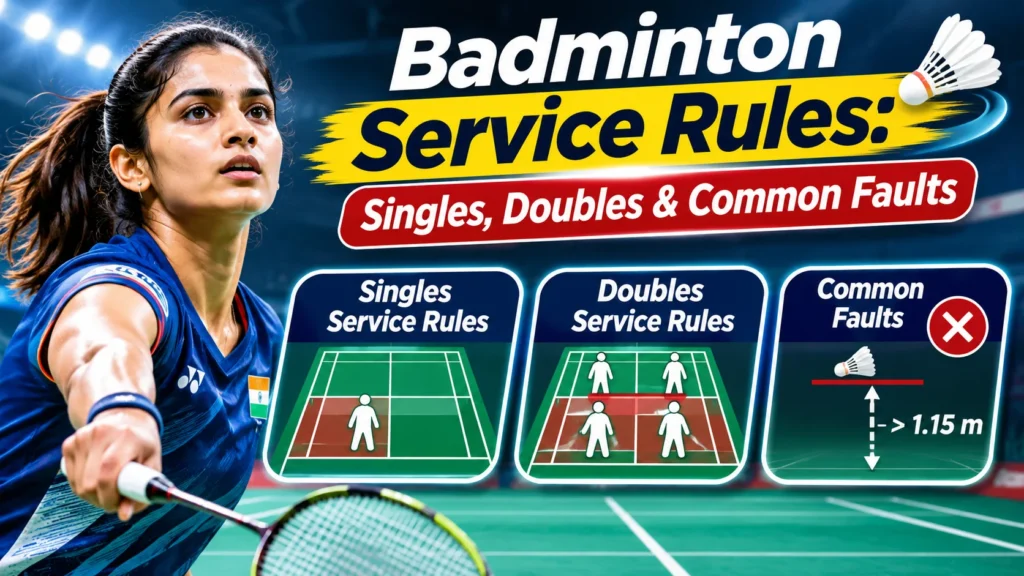
Badminton service rules require you to serve diagonally, stand inside the correct service court, keep your feet still, and contact the shuttle below the official height. The side’s score decides whether the serve starts on the right or left. Singles and doubles share the basic service laws, but doubles has a special rotation system.
A serve looks simple until someone asks which line counts, whether your partner can receive, or what happens when the shuttle clips the net. These small details decide real points. If you learn them early, you can focus on the rally instead of arguing before it begins.
Badminton Service Rules: The Quick Legal-Serve Checklist
Every rally begins with the server and receiver in opposite diagonal service courts. A good serve sends the shuttle upward over the net toward the correct box. The shuttle may land on a boundary line that belongs to that box, but neither player may stand on a service-court line while preparing and delivering the serve.
BWF Law 9 sets the standard. You can check the formal wording in the official BWF Laws of Badminton. The same basic rules apply to forehand and backhand service, whether you are playing singles, men’s doubles, women’s doubles or mixed doubles.
| Requirement | What you must do | Common mistake |
|---|---|---|
| Position | Stand inside the correct service court | Foot touches a boundary line |
| Direction | Serve diagonally | Shuttle goes to the wrong box |
| Feet | Keep part of both feet still and grounded | Sliding a foot before contact |
| Height | Keep the whole shuttle below 1.15 m at contact | Hitting too high |
| Release | Do not add spin when releasing the shuttle | Twisting it deliberately |
| Contact | Hit the base of the shuttle first | Striking feathers first |
| Motion | Continue the racket’s forward movement | Pausing after starting |
| Attempt | Make contact after starting the service | Missing the shuttle |
The server must also avoid undue delay once both sides are ready. The receiving player must be ready before the serve, and a return attempt normally counts as readiness. These rules protect fairness: neither side should gain an advantage by moving early, faking a second swing or serving while the other player is unprepared.
Simple memory rule: Right for even, left for odd; serve across; keep your feet planted; strike low and cleanly.
Singles Service Rules: Which Side Do You Serve From?
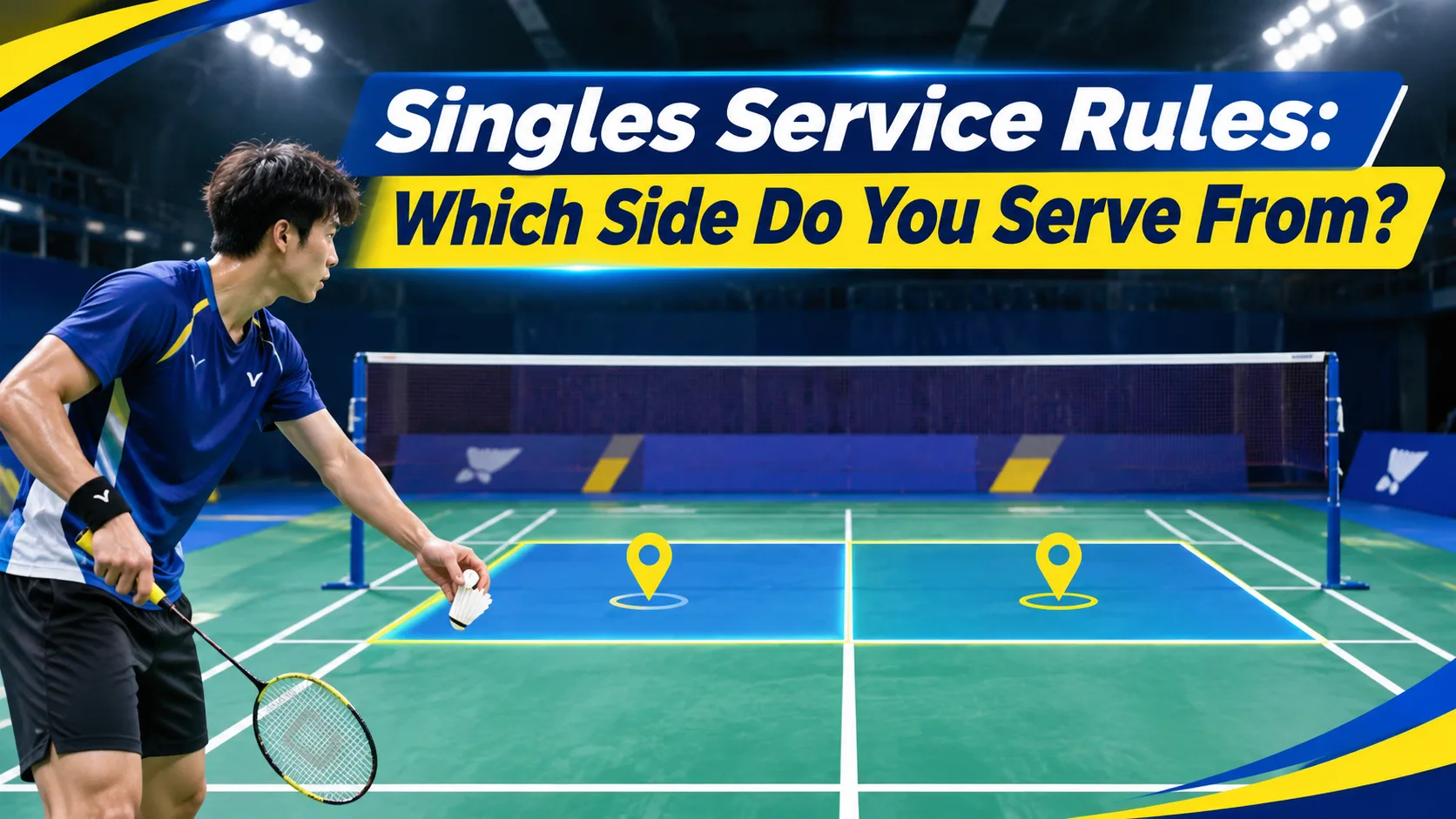
In singles, each player covers the court alone. The most useful rule is also the easiest to remember: look at the server’s current score, not the opponent’s score. If the server has zero or an even number of points, the serve comes from the right service court. If the server has an odd number, it comes from the left.
Serve diagonally when your score is even, including the opening 0–0 score.
Serve diagonally when your score is odd. Switch courts after winning a point on your serve.
Imagine Riya serving at 6–4. Six is even, so she stands on her right. She wins the rally and her score becomes seven. She now serves from the left. If she loses the next rally, her opponent earns a point and becomes the server. The opponent checks their own score to choose the new serving court.
Notice what does not happen: players do not keep serving from the right because they won the last rally, nor do they use the combined match score. Service court choice follows the serving player’s score in that game. Winning a rally while receiving gives you both a point and the next serve under rally-point scoring.
| Server’s score | Service court | Why? |
|---|---|---|
| 0 at 0–0 | Right | Zero is even |
| 5 at 5–3 | Left | Five is odd |
| 12 at 12–11 | Right | Twelve is even |
| 17 at 17–19 | Left | Seventeen is odd |
Singles serves use the narrower side boundaries and the full length to the back boundary line. A high, deep serve is common in many singles matches because it can push the opponent back. A low serve can also be legal and useful. There is no rule that singles must use one particular style.
Doubles Service Rules: Rotation, Partners and Receiver
Doubles often confuses beginners because four people share the court. Start with the same score rule: if the serving pair’s score is even, the serve comes from the right; if it is odd, from the left. Only the player diagonally opposite the server is the designated receiver for that service.
After a pair wins a rally while serving, it scores a point. The same player serves again from the other service court, so the serving partners change positions. If the pair loses the rally, the opponents score a point and get the service. The receiving pair does not swap courts just for winning a receiving rally.
Consider pair A/B against pair C/D. A starts serving at 0–0 from the right. If A/B win, they lead 1–0, and A moves to the left to serve again. If C/D then win the rally, the score becomes 1–1. C/D take the serve; the player in the left service court serves because their score is odd. Their partners do not switch simply because they gained service.
Only one player in the receiving pair should return the serve: the player standing diagonally opposite. After that legal return, either partner may hit shots during the rally. Partners may stand at different positions, provided they do not block the view of the opposing server or receiver during delivery.
| Situation | Who serves next? | Do partners switch courts? |
|---|---|---|
| Serving pair wins | Same server | Yes, serving pair switches |
| Receiving pair wins | Player in court matching new score | No automatic switch |
| Let is called | Same server repeats | No |
| Wrong order found | Correct the order | Restore correct courts; score stands |
Do not use the outdated idea that each partner must take one serve before the service passes over. Under modern rally-point scoring, a side has one turn of service. Doubles rotation follows where each player is standing and who last served; it is not a fresh choice of server after every point.
Mixed doubles follows the same service laws. One partner does not receive special serving rights because of gender, height or position at the net. A pair can agree on tactics, but it cannot change the official service order to suit a preferred player.
Badminton Service Court Lines: Singles vs Doubles
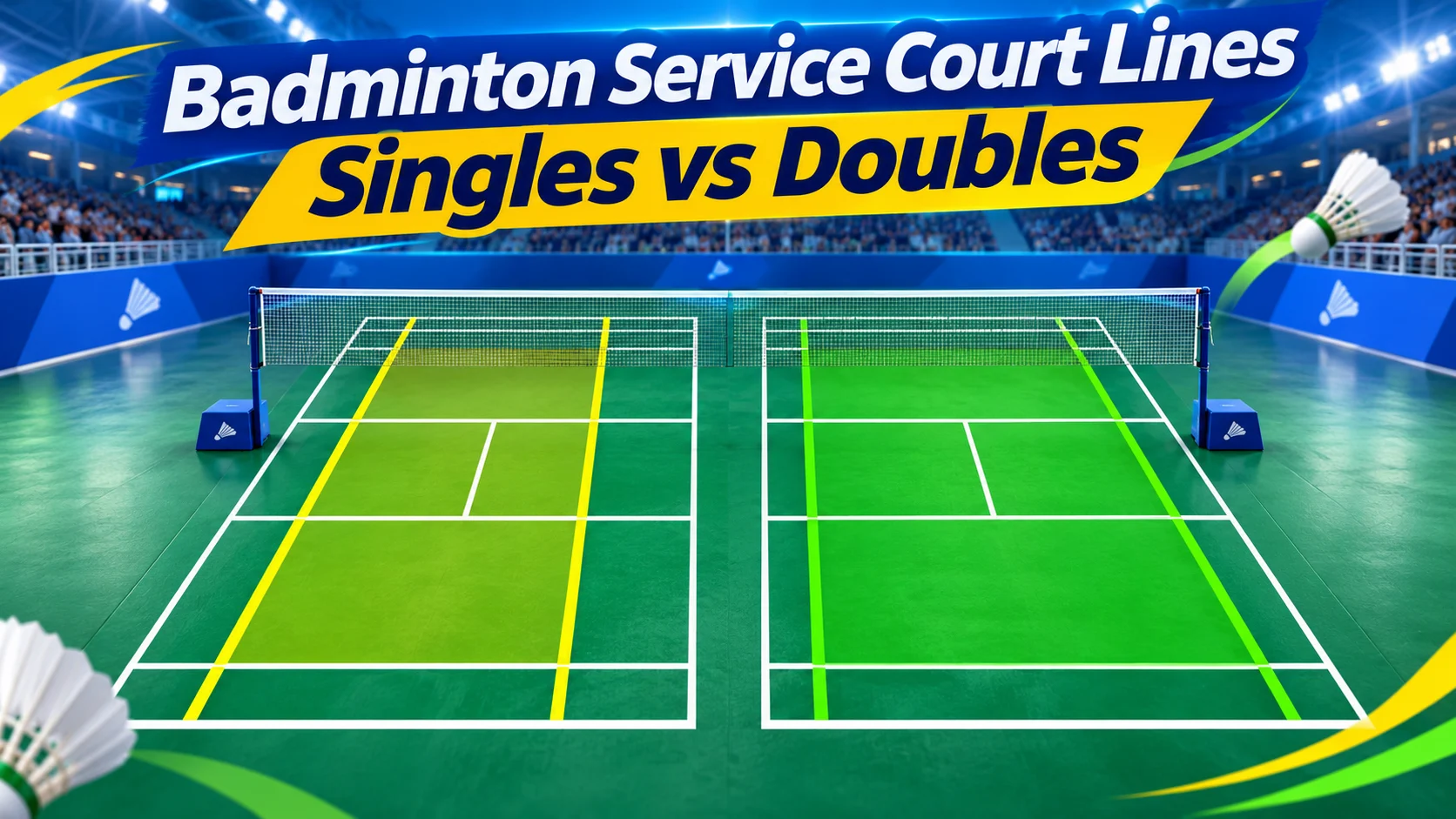
Badminton courts display several boundary lines. For normal rallies, singles uses the inner side lines and the full back boundary. Doubles uses the wider side lines. But the doubles service box is shorter than the doubles rally court, because the long service line for doubles sits inside the back boundary.
That difference causes many avoidable faults. A deep serve that lands close to the back boundary may be legal in singles but too long in doubles. A wide serve near the outer side line may be legal in doubles but out in singles. In both versions, the shuttle must cross the short service line to reach the proper service area.
| Court feature | Singles service | Doubles service |
|---|---|---|
| Side boundaries | Inner singles side lines | Outer doubles side lines |
| Near boundary | Short service line | Short service line |
| Far boundary | Full back boundary line | Doubles long service line |
| Direction | Diagonal opposite box | Diagonal opposite box |
| Shuttle on a valid line | In | In |
Remember the difference between a player touching a line and a shuttle landing on a line. The first may be a service fault if it is a line of the service court and the player is serving or receiving. The second is legal when that line belongs to the receiver’s correct service box.
Serve Height, Feet, Racket Movement and Spin
The fixed 1.15-metre service height
Under the standard BWF law, the entire shuttle must be below 1.15 metres from the surface of the court when the racket hits it. The rule measures the shuttle, not the racket grip or the player’s waist. It is the same fixed height for players of different heights in standard badminton.
Older tutorials may say that the shuttle must be hit below the waist with the racket pointing down. That wording belongs to an alternative service-law system rather than the standard fixed-height test. Some local competitions use different approved rules, so check your tournament’s event regulations. Para badminton also has specific provisions, including for wheelchair and standing classifications.
Stationary feet and a clean first hit
From the start of service until delivery, some part of both feet of both the server and receiver must remain on the floor in a stationary position. This does not mean you must stay frozen for the full rally. It means you cannot slide, lift or step as the service is being delivered.
The server must release the shuttle without adding spin, and the racket must first strike its base. Deliberately twisting the shuttle with the fingers before contact breaks that rule. It also does not become legal simply because the shuttle lands inside the service box.
One continuous forward racket movement
The forward movement of the racket head marks the start of service. After that point, the racket must continue forward until the serve is delivered. A pause, extra fake or second forward attempt is not a valid way to trick the receiver. If the server begins the service and misses the shuttle, the attempt is a fault; badminton does not offer a tennis-style second serve.
A forehand high serve, backhand short serve and flick serve can all satisfy the laws. Their different flight paths are choices of technique, not separate permissions to ignore height or foot rules. Good players make the same legal preparation look controlled and repeatable.
Common Service Faults, Lets and Court Errors
A service fault normally gives the opposing side the rally and a point. Examples include serving too high, moving a foot before contact, serving from outside the proper service box or failing to strike the shuttle after the service starts. A serve that lands outside the opponent’s correct service court also loses the rally.
| What happens? | Decision | Reason |
|---|---|---|
| Foot touches a service line during delivery | Fault | Illegal standing position |
| Whole shuttle at or above 1.15 m at contact | Fault | Height condition not met |
| Server adds spin on release | Fault | Illegal shuttle release |
| Shuttle clips net and lands in correct service box | Play on | Net contact alone is legal |
| Receiver not ready and does not attempt return | Let | Rally is replayed |
| Service from wrong court is discovered | Correct error | Existing score stands under Law 12 |
| Receiving partner intercepts service | Fault | Wrong player returns serve |
A let is not the same as a fault. A let cancels the interrupted rally, leaves the score unchanged and has the same server try again. For example, if a player serves before the receiver is ready and the receiver does not try to return, a let may be called. For more precise situations, see our guide to what is a let in badminton.
One frequent myth says that touching the net automatically makes a service a let. In fact, if the shuttle touches the net and travels over into the correct box, play continues. If a served shuttle is caught on the net and stays there, the rules treat that as a fault. The shuttle’s final outcome matters.
There is another important distinction: under BWF Law 12, a service-court error means a player served or received out of order or from the wrong service court. When discovered, the officials correct the error while the shuttle is not in play, and the existing score stays. Do not automatically replay every earlier rally or remove points already scored.
Practise a Legal Serve and Understand the 2026 Scoring Change
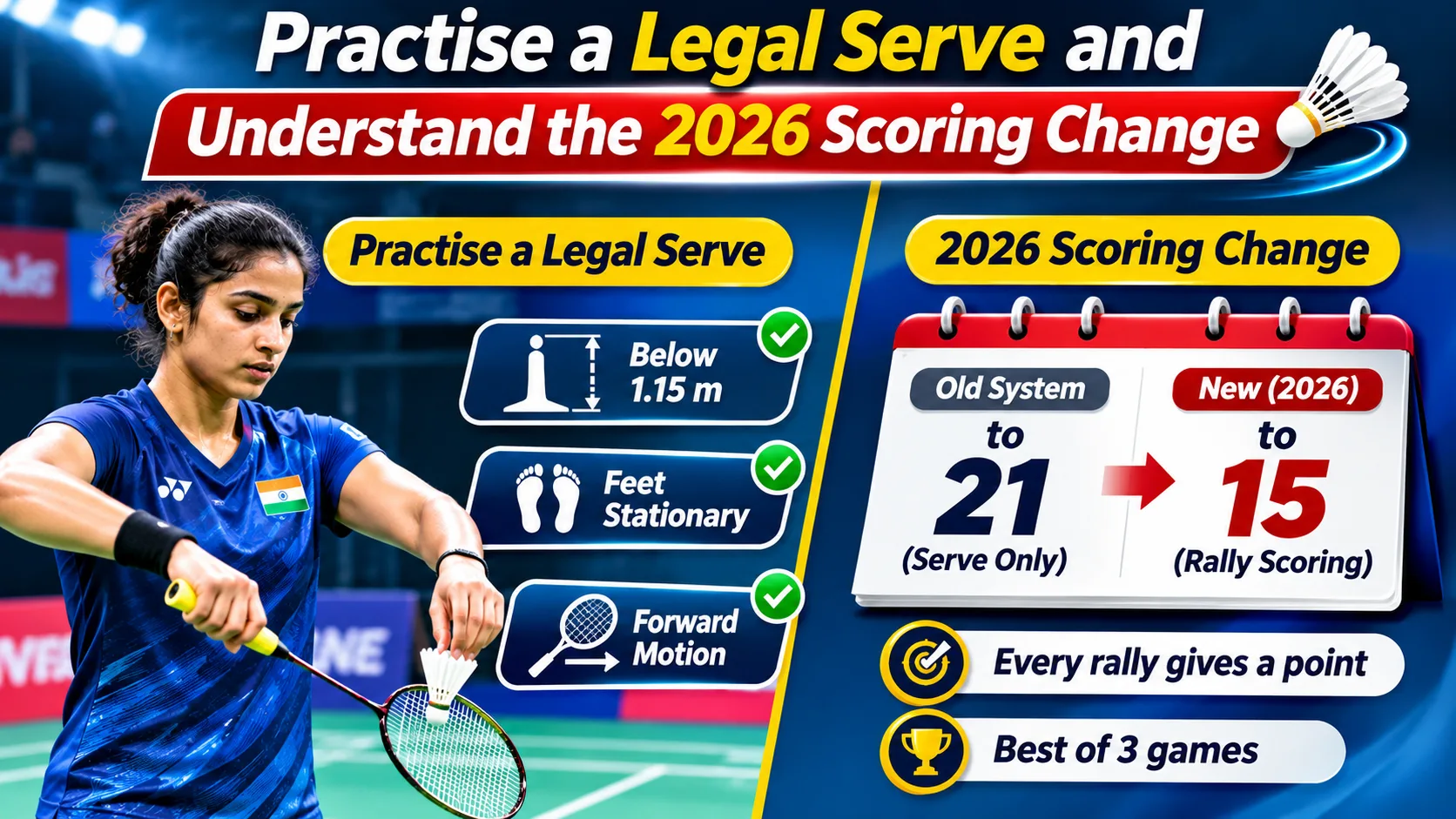
You can learn the law and still make faults under pressure. The best approach is to repeat a short routine. Check the score, move to the correct side, face the right receiver, settle your feet and make a smooth forward movement. Place the shuttle below the legal height before you strike it.
- Mark two targets. Aim one near the short service line and one deeper inside the valid box.
- Practise ten serves from the right. Use an even score as your cue, then count the ones that land in.
- Practise ten from the left. Use odd-score examples and check your feet each time.
- Rehearse doubles rotation. Play four points slowly and say the server’s name and score aloud.
- Ask a partner to watch. They should check moving feet, height and whether your racket pauses.
Try three match situations. First, the score is 8–6 in singles: the server uses the right court. Second, the serving doubles pair wins at 3–3: its score rises to four and the same server moves from left to right. Third, a serve hits the net tape but drops legally into the diagonal box: the receiver must still play it.
India’s major domestic badminton competitions began moving to best of three games to 15 points from July 2026. BWF-sanctioned international events are scheduled to adopt that format from 4 January 2027. In November 2026, the 21-point system remains the international standard unless a competition uses an approved alternative.
This change mainly affects how long games last. The core service habits—correct court, height, contact and movement—remain essential whether a game is played to 15 or 21. A score of 14 is even, so service comes from the right; a score of 15 is odd, so it comes from the left. The score target does not change parity.
Frequently Asked Questions About Badminton Service Rules
1. What is the official height for a badminton serve?
In standard BWF badminton, the whole shuttle must be below 1.15 metres above the court surface at the instant of racket contact. Some approved alternative and Para badminton service provisions differ, so check the event rules if relevant.
2. Which side serves first in badminton singles?
The opening serve is taken from the right service court because the server’s score is 0, an even number. After that, the server uses the right for even scores and the left for odd scores.
3. Does the same partner keep serving in doubles?
Yes, while the serving pair keeps winning rallies, the same player serves and alternates between service courts. Once the pair loses a rally, service passes to the opposing pair according to the proper service order.
4. Is a serve legal if it touches the net?
Yes. If the served shuttle touches the net but crosses and lands in the correct diagonal service court, it is legal and the rally continues. If it fails to cross or becomes trapped, the server may be faulted.
5. What happens if someone serves from the wrong court?
BWF Law 12 treats this as a service-court error. When it is discovered, the correct court or order is restored while the shuttle is out of play, and the existing score stands.
6. Can a player get a second serve after a miss?
No. If the server starts the service and misses the shuttle, that is a fault. The opponent wins the rally and point; badminton does not have a second-service system like tennis.
Final Takeaway: Serve Fairly in Every Game
The best way to remember badminton service rules is to follow the same order every rally: check your score, choose the right or left court, face the diagonal receiver, keep your feet still and strike the shuttle below 1.15 metres with one continuous legal movement. Learn the service boundaries for singles and doubles before your next game.
In doubles, focus on who is actually serving and receiving rather than moving partners at random. If an unusual incident occurs, decide whether it was a fault, a let or a correctable service-court error. These distinctions make close matches fairer and help new players enjoy the sport with fewer stoppages.