

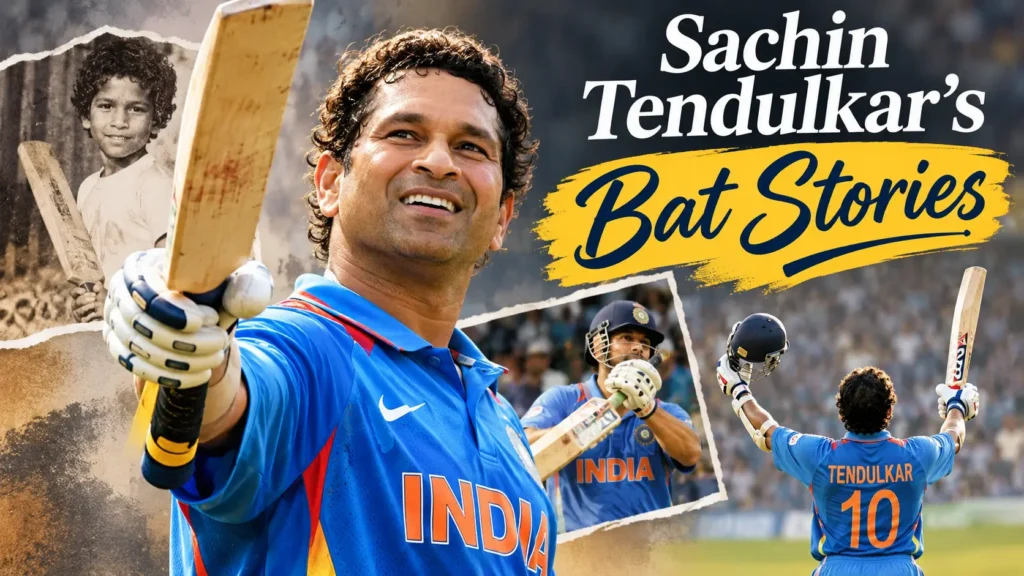
From a childhood gift brought from Kashmir to the bats associated with landmark innings, Sachin Tendulkar’s stories reveal how confidence, comfort, family values and respect for equipment shaped his relationship with cricket.
For Sachin Tendulkar, a cricket bat was much more than a piece of willow used to score runs. The most memorable Sachin Tendulkar bat stories reveal a connection built through childhood, training, international cricket and some of the sport’s greatest moments. His recollections of individual bats show how equipment can become connected to confidence, routine and personal history.
When a collection of 25 bats from Tendulkar’s career was presented for display at the Mumbai Cricket Association’s Sharad Pawar Cricket Museum, the stories behind them offered fans a different way to understand the batting legend. They covered an unexpected childhood gift, his first season-ball bat, a blank bat during the 1996 World Cup, a bat originally intended for Sunil Joshi and the equipment he used during major innings. The central message was consistent: a bat must feel right, and a player should respect the equipment and the opportunity it represents.
One of the Most Memorable Sachin Tendulkar Bat Stories: His First Bat
Tendulkar recalled receiving his first cricket bat at around five years old, when his elder sister Savita returned from Kashmir with it. He had expected familiar gifts such as fruit or dry fruits, so the bat came as a delightful surprise. He described becoming so excited that the bat accompanied him wherever he went.
Sport was part of his childhood more broadly: he enjoyed badminton, hockey, tennis and table tennis. In his residential colony in Bandra, he and his brothers played tennis on the terrace, sometimes with a tennis racket in one hand and a cricket bat in the other. The playful experience helped him notice that he enjoyed batting more than tennis-racket play a small memory that neatly captures how his sporting interest became increasingly focused on cricket.
Early Play and Natural Discovery
These were informal games rather than a formal training programme, but they offered repetition, coordination and the pleasure of striking a ball. The story also illustrates a useful principle for young athletes: enjoyment can be an important starting point before structured practice and competition become central. A childhood object can hold emotional significance long after its practical role has changed.
His First Season-Ball Bat and the Importance of Feel
As Tendulkar became more serious about cricket after changing schools around the sixth-standard stage, his family recognised that he needed his own kit. Until then, he had borrowed bats and protective equipment from his club. His brother Ajit spoke to their father about getting him a proper kit, and coach Ramakant Achrekar accompanied him to a showroom to choose a bat.
Tendulkar immediately liked a full-size bat, even though Achrekar considered it heavy and large for an 11- or 12-year-old. He had previously shared a full-size bat at a camp and developed a grip lower on the handle to make it feel more manageable. The coach tried changing his grip, but Tendulkar struggled with the adjustment and returned to the grip that felt natural.
He later used that bat in school matches and scored runs with it. He remembered being protective of it after noticing that some senior players at Wankhede appeared interested in the bat. The anecdote is a reminder that the best bat for a player is not necessarily the one selected by appearance, brand or a generic specification; it is the one that allows the player to swing comfortably and confidently.
The Blank Bat and the 1996 World Cup Decision
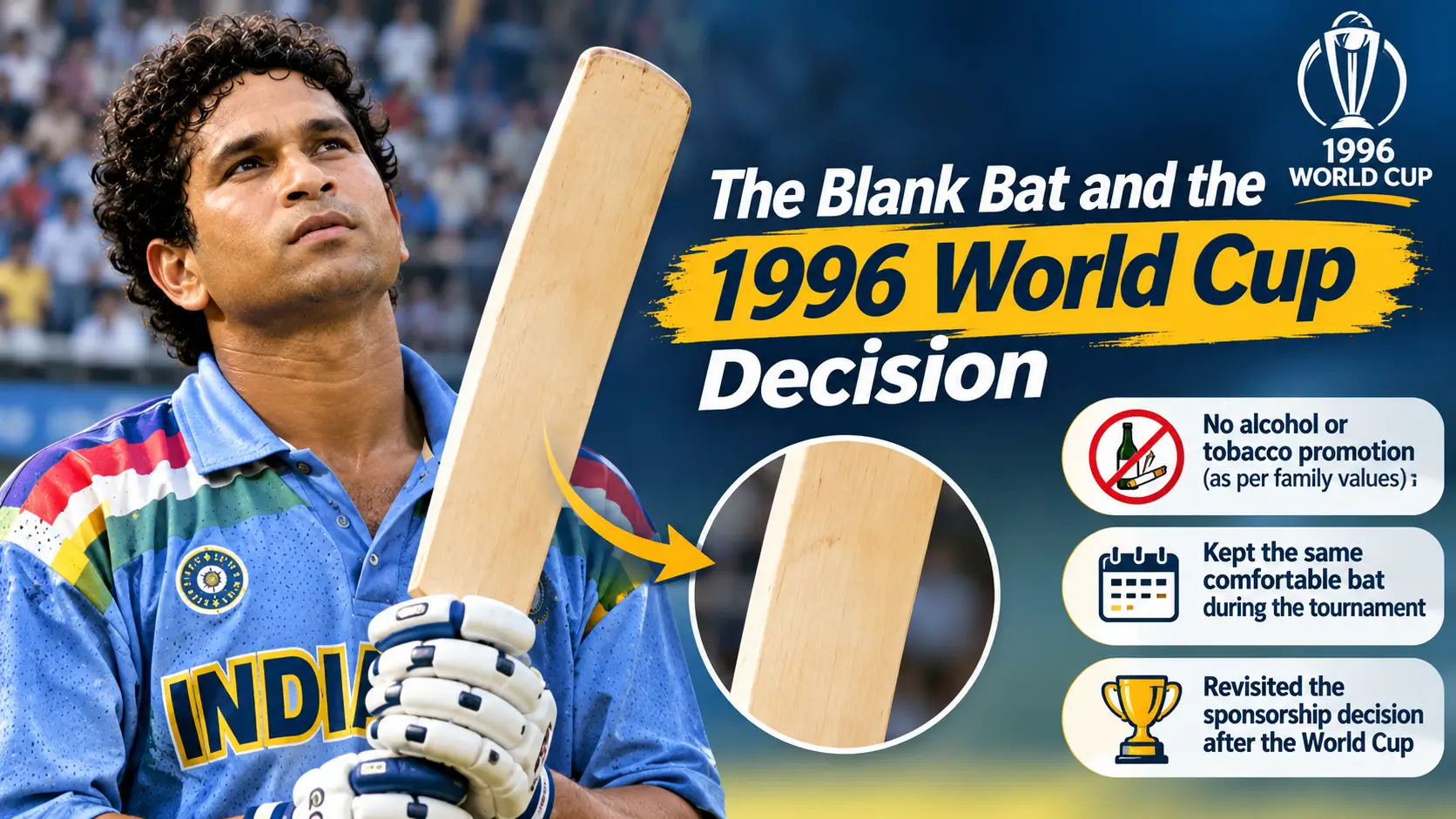
Tendulkar explained that his family had decided he would not endorse alcohol or tobacco products. At a time when such companies appeared on cricket-bat stickers, he played for close to two years without a sponsor’s logo on his bat. During the 1996 World Cup, he had begun the tournament with the blank bat and felt comfortable using it.
He recalled that a sports-brand representative offered to accept his terms during the tournament and asked him to put the sticker on immediately. Tendulkar declined, saying he had become superstitious about the bat after early success and preferred not to change anything during the competition. He planned to revisit the sponsorship discussion after the World Cup instead.
The decision reflected both family principles and tournament routine. It was not a rejection of all sponsorship; rather, he explained that the family’s position concerned alcohol and tobacco promotion, while the timing of the other offer was affected by his preference to retain a familiar bat while he was scoring runs.
What This Episode Says About Athlete Decision-Making
| Factor | What the Story Illustrates |
|---|---|
| Family values | A commercial choice was guided by a principle established at home. |
| Routine | He chose not to change equipment during a tournament after becoming comfortable with it. |
| Confidence | Familiarity with the blank bat had become psychologically reassuring. |
| Professional judgement | He deferred a sponsorship decision until after the competition. |
The Bat Intended for Sunil Joshi and the 175 in Hyderabad
During India’s 2009 series against Australia, bat-maker Sumit Kohli showed Tendulkar several bats. Tendulkar noticed one that had been made for former India spinner Sunil Joshi and asked to use it instead. He wanted the bat shortened from the bottom, despite being warned that the adjustment could alter its balance, and said he would manage the change.
The next match was in Hyderabad, and the bat arrived at the hotel shortly before the team bus was leaving for the stadium. Tendulkar said he had not faced a ball with it before taking it into the match. It became one of his favourite bats, and he scored 175 against Australia in the fifth ODI on 5 November 2009.
Innings Breakdown
His strike rate was approximately 124.11 runs per 100 balls, calculated from 175 runs off 141 deliveries. India were chasing 351 and lost by three runs, making the innings one of the most memorable near-misses in ODI cricket. The bat story is striking because the equipment was unfamiliar, yet Tendulkar trusted his feel for it; the broader lesson, however, is that his elite skill and adaptability not a new bat alone made the performance possible.
The Favourite Bat That Broke During the 2011 World Cup
Tendulkar also recalled a favourite bat used against England in Bengaluru during the 2011 World Cup. He said he felt especially confident when holding it, but a cut shot against a short-of-length delivery damaged the bat and forced him to change equipment. He had previously repaired and glued the bat himself, which made the moment particularly disappointing.
The match was a dramatic tie: India made 338, and England also finished on 338 for eight. Tendulkar scored 120 from 115 balls, with 10 fours and five sixes. He eventually reached his century with a different bat, a detail that shows how a player can experience disappointment with equipment and still refocus on the contest.
Match Score Snapshot
| Team | Score | Result |
|---|---|---|
| India | 338 | Match tied |
| England | 338/8 |
The incident reinforces a practical point: athletes may become attached to equipment, but competition requires the ability to adjust. Confidence should support a player rather than become a condition for performance. Tendulkar’s innings is an example of returning attention to the next ball even after an emotionally difficult equipment change.
Why Tendulkar Believed a Bat Should Be Respected
One of the most personal comments in the bat conversation concerned throwing equipment in frustration. Tendulkar questioned what a player achieves by throwing a bat after dismissal and said it disrespects something that helped bring the player to that level. He connected the attitude to advice from his father: take care of belongings, including talent, which he regarded as a gift that should be looked after.
His approach was not presented as a grand achievement; he described it as a simple part of his upbringing. The idea is relevant to young players because discipline is often expressed through small habits maintaining gear, responding calmly to failure and avoiding destructive reactions. Respect for equipment can also encourage players to inspect their bats, grips and protective gear before matches.
How Young Cricketers Can Choose a Bat
Tendulkar’s advice was to prioritise the feel of a bat. A player should be able to hold it comfortably, swing it naturally and try movements associated with shots such as the cut and pull. A bat that feels wrong may make timing and control difficult, regardless of its price or reputation.
Weight is only one consideration. Balance, handle comfort, size, swing control and the player’s physical development all matter. A young cricketer should test equipment with a coach or knowledgeable adult and avoid assuming that a professional’s bat specification will automatically suit their own game.
| Check | Practical Question |
|---|---|
| Weight | Can I lift and swing it repeatedly without losing control? |
| Balance | Does the bat feel natural through the batting arc? |
| Grip | Is the handle comfortable and secure in my hands? |
| Size | Is the length appropriate for my height and stance? |
| Shot testing | Can I practise basic defensive, cut and pull movements comfortably? |
| Confidence | Do I feel comfortable using it not just attracted to its appearance? |
What the Bat Stories Reveal About Tendulkar’s Mindset
Across the memories, several themes recur: familiarity, discipline, family influence, confidence and adaptability. The childhood bat represented joy, the first leather-ball bat marked greater seriousness, the blank bat reflected values and tournament routine, and the bat from the 2009 Australia series became associated with a major innings. The favourite bat that broke in 2011 showed that emotional attachment can be real without preventing a player from adapting.
These memories also demonstrate how a sporting career is shaped by people around the athlete. His sister provided the first bat, his brother and father helped arrange equipment, and Achrekar guided his early development. Coaches, family members and equipment specialists can all help young players make decisions, but the player’s own comfort and confidence must remain central.
Career Context: The Numbers Behind the Legacy
The bat anecdotes sit within a career of exceptional statistical achievement. Tendulkar retired from international cricket with 100 international centuries 51 in Tests and 49 in ODIs and was the first player to score an ODI double century. Those achievements are useful context for readers, but the bat stories focus on the human details behind the numbers: preparation, routine, preferences and the ability to respond to pressure.
| Career Milestone | Figure |
|---|---|
| International centuries | 100 |
| Test centuries | 51 |
| ODI centuries | 49 |
| First ODI double century | 200 not out vs South Africa, 2010 |
| World Cup title | 2011, India |
Sachin Tendulkar and MS Dhoni: Respect, Friendship and a World Cup Bond
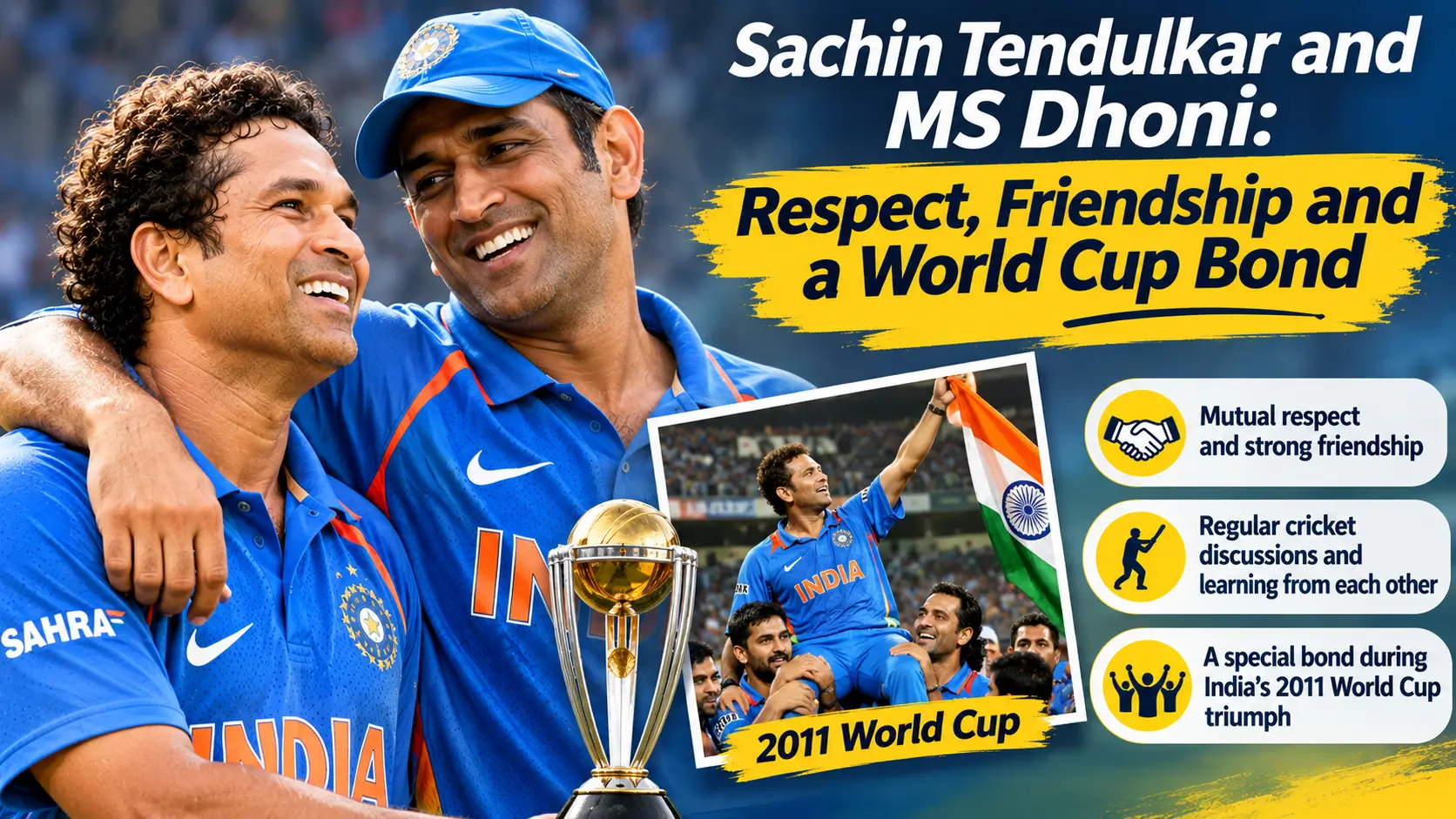
The connection between Tendulkar and MS Dhoni was more than a senior star and a younger teammate sharing a dressing room. Dhoni grew up watching Tendulkar and described him as an inspiration because of his skill, humility and commitment to improving. As their careers overlapped, that admiration developed into a working relationship in which the two could discuss strategy, share opinions and learn from each other.
Tendulkar later recalled observing Dhoni’s cricketing brain and his ability to communicate decisions while they interacted on the field. He supported Dhoni’s name for captaincy, believing that Dhoni understood the game well and could bring conviction to his decisions. Their relationship also reflected a healthy team culture: senior players could guide younger teammates, while the younger players could offer honest opinions rather than simply agreeing.
The 2011 World Cup victory in Mumbai became a particularly emotional shared memory. Tendulkar had spent years carrying the hopes of Indian fans, and the title gave him the long-awaited World Cup triumph. Dhoni and the team celebrated with him, including the iconic moment when teammates carried Tendulkar on their shoulders around the ground. The image captured the affection and respect the team had for a player whose career had inspired many of them.
Batography: Turning a Career Into a Collection of Memories
The collection of 25 bats presents cricket history through objects, not just scorecards and photographs. Each bat is linked to a period, match, decision or feeling. A scorecard records runs and balls, but an object can preserve the story of how it was chosen, how it felt in the hands and what happened before it reached the middle.
The collection included equipment from different stages of Tendulkar’s career and other memorabilia. Its value is not only historical; it tells a story of development, from a young player discovering cricket to a professional whose equipment preferences and routines became part of preparation.
For fans, the collection makes cricket history personal. The bats also represent people who helped Tendulkar: his sister, father, brother, coach and bat-makers. The memorabilia therefore records relationships as well as achievements.
Equipment, Preparation and the Role of Confidence
There is a difference between calling a bat lucky and recognising that familiar equipment can support confidence. Sachin Tendulkar valued feel and was reluctant to change a trusted bat during a match. Comfort can support routine, but it does not guarantee performance; cricket still depends on skill, judgement, conditions and opposition.
Preparation means checking the grip, edges, toe, handle and condition, then practising with the bat before a game. Any repair or adjustment should be tested ahead of match day. Tendulkar’s Hyderabad story is remarkable because he trusted a new bat quickly; young players should not take it as advice to skip preparation.
What Makes These Anecdotes Useful Beyond Cricket?
These stories offer valuable lessons that extend beyond the cricket field. They show how personal values can influence professional decisions, how familiar equipment can build confidence, why adaptability is important when situations change, and how taking care of your belongings reflects discipline and respect for your work.
The blank bat during the 1996 World Cup highlights the importance of staying true to personal principles. The bat associated with his 175 against Australia in 2009 demonstrates confidence and adaptability, while the damaged bat during the 2011 World Cup captures a moment of disappointment and the determination to keep moving forward. Together, these Sachin Tendulkar bat stories reveal that success is not simply about having a lucky bat it is also about mindset, preparation and resilience.
Young cricketers do not need to copy a professional player’s exact equipment or rituals. Instead, they can develop their own pre-match routines, take care of their cricket gear, seek guidance from experienced players and learn to reset after setbacks. These habits can prove valuable not only in cricket but also in school, club competitions and everyday life.
Why a Bat’s Specifications Should Not Overshadow Technique
Bat discussions often focus on weight, willow grade, edges, spine, sweet spot and brand. These details matter only when the bat suits the player’s body, stance, timing and shots. Neither heavier nor lighter is universally best; test options and seek coaching advice.
Technique remains the foundation: grip, balance, head position, footwork and decision-making shape consistency. Equipment supports these fundamentals but cannot replace them. Tendulkar’s memories are reminders to find individual fit not proof that a particular bat produces runs.
Conclusion: More Than Willow and Leather
The most memorable Sachin Tendulkar bat stories provide a personal lens on a remarkable cricket career. They begin with a childhood surprise and move through equipment choices, family principles, tournament routines, unforgettable innings and a belief in treating sporting gear with respect. These stories are memorable because they connect cricket’s public achievements with ordinary decisions and emotions.
These Sachin Tendulkar bat stories highlight more than cricket equipment. They reveal the importance of family values, confidence, preparation, adaptability and respect for the game. From his childhood bat to the equipment used during memorable international innings, each story offers fans a glimpse into the mindset of one of cricket’s greatest players.
The practical lesson for young players is simple: choose equipment that feels right, practise with it, take care of it and be ready to adapt when circumstances change. A bat can help a player feel confident, but technique, preparation, concentration and character remain the foundations of performance. Tendulkar’s stories remind fans that behind every scorecard is a person, a routine and a collection of memories that make the game meaningful.
Frequently Asked Questions About Sachin Tendulkar Bat Stories
What are the most famous Sachin Tendulkar bat stories?
Some of the most memorable stories include his first bat gifted by his sister, the blank bat he used during the 1996 World Cup, the bat associated with his 175 against Australia in Hyderabad in 2009, and his favourite bat that broke during the 2011 World Cup match against England.
What was Sachin Tendulkar’s first cricket bat?
Tendulkar recalled receiving his first cricket bat from his elder sister Savita, who brought it from Kashmir when he was around five years old. The gift became an important childhood memory and helped strengthen his early connection with cricket.
Why did Sachin Tendulkar use a blank bat during the 1996 World Cup?
Tendulkar played with a blank bat because of his family’s decision not to promote alcohol or tobacco products. During the tournament, he also preferred not to change the bat he was comfortable with while performing well.
Which bat did Sachin Tendulkar use to score 175 against Australia?
Tendulkar scored 175 runs against Australia in Hyderabad on 5 November 2009 using a bat that had originally been made for former Indian spinner Sunil Joshi. He requested an adjustment to the bat before using it in the match and went on to score 175 from 141 balls.
Did Sachin Tendulkar have a favourite cricket bat?
Yes, Tendulkar recalled having bats that he particularly liked because of their feel and comfort. One of his favourite bats was damaged during India’s 2011 World Cup match against England in Bengaluru, forcing him to change bats during his innings.
What did Sachin Tendulkar recommend when choosing a cricket bat?
Tendulkar emphasised choosing a bat that feels comfortable and suits the player. He recommended considering its weight, balance, grip and size, while testing whether it feels natural when playing shots such as the cut and pull.
How many international centuries did Sachin Tendulkar score?
Sachin Tendulkar scored 100 international centuries during his career, including 51 Test centuries and 49 ODI centuries. He remains one of cricket’s most celebrated batsmen and was the first player to score a double century in men’s ODI cricket.
Why did Sachin Tendulkar respect his cricket bat so much?
Tendulkar believed that throwing a bat in frustration showed disrespect towards the equipment that helped a player succeed. His attitude reflected the values taught by his father, including taking care of belongings, appreciating talent and maintaining discipline.