

India tour of New Zealand 2026–27
India’s 3–0 T20I Dominance in the 2026 New Zealand series has delivered three successful India chases, two narrow escapes and one extraordinary batting display. After victories in Christchurch on 22 and 24 October and Wellington on 27 October, India secured an unassailable 3–0 lead in the five-match series.
New Zealand posted competitive totals in every match, and India had to recover from six wickets down in the first two encounters. Only the third game became a genuine demolition, as Abhishek Sharma’s 113 off 38 balls drove a chase of 199 in just 13.2 overs.
India’s 3–0 T20I Dominance: All Three Match Results
The opening three India vs New Zealand T20I 2026 matches took place across two New Zealand cities. India chose to field in each fixture and won all three while chasing. The scorecards below establish the foundations for the tactical discussion and distinguish the tight first two finishes from the decisive third.
| Match and date | Venue | New Zealand | India | Result |
|---|---|---|---|---|
| 1st, 22 Oct | Hagley Oval, Christchurch | 225/4 (20 ov) | 230/6 (19.4 ov) | India by 4 wickets |
| 2nd, 24 Oct | Hagley Oval, Christchurch | 180/5 (20 ov) | 181/6 (19.5 ov) | India by 4 wickets |
| 3rd, 27 Oct | Wellington (venue to confirm) | 198/3 (20 ov) | 199/4 (13.2 ov) | India by 6 wickets |
Across the three completed matches, New Zealand accumulated 603 runs and India scored 610. India faced 52 overs and five balls, compared with New Zealand’s full 60 overs; the difference captures how dramatically the Wellington chase accelerated the overall scoring rate.
First T20I: Samson and Dhir Complete a Record Chase
The first India vs New Zealand T20I 2026 meeting on 22 October saw New Zealand post 225/4 in Christchurch. Finn Allen contributed 45 off 24 balls, while Glenn Phillips powered the middle and late overs with an unbeaten 82 from 40. India needed 226, a demanding T20 target.
Sanju Samson immediately changed the tone. His 67 off 33 balls included aggressive boundary hitting and gave the visitors momentum. Abhishek Sharma added 29 from 12 deliveries, but New Zealand’s spinners then interrupted the chase. India lost important wickets, and the match shifted from a seemingly free-flowing pursuit into a pressure test.
Captain Shreyas Iyer made 42, Axar Patel produced a useful 24 and Naman Dhir supplied the unforgettable finish. Dhir struck 42 not out from only 15 balls, bringing the chase home with two deliveries unused. India finished on 230/6, their highest successful T20I chase at the time of this match according to the ICC report.
The key lesson was not simply that India’s top order could attack a large target. Their batting continued to generate momentum after a wobble. Dhir arrived late, recognised the required tempo and took calculated risks immediately. New Zealand’s missed opportunities in the field also showed how costly small errors become when defending a total above 220.
What decided the opener?
Samson established the chase, Iyer and Axar kept the target within sight, and Dhir delivered the finishing acceleration. Phillips’ 82 deserved attention too: without his innings, New Zealand would not have applied the same pressure. India’s victory was a combination of batting depth, positive intent and enough late-innings execution to overcome a difficult target.
Second T20I: From 112/6 to an Unlikely Victory
The second India vs New Zealand T20I 2026 meeting on 24 October was tactically different. New Zealand slipped to 41/3 in the powerplay before Phillips and Bevon Jacobs rebuilt the innings. Phillips made 70 off 43 balls, Jacobs scored 58 off 46, and their 116-run partnership helped lift the hosts to 180/5.
India’s pursuit initially looked manageable but unravelled against Mitchell Santner’s left-arm spin. Santner returned 4/21 from four overs, removing important batters and eventually dismissing Naman Dhir. India’s scoreboard read 112/6 after 14.5 overs. At that point, 69 runs remained and there were only 31 legal deliveries available.
Tilak Varma and Nitish Kumar Reddy refused to let the required rate dictate panic. Tilak finished unbeaten on 51 off 26 balls, while Nitish contributed 26 not out from 13. Their unbroken seventh-wicket partnership of 69 carried India to 181/6 with a ball remaining. Both players found crucial late boundaries.
For readers tracking India’s performances beyond the scoreline, KhelKhabri offers another cricket news destination for match updates and analysis. The Christchurch comeback, in particular, demonstrated why pressure situations deserve closer examination than a final result alone.
This finish matters because it shows the difference between depth on paper and depth in practice. India had already lost six wickets; the responsibility no longer rested with established openers or the captain. A set middle-order batter and a lower-order partner had to execute a chase while maintaining tempo. They did exactly that.
India vs New Zealand T20I 2026: Abhishek’s Wellington Masterclass
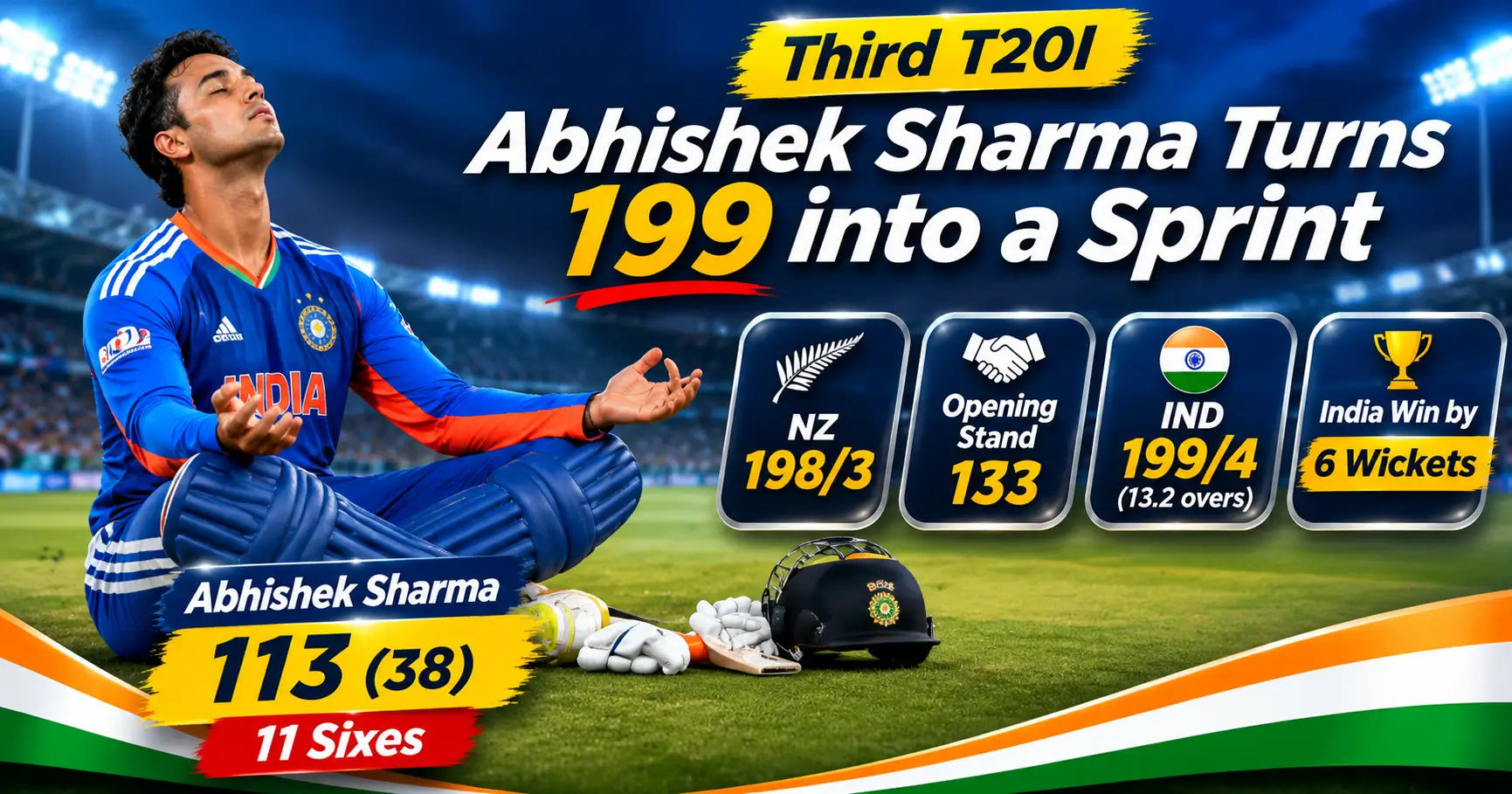
The third India vs New Zealand T20I 2026 match, played in Wellington on 27 October, produced the innings that defined the 3–0 lead. New Zealand scored 198/3, with Daryl Mitchell anchoring the hosts’ effort on an unbeaten 89 off 52. Finn Allen’s 40 and Bevon Jacobs’ unbeaten 39 helped shape a target that would ordinarily require sustained aggression for most of 20 overs.
Instead, India’s opening pair altered the mathematics within six overs. Abhishek Sharma and Vaibhav Sooryavanshi put on 118 without loss in the powerplay, the highest men’s T20I powerplay total reported for the match. Sooryavanshi contributed 45 off 19 balls, while Abhishek overwhelmed the bowling from the start.
Abhishek completed a century in 35 balls and eventually scored 113 from 38, including 11 sixes according to the detailed scorecard. The opening partnership reached 133 before Sooryavanshi departed. Despite four eventual wickets, India reached 199/4 in only 13.2 overs—40 legal balls remaining—and won by six wickets.
That margin is remarkable because New Zealand had not produced a weak batting performance. Their 198 was highly competitive; it simply became insufficient against an unprecedented burst of powerplay scoring. The required rate plunged so quickly that the visitors were able to absorb later dismissals without jeopardising the result.
India’s 3–0 T20I Dominance: Why Wellington Was Different
Christchurch exposed the importance of rescuing innings after collapses. Wellington showed the value of winning a match before the middle overs even begin. The openers targeted scoring opportunities almost continuously, forcing New Zealand to defend with aggressive fields and rapidly shrinking their tactical options. India’s batting strategy changed from recovery to domination, but the central theme—clear roles under match pressure—remained constant.
Graph: India and New Zealand Runs in the First Three Matches
The HTML/CSS bars below compare innings totals without requiring JavaScript.
Runs scored by match
Blue: India | Grey: New Zealand | Scale: 230 runs maximum
Graph: Chase Speed Reveals the Real Difference
India’s 3–0 T20I Dominance was built on three successful chases, yet the speed of those wins varied sharply.
A second view is more instructive than raw innings totals. All three targets were reached, but the available deliveries remaining varied sharply: two in the opener, one in the second match and 40 in Wellington. The final fixture was therefore far more decisive than the near-equal scores might suggest.
Legal balls remaining when India won
Standout Players and Match-Winning Contributions
The India vs New Zealand T20I 2026 contest has featured several match-winners rather than one standout player in all three games. Different members of India’s batting group supplied the decisive innings, and New Zealand had individual performers who kept the contests competitive.
| Player | Match | Verified contribution | Why it mattered |
|---|---|---|---|
| Sanju Samson | 1st | 67 off 33 | Launched the 226-run chase |
| Naman Dhir | 1st | 42* off 15 | Finished the record chase |
| Glenn Phillips | 1st, 2nd | 82 runs (40 balls); 70 runs (2nd T20I) | Led NZ’s attacking and recovery efforts |
| Mitchell Santner | 2nd | 4/21 | Nearly defended 180 for NZ |
| Tilak Varma | 2nd | 51* off 26 | Guided the late recovery |
| Nitish Kumar Reddy | 2nd | 26* off 13 | Partnered Tilak in a 69-run stand |
| Daryl Mitchell | 3rd | 89* off 52 | Anchored New Zealand’s 198 |
| Vaibhav Sooryavanshi | 3rd | 45 off 19 | Shared record opening burst |
| Abhishek Sharma | 3rd | 113 off 38 | Decisive series-clinching century |
Three Tactical Reasons Behind India’s 3–0 T20I Dominance
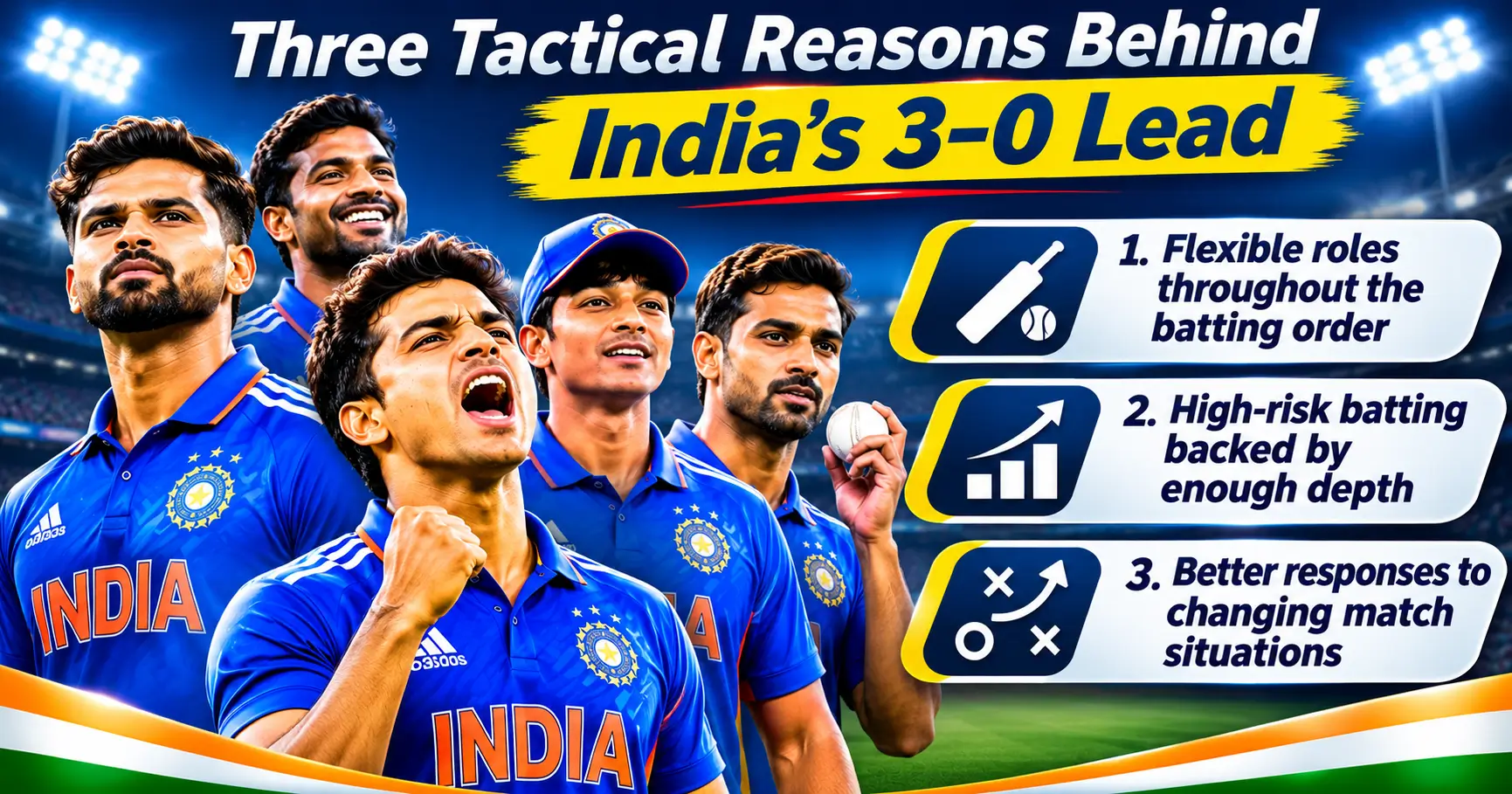
1. Flexible roles throughout the batting order
Across India vs New Zealand T20I 2026, India did not depend on one rigid batting formula. Samson began the first chase at speed, Dhir finished it, Tilak and Nitish controlled the second finish, and Abhishek with Sooryavanshi overwhelmed the opposition in the third. This versatility made India’s batting harder to contain because the main danger moved around the order.
2. High-risk batting backed by enough depth
Modern T20 cricket rewards calculated aggression, but rapid scoring can cause collapses. India experienced that danger twice in Christchurch. Crucially, their replacements at the crease did not abandon the chase. The series illustrates that deep batting can make positive top-order intent more sustainable, provided lower-order players retain clarity about their roles.
3. Better responses to changing match situations
The narrow wins demanded composure as the required rate climbed; the Wellington contest demanded continued attack even while the original asking rate collapsed. India’s players adjusted to those contrasting circumstances. New Zealand, meanwhile, will reflect on missed chances, bowling execution and the difficulty of limiting set batters once the field is spread.
What the Scoreline Does Not Tell Us
India’s 3–0 T20I Dominance in the New Zealand series deserves praise, but 3–0 should not erase New Zealand’s positives. Their batting crossed 180 in all three matches, Phillips delivered back-to-back impactful innings, Santner took four wickets in the second match, and Daryl Mitchell made 89 not out in the third.
India’s bowling was not consistently dominant either. Conceding 225 in the opener and 198 in Wellington indicates areas for improvement in lengths, death-over planning and defensive fields. Chasing brilliance compensated for those issues; relying on record-setting batting performances every match would not be a sensible long-term plan.
A 3–0 lead in a five-match contest confirms the series winner, but there are still two fixtures scheduled. Describing the result as a 3–0 whitewash or treating the tour as completed would be inaccurate as of 28 October 2026.
India vs New Zealand: What Happens Next?
With the India vs New Zealand T20I 2026 series secured, India’s next two matches present opportunities to test combinations while preserving winning momentum. New Zealand can use the remaining fixtures to refine bowling plans against India’s aggressive opening options and seek a result that better reflects their competitive passages in Christchurch.
| Fixture | Date | Venue | Status as of 28 October |
|---|---|---|---|
| 4th T20I | 30 October 2026 | Eden Park, Auckland | Scheduled |
| 5th T20I | 1 November 2026 | Seddon Park, Hamilton | Scheduled |
For the official description of how India secured the series and the next fixture, see the ICC match report on the Wellington victory.
India vs New Zealand T20I 2026: Frequently Asked Questions
Yes. India’s third successive victory on 27 October gave them an unassailable 3–0 lead in the five-match series.
No. India fielded first and chased the target successfully in all three matches.
Abhishek Sharma scored 113 from 38 balls in Wellington, reaching his century in 35 deliveries as India chased 199 in 13.2 overs.
India were 112/6 after 14.5 overs before Tilak Varma and Nitish Kumar Reddy added an unbroken 69 to win.
No. The five-match series is not yet complete. India have clinched it with two scheduled games remaining.
The fourth is scheduled in Auckland on 30 October and the fifth in Hamilton on 1 November 2026.
Final Verdict: A Series Won in Three Different Ways
India’s 3–0 T20I Dominance is compelling because the wins did not follow one script. The first required a record chase and a spectacular finishing cameo. The second demanded nerve after a collapse to 112/6. The third displayed extraordinary powerplay hitting that made a target of 199 look modest.
The larger takeaway from India vs New Zealand T20I 2026 is the visitors’ ability to find different match-winners within a deep batting group. There remain bowling questions and two fixtures to play, but the series outcome is already decided. India have combined resilience, aggressive intent and adaptability to secure victory in New Zealand with two matches to spare.