


Afghanistan Cricket · Player Feature
From a teenage leg-spinner in Afghanistan to a global T20 star, Rashid Khan has built a career on fearless attacking cricket, sharp variations and an instinct for taking wickets when his team needs them most.
Rashid Khan’s rise is one of the most remarkable stories in modern cricket. He emerged from Afghanistan’s growing cricket system and quickly became a bowler batters had to plan around. His quick leg-spin, deceptive googly, and calm approach under pressure made him a central figure for his country and one of the most sought-after players in franchise T20 leagues.
His latest ranking achievement underlines that reputation. In the ICC Men’s ODI bowling rankings and T20I bowling rankings dated 20 October 2026, Rashid was ranked No. 1 in both formats. He held 742 rating points in ODIs after a match-changing spell against Zimbabwe, while his T20I rating stood at 720. Rankings can shift week to week, but topping both white-ball formats is significant recognition of his consistency and impact.
Rashid Khan’s early life and rise in Afghanistan cricket
Rashid Khan was born on 20 September 1998 in Nangarhar, eastern Afghanistan. Like many young cricketers in the country, he developed his game in challenging circumstances, with cricket becoming both a passion and a route to opportunity. He has spoken about admiring Pakistan leg-spinner Shahid Afridi, whose attacking approach helped shape Rashid’s own fearless style.
Rather than building his reputation through a long apprenticeship in a major domestic system, Rashid made an impact quickly. His energy, fast arm action and willingness to challenge batters caught attention, and his progress through Afghanistan’s setup brought him into international cricket as a teenager. His story is closely linked to the wider rise of Afghanistan as a competitive international team.
Rashid made his ODI debut against Zimbabwe on 18 October 2015 and his T20I debut against the same opposition eight days later. Those first appearances began a career that would take him from international fixtures to some of the world’s biggest franchise tournaments. For a young player from Afghanistan, that rapid transition was significant: he was not simply learning the international game, but soon becoming one of its most recognisable specialist bowlers.
Why Rashid Khan’s No. 1 ranking matters
Being the highest-ranked bowler in two formats is not just a headline. ODI cricket rewards patience, control over longer spells, and the ability to attack in different phases of an innings. T20I cricket gives bowlers far less room for error, as batters often look to score quickly from the start. Rashid has shown that his skill set can adapt to both challenges.
His ODI rating rose from 714 to 742 after he took four wickets for 17 runs from eight overs against Zimbabwe on 19 October 2026. That spell helped Afghanistan secure a 158-run victory and gave Rashid an 80-point lead over second-placed Abrar Ahmed in the ODI rankings. It combined control with decisive wicket-taking.
The T20I ranking tells a complementary story. Rashid’s career has been shaped by the shortest format, where he has played for Afghanistan and numerous franchise teams. His variations, fast pace through the air, and confidence in high-pressure overs make him a threat even when batters know he’ll attack.
Latest performance: Rashid Khan turns the match against Zimbabwe
Rashid’s figures of 4 for 17 against Zimbabwe were the clearest recent illustration of his value in ODI cricket. He conceded only 17 runs in eight overs and took four wickets, limiting Zimbabwe’s ability to build a response. Afghanistan went on to win by 158 runs, and the result also helped Rashid climb further up the bowling rankings.
Economy and wickets work together in a spell like this. When a bowler prevents boundaries, batters may feel pressure to manufacture shots or take risks against deliveries they would otherwise leave alone. When wickets fall in quick succession, the batting side must rebuild with new players at the crease. Rashid’s spell brought both pressures.
He continued to contribute in the T20I format later in the month, returning figures of 2 for 20 against Zimbabwe on 27 October 2026. Recent match logs also record four-wicket hauls against Bangladesh and Zimbabwe in the ODI tri-series. These performances add context to the ranking update: current results, not just past achievements, are reinforcing Rashid’s position.
Rashid Khan’s international career stats
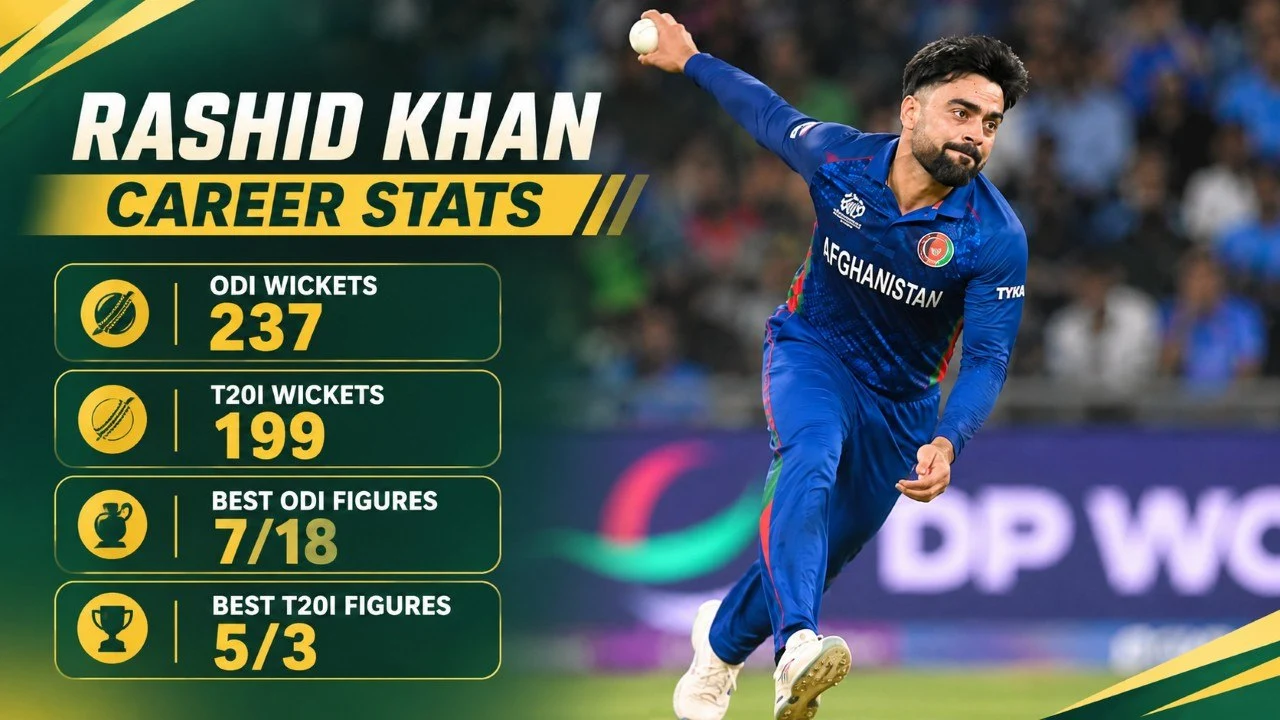
Rashid Khan has a deep impact across ODI and T20I cricket. His ODI numbers highlight his ability to bowl long spells and control scoring, while his T20I record shows how often he can break partnerships in a format that encourages batters to attack.
| Career statistic | ODI | T20I |
|---|---|---|
| Matches | 126 | 119 |
| Wickets | 237 | 199 |
| Bowling average | 18.91 | 13.98 |
| Economy rate | 4.25 | 6.13 |
| Best bowling | 7/18 | 5/3 |
| Five-wicket hauls | 7 | 2 |
Career figures reflect the player-profile snapshot available in October 2026. Bowling records and match totals can change after each fixture.
How Rashid Khan’s records compare across formats
Rashid’s numbers are best understood by looking at the demands of each format rather than treating every wicket as identical. In ODIs, a spinner may be asked to bowl a substantial middle-overs spell, break partnerships and keep the batting side from accelerating before the final overs. His listed ODI economy rate of 4.25 reflects that control, while his 7 for 18 remains the standout example of how quickly he can dismantle a line-up.
T20 internationals offer a different challenge. Batters have fewer deliveries to settle and often attack from the start, so a bowler must balance wicket-taking intent with the risk of conceding boundaries. Rashid’s listed T20I average of 13.98 and economy rate of 6.13 show why he has been valued in the format: he can take wickets without allowing scoring to become easy. These figures are a snapshot from the article’s October 2026 dataset and should be refreshed against a current scorecard database before publication.
Bowling average and economy rate measure different things. Average divides runs conceded by wickets taken, so it reflects the cost of each wicket. Economy rate measures runs conceded per over, regardless of whether a wicket falls. Reading both together gives a more useful picture of Rashid’s impact than focusing on a single headline number.
CAREER SNAPSHOT
International wickets by format
A side-by-side look at Rashid Khan’s wickets in the two international white-ball formats.
Figures shown are from the article’s October 2026 career-statistics snapshot. The bars compare wicket totals, not the difficulty of each format.
Best career highlights of Rashid Khan
1. A stunning 7 for 18 in ODI cricket
Rashid’s career-best ODI figures of 7 for 18 against the West Indies in 2017 remain one of the defining performances of his early international career. A seven-wicket haul is rare in any ODI, and doing it while conceding only 18 runs demonstrated how effectively he could combine attacking spin with control. It announced that Afghanistan had a bowler capable of dismantling a top international batting line-up.
The performance also illustrated a key part of Rashid’s method: he rarely relies on one variation alone. A batter may prepare for the leg-break, only to face a googly or a delivery that skids faster than expected. When a bowler can make batters second-guess their first read, mistakes become more likely.
2. The T20I best of 5 for 3
Rashid’s best T20I figures of 5 for 3 against Ireland in Dehradun in 2018 are another landmark. Taking five wickets while conceding just three runs is an extraordinary return in a format designed to reward aggressive batting. It remains a concise illustration of how quickly Rashid can turn a match when conditions and execution align.
Such a spell demands more than turn. The bowler must vary pace and length, read the batter’s intentions, and stay disciplined even when a wicket tempts them to chase another. Rashid’s ability to maintain that focus helped him become one of T20 cricket’s most feared bowlers.
BOWLING CONTROL
Bowling average by format
The bowling average shows how many runs Rashid concedes, on average, for each wicket taken.
Figures are taken from the article’s October 2026 career-statistics snapshot.
3. Becoming a leading figure in Afghanistan’s rise
Rashid made his international debut in 2015 and rapidly became one of Afghanistan’s most recognizable players. His rise coincided with the team’s progress from an emerging side into a competitive opponent capable of troubling established nations. His wickets gave Afghanistan a strike option in the middle overs, while his presence helped build belief in the team’s ability to compete at the highest level.
He has also taken on leadership responsibility, including captaining Afghanistan in T20 internationals. Leadership brings a different challenge to bowling: the captain must consider matchups, manage teammates’ workloads, and decide when to attack or defend. Rashid’s experience in global leagues has added to his tactical knowledge and familiarity with a wide range of batters.
4. A memorable run at the 2024 T20 World Cup
Afghanistan’s run to the semi-finals of the 2024 Men’s T20 World Cup was a historic team achievement, and Rashid was central to the campaign as captain and frontline spinner. Afghanistan defeated New Zealand in the group stage and produced a famous Super Eight win over Australia, showing that the team could beat elite opposition on the biggest stage.
The victory over Australia was especially important for Afghanistan’s confidence and tournament hopes. Rashid’s role was not only to take wickets himself but also to guide the attack, keep his players focused, and make tactical decisions in a high-pressure match. Afghanistan eventually reached their first senior men’s World Cup semi-final, a landmark that expanded the team’s ambitions and profile worldwide.
5. A global franchise cricket career
Rashid’s influence is not limited to international cricket. He has played in major franchise competitions, including the Indian Premier League, where he has represented Sunrisers Hyderabad and Gujarat Titans. He has also featured in leagues across Australia, the Caribbean, Pakistan, South Africa, and other cricket markets.
Franchise cricket places bowlers in unfamiliar conditions and against batters with different strengths. A spinner might bowl on a slow surface one week and a fast, high-scoring ground the next. Rashid’s ability to adapt his lengths, pace and plans has made him a valued player across competitions. His franchise experience also gives Afghanistan access to a cricketer who has repeatedly handled pressure in high-profile games.
Rashid Khan’s impact in the Indian Premier League
The Indian Premier League has been one of the most visible stages of Rashid’s franchise career. He first represented Sunrisers Hyderabad before joining Gujarat Titans ahead of the franchise’s debut season in 2022. At Gujarat, he became part of a side that won the title in its first season, bringing his international experience into a tournament where batters routinely target spin.
The IPL tests a bowler’s plans because opposition teams can study footage, build match-ups and choose when to attack. Rashid’s quick release and compact action make it difficult for batters to pick the ball early, while his ability to bowl in different phases gives captains tactical options. He can be used to attack in the middle overs, slow a partnership or return when a match is reaching a decisive point.
His franchise experience extends beyond India, with appearances in competitions such as Australia’s Big Bash League, Pakistan’s PSL, South Africa’s SA20 and other global T20 leagues. Playing in different conditions forces a bowler to adapt: a plan that works on a slow surface may need adjustment on a hard, high-scoring pitch. That range of experience has helped make Rashid a familiar figure for teams seeking a specialist who can handle pressure and unfamiliar opponents.
What makes Rashid Khan so difficult to face?

The googly and the threat of uncertainty
Rashid is a right-arm leg-spinner whose stock delivery turns away from a right-handed batter. His googly turns the other way, challenging a batter who has committed to playing for the leg-break. That change in direction can beat the inside edge, strike the pads or force a mistimed shot. Even when the batter reads the variation, the uncertainty can affect footwork and shot selection.
Speed through the air
Rashid often bowls quicker through the air than traditional wrist-spinners. That reduces the time a batter has to read the flight and adjust. It can make sweeping or advancing down the pitch riskier, particularly when the length is difficult to predict. Pace is not his only weapon, but it works with his wrist position and variations to create doubt.
Control that creates pressure
Wickets are the headline statistic, but pressure is just as important. Dot balls force batters to look for scoring options elsewhere, creating opportunities for Rashid or the bowler at the other end. In ODIs, this control can squeeze a batting side across several overs. In T20Is, it can interrupt a team’s momentum at a point when one expensive over might change the match.
RUNS CONCEDED
Economy rate by format
Economy rate measures the average number of runs conceded per over.
The ODI and T20I figures are shown on the same scale within this chart. Lower economy rates indicate fewer runs conceded per over.
Rashid Khan as captain and leader of Afghanistan
Rashid’s responsibilities have grown beyond taking wickets. As a leader in Afghanistan’s T20 setup, he has had to think about match-ups, field placements, bowling changes and how to keep a team composed when momentum swings. Those decisions are particularly demanding in T20 cricket, where one over can change the direction of a game.
His leadership is also shaped by his experience in franchise competitions. Regularly sharing dressing rooms with international players exposes a cricketer to different tactical approaches and ways of preparing for opponents. That knowledge can be useful for Afghanistan, whose players have increasingly shown they can compete with established cricket nations.
Leadership should not be measured only by a captain’s personal statistics. It also involves creating clarity for teammates, backing bowlers through difficult overs and helping the side respond after setbacks. Rashid’s role in Afghanistan’s historic run to the semi-finals of the 2024 Men’s T20 World Cup was an important part of that broader story, even though the achievement belonged to the whole squad and support staff.
Rashid Khan’s influence beyond the scorecard
Rashid has become a role model for young cricketers in Afghanistan and a recognizable ambassador for the country’s cricketing progress. His success shows how a player from an emerging cricket nation can reach the top of global rankings and become a regular presence in the sport’s biggest leagues.
His story also reflects the value of development pathways. Afghanistan’s progress has come through growing domestic competitions, coaching, international exposure, and a generation of players who have learned to compete without being intimidated by reputation. Rashid is one of the clearest examples of that shift, but his achievements sit alongside the contributions of batters, fast bowlers, fielders and coaches who have strengthened the national side.
Rashid Khan has become one of Afghanistan’s most recognizable cricketers, combining international success with a major presence in franchise leagues around the world.
What Rashid Khan’s success means for Afghanistan cricket
Rashid’s rise has helped change how Afghanistan is viewed in international cricket. His performances have made him a global name, but they have also drawn attention to the country’s wider pool of talent. Afghanistan’s progress has depended on more than one player: batters capable of building competitive totals, fast bowlers who can strike with the new ball, athletic fielders and a growing group of cricketers with experience in major leagues have all contributed.
For young players, Rashid offers a visible example of how specialist skills can travel across formats and competitions. His wrist-spin is distinctive, but the broader lesson is about repetition, adaptability and confidence. A bowler must keep refining variations, study how batters respond and accept that the same delivery will not work in every situation.
His influence is also practical. International and franchise cricket expose him to different coaching methods, preparation routines and tactical ideas. When that experience feeds back into Afghanistan’s dressing room, it can help teammates understand how to prepare for elite opposition. The long-term measure of his legacy will therefore include not only wickets and rankings, but also the strength and ambition of the team around him.
What comes next for Rashid Khan?
With the 2027 ODI World Cup approaching, Rashid’s experience will be valuable to Afghanistan’s plans in the 50-over format. A successful campaign will require balance across the side: reliable top-order runs, pace bowlers who can take early wickets, disciplined fielding and spinners who can control the middle overs. Rashid offers a proven option in that final role, but his effectiveness will depend on the support around him and the conditions he encounters.
In T20 cricket, the challenge is always evolving. Batters are increasingly prepared to attack spin with sweeps, reverse sweeps and powerful shots down the ground. Rashid will need to keep adjusting his plans, using changes of pace and angles while resisting the temptation to become predictable. His long experience across leagues gives him a strong foundation for those tactical battles.
Rashid’s role in Afghanistan’s ODI and T20I plans will continue to center on taking wickets through the middle overs, controlling the scoring rate and adjusting his variations to different conditions. As opposition batters develop new ways to attack spin, his ability to vary pace, length and angle will remain important to his effectiveness across both white-ball formats.
Rashid Khan: key records at a glance
| Milestone | Achievement |
|---|---|
| Current ICC ranking snapshot | No. 1 in ODI and T20I bowling (20 October 2026) |
| ODI wickets | 237 in 126 matches |
| T20I wickets | 199 in 119 matches |
| Best ODI figures | 7/18 |
| Best T20I figures | 5/3 |
| Major team milestone | Afghanistan reached the 2024 T20 World Cup semi-finals |
| Recent ODI highlight | 4/17 against Zimbabwe, 19 October 2026 |
Frequently asked questions
Is Rashid Khan ranked No. 1 in ODI and T20I bowling?
In the ICC ranking snapshot dated 20 October 2026, Rashid Khan was ranked No. 1 in both men’s ODI and T20I bowling. Rankings are updated regularly, so check the latest table before publication.
What are Rashid Khan’s best international bowling figures?
His best ODI figures are 7 for 18, while his best T20I figures are 5 for 3.
How many ODI and T20I wickets has Rashid Khan taken?
The October 2026 player-statistics snapshot lists 237 ODI wickets and 199 T20I wickets. Career totals may change after new matches.
What is Rashid Khan known for as a bowler?
He is known for right-arm leg-spin, a deceptive googly, brisk pace, and the ability to take wickets while limiting scoring in white-ball cricket.
What was Afghanistan’s biggest milestone at the 2024 T20 World Cup?
Afghanistan reached the semi-finals of the men’s T20 World Cup for the first time, including a notable Super Eight victory over Australia.
Conclusion: Rashid Khan continues to set the standard
Rashid Khan’s continued position at the top of the ICC ODI and T20I bowling rankings is another milestone in a career built on skill, adaptability and an appetite for big moments. From his remarkable 7 for 18 in ODI cricket to his 5 for 3 in T20Is and his leadership during Afghanistan’s 2024 World Cup run, his highlights show a bowler who has repeatedly delivered on major stages.
His career statistics explain the scale of his impact, but they do not tell the entire story. Rashid has helped change expectations for Afghanistan cricket, earned opportunities worldwide, and become a player opposition teams must plan for carefully. As he continues to evolve with the game, his challenge will be to maintain that edge and help Afghanistan turn individual excellence into more team success.