


Afghanistan produced a remarkable comeback with the bat before holding their nerve with the ball to defeat Zimbabwe by 19 runs in Second T20I at the Sharjah Cricket Stadium on October 29, 2026. Azmatullah Omarzai delivered a career-defining performance, scoring a breathtaking 116 off just 50 balls, while Sikandar Raza’s unbeaten century kept Zimbabwe in the contest until the final over.
The victory gave Afghanistan an unassailable 2-0 lead in the three-match T20I series. It was also a memorable evening for Rashid Khan, who became the first player in men’s T20I cricket to reach 200 wickets. The milestone was independently reported by Reuters, while the ABC score centre also carries the match result and innings scorecard.
Afghanistan finished their 20 overs at 221/7 after recovering from a difficult position of 38/5. Zimbabwe responded with 202/5, with Raza remaining unbeaten on 106. However, the visitors could not maintain the required scoring rate throughout the chase and fell short despite a strong finish.
The scorecard shows how unusual the recovery was: Afghanistan lost four wickets for only five runs before Omarzai and Ijaz Ahmadzai rebuilt the innings. The ICC match report also highlighted the scale of the comeback and Rashid Khan’s landmark. The Cricbuzz report provides further detail on the late stages of both innings.
Afghanistan vs Zimbabwe 2nd T20I 2026: Match Details
| Match detail | Information |
|---|---|
| Match | Afghanistan vs Zimbabwe, 2nd T20I |
| Date | October 29, 2026 |
| Venue | Sharjah Cricket Stadium, Sharjah |
| Toss | Zimbabwe elected to field |
| Afghanistan | 221/7 in 20 overs |
| Zimbabwe | 202/5 in 20 overs |
| Result | Afghanistan won by 19 runs |
| Player of the Match | Azmatullah Omarzai |
| Series score | Afghanistan lead 2-0 |
Afghanistan’s Top Order Collapses as Zimbabwe Strike Early

Zimbabwe captain Sikandar Raza won the toss and chose to bowl, a decision that initially appeared to put his side in a strong position. Zimbabwe’s bowlers made an immediate impact, exploiting Afghanistan’s difficult start and putting pressure on the hosts before they could settle.
Early Wickets Put Afghanistan Under Pressure
Rahmanullah Gurbaz was dismissed for a duck in the opening over. Mohammad Akram also departed without scoring, while Ibrahim Zadran managed only one run from nine deliveries. Kundai Matigimu and Brad Evans were particularly effective early on, preventing Afghanistan’s top order from building momentum.
The situation worsened when Shahidullah Kamal was dismissed for a duck. Afghanistan lost four wickets for just five runs, leaving the middle order with a huge task.
The fall-of-wickets record makes the pressure clear. Afghanistan were 0/1 after 0.2 overs, 1/2 after 0.4 overs, and 5/4 after 3.2 overs. That left the side with almost the entire innings still to play but very little batting security at the crease. Zimbabwe’s early success came from taking wickets before Afghanistan could establish partnerships or settle into their preferred scoring rhythm.
Sediqullah Atal Fails to Stabilize the Innings
Sediqullah Atal tried to steady the innings but couldn’t turn his start into a substantial score. His dismissal for 17 left Afghanistan at 38/5 in the ninth over.
At that stage, Zimbabwe had every reason to believe that they could restrict Afghanistan to a modest total. The hosts had struggled to score freely, and their established batters were already back in the dressing room.
At 38/5 after 8.1 overs, Afghanistan had lost half their side before reaching even 40 runs. The remaining batters therefore had two jobs: protect their wickets and find a way to lift the scoring rate. The match report from the Afghanistan Cricket Board describes the sixth-wicket stand as the turning point that changed the innings.
Omarzai and Ijaz Ahmadzai Begin Afghanistan’s Recovery
However, the match changed dramatically when Azmatullah Omarzai and Ijaz Ahmadzai came together. Their partnership gave Afghanistan fresh hope and completely changed the innings’ direction.
Azmatullah Omarzai and Ijaz Ahmadzai Build a Record Recovery
Omarzai responded to the collapse with an aggressive innings that completely changed the contest’s direction. Rather than letting the pressure build, he attacked the Zimbabwean bowlers and looked for scoring opportunities against both pace and spin.
Omarzai Takes Charge with Aggressive Batting
Ijaz Ahmadzai provided the support Afghanistan needed at the other end. He rotated the strike, found boundaries at key moments, and let Omarzai continue his attacking game.
This partnership worked because the two batters offered different strengths. Omarzai supplied the major boundary-hitting threat, while Ijaz kept the scoreboard moving and made Zimbabwe work for every breakthrough. The 142-run stand is especially significant because it came after five wickets had fallen and restored Afghanistan’s ability to set a challenging target. According to the ICC’s report, it was the highest sixth-wicket-or-lower partnership in men’s T20I cricket.
Their sixth-wicket partnership added 142 runs, taking Afghanistan from 38/5 to a total that eventually crossed 220. The stand formed the foundation of the innings and gave the hosts a realistic chance to defend their total.
Omarzai Scores a Stunning 116 off 50 Balls
Omarzai reached his half-century off 31 balls and accelerated as the partnership grew. He reached his hundred off 44 deliveries, striking boundaries with remarkable consistency. He finished with 116 off 50 balls, including five fours and 12 sixes.
Ijaz also contributed, scoring 52 off 27 balls, with five fours and three sixes. His innings ensured that Afghanistan did not depend entirely on Omarzai for acceleration. By scoring at a strike rate above 190, he kept the pressure on Zimbabwe and helped turn the recovery into a strong platform for the final overs.
Afghanistan’s Leading Batting Scores
Runs scored by the leading Afghanistan batters in the supplied scorecard.
Rashid Khan Provides a Powerful Finish
Afghanistan still had a few overs left after Omarzai’s dismissal, and Rashid Khan ensured the innings ended with another burst of attacking cricket.
Best bowling figures
| Bowler | Overs | Runs | Wickets |
|---|---|---|---|
| Brad Evans | 4 | 40 | 2 |
| Kundai Matigimu | 4 | 48 | 2 |
| Abdullah Ahmadzai | 4 | 34 | 2 |
| Rashid Khan | 4 | 29 | 1 |
| Azmatullah Omarzai | 2 | 17 | 1 |
Rashid smashed four sixes in his unbeaten six-ball 25. His strike rate of 416.67 gave Afghanistan valuable late runs and pushed the total to 221/7.
Mujeeb Ur Rahman remained unbeaten on two, while Zimbabwe’s bowlers struggled to contain the scoring in the final overs. Brad Evans and Kundai Matigimu finished with two wickets each, while Ernest Masuku, Vincent Masekesa and Raza claimed one apiece.
The recovery was particularly impressive because Afghanistan had managed only 45 runs by the halfway stage. Their late acceleration turned what could have been a low total into a challenging target of 222.
Omarzai’s 116 came at a strike rate of 232, while Ijaz’s 52 came at 192.59. Together, they added 142 runs, and Rashid then scored 25 not out from only six balls. These contributions explain why the innings rose from a collapse to 221/7.
Zimbabwe’s Chase: A Promising Start Followed by a Middle-Order Collapse
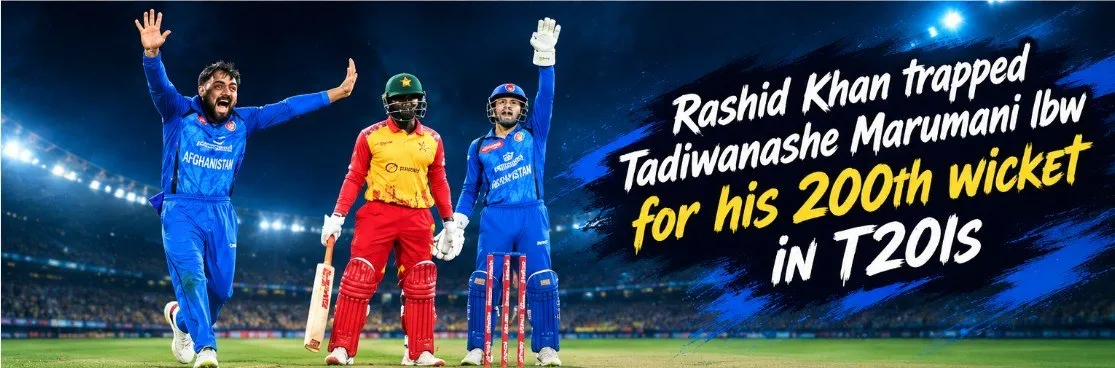
Zimbabwe started well and showed the target was within reach. Innocent Kaia and Brian Bennett attacked during the Powerplay, helping the visitors get off to a quick start. Kaia scored 25 off 13 balls, while Bennett added 22 off 15. However, Afghanistan found important breakthroughs before Zimbabwe could build a match-defining partnership.
Omarzai dismissed Kaia, while Abdullah Ahmadzai removed Bennett. Ryan Burl, Tadiwanashe Marumani and Wesley Madhevere also departed as Afghanistan tightened their grip on the innings.
Zimbabwe slipped to 85/5 by the halfway stage. The required rate was increasing, and the visitors needed a substantial partnership to keep their hopes alive.
With five wickets down, Zimbabwe had limited batting depth available and needed to protect Raza while still scoring quickly. Afghanistan’s breakthroughs had put the chase under pressure, but the visitors were not out of the contest because Raza remained at the crease. His fighting approach reflected the fearless batting style of legends such as Sir Vivian Richards, often called the Godfather of Cricket for his lasting impact on the game.
Rashid Khan also made history during this phase. He became the first player to reach 200 wickets in men’s T20I cricket, adding another milestone to an already remarkable international career.
Sikandar Raza’s Century Keeps Zimbabwe in the Contest
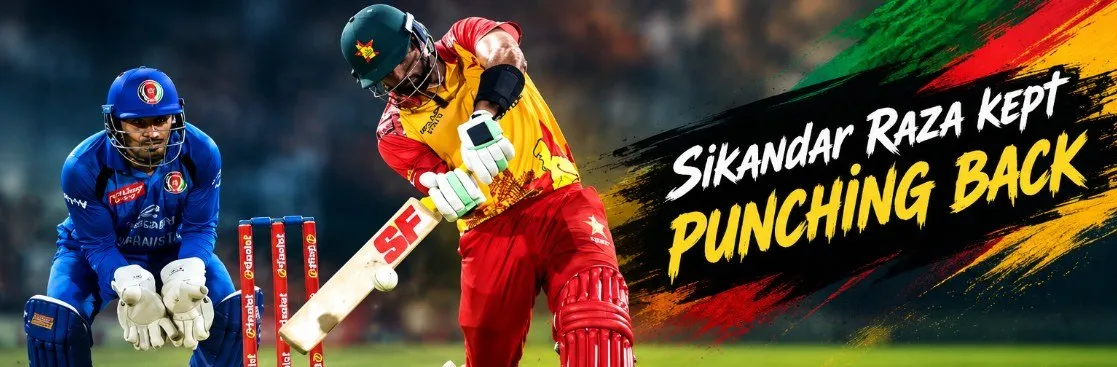
With five wickets down, Raza took responsibility for the chase. The Zimbabwe captain played an outstanding innings, combining calculated stroke play with powerful hitting to keep the required rate within reach for as long as possible.
Raza found an important partner in Tafadzwa Tsiga. The pair avoided further losses and built an unbeaten 120-run sixth-wicket partnership. Tsiga contributed 31 not out off 23 balls, supporting Raza while continuing to rotate the strike.
Raza reached his century off 54 balls and finished unbeaten on 106 from 56. He hit five fours and nine sixes. It was a remarkable individual effort, particularly after Zimbabwe had lost half their side for 82.
However, the partnership began too late to completely reverse the situation. Afghanistan continued to defend the target by slowing the game at key moments and protecting the boundaries. Zimbabwe finished on 202/5, 19 runs short of the target.
The final-over equation shows how close Raza came to changing the result. Zimbabwe needed 36 runs from the last six balls, a demand that required an extraordinary finish even with Raza set. Afghanistan conceded 16 in the final over and closed out the match. The Cricbuzz match report records that late equation and explains how the hosts held on.
Leading Scores: Afghanistan vs Zimbabwe
Top individual scores from both teams.
Key Performances and Match Statistics
Afghanistan batting
| Batter | Runs | Balls | Fours | Sixes |
|---|---|---|---|---|
| Azmatullah Omarzai | 116 | 50 | 5 | 12 |
| Ijaz Ahmad Ahmadzai | 52 | 27 | 5 | 3 |
| Rashid Khan | 25* | 6 | 0 | 4 |
| Sediqullah Atal | 17 | 21 | 2 | 0 |
Zimbabwe batting
| Batter | Runs | Balls | Fours | Sixes |
|---|---|---|---|---|
| Sikandar Raza | 106* | 56 | 5 | 9 |
| Tafadzwa Tsiga | 31* | 23 | 1 | 2 |
| Innocent Kaia | 25 | 13 | 3 | 1 |
| Brian Bennett | 22 | 15 | 1 | 2 |
Three Major Turning Points of the Match
1. Afghanistan’s recovery from 38/5
The 142-run partnership between Omarzai and Ijaz was the match’s most important batting phase. Without their contribution, Afghanistan would have struggled to post a competitive total.
2. Zimbabwe’s collapse to 82/5
The visitors started well, but losing five wickets before the halfway mark made the chase significantly harder. Afghanistan’s bowlers created pressure at the right time.
3. Rashid Khan’s late sixes
Rashid’s unbeaten 25 off six balls gave Afghanistan another burst of runs. Those late runs proved important when Zimbabwe finished 19 runs short.
What the Result Means for the T20I Series
Afghanistan’s second consecutive victory gave them an unassailable 2-0 lead in the three-match series. After winning the opening T20I by 37 runs, the hosts sealed the series with another victory in Sharjah.
The result also highlighted Afghanistan’s ability to recover from difficult situations. Their top order struggled, but the middle and lower order produced enough runs to put pressure on Zimbabwe. The bowlers then delivered crucial wickets despite Raza’s outstanding century.
There were two clear lessons for Afghanistan from this performance. First, the side showed that its lower order can contribute meaningfully when the top order fails. Second, its bowlers kept taking wickets during the middle phase instead of allowing Raza and Tsiga to begin their partnership earlier.
Zimbabwe, meanwhile, will take confidence from Raza’s form and the late partnership with Tsiga. However, the team will need a more consistent performance from its batting order if it wants to finish the series with a win.
Conclusion
Afghanistan’s 19-run victory came from an extraordinary recovery led by Azmatullah Omarzai. His 116 off 50 balls, supported by Ijaz Ahmadzai’s half-century and Rashid Khan’s late hitting, lifted Afghanistan from 38/5 to 221/7. Zimbabwe responded with determination, but Sikandar Raza’s unbeaten 106 and Tsiga’s support were not enough to complete the chase.
The win gave Afghanistan a 2-0 lead in the T20I series. It also gave Rashid Khan a historic milestone: he became the first player to reach 200 wickets in men’s T20Is. Afghanistan will now look to carry this momentum into the final match, while Zimbabwe will aim to finish the series on a positive note.
Frequently Asked Questions
Who won the Afghanistan vs Zimbabwe 2nd T20I in 2026?
Afghanistan defeated Zimbabwe by 19 runs at the Sharjah Cricket Stadium on October 29, 2026.
What was Afghanistan’s score in the second T20I?
Afghanistan scored 221/7 in 20 overs after recovering from 38/5.
How many runs did Azmatullah Omarzai score?
Omarzai scored 116 runs from 50 balls, including five fours and 12 sixes.
Who scored a century for Zimbabwe?
Sikandar Raza scored an unbeaten 106 from 56 balls, but Zimbabwe finished on 202/5.
Who was Player of the Match?
Azmatullah Omarzai was named Player of the Match for his 116 and a wicket for 17.
What is the series score after the second T20I?
Afghanistan lead the three-match series 2-0 and have secured the series.
Which milestone did Rashid Khan achieve?
Rashid Khan became the first player to take 200 wickets in men’s T20I cricket.