

Cricket History • West Indies Legends • ODI Records
Who is the Godfather of Cricket? There is no official holder of the title, but Sir Viv Richards transformed one-day batting and remains one of the strongest candidates when the discussion turns to the pioneers of aggressive ODI cricket.
“Godfather of Cricket” is an unofficial nickname, not an award granted by the ICC. Sir Donald Bradman is frequently associated with batting greatness, while W.G. Grace helped shape the modern game. Sachin Tendulkar is popularly called the “God of Cricket”. Sir Viv Richards deserves special consideration as a godfather of attacking ODI batting because of his influence, exceptional scoring rate for his era and memorable World Cup achievements.
Sir Vivian Richards played international cricket in an age when a watchful approach to one-day batting was widely accepted. Yet the West Indies legend repeatedly showed that it was possible to score quickly and consistently without abandoning sound judgement. He attacked renowned bowlers with remarkable conviction and made the contest feel different from the moment he took guard.
His style created a legacy extending far beyond the scorebook. To some fans, he is the original model of the modern limited-overs power batter: a player who shaped the way later generations thought about scoring intent, match pressure and personal authority.
Richards’ extraordinary reputation resurfaced in a March 2015 feature from ESPNcricinfo’s The Cricket Monthly, which paired a discussion by Michael Holding and Ian Chappell with a jury’s selection of the greatest ODI cricketer. That feature is an excellent starting point for assessing why Richards is still central to cricket’s greatest-player debates.
Who Is the Godfather of Cricket?
There is no single official answer because the phrase does not have a formal definition. Some use it for the batsman whose records were most dominant, others for a historical pioneer, and still others for a charismatic player who transformed how the sport was played.
Bradman is a strong candidate if the benchmark is statistical supremacy: his 99.94 Test batting average remains the most celebrated average in the format. W.G. Grace is associated with the evolution of nineteenth-century cricket and its batting techniques. Tendulkar occupies a different place in fan language through the popular “God of Cricket” nickname. And Richards stands out as an ODI innovator whose impact cannot be measured by runs alone.
| Cricket legend | Reason for recognition | Best context |
|---|---|---|
| Sir Donald Bradman | Test batting dominance and an average of 99.94 | Greatest batsman debates |
| W.G. Grace | Influence on cricket’s early development and batting technique | Father of modern cricket |
| Sachin Tendulkar | Remarkable records and enormous worldwide appeal | “God of Cricket” fan nickname |
| Sir Viv Richards | Era-defining ODI aggression and major tournament impact | Pioneer of attacking one-day cricket |
Therefore, it is more accurate to ask why Viv Richards deserves a place in the Godfather of Cricket debate than to claim that one authority formally awarded him that title.
Why Viv Richards Is Central to the Godfather of Cricket Debate
Richards had the rare ability to change the atmosphere of a match before the score had changed very much. Bowlers knew that a slightly loose delivery could disappear to the boundary; fielding captains understood that defensive fields might give him room to rotate the strike. His power came with timing, balance and a clear sense of when to attack.
More importantly, his approach was unusual for the limited-overs cricket of the 1970s and 1980s. He finished his ODI career with a strike rate of 90.20 and an average of 47.00, a powerful combination in an era with a different scoring environment.
His case rests on three separate arguments: he dominated the batting expectations of his period, he delivered historically important innings, and his style helped establish a template for future one-day cricket.
Michael Holding and Ian Chappell on Viv Richards’ Greatness
In March 2015, The Cricket Monthly released a short feature titled “Sometimes it seemed like he was getting bored batting”. The page identifies Michael Holding and Ian Chappell as the speakers and describes the subject as Richards’ exceptional talent following his selection as the greatest ODI player by a Cricket Monthly jury.
Holding was Richards’ teammate during West Indies’ era of dominance. Having shared the dressing room with him, the fast-bowling great brought an insider’s perspective on how the batsman performed under pressure. Chappell, the former Australian captain, brought the perspective of a competitor who understood the strategic challenge posed by confident, attacking players.
The video’s description highlights Viv Richards’ exceptional talent and his impact on cricket. However, the complete spoken transcript could not be verified from the accessible page, so this article does not attribute unverified quotations to either man. Readers can watch the original Cricket Monthly feature for further context.
For more coverage of international tournaments, Proteas performances, and expert cricket analysis, explore the latest cricket news and updates on KhelKhabri.
2015 ESPNcricinfo Poll: How Viv Richards Finished First
The Cricket Monthly invited 50 cricket players and writers to rank their top three ODI cricketers of all time. A first-place selection earned five points, second place three and third place one. Richards came first by a remarkable margin.
Chart 1: Greatest ODI Player Jury Points (2015)
Bar lengths are proportional to jury points, not career runs. Source: The Cricket Monthly’s March 2015 poll.
| Rank | Player | First-place votes | Total points |
|---|---|---|---|
| 1 | Viv Richards | 29 | 179 |
| 2 | Sachin Tendulkar | 7 | 68 |
| 3 | Wasim Akram | 5 | 66 |
| 4 | Adam Gilchrist | 4 | 29 |
| 5 | MS Dhoni | 0 | 25 |
Chart 2: First-Place Votes out of 50 Jurors
Each bar is scaled to all 50 available first-place votes. Richards received 58% of them. Historical editorial poll, not an ICC ranking.
Richards attracted more than twice as many total points as the runner-up. The result is especially revealing because the electorate included observers of many different national teams and generations. It showed how highly the jury valued performance relative to an era, not just career totals.
Viv Richards ODI Career Stats: Runs, Average and Strike Rate
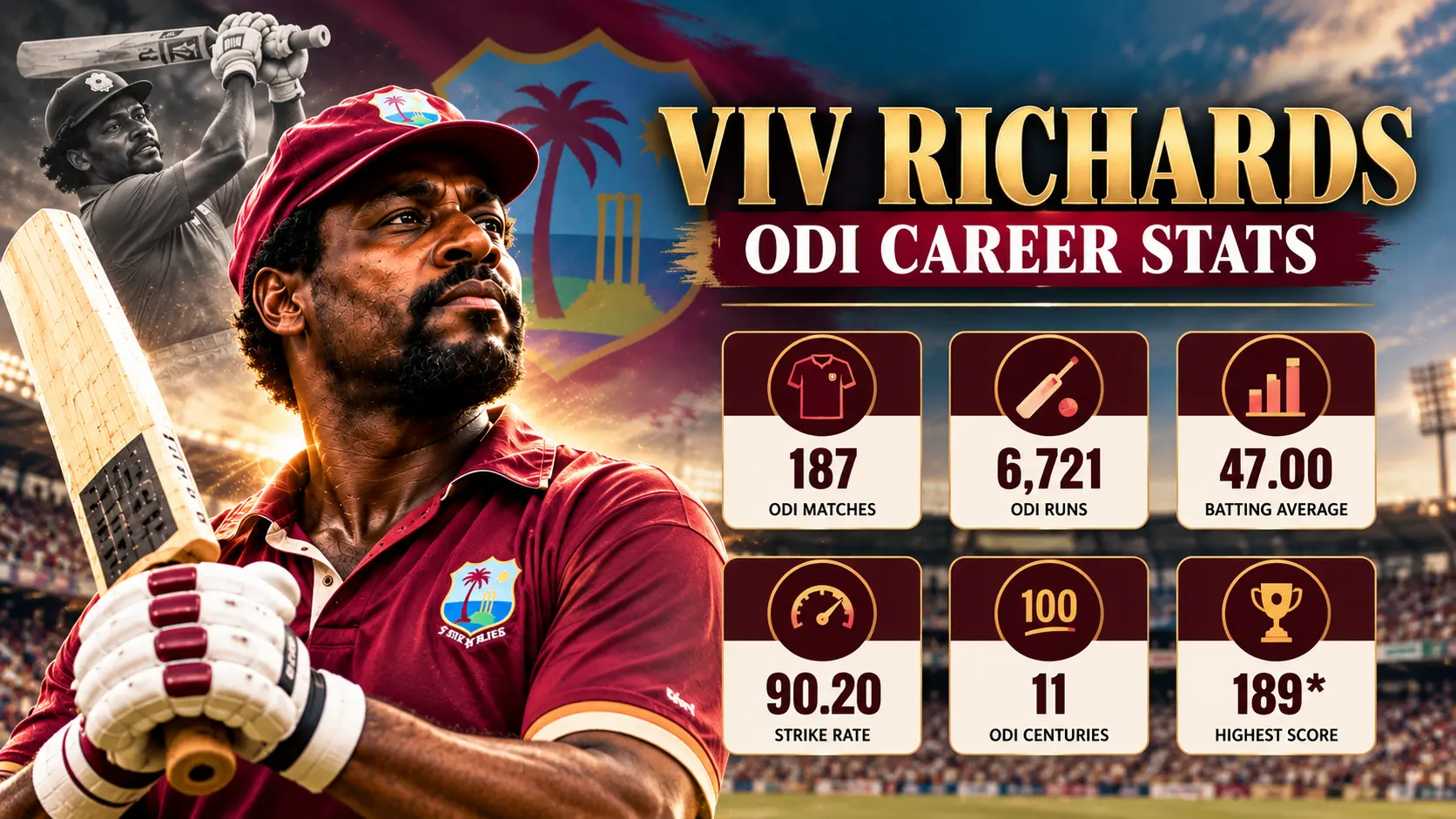
Richards played 187 ODIs between 1975 and 1991, scoring 6,721 runs in 167 innings. His 24 not-outs helped him maintain a batting average of 47.00, while 11 centuries and 45 half-centuries demonstrated remarkable consistency.
| Career statistic | Viv Richards |
|---|---|
| ODI matches | 187 |
| Innings | 167 |
| Not outs | 24 |
| Runs | 6,721 |
| Batting average | 47.00 |
| Strike rate | 90.20 |
| Centuries / Half-centuries | 11 / 45 |
| Highest ODI score | 189* |
| ODI wickets | 118 |
| Best ODI bowling | 6/41 |
| ODI catches | 100 |
The numbers are impressive by themselves, but they gain meaning when considered against the format’s historical conditions. During much of Richards’ career, 60-over cricket remained an important form of the ODI game and batting strategies often prioritised wicket preservation. Richards could be simultaneously fast-scoring and dependable.
For independently listed career records, see the Cricbuzz Viv Richards player profile and the ICC career statistics.
How Viv Richards Changed One-Day Batting
Richards did not invent aggressive batting, but he proved that attacking intent could be the foundation of a successful ODI career rather than an occasional gamble. At his best, he forced bowlers to alter their plans long before the closing overs.
He pressured the bowling attack instead of waiting
Short deliveries invited pulls and hooks. Fuller balls could be driven hard through the off side or whipped through midwicket. Because he had shots on both sides of the wicket, defensive fields did not guarantee control.
He blended power with judgement
His average shows that he was more than a boundary-hitter. He could adjust to setbacks, farm the strike with the lower order and accelerate again when the situation demanded. This balance is a recurring theme in his most famous performances.
His approach anticipated modern ODI and T20 principles
Current limited-overs batting often emphasises control of the scoring rate, aggressive intent and making bowlers respond. Those principles also characterised Richards’ game, even though he played decades before international T20 cricket existed.
Viv Richards’ 189 Not Out vs England in 1984
One innings captures Richards’ blend of courage, tactical awareness and attacking brilliance: his unbeaten 189 against England at Old Trafford on 31 May 1984.
West Indies had slumped to 102 for seven. After the dismissal of Joel Garner, they were 166 for nine, still in danger of posting a below-par score. Richards then shared an extraordinary unbroken tenth-wicket stand of 106 with Michael Holding.
Holding made 12 not out from 27 balls. Richards finished with 189 not out from 170 balls, hitting 21 fours and five sixes. The team reached 272 for nine in 55 overs and dismissed England for 168, winning by 104 runs.
| 1984 Old Trafford ODI | Match detail |
|---|---|
| Viv Richards | 189* off 170 deliveries |
| Boundaries | 21 fours, 5 sixes |
| West Indies total | 272/9 (55 overs) |
| England total | 168 all out |
| Last-wicket stand | 106* with Michael Holding |
| Result | West Indies won by 104 runs |
Chart 3: Richards’ Share of West Indies’ 1984 Total
189 runs — Viv Richards
83 runs — rest of the innings, including extras
272/9 — West Indies total
189 divided by 272 = 69.5%. The remaining 83 runs include all other batters and extras; this is a share-of-total chart.
His 189 was then a world-record individual ODI score. It stood until Saeed Anwar made 194 in 1997. The innings is also frequently cited because Richards ended with a score greater than England’s entire total. Wisden’s retrospective explains how the innings unfolded.
1979 World Cup Final: Richards’ Match-Winning 138 Not Out
Richards’ biggest ODI performances were not confined to ordinary series. On 23 June 1979, he scored 138 not out from 157 balls against England at Lord’s in the Cricket World Cup final.
West Indies were 99 for four before Richards and Collis King added 139 for the fifth wicket. King contributed a dynamic 86, and Richards remained unbeaten as the defending champions reached 286 for nine from 60 overs.
England were bowled out for 194, giving West Indies a 92-run victory and a second consecutive men’s World Cup title. Richards was named Player of the Match.
Chart 4: Richards’ Share of the 1979 Final Total
138 runs — Viv Richards
148 runs — rest of the innings, including extras
286/9 — West Indies total
138 divided by 286 = 48.3%. The remaining 148 runs include other batters and extras.
At Lord’s, Richards delivered a complete ODI innings: resilience after early wickets, a decisive partnership and enough acceleration to leave England with a demanding target. The official Lord’s account records the unbeaten 138 and describes the winning performance.
The 1975 and 1979 World Cups: Two Different Contributions
Richards was part of the West Indies teams that won the first two men’s World Cups. His contribution in the 1975 final against Australia was most notable in the field, where his involvement in three run-outs helped the team defend its total. Four years later, he played the defining batting innings of the final.
This contrast makes his early World Cup career particularly interesting. Richards did not always need to top the scorecard to affect a major match, but when West Indies needed a batting centrepiece in 1979, he supplied it.
Was Viv Richards Only a Batsman? His ODI Bowling and Fielding
Although batting rightly dominates the conversation, Richards also took 118 ODI wickets, with best figures of 6 for 41, and completed 100 catches. Those contributions broaden the case for judging him as an outstanding ODI cricketer rather than solely a great batter.
His bowling was useful because it provided another option for captains, while his sharp fielding reflected the athleticism that became associated with West Indies’ greatest sides.
Viv Richards vs Sachin Tendulkar, Bradman and AB de Villiers
Cross-era comparisons need care. Bradman played Test cricket long before the ODI format existed. Tendulkar built a remarkable one-day record through longevity and consistency. AB de Villiers became synonymous with attacking innovation in a very different, modern scoring environment.
| Player | Reason supporters rate him highly | Important limitation |
|---|---|---|
| Viv Richards | Era-defining ODI scoring rate and big-match influence | Played in a very different ODI environment |
| Sachin Tendulkar | Longevity, ODI run records and adaptability | Played over an unusually long period of changing rules |
| Sir Don Bradman | Historic Test dominance | No ODI career for a direct comparison |
| AB de Villiers | Innovative strokes and rapid scoring | Benefited from a later era of one-day batting development |
A sensible assessment looks beyond who scored the most runs. It considers each player’s influence relative to contemporary tactics, equipment, competition and match situations. Richards’ leading position in the 2015 jury poll is meaningful, but it is not proof that every modern observer would reach the same conclusion.
Godfather of Cricket vs God of Cricket vs Father of Cricket
These phrases are sometimes confused in search results, yet they express different ideas.
Godfather of Cricket
An informal way to praise a figure who guided, pioneered or profoundly influenced the game. There is no official, universally accepted holder.
God of Cricket
A famous fan nickname for Sachin Tendulkar, reflecting his enormous sporting and cultural influence.
Father of Modern Cricket
A description strongly associated with W.G. Grace because of his role in popularising and reshaping the sport. The Lord’s historical timeline documents his place in the early modern game.
Editorial distinction: Calling Richards a pioneering figure in attacking ODI cricket is supported by his career and performances. Presenting “Godfather of Cricket” as an officially conferred Richards nickname would overstate the evidence.
How Richards Influenced Modern Limited-Overs Cricket
Power-hitting, flexible stroke selection and a positive scoring mindset now shape much of ODI and T20 cricket. Richards’ approach anticipated these priorities before modern franchise leagues, batting powerplays and contemporary equipment.
His influence is best understood as an example rather than a direct cause of every modern innovation. He demonstrated that elite batters could dictate the tempo of a match and maintain strong averages while refusing to let bowlers settle.
The image of Richards walking out with calm authority remains part of cricket’s collective memory because it represented something larger than a particular score: the freedom to take control of the contest.
Five Lessons Modern Cricketers Can Learn from Viv Richards
- Play with positive intent. Look for opportunities rather than treating every delivery as a threat.
- Develop a complete range of strokes. Effective aggression requires more than hitting in one direction.
- Read the match situation. Richards could rebuild an innings after a collapse and still finish strongly.
- Build psychological resilience. Confident decision-making matters when facing elite bowlers.
- Value decisive performances. A World Cup final century or a rescue innings can shape a legacy more than an ordinary score.
Frequently Asked Questions
Who is the Godfather of Cricket?
There is no official holder of that title. Depending on the intended meaning, fans may discuss W.G. Grace, Don Bradman, Sachin Tendulkar or Viv Richards. Richards is especially relevant as a pioneer of aggressive ODI batting.
Is Viv Richards officially called the Godfather of Cricket?
No. It is an informal description, not an ICC honour. His verified historical recognition includes finishing first in The Cricket Monthly’s 2015 greatest ODI player poll.
Why did Michael Holding and Ian Chappell discuss Viv Richards?
They appeared in a March 2015 Cricket Monthly feature on Richards’ exceptional ODI talent after the jury selected him as the greatest ODI player. The full transcript has not been independently verified here.
What are Viv Richards’ ODI runs, average and strike rate?
He scored 6,721 runs in 187 ODIs, averaging 47.00 with a strike rate of 90.20.
What was Viv Richards’ highest ODI score?
189 not out from 170 deliveries against England at Old Trafford on 31 May 1984.
How many Cricket World Cups did Viv Richards win?
He played in the West Indies sides that won the 1975 and 1979 men’s World Cups.
How did Richards perform in the 1979 World Cup final?
Richards scored 138 not out from 157 deliveries against England at Lord’s as West Indies won by 92 runs.
Who is popularly known as the God of Cricket?
Sachin Tendulkar is widely known by that fan nickname. It is different from the broader, unofficial phrase “Godfather of Cricket”.
Conclusion: Does Viv Richards Deserve the Godfather of Cricket Label?
The term “Godfather of Cricket” will always invite debate because it combines history, admiration and personal judgement. No single official ranking can settle it. But when the discussion focuses on the evolution of attacking one-day batting, Sir Viv Richards has an exceptional claim.
His career combined 6,721 ODI runs, a strike rate of 90.20 and performances that remain vivid decades later. His 189 not out against England in 1984 and 138 not out in the 1979 World Cup final show a batter capable of taking responsibility when the stakes were highest.
The 2015 Cricket Monthly jury vote provides additional evidence of his standing among experts. Rather than exaggerating an unofficial nickname, Richards’ achievements offer a stronger conclusion: he was one of the players who helped redefine what aggressive ODI batting could be.