

Cricket Analytics / IND vs NZ ODI 2026

Complete head-to-head numbers, sweep-shot and footwork charts, the tactical lessons of Dharamsala, Dubai and Rajkot, and what may change when India meet New Zealand in November 2026.
Daryl Mitchell has scored 184 runs against Kuldeep Yadav in ODIs at a strike rate of approximately 111, while the India spinner has dismissed him twice in nine meetings. The remarkable feature is not just the scoring volume. Mitchell repeatedly changes the terms of the contest through an unusually frequent sweep, purposeful footwork and a willingness to attack before Kuldeep can settle into his ideal length.
Yet Kuldeep’s success in Dubai in 2025 shows that the matchup is far from one-sided. Across two Champions Trophy matches, Mitchell scored only 16 runs off 32 balls against him. With another ODI series beginning in New Zealand on 4 November 2026, the intriguing question is which version of this battle will emerge.
Source: Cricbuzz’s 3 November 2026 tactical analysis. Head-to-head numbers are a pre-series snapshot, not live totals. The 184 runs and two dismissals imply 92 runs per dismissal, which is different from a conventional batting average across completed innings.
Daryl Mitchell vs Kuldeep Yadav: Head-to-Head ODI Stats
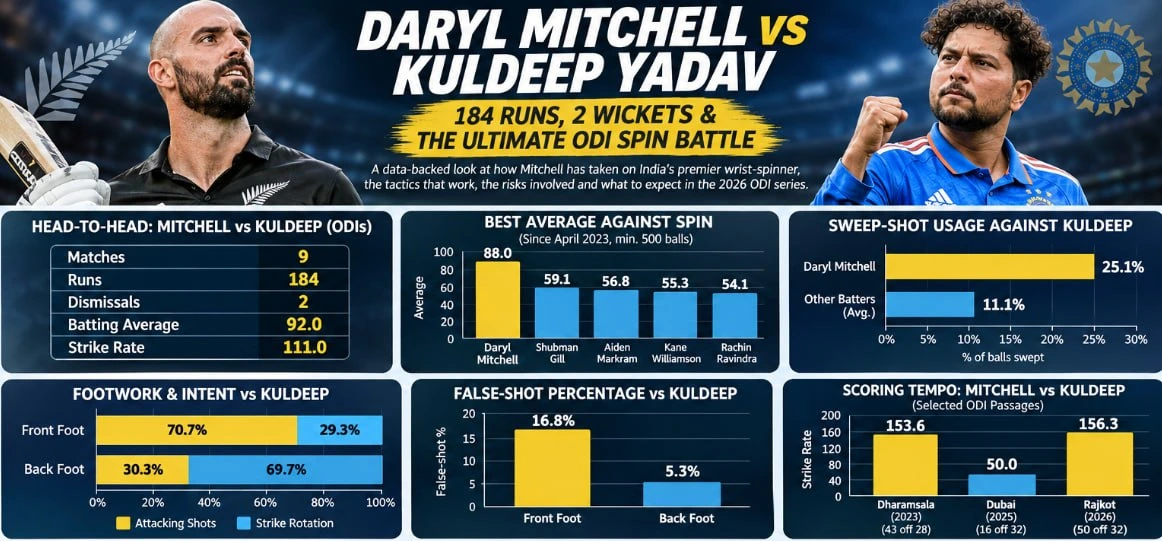
The most useful starting point is a direct comparison of runs, dismissals and methods of scoring. Mitchell’s 184 runs have come in nine ODI encounters with Kuldeep, a substantial sample for an individual batter-versus-bowler contest. This battle is also a key factor in the India vs New Zealand 1st ODI Prediction 2026, as Kuldeep will look to restrict Mitchell’s scoring options. However, the sample is still small enough for one exceptional innings to influence the overall strike rate.
| ODI matchup metric | Recorded figure | What it reveals |
|---|---|---|
| ODI meetings | 9 | Multiple spells and conditions, not one isolated game |
| Runs against Kuldeep | 184 | Significant scoring volume against a specialist wrist-spinner |
| Approximate strike rate | 111 | More than a run a ball in 50-over cricket |
| Dismissals to Kuldeep | 2 | Both identified as lbw in the cited matchup study |
| Runs per dismissal | 92.0 | Calculated from 184 runs divided by 2 dismissals |
| Sweep frequency against Kuldeep | 25.1% | More than double the usual batter’s 11.1% |
| Advancing down the pitch against Kuldeep | 4.5% | Above the overall 2.6% rate of other batters facing him |
Why the strike rate matters: Kuldeep’s normal value in an ODI extends beyond wickets. He can make batters wait for a boundary ball, protect the middle overs and force them to attack a turning delivery. Mitchell’s approach challenges that control: instead of merely surviving the spell, he tries to make the spinner defend.
Why Is Daryl Mitchell So Effective Against Spin?

Mitchell’s recent ODI numbers against spin suggest that his record against Kuldeep is part of a broader skill set. In the period from April 2023 covered by the Cricbuzz study, 62 batters faced at least 500 deliveries from spinners. Mitchell led that qualified group for batting average with 88, while scoring at a strike rate of 96—the eighth-fastest rate among the 62.
This combination matters because high averages alone can come from defensive batting, while high strike rates can conceal a high dismissal risk. Mitchell has produced both sustained scoring and relatively infrequent dismissals. Among faster-scoring batters from Full Member nations, Shubman Gill was the nearest to his average in the source comparison, at 59.06; that is a qualified comparison, not a claim that Gill ranked second overall.
Since April 2023; at least 500 balls faced against spin. Gill is the closest-average comparator among faster-scoring Full Member batters, not the outright runner-up.
There is a technical explanation. Mitchell’s reach allows him to get close to the pitch of a fuller delivery and drive straight, while his sweep can score from a length that other batters might defend. By retaining a reliable method at both ends of the length spectrum, he reduces the bowler’s margin for error.
The Sweep Shot: Mitchell’s Strongest Counter to Kuldeep
Against spin overall, Mitchell sweeps on 16.7% of deliveries—roughly once every six balls. Against Kuldeep specifically, the number climbs to 25.1%. The comparison group of other batters sweeps Kuldeep on just 11.1% of balls. Therefore, Mitchell uses the sweep against the India spinner at approximately 2.26 times the typical frequency.
A higher sweep frequency indicates a different scoring method, not automatically a better outcome.
The conventional wrist-spin plan against a right-hander is to control the area around off stump, invite a risky drive and use turn or the googly to attack the pads and stumps. Sweeping changes the geometry. The batter can send a ball that would otherwise be met with a straight bat behind square, making the bowler reconsider how much protection is needed at fine leg and square leg.
The reverse sweep adds another problem. If a fielder is moved behind point to guard that shot, a different gap may appear on the leg side. These fielding changes are particularly expensive during the middle overs, when the spinner’s attacking field is meant to create wicket-taking pressure.
There is also risk in Mitchell’s method: the two ODI dismissals Kuldeep has achieved against him came via lbw, according to the reference analysis. The sweep can disrupt an attacking line, but a misjudged length or flight can leave a batter vulnerable in front of the stumps.
Footwork Is the Second Weapon: Moving the Bowler’s Length
Mitchell does not rely on the sweep alone. Since April 2023, batters collectively advanced down the wicket against Kuldeep on 2.6% of deliveries. Mitchell did so on 4.5%. That difference may look small as a percentage, but even the possibility of an early charge can prompt a bowler to shorten his length, which can create cutting and pulling opportunities later in the over.
Mitchell’s first- and second-spell figures show how early pressure can influence Kuldeep’s bowling plan.
Mitchell’s use of his feet is strongest in Kuldeep’s first spell: 5.5% of balls compared with 4.2% in the second. By the late overs, fewer charges may be worth the risk because more fielders can be stationed on the boundary. This tactical context helps explain why an apparently small difference in footwork frequency can influence the middle-overs field.
Front Foot vs Back Foot: Aggression with a Purpose
The most revealing aspect of the matchup is that Mitchell does not attack every ball indiscriminately. When he plays off the front foot against Kuldeep—including balls where he advances—70.7% of those deliveries are attacked. Off the back foot, his attack rate is just 30.3%. Meanwhile, 64.2% of his back-foot shots are used to rotate the strike.
That is a clear division of roles. The front foot is his boundary-seeking option; the back foot is predominantly a way to preserve rhythm, keep the scoreboard moving and avoid becoming stuck against a spinner who varies pace.
Proportion of balls attacked within each footwork category.
More attacking intent on the front foot brings higher execution risk.
The false-shot data reinforces the trade-off. Mitchell’s false-shot frequency is 16.8% off the front foot and just 5.3% off the back foot. He accepts more uncertainty when playing the higher-value attacking option, then uses less risky back-foot shots to rotate strike between those opportunities.
For Kuldeep, this makes the decision about flight and length unusually delicate. A fuller ball risks being driven or lofted; a ball short enough for the back foot may surrender an easy single or an occasional cut. His best route is not necessarily to stop every run, but to make Mitchell misread the length before he chooses an aggressive shot.
Three Encounters That Explain the Rivalry
The aggregate head-to-head record becomes more informative when we separate the distinct tactical phases of the contest. Dharamsala showed Mitchell’s aggressive ceiling, Dubai showed Kuldeep’s ability to regain control and Rajkot showed how a batter can use the field itself as an attacking target.
Mitchell’s early assault forced a change of plan
In the league-stage World Cup encounter, Mitchell scored 43 off 28 balls against Kuldeep. The wrist-spinner conceded 48 runs without taking a wicket in his opening five overs, and Mitchell’s charge down the pitch encouraged him to change pace and line. Kuldeep later recovered to finish the remaining part of his spell with 2/25, demonstrating that a bowler can adjust even after losing the opening exchange.
The lesson is broader than one boundary sequence: when the batter makes the spinner defensive early, the captain may have to protect scoring areas that would otherwise remain attacking positions.
Slower conditions helped Kuldeep dictate the exchange
In two Champions Trophy meetings in Dubai, Mitchell managed just 16 runs from 32 deliveries against Kuldeep, with no boundary. Kuldeep dismissed him once across those encounters. On slower surfaces, the batter had less freedom to manufacture straight hitting through decisive footwork, and Kuldeep could hold his length for longer.
This was evidence of a successful counter-plan, not proof that Mitchell’s method had stopped working permanently. Match conditions and the stage of a batter’s innings can determine whether the same option is a strength or a liability.
Mitchell attacked both the bowling and the field
In Rajkot, Mitchell scored 50 from 32 balls against Kuldeep, including four fours and a six. He finished with an unbeaten 131 as New Zealand chased 285 and won by seven wickets with 15 balls to spare. Mitchell began with aggressive movement, then exploited the spaces created when Kuldeep and his captain changed fielders to protect the sweep and reverse sweep.
That is why the innings stands out tactically: Mitchell did not need to hit every good ball for a boundary. By making the bowler alter his initial plan, he also created routes for singles and twos that were unavailable at the start of the spell.
Extra Original Stats Graph: How the Duel Swung Across Matches
The raw runs scored can hide how different the scoring tempo was in each setting. Converting each recorded passage to runs per 100 balls creates a direct comparison across the three samples. The resulting chart is the additional analysis graph, calculated from the match-level runs and balls reported in the reference article.
Calculated as runs divided by balls faced, multiplied by 100. This compares selected passages, not complete series averages.
Rajkot’s 156.3 and Dharamsala’s 153.6 are close, despite the different match situations. Dubai’s 50.0 is dramatically lower. That is not a straight-line progression from one player improving to another declining. It is evidence that this matchup is sensitive to conditions, how early the batter faces the spinner and whether the spinner can retain an attacking length.
Indore 2026: Why the threat stayed alive
Mitchell followed the Rajkot century with 137 in the January ODI decider in Indore, helping New Zealand secure a 2–1 series victory. He attacked Kuldeep’s googly early in the spell and India subsequently restricted Kuldeep’s first spell to three overs, according to the reference analysis. The significance lies in the captaincy problem: even a short burst of aggressive batting can affect how an entire bowling allocation is used.
How Can Kuldeep Yadav Counter Daryl Mitchell in 2026?
The best answer is not simply to bowl faster or wider. Those reactive choices can be exactly what Mitchell wants. A more effective plan should combine the conditions, field and batter’s shot selection rather than overcorrecting after one boundary.
- Make the first six balls a contest of length. Instead of immediately shortening after a charge, use changes of pace and flight to make advancing early uncertain.
- Protect the stumps without becoming predictable. The lbw dismissals show that flight beating the bat remains a route to a wicket. However, a repeatable stump-to-stump pattern can invite the conventional sweep.
- Do not let one sweep dictate the entire field. Keeping a balanced arrangement can avoid opening the secondary scoring gaps Mitchell seeks through reverse sweeps, nudges and drives.
- Consider the phase of the innings. The Dubai encounters suggest bowling to Mitchell before he settles may be more productive than waiting until he has established his length and field preferences.
- Use surface behavior rather than assumptions. A ball that grips or turns more sharply can increase the risk of premeditated movement; on a skiddier surface, execution and defensive placements may matter more.
These are tactical recommendations derived from the historic examples, not claims about a confirmed Indian team plan. Kuldeep’s googly, release position and flight remain essential; the objective is to reduce Mitchell’s ability to predetermine the type of shot available.
Why New Zealand Conditions Make the November 2026 ODIs Interesting

The new five-match ODI series begins on 4 November 2026 in Auckland. As of this article’s update, Daryl Mitchell is in New Zealand’s squad for the first three ODIs only, while Kuldeep is listed in India’s ODI squads. That means Auckland, Wellington and Hamilton are the scheduled opportunities for a renewed individual duel if both men are selected in the playing XIs. No head-to-head result from the new series is included in the historical figures above.
| Match | Date (2026) | Venue | Mitchell–Kuldeep meeting possible? |
|---|---|---|---|
| 1st ODI | 4 November | Eden Park, Auckland | Yes, if both play |
| 2nd ODI | 7 November | Wellington | Yes, if both play |
| 3rd ODI | 10 November | Seddon Park, Hamilton | Yes, if both play |
| 4th ODI | 13 November | Bay Oval, Mount Maunganui | Not in the named NZ squad for this match |
| 5th ODI | 15 November | Bay Oval, Mount Maunganui | Not in the named NZ squad for this match |
All five matches are scheduled for 3:00 pm New Zealand local time, equivalent to 7:30 am IST, according to the published fixture list. Squad plans can change, so selection should be reconfirmed before publishing an individual match preview.
For the matchup itself, the most important variable is how the Eden Park, Auckland pitch plays on the day. A surface offering sufficient grip might help Kuldeep retain his attacking length. However, a surface on which Mitchell can meet the ball on the rise could favour his straight hitting and sweeps. These are conditional scenarios, not a verified venue-by-venue pitch forecast.
What the Numbers Prove—and What They Do Not
There is a temptation to treat a head-to-head average of 92 runs per dismissal as a prediction that Mitchell will dominate the next ODI. That would be poor statistical practice. This figure describes what happened in previous deliveries and is vulnerable to changes in pitch, match phase, field settings and team selection.
Several of the cited percentages also describe different populations: all spin deliveries, balls faced specifically from Kuldeep, first-spell deliveries, and shots selected off the front or back foot. Their trends are useful, but they should not be combined as though they share one denominator. Likewise, the Dubai sample covers two matches while the Dharamsala and Rajkot passages represent one each.
The strongest defensible conclusion is narrower and more interesting: Mitchell’s scoring method has repeatedly made Kuldeep alter his length and field, but Kuldeep has shown a credible counter when conditions and the timing of the contest favor him. That makes the ODI matchup strategically rich rather than predetermined.
Frequently Asked Questions
How many runs has Daryl Mitchell scored against Kuldeep Yadav in ODIs?
Before the November 2026 ODI series, Mitchell had scored 184 runs against Kuldeep in ODIs at a strike rate of approximately 111, according to the cited Cricbuzz analysis.
How many times has Kuldeep Yadav dismissed Daryl Mitchell in ODIs?
Kuldeep had dismissed Mitchell twice in the nine ODI encounters covered by the source, both times lbw.
Why does Daryl Mitchell sweep Kuldeep Yadav so often?
The sweep allows Mitchell to score from fuller and good-length deliveries, and can force the field to change. He swept 25.1% of his deliveries against Kuldeep, compared with 11.1% for the general batter comparison.
What happened when Mitchell faced Kuldeep in the 2025 Champions Trophy?
Across their two games in Dubai, Mitchell scored 16 runs from 32 balls against Kuldeep without hitting a boundary, and Kuldeep dismissed him once.
Who won the Mitchell vs Kuldeep battle in Rajkot in January 2026?
Mitchell dominated their individual passage with 50 from 32 balls, finishing the match unbeaten on 131 as New Zealand won by seven wickets.
Will Daryl Mitchell face Kuldeep Yadav in New Zealand in November 2026?
Both are named in squads covering the first three ODIs on 4, 7 and 10 November 2026. A head-to-head encounter depends on playing-XI selection and match circumstances; Mitchell was not named in New Zealand’s initial squad for ODIs four and five.
Final Verdict: A Battle of Control, Not Just Runs
Daryl Mitchell’s ODI record against Kuldeep Yadav is impressive: 184 runs, a strike rate around 111 and only two dismissals. But the more revealing story is how those numbers were achieved. Mitchell sweeps much more frequently than the average opponent, uses his feet to challenge Kuldeep’s length and divides his batting between aggressive front-foot scoring and lower-risk back-foot rotation.
Kuldeep’s response in Dubai proves that the spinner has a workable plan when he gets enough help from the surface and can prevent Mitchell from initiating the exchange. The November 2026 series therefore offers an opportunity to see whether Mitchell’s established method works again in a new country—or whether Kuldeep can make the batter solve a different problem.