

Basketball Biography
Michael Jordan is widely regarded as one of basketball’s greatest players. He won six NBA championships with the Chicago Bulls, earned five regular-season MVP awards and finished his NBA career with a record 30.1 points per game. His influence also reached Olympic basketball, sports marketing and global popular culture.
In short, Michael Jordan’s legacy rests on elite scoring, six championships in six NBA Finals appearances, five MVP awards and two Olympic gold medals. His competitive style and Air Jordan brand helped make him one of the most influential athletes in history.
Michael Jordan Biography: Early Life, Family and Education
Michael Jordan Biography: Quick Facts
| Personal Details | Information |
|---|---|
| Full Name | Michael Jeffrey Jordan |
| Date of Birth | February 17, 1963 |
| Birthplace | Brooklyn, New York, USA |
| Nationality | American |
| Height | 6 feet 6 inches |
| Profession | Former professional basketball player, businessman |
| Position | Shooting guard |
| College | University of North Carolina |
| NBA Teams | Chicago Bulls, Washington Wizards |
| NBA Championships | 6 |
| Hall of Fame | Inducted in 2009 |
Early Life and Childhood of Michael Jordan
Michael Jeffrey Jordan was born on February 17, 1963, in Brooklyn, New York. His parents were James Jordan and Deloris Jordan. He grew up with his siblings in a family that encouraged discipline, education and hard work.
During his childhood, the family moved to Wilmington, North Carolina. This became an important place in Jordan’s development as a basketball player. He attended Emsley A. Laney High School, where he participated in several sports.
Jordan developed a strong interest in basketball during his teenage years. As a sophomore, he famously missed selection for the varsity basketball team. Instead of giving up, he used the disappointment as motivation to improve his skills.
He spent extra time practising and worked to become stronger, quicker and more confident on the court. His family environment also shaped his approach to sport. His father encouraged him to work with his hands and stay focused, while his mother stressed discipline and education. These lessons became part of the competitive attitude that later defined his professional career.
High School Basketball Career
After improving his game, Jordan became a leading player at Laney High School. His performances attracted attention from college basketball programmes. Coaches recognised his scoring ability, athleticism and competitive attitude.
His improvement demonstrated that early setbacks do not determine a person’s future. By the end of high school, he had developed into a highly regarded basketball prospect. His next major step was joining the University of North Carolina.
Jordan’s high school progress was important because it showed how much consistent practice could change a young athlete’s future. He became known for his jumping ability, speed and willingness to compete. College coaches began to see him as a player who could contribute at a high level, even though he still had room to develop his game.
College Career at the University of North Carolina
Michael Jordan joined the University of North Carolina in 1981. He played under legendary coach Dean Smith and represented the North Carolina Tar Heels.
One of the most memorable moments of his college career came in the 1982 NCAA Championship game against Georgetown. Jordan scored the winning basket, helping North Carolina secure the national championship. Read more basketball stories on Khel Khabri.
Jordan received the Naismith and Wooden College Player of the Year awards in 1984. These honours recognised his impact on college basketball. After completing three college seasons, he decided to enter the NBA Draft.
His time in Chapel Hill gave him a strong foundation in team play. Coach Dean Smith placed importance on passing, defence and making good decisions. Jordan learned to balance individual scoring with the needs of the team. The 1982 championship-winning shot also gave him an early experience of performing under pressure on a national stage.
Michael Jordan’s NBA Career: From Rookie to Global Superstar
Michael Jordan’s Entry into the NBA
The Chicago Bulls selected Michael Jordan with the third overall pick in the 1984 NBA Draft. He made his NBA debut on October 26, 1984, and quickly established himself as an outstanding scorer.
During his rookie season, he averaged 28.2 points per game. His performances earned him the NBA Rookie of the Year award and a place in the All-Rookie First Team.
Jordan quickly became one of the league’s most exciting young players. Fans were drawn to his speed, powerful drives to the basket and ability to finish difficult plays. He also made an impact on defence, using his athleticism to challenge opponents and create turnovers. Although the Bulls were not yet a championship team, Jordan gave the franchise a clear star around whom it could build.
Chicago Bulls Dynasty: Six Championships and Two Three-Peats
Chicago Bulls Career and Championship Success
Jordan spent most of his NBA career with the Chicago Bulls. His partnership with players such as Scottie Pippen helped build one of basketball’s most successful teams.
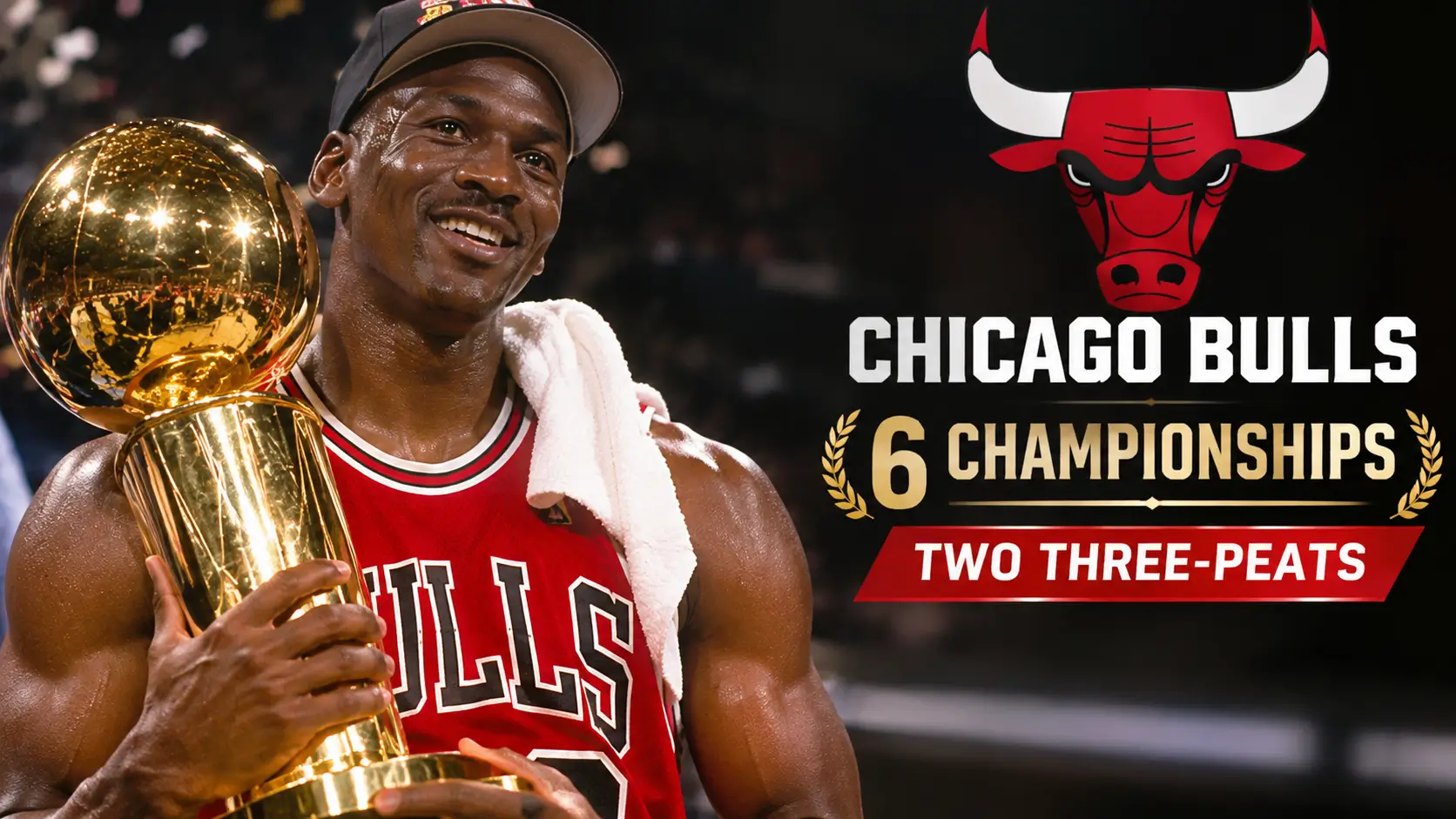
The Bulls won their first NBA championship in 1991, defeating the Los Angeles Lakers in the Finals. Jordan earned his first Finals MVP award. Chicago repeated the achievement in 1992 and 1993, completing its first three-peat.
After a period away from basketball, Jordan returned and helped the Bulls win three more championships in 1996, 1997 and 1998. These six titles established him as one of the defining players of the NBA’s modern era.
Jordan’s role was not limited to scoring points. He set the tone in training, demanded high standards and often took responsibility during close games. His partnership with Pippen gave Chicago a strong combination of scoring, defence and playmaking. Coach Phil Jackson also helped the group work within the triangle offence, which relied on movement, teamwork and smart choices.
First Retirement and Baseball Journey
In October 1993, Jordan announced his retirement from professional basketball. The death of his father, James Jordan, earlier that year was an important personal event during this period. Jordan subsequently pursued another sporting interest: professional baseball. Readers who follow sport across disciplines can explore Khel Khabri.
He joined the Birmingham Barons, a minor league baseball team affiliated with the Chicago White Sox. Although baseball did not bring him the same success as basketball, the experience represented a new challenge. Jordan returned to the NBA in March 1995.
His return attracted enormous attention. Jordan needed time to regain his basketball rhythm, but he soon became a central part of Chicago’s title push. The Bulls’ success in the following seasons showed that he could adapt after a major break from the sport. His baseball period remains a unique chapter in the career of an athlete best known for basketball.
The Second Three-Peat: 1996 to 1998
Jordan’s return helped Chicago build another championship-winning team. Alongside Scottie Pippen and Dennis Rodman, he played a major role in the Bulls’ success.
In the 1995–96 season, Chicago recorded a 72–10 regular-season record. The team won the NBA championship against the Seattle SuperSonics. The Bulls repeated their success in 1997 and 1998, with Jordan earning Finals MVP honours in all three championship seasons.
Washington Wizards Career
After retiring in 1999, Jordan returned to professional basketball in 2001. He joined the Washington Wizards as a player and also held an executive role with the organisation.
Jordan played two seasons for Washington, competing during the 2001–02 and 2002–03 campaigns. His final NBA game took place on April 16, 2003, against the Philadelphia 76ers.
Michael Jordan Career Stats, Records and Major Achievements
Major NBA Records and Achievements
Jordan’s career includes outstanding individual and team achievements. His scoring consistency and performances in important matches helped establish his reputation.
- 6 NBA Championships: Won with the Chicago Bulls in 1991, 1992, 1993, 1996, 1997 and 1998.
- 5 NBA MVP Awards: Recognised as the league’s Most Valuable Player five times.
- 6 NBA Finals MVP Awards: Earned the award in every championship-winning Finals appearance.
- 10 Scoring Titles: Finished as the NBA’s leading scorer in ten seasons.
- 14 NBA All-Star Selections: Represented the league in fourteen All-Star Games.
- Defensive Player of the Year: Received the honour in 1988.
- 2 Olympic Gold Medals: Won in 1984 and 1992.
- NBA Rookie of the Year: Earned the award in 1985.
Michael Jordan’s Major NBA Honours
Counts are taken directly from the achievements listed in this biography.
Scale: zero to 14 awards/selections. These are separate achievement categories, not a combined total.
Michael Jordan’s Career Statistics
Jordan’s NBA statistics reflect his scoring ability and all-around contribution. The following figures cover his NBA regular-season career.
| Career Statistic | Record |
|---|---|
| Matches Played | 1,072 |
| Total Points | 32,292 |
| Points Per Game | 30.1 |
| Rebounds Per Game | 6.2 |
| Assists Per Game | 5.3 |
| Steals Per Game | 2.3 |
| Field Goal Percentage | 49.7% |
His career scoring average of 30.1 points per game remains the highest in NBA regular-season history among players with qualifying career averages.
Michael Jordan’s NBA Career: Per-Game Statistics
Regular-season career averages stated in the article. Each bar uses the same scale, from zero to 32.
Source: career-statistics table in this article. Values are per-game averages; bar lengths are scaled to a maximum of 32.
The 1992 Olympic Dream Team and International Success
The 1992 Olympic Dream Team
Jordan won his first Olympic gold medal at the 1984 Los Angeles Olympics. Eight years later, he became part of the famous 1992 United States Olympic basketball team.
Known as the Dream Team, the squad included basketball legends such as Magic Johnson, Larry Bird and Charles Barkley. The team dominated the Barcelona Olympics and won gold, helping introduce international audiences to the extraordinary talent of American professional basketball.
The 1992 team became famous for its depth and star power. Jordan was one of its leading names, but the squad also showed how elite players could work together for a shared goal. Its performances helped inspire young players around the world and increased interest in basketball outside the United States. Jordan’s Olympic success added another major achievement to his already growing legacy.
Air Jordan, Business Ventures and Charlotte Hornets Ownership
Air Jordan Brand and Business Career
Jordan’s influence extended far beyond the basketball court. His basketball career and international achievements are also documented by USA Basketball. His partnership with Nike became one of the most successful athlete-brand collaborations in sports history.
Jordan signed his first major Nike deal in 1984. The company launched the original Air Jordan basketball shoes in 1985. The footwear line became popular among basketball fans and sneaker collectors, eventually growing into a major global sportswear business.
Jordan also worked with companies such as Gatorade, Hanes and Upper Deck. His advertising campaigns helped make him one of the most recognisable athletes in commercial history.
The Air Jordan name became more than a shoe line. It developed into a cultural symbol connected with sport, fashion and streetwear. New designs and re-releases attracted both basketball players and collectors. Jordan’s influence showed how an athlete’s identity could reach people who might never watch a full NBA game.
Ownership of the Charlotte Hornets
Jordan became involved with the Charlotte basketball franchise in 2006. In 2010, he became its majority owner, making history as the first former NBA player to become the majority owner of an NBA franchise.
The franchise later returned to the Charlotte Hornets name in 2014. In August 2023, Jordan completed the sale of his majority ownership stake to a group led by Gabe Plotkin and Rick Schnall. He retained a minority ownership interest.
Personal Life, Family and Michael Jordan’s Legacy
Personal Life and Family
Jordan’s family has remained an important part of his life. His parents, James and Deloris, played significant roles in his upbringing.
Jordan married Juanita Vanoy in 1989, and they later divorced in 2006. They have three children: Jeffrey, Marcus and Jasmine. In 2013, Jordan married Yvette Prieto. The couple have twin daughters, Victoria and Ysabel.
Legacy and Influence on Basketball
Michael Jordan changed the way people viewed professional basketball. His performances helped increase the NBA’s international popularity during the 1990s.
His competitive attitude, scoring ability and championship performances inspired generations of athletes. His legacy also extends into fashion, advertising and sports business. The Air Jordan brand remains one of the most recognisable names in athletic footwear.
In 2009, Jordan was inducted into the Naismith Memorial Basketball Hall of Fame as an individual player. In 2010, he was also inducted as a member of the 1992 Olympic Dream Team.
His influence can be seen in the players who followed him. Many stars have spoken about studying his footwork, focus and approach to important moments. Modern basketball has changed, but his career remains a reference point when fans discuss greatness, leadership and the pressure of winning. His story continues to attract new audiences through documentaries, interviews and the lasting popularity of his signature brand.
Jordan’s career is also best understood through its different phases. His early Bulls years showed his scoring talent, while the championship seasons demonstrated how individual excellence could serve a team goal. The move to Washington later in his career brought a different challenge: leading a younger group while managing the physical demands of the NBA. These stages help explain why his story is more than a list of titles. It combines skill, adaptation, leadership and a lasting effect on how basketball is watched and marketed around the world. His legacy remains visible in the players who study his footwork, the global reach of the sport and the continuing popularity of the Jordan name.
Frequently Asked Questions About Michael Jordan
Frequently Asked Questions About Michael Jordan
When was Michael Jordan born?
Michael Jordan was born on February 17, 1963, in Brooklyn, New York, USA.
How many NBA championships did Michael Jordan win?
He won six NBA championships with the Chicago Bulls in 1991, 1992, 1993, 1996, 1997 and 1998.
How many MVP awards did Michael Jordan win?
Jordan won five NBA regular-season Most Valuable Player awards and six NBA Finals MVP awards.
Which NBA teams did Michael Jordan play for?
He played for the Chicago Bulls and Washington Wizards during his professional NBA career.
What was Michael Jordan’s career scoring average?
His career regular-season scoring average was 30.1 points per game.
How many Olympic gold medals did Michael Jordan win?
He won two Olympic gold medals, in 1984 and 1992, representing the United States.
When did Michael Jordan retire from basketball?
Jordan retired for the final time in 2003 after playing two seasons with the Washington Wizards.
Final Thoughts: Why Michael Jordan Remains a Basketball Legend
Michael Jordan’s biography is a story of determination, talent and remarkable achievement. From his early days in North Carolina to six NBA championships with the Chicago Bulls, he demonstrated an exceptional competitive spirit. His success extended beyond basketball through the Air Jordan brand and business ventures. His influence continues to inspire basketball fans and athletes around the world.