

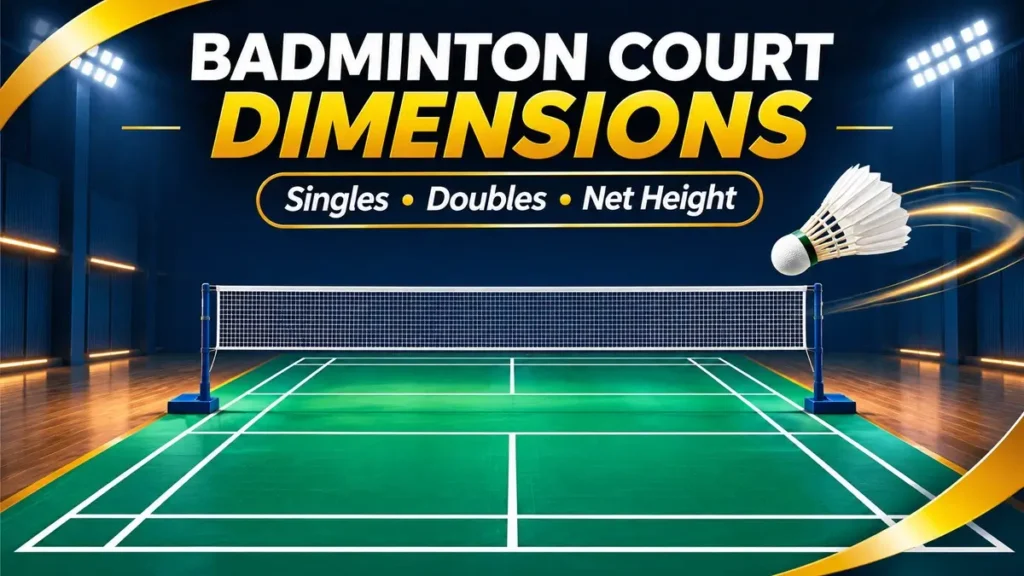
A badminton court looks simple until a serve lands near the back line or a shuttle clips the narrow strip beside the singles boundary. The exact markings determine whether the shot wins a point. This practical guide explains badminton court dimensions, the difference between singles and doubles, how each service box works, and where the net must be measured—with built-in court diagrams you can view while training, coaching or planning a court.
44 ft
20 ft
17 ft
What is the standard size of a badminton court?
A regulation badminton court is 13.40 meters long in both formats. It is 6.10 meters wide for doubles and 5.18 meters wide for singles. The net is 1.55 m high at the posts and 1.524 m high at the centre. Court lines are 40 mm wide and count as part of the playing area. These measurements follow the Badminton World Federation (BWF) Laws of Badminton.
Official badminton court dimensions: complete measurement table
Badminton uses a single rectangular playing court for men’s and women’s singles, doubles and mixed doubles. What changes is which of the painted boundaries count for the format and for a serve. A court therefore needs both sets of side markings rather than separate permanent floors for each event.
| Element | Meters | Feet / other units |
|---|---|---|
| Overall court length | 13.40 m | 44 ft |
| Overall doubles width | 6.10 m | 20 ft |
| Singles playing width | 5.18 m | 17 ft |
| Each doubles side alley | 0.46 m | Approx. 1 ft 6 in |
| Each half of court (net to baseline) | 6.70 m | 22 ft |
| Short service line from net | 1.98 m | 6 ft 6 in |
| Doubles long service line from back boundary | 0.76 m | Approx. 2 ft 6 in |
| Net at its centre | 1.524 m | 5 ft |
| Net over the doubles sidelines | 1.55 m | Approx. 5 ft 1 in |
| Marked line width | 0.04 m | 40 mm |
| Full-court diagonal | 14.723 m | Approx. 48.3 ft |
All values above are based on the BWF court diagram and Law 1. The familiar foot measurements—44 × 20 ft for doubles and 44 × 17 ft for singles—are the traditional nominal dimensions; centimeter-accurate layout should use the specified metric values and a consistent line-marking method.
Badminton court diagram: every marking explained
Badminton court diagram — labeled measurements
- Outer side boundariesDoubles court width is 6.10 m (20 ft).
- Inner side boundariesSingles court width is 5.18 m (17 ft); the side strip is 0.46 m on each side.
- Gold horizontal netDivides the court into two equal 6.70 m halves.
- Short service linesMarked 1.98 m from either side of the net.
- Rear doubles service linesMarked 0.76 m inward from both back boundaries.
Imagine viewing the court from above. The net divides the 13.40 m rectangle into two equal halves of 6.70 m each. Every half contains a left and right service court, divided by a centre line. The short service line sits 1.98 m from the net, while a separate rear service line limits a doubles serve.
Back boundary lines
The end lines mark the farthest permitted landing point during a singles or doubles rally. For singles service, the back boundary is also the rear limit of the receiving service court. For doubles service, the nearer long-service line is the rear limit; the strip beyond it is out for a serve but remains in during a rally.
Sidelines and tramlines
The outside lines create a 6.10 m-wide doubles court. The inner parallel lines create a 5.18 m-wide singles court. The gap between the two is 0.46 m on each side; players often call these strips the side alleys or tramlines. In singles they are out, while in doubles they are in after the serve and also within the doubles service width.
Centre line and short service line
The centre line splits each side into left and right service courts. The short service line is the boundary closest to the net that a legal serve must cross. Its distance is measured from the net line: 1.98 m, or approximately 6 ft 6 in.
Singles vs doubles badminton court: what changes?
Only the playable width changes between singles and doubles during open play; both formats use the full court length. The tactical result is significant. Singles players must recover to cover a long, narrow rectangle, while doubles pairs have to defend and attack across a wider court.
Singles versus doubles: legal service zones
The yellow shaded part illustrates one diagonal receiving box on the opponent’s side of the net. In a real game, the eligible box switches when the server changes from the right court to the left court.
Singles service
Long and narrow: the serve may reach the rear baseline, but not the outer side tramline.
Doubles service
Short and wide: the serve can use the outer sideline, but must land before the rear service line.
Singles court
13.40 × 5.18 m (44 × 17 ft)
Playable area: 69.41 m². The narrow sidelines apply. A legal serve can travel to the full back boundary.
Doubles court
13.40 × 6.10 m (44 × 20 ft)
Playable area: 81.74 m². Outer sidelines apply. Serves stop at the doubles long service line.
How much bigger is a doubles court?
The doubles playing surface is 12.33 m² larger than the singles surface, or about 17.8% more area. That increase comes entirely from the extra width, not the length.
Chart: singles vs doubles playing area
Both courts are 13.40 m long. Doubles has about 17.8% more playable area than singles, calculated using the official court widths.
Badminton service court dimensions and diagonal serving
Four service boxes are indicated on a standard court: two on each side of the net. The shuttle must be struck toward the diagonally opposite service court, not straight ahead. A serve landing on one of the receiver’s applicable service boundary lines counts as in, provided it otherwise satisfies the service laws.
| Service court | Approx. nominal length | Approx. nominal width | Rear service limit |
|---|---|---|---|
| Singles | 4.72 m | 2.59 m | Back boundary line |
| Doubles | 3.96 m | 3.05 m | Doubles long service line |
These useful service-box dimensions are calculated from the court-marking layout; they are not separate stand-alone BWF court specifications. Singles is a long, narrow service target; doubles is a shorter, wider service target. Remember that the doubles rear service restriction applies only to the serve, not to subsequent shots in the rally.
Badminton net height, width, depth and posts
A correctly installed badminton net is not level to an identical height at every point. The top measures 1.55 m above the floor at the doubles sidelines, while its centre measures 1.524 m. The difference is just 26 mm, but it matters for accurate setup and consistent net play.
Net height diagram: centre vs posts
| Net specification | BWF requirement |
|---|---|
| Height above doubles sidelines | 1.55 m |
| Height at net centre | 1.524 m |
| Net depth | 760 mm |
| Minimum net width | 6.10 m |
| Mesh opening | 15–20 mm |
| White tape along top | 75 mm wide |
| Post location | On doubles sidelines, even during singles |
Measure the net above the playing surface, not from the top of a raised base or other hardware. Set both posts on the doubles sidelines, tension the cable, and check the centre measurement after adjustment. BWF Law 1 also requires the net ends to meet the posts without gaps.
When is a shuttle in or out? Court line rules
A shuttle is in if it lands on the court or touches any boundary line that applies to the current rally or serve. BWF Law 1.3 says that the lines form part of the areas they define. In close decisions, look for the first point where the shuttle touches the floor—not where the feathers fall after the cork makes contact.
- Singles rally: inner sidelines and back boundary count; side alleys are out.
- Doubles rally: outer sidelines and back boundary count.
- Singles serve: shuttle must land diagonally, beyond the short service line, inside the inner sidelines and up to the back boundary.
- Doubles serve: shuttle must land diagonally, beyond the short service line, within the outer sidelines, and before or on the doubles long service line.
Physical court markings must be 40 mm wide, preferably white or yellow so that players and officials can distinguish them. A 40 mm painted line should not be confused with the 0.46 m side alley, which is much wider.
Badminton court flooring, lighting and setup
The floor under the markings affects more than appearance. Players accelerate, lunge, pivot and brake repeatedly, so they need dependable traction without a slippery or excessively sticky feel. Many indoor sports halls use a sprung timber base or a compatible synthetic badminton playing surface. The specific layer system and shock absorption should be selected for the venue’s governing competition and facility requirements rather than assumed to be defined by BWF Law 1 alone.
Indoor vs outdoor badminton courts
Regulation competitive badminton is normally played indoors because even modest wind can change a shuttle’s flight. For recreational backyard games, temporary outdoor lines can be useful, but air movement, uneven terrain and improvised net tension make results different from indoor competition. Outdoor setups are best described as recreational, not automatically tournament compliant.
How much space should you allow around a court?
The marked doubles rectangle occupies 81.74 m², but that is not the complete building footprint. Players need run-off space beyond every boundary, plus suitable overhead clearance, lighting, seating and safe circulation. These requirements vary by competition standard, venue design and governing-body guidance. Avoid treating a generic room size as a universal BWF minimum; have a qualified facility designer verify the clearance requirements for your intended level of play.
How to mark a badminton court in six steps
- Choose a flat, suitable indoor sports surface with verified run-off and overhead clearances.
- Establish a 13.40 × 6.10 m doubles rectangle with square corners.
- Check the full-court diagonal: approximately 14.723 m per the BWF diagram.
- Mark a singles sideline 0.46 m inward from each doubles sideline.
- Locate the net at the court midpoint; mark short service lines 1.98 m from it and doubles long service lines 0.76 m in from each back boundary.
- Add the central service dividing lines, use compliant 40 mm visible markings, and check all distances before use.
Badminton service rules and scoring in 2026
The scoring format affects who serves from which side but does not alter the court’s physical dimensions. Under the BWF international rules in force during 2026, ordinary matches are best of three games to 21 points. The BWF approved a move to best of three games to 15 points from 4 January 2027; some domestic or test events may already use 15-point scoring. Always check the event rules. Badminton Europe explains the 2027 change.
Even serving score
Serve from the right service court when the serving side’s score is 0, 2, 4, 6 and so on.
Odd serving score
Serve from the left service court when the serving side’s score is 1, 3, 5 and so on.
Under BWF service rules, the server and receiver stand in diagonally opposite service courts without touching the service boundary lines, the server hits the shuttle’s base first, and the whole shuttle must be below 1.15 m at contact under the standard fixed-height law. The racket must move forward continuously from the start of the service until contact. For Para-badminton, certain class-specific service exceptions apply.
Why the court matters to strategy
In singles, length is often the best weapon: a deep clear stretches the opponent backward, while a tight net shot pulls them forward. Because the side alleys are out, a disciplined player can recover toward a narrower central base. In doubles, flat drives and angled placements create pressure across the extra 0.92 m of width. Short, controlled serves reduce the opportunity for opponents to attack at the net.
Seven common badminton court mistakes
- Using 6.10 m as the singles width. Singles uses 5.18 m; doubles uses 6.10 m.
- Treating the doubles rear service line as a rally boundary. It limits the serve only; later shots can land at the back boundary.
- Marking 0.72 m instead of 0.76 m at the rear service line. The BWF diagram uses 760 mm.
- Measuring the net centre as 1.55 m. The centre should be 1.524 m.
- Calling a shot out because it touched a painted line. Relevant boundary lines count as in.
- Installing net posts on singles sidelines. Posts belong on doubles sidelines for both formats.
- Assuming the marked playing rectangle equals the room’s space requirement. Safe clearances require separate planning.
Frequently asked questions about badminton courts
1. What is the size of a badminton court in feet?
A standard court is 44 ft long and 20 ft wide for doubles; singles is 44 ft long and 17 ft wide.
2. What are the badminton court dimensions in meters?
13.40 × 6.10 m for doubles and 13.40 × 5.18 m for singles.
3. Is badminton court length different for singles and doubles?
No. Both formats use a 13.40 m full-length playing court. Their playable widths differ.
4. How high is a badminton net?
1.55 m at the posts above the doubles sidelines and 1.524 m at the centre.
5. How far is the short service line from the net?
It is 1.98 m, approximately 6 ft 6 in, from the net.
6. How far is the doubles long service line from the baseline?
0.76 m, or about 2 ft 6 in, inside the back boundary.
7. Are badminton court boundary lines in or out?
They are in whenever the line defines the legal court or receiving service area for that shot.
8. Where are badminton net posts placed during singles?
On the outer doubles sidelines, even when the singles court is being used.
9. What are the dimensions of a doubles service box?
Its nominal width is about 3.05 m and its length is about 3.96 m, derived from the marked court geometry.
10. Does the 2027 scoring change affect court dimensions?
No. The BWF’s approved 3 × 15 scoring change starts on 4 January 2027 for the international standard; the court measurement rules remain separate.
Final takeaway
Memorise three figures first: 13.40 m long, 6.10 m wide for doubles and 5.18 m wide for singles. Then learn the two service exceptions: singles serves can go deep to the baseline, whereas doubles serves stop 0.76 m short of it; both must clear the short service line. Use the labeled illustrations above whenever you coach beginners, settle a close line call or mark out a new court.