

CRICKET ANALYSIS / DEEP DIVE

Test cricket faces packed schedules and changing viewing habits. Yet contests still reward skill, patience and smart plans, giving the five-day format a future for fans everywhere.
Standfirst: Test cricket faces serious questions about money, time and attention. Yet the results of 2026 tell a more interesting story. South Africa’s dramatic series win over Australia, rare draws and a historic anniversary on the horizon suggest the format is changing, not simply fading away.
A sport that is nearly 150 years old should not have to explain why it still matters. Test cricket does it almost every season.
Some fans see empty seats and short matches. Others see packed sessions, brave batting and final-day drama. Both groups have a point. The five-day game has real problems. It also produces stories that shorter formats cannot easily match.
The recent South Africa vs Australia Test series showed why. Australia won the opener by 214 runs. South Africa then answered with an innings win. In the decider, they recovered from a 100-run first-innings deficit and won by 176 runs. A series that looked one-sided became a fight about skill, patience and nerve.
So, is Test cricket dying in 2026? The best answer is more careful than yes or no. Its place in the cricket calendar is under pressure. Its ability to deliver great sport is not.
This article looks at the scorecards, the numbers behind changing match lengths, the role of the World Test Championship and what must happen before the game’s 150th anniversary in 2027.
Test cricket in 2026: the main numbers
The following figures tell different parts of the same story. Some show what happened on the field. Others raise questions about how to measure the health of the format.
Verified figures: Cricket Australia, ICC and historical record.
| What to know | Verified figure | What it means |
|---|---|---|
| Cape Town decider | SA 329 & 387; AUS 429 & 111 | Australia led first innings, then lost |
| 2026 World Test Championship | 12 points for a win | Every Test has value in the table |
| Historic first Test | 15 March 1877 | 150th anniversary falls in March 2027 |
| 2027 anniversary match | 11–15 March, MCG | Australia vs England, day-night Test |
The most important warning is simple. A strong month does not prove a lasting recovery. In the same way, one dull draw does not prove that Test cricket is finished. Short samples can move quickly. Long-term trends matter more.
South Africa vs Australia 2026: the series that made the case for five-day cricket
A good Test series needs more than close scores. It needs a story that changes. Players must solve new problems. Plans that work in the first match may fail in the next. That is exactly what happened in South Africa.
At Kingsmead in Durban, Australia looked in control. Matt Renshaw made 190 in the first innings and followed it with 82 in the second. Josh Hazlewood finished South Africa’s chase with six wickets for 49 runs. Australia won by 214 runs and went 1–0 ahead.
There was an obvious question before the second Test. Could South Africa recover, or would Australia keep the pressure on?
At St George’s Park in Gqeberha, the answer came from Temba Bavuma. South Africa were in trouble at 110 for 6. The captain made 179. Simon Harmer added 82 and helped turn a weak position into 425 for 9 declared. Australia’s first innings lasted only 42.3 overs and ended at 99. South Africa won by an innings and 31 runs.
Then came Newlands. The final Test began with the series level at 1–1. Australia made 429 in reply to South Africa’s 329. A lead of 100 runs should have offered the tourists a good chance. Instead, the balance moved again.
Ryan Rickelton scored 101. Wiaan Mulder made 115. The pair added 154 runs for the sixth wicket. Their work gave South Africa 387 in the second innings and set Australia 288 to win. On the last day, Australia fell for 111. South Africa won by 176 runs and sealed the series 2–1.
For more coverage of international tournaments, Proteas performances, and expert cricket analysis, explore the latest cricket news and updates on KhelKhabri.
South Africa vs Australia, three-Test series, October 2026. “dec.” means declared; “f/o” means follow-on.
| Test and venue | South Africa innings | Australia innings | Winner |
|---|---|---|---|
| 1st: Durban, 9–13 Oct | 284; 206 | 390; 314/6 dec. | Australia by 214 runs |
| 2nd: Gqeberha, 18–22 Oct | 425/9 dec. | 99; 295 f/o | South Africa by an innings and 31 |
| 3rd: Cape Town, 27–31 Oct | 329; 387 | 429; 111 | South Africa by 176 runs |
These were not three identical Tests. Durban showed strong top-order batting and disciplined pace bowling. Gqeberha showed a captain rescuing an innings from deep trouble. Cape Town gave fans long resistance, late movement and a dramatic final-day collapse.
That variety matters. It is difficult to tell the story of this series by looking at one highlights clip. Each day changed the meaning of the day before it.
Australia led 1–0 after Durban. South Africa finished with two victories in the three-Test series.
Why a three-Test series gave this comeback room to happen
If the tour had ended after two Tests, it would have finished 1–1. We would have remembered a heavy win for each side. We would not have seen the true decider at Newlands.
The third match created space for adjustment. It tested both teams after their first plans had been exposed. South Africa had to prove that Gqeberha was not a one-off. Australia had to find a response to failure. Those questions made the final Test important before the first ball was bowled.
This is one reason three-match series deserve protection. A two-Test series can still be excellent. But a longer series gives a rivalry more chances to change direction. It gives form, fitness and tactics time to matter.
Cape Town’s 111 all out: why the last day made the difference
A Test match can change quickly after four days of slow work. Newlands was a perfect example.
South Africa’s 387 in their second innings took 134.4 overs. Rickelton faced 219 balls for his 101. Mulder faced 221 for his 115. Those innings were not designed for instant excitement. They were designed to make every Australian wicket more valuable later in the match.
The reward came on day five. Australia needed 288. They had enough time in theory. Yet time was not the only problem. The pitch had changed. South Africa’s bowlers had learned what lengths worked. Fielders stood close to the bat. Every missed ball carried more weight.
Kagiso Rabada struck with pace and finished with 3 for 39. Harmer used his off-spin and took 6 for 16 in the final innings. His ten wickets for 120 runs across the match earned him Player of the Match honours. Australia were dismissed for 111 in 57.1 overs.
Runs scored, not run rate. South Africa won by 176 runs after Australia were all out chasing 288.
The four innings add up to a result that was not easy to predict after the halfway point. Australia had led by 100 runs. Yet they lost by 176. That swing is the value of a contest played across changing conditions.
It also offers a lesson for future pitches. Fast wickets can be entertaining. So can flat surfaces that produce bold batting. The ideal Test surface, however, gives both skills a fair chance over time. It should not decide the match before players have had the chance to adapt.
A collapse should not hide the work that caused it
It is easy to share a video of six wickets falling. It is harder to show the 318 balls Rickelton and Mulder spent building their sixth-wicket stand. Both parts belong to the same story.
The long partnership added runs. It also used time. It asked Australia’s bowlers to return for fresh spells. It made the final innings happen on an older pitch. It gave South Africa more fielding options as the match went deeper.
This is the quiet side of Test cricket. A defensive shot on Friday can help create a wicket on Saturday. It may not make sense in a short clip. It makes perfect sense in a five-day match.
Are Test matches becoming shorter? What the data actually says
The concern about match length is not imaginary. Recent Tests have often ended well before the fifth evening.
A 2025 ESPNcricinfo analysis examined 120 Tests played from 2022 to the end of the 2024–25 period. It found that 81 were finished by the fourth day. That is 67.5% of the sample. It also found that 31 were finished within three days. The average match lasted about 1,701 balls, or roughly 283.5 six-ball overs.
These figures show a real change in how much cricket fans see in one Test. They do not tell us the whole reason. Some matches end early because bowlers are outstanding. Others end early because teams bat badly. Uneven pitches can also speed up results. So can aggressive declarations and new attacking methods.
The point is not that every Test should last five full days. The point is that fans should feel they are getting a fair contest, rather than a race to the finish on a surface that leaves little room for skill.
These categories overlap. The three-day group is included within the four-day figure. Source: ESPNcricinfo 2025 analysis.
There is also a commercial question. People may buy tickets for a fourth or fifth day and then see no play. Broadcasters plan around a match that may stop early. Grounds must handle staffing and event costs with uncertain schedules.
Those are valid concerns. Yet forced five-day Tests would be a mistake. A game should not be made longer simply to fill time. The better goal is fair pitches, strong batting skills and competition that can turn more than once.
Drawn Tests are back in the conversation, but context matters
A draw has become less common in modern Test cricket. That can make the format feel more decisive. It can also remove an important kind of tension: the fight to survive.
The ESPNcricinfo review of the 120 Tests from 2022 to 2024–25 recorded just 11 draws. That is about 9.2% of matches. The supplied November 2026 statistical column reported three draws in seven completed Tests since the start of October. That early figure is roughly 42.9%.
The first figure is from ESPNcricinfo’s 120-Test analysis. The small seven-Test figure is reported by the supplied November 2026 column. Different samples; not proof of a new trend.
The two samples cover different periods and are not equally large. They should not be treated as proof of a reversal. They are useful for a different reason. They remind us that one season can produce a very different balance between batting and bowling.
The Zimbabwe vs Afghanistan Test in Sharjah offered a strong example. Afghanistan posted 514. Zimbabwe replied with 504 and then made 523 for 5. Craig Ervine finished 206 not out and Wessly Madhevere made an unbeaten 100. The match ended in a draw.
That was a remarkable scoring record. It was also an example of the format’s weakness when bowlers receive little help. A draw can be thrilling when one side is fighting to save the game. It can be flat when the pitch removes nearly every threat.
The result alone cannot tell us which kind of draw we watched.
What makes a draw worth watching?
A worthwhile draw has an active contest within it. A team may need to bat through the final session with only two wickets left. The fielding captain may choose between attacking slips and protecting the boundary. A batter may leave a wide ball when the crowd wants a big shot.
Each small decision has a clear purpose. The scoreboard moves slowly, but the stakes rise. That is very different from two teams piling up runs without much danger.
Test cricket should not fear the draw. It should fear matches in which one skill has no chance to challenge the other.
Aggressive batting has changed the game, but patience has not disappeared
Modern batters grow up with T20 leagues, new shots and faster scoring rates. These skills have also changed Tests. A player can reverse-sweep a spinner, attack the second new ball or turn a defensive field into a scoring chance.
There is a clear benefit. A team can recover lost time. A lower-order batter can change a session with a fast fifty. A captain can declare earlier because the runs arrived more quickly.
The danger comes when aggression becomes a rule rather than a choice. Sometimes the best shot is a straight drive. Sometimes the best shot is no shot at all. The smartest players know when to use both approaches.
Cape Town gave a useful comparison. Rickelton’s century took 219 balls. Mulder’s took 221. Their patient stand did more damage than a short burst of boundaries would have done. It moved the game into a position where South Africa’s attack could win.
The best future for Test batting is not old style against new style. It is a mix of both. Players need range. They must score quickly when conditions allow it. They must also stay at the crease when conditions demand care.
Why this is still a special test of batting skill
In a T20 match, a batter may face only a few overs. There is little time for a bowler to build a plan across several spells. A Test gives the contest space.
The same bowler may change the angle, adjust the seam position and set a trap over 20 overs. A batter must notice those changes. A captain can keep attacking one weakness for an entire session. Fitness and concentration become part of technique.
This does not make one format better for every fan. It makes the formats different. Cricket is stronger when each offers something worth watching.
Comeback series: the strongest argument for more than two Tests
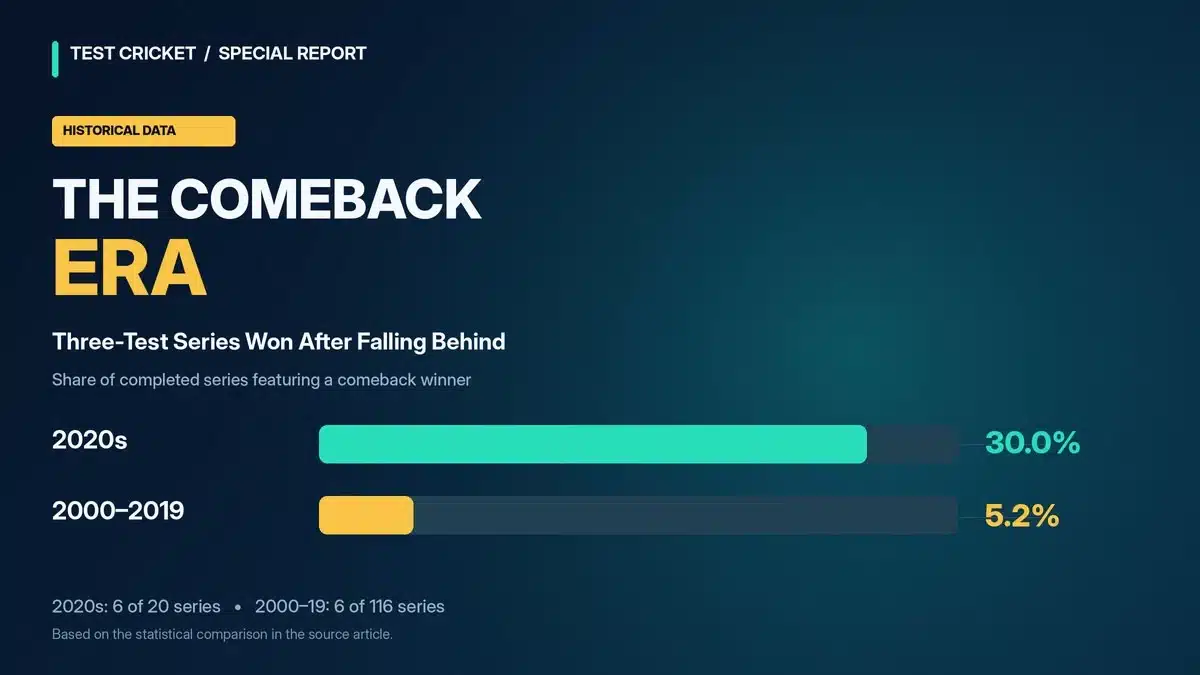
A series comeback is one of Test cricket’s best stories. The first match sets a problem. The second creates a response. The last match delivers a verdict.
The November 2026 statistical column supplied for this article reported six series wins from behind in 20 three-Test series started during the 2020s. That is 30%. It compared them with six in 116 three-Test series across the 2000s and 2010s, and six in 156 such series before 2000.
Rates calculated from historical counts reported in the supplied November 2026 column. The 2020s sample is much smaller.
These are historical counts reported in the supplied column, not a new database calculation for this article. The comparison is still worth thinking about. It suggests that modern three-Test series can change direction more often than fans may expect.
Why? Teams now push harder for wins. Captains may take risks instead of settling for draws. Visiting teams also have more chances to steal an early result. If the first Test goes against the stronger side, the remaining matches become far more interesting.
But the calendar puts a limit on this drama. Many teams receive short tours. Two Tests can disappear quickly. A rain-hit game can leave the second as a lonely decider. A three-Test series gives the contest more breathing room.
More Tests are not always possible. Player workload matters. Boards have budgets. Other formats need space. Yet major rivalries should not be squeezed without thinking about the stories they lose.
Away teams are making Test cricket less predictable
Home advantage has always mattered in Test cricket. Pitches, weather, crowds and preparation can all help the local side. Tours once gave visiting players more time to learn those conditions.
The supplied statistical column measured away wins relative to defeats in opening Tests that produced a result. It reported a ratio of 0.47 from 1980 to 1999, 0.59 from 2000 to 2019 and 0.84 in the more recent period examined.
A ratio of 0.84 means roughly 84 away wins for every 100 away defeats in that sample. It does not mean visitors won 84% of matches. That distinction is important.
Ratio is away wins divided by away losses, not an away win percentage. Historical figures are reported in the supplied column.
If visitors compete more often in the first match, a series can become unpredictable immediately. Fans are no longer asked to wait for the tourists to settle in. The contest begins with a real threat to the home side.
There may be several reasons. Touring players now meet each other in franchise leagues. Video analysis makes opponents familiar. Some home players also arrive with little recent red-ball practice. None of these ideas should be treated as the single proven cause. But they help explain why old assumptions may not hold.
South Africa’s 2026 comeback was also a reminder that home advantage does not settle a series by itself. The Proteas still had to adjust after losing heavily at Durban. Home conditions offered a chance, not a free win.
How the World Test Championship helps, and where it falls short
The World Test Championship gives Tests a table that fans can follow across countries. It connects series that would otherwise look separate. Points can matter months after a match has finished.
In the 2025–27 cycle, a win earns 12 points, a tie earns six, a draw earns four and a loss earns none. Teams are ranked by the percentage of available points they earn, with slow over-rate penalties also able to reduce totals. The two highest teams reach the 2027 final.
ICC World Test Championship 2025–27. Rankings are based on points percentage; slow over rates can lead to deductions.
| Match outcome | WTC points | What it rewards |
|---|---|---|
| Win | 12 | Winning the Test match |
| Tie | 6 | Level scores at the end of play |
| Draw | 4 | Neither team wins |
| Loss | 0 | No match points |
This gives extra value to a fourth-innings chase or a brave draw. It also gives fans another reason to follow matches that do not involve their own country.
But the system has limits. The nine participating teams do not play every other team in the cycle. Each plays six series, with three at home and three away. The number of matches can differ. The percentage system helps compare uneven schedules, but it cannot make every opponent or set of conditions equally difficult.
The championship also does not solve every money problem. A meaningful points table is useful. It cannot pay for a long tour or guarantee that smaller Test countries receive enough matches.
A strong future needs both parts: a championship that makes results matter and a calendar that gives all participating teams a fair chance to grow.
The business problem is bigger than the entertainment problem
One dramatic week cannot settle the debate about the future of Test cricket. The harder questions sit off the field.
A five-day event costs money to stage. Teams must travel. Players need rest and specialist training. Grounds need staff and equipment. Broadcasters need clear plans. Smaller boards may struggle to build a regular Test programme when shorter matches are easier to package.
This does not mean that T20 cricket is the enemy. Shorter formats bring new fans and new skills. They can support the wider game. The real risk is a calendar in which there is never enough room for Tests to develop their own stories.
For a Test side to improve, it needs repeat opportunities. A single tour every long while is not enough. Batters must learn to face the new ball in different countries. Bowlers need long spells. Captains need experience setting fields across several sessions.
If the strongest teams play each other often while others rarely get the same chance, the gap may grow. That is bad for competition. It is also bad for the product fans are being asked to watch.
Three practical pressures that need attention
A crowded schedule. International series, domestic competitions and franchise leagues compete for the same weeks. A better calendar must leave genuine blocks for red-ball cricket rather than placing Tests around every available gap.
Unequal opportunities. Countries need enough matches to plan squads and reward good performances. Development is difficult when a player may wait a long time for the next Test.
Uncertain viewing value. Tickets, travel and broadcast plans are harder when matches can finish in two or three days. Clear communication, flexible ticket terms and better match presentation would make the fan experience easier.
These issues may not create headlines like a six-wicket collapse. But they decide whether the next great series can happen at all.
What India and other major Test nations can do
India has a major role because it has a large cricket audience, strong domestic cricket and huge interest in international matches. The same broad responsibility sits with other leading boards.
First, top nations should support series that have a clear sporting purpose. A long rivalry needs enough matches to build a story. Second, schedules should allow visiting teams reasonable preparation. Third, domestic red-ball cricket should remain a meaningful path into the Test side.
There is also a job for publishers and broadcasters. Fans need more than a result. They need to understand the contest. Good coverage can explain why a captain used a short-leg fielder, why an old ball reversed or why a batter refused a risky single.
That kind of detail turns a slow session into something viewers can follow. It does not require complicated English. It requires clear reporting and accurate data.
A simple scorecard can show that a batter made 75. A better story can show that he faced 237 balls while the match was slipping away. Both numbers matter, but the second explains the effort.
The road to 150 years: why March 2027 matters
Test cricket began at the Melbourne Cricket Ground on 15 March 1877. Australia beat England by 45 runs. Charles Bannerman made 165 out of Australia’s 245 in the first innings. His share of the total, about 67.3%, is still a striking record.
In 1977, the same teams played a centenary Test at the MCG. Australia again won by 45 runs. The repeated margin gave the game’s history an unlikely echo.
The next chapter is already scheduled. Australia and England will play a special day-night Test at the MCG from 11 to 15 March 2027. The match will mark the 150th anniversary of the first Test.
The 2027 fixture is scheduled for a day-night format. Do not describe it as completed.
| Year | Event | Result or plan |
|---|---|---|
| 1877 | First recognised Test at MCG | Australia beat England by 45 runs |
| 1977 | Centenary Test at MCG | Australia beat England by 45 runs |
| 2027 | 150th anniversary Test at MCG | Australia vs England, scheduled 11–15 March |
That match is a celebration, not a cure. History gives the format prestige. A well-run future gives it purpose. The anniversary will mean more if fans can see a clear plan for the next decade as well as a tribute to the last century and a half.
What should the 150th anniversary stand for?
It should honour the players who built the format. It should welcome people watching their first Test. It should also invite serious questions about who gets to play, where matches are shown and how the five-day game remains competitive.
A special match under lights is one way to reach a modern audience. It shows that tradition and change do not have to fight. Test cricket can keep its core while improving the experience around it.
Five changes that would make Test cricket stronger after 2026
1. Protect more meaningful series
Not every tour needs five Tests. But important contests should have enough matches to reward a comeback. Three-Test series offer a useful middle ground. They give teams a chance to respond after a poor start.
2. Build fair pitches with changing conditions
A good Test pitch should reward strong batting and accurate bowling. It can be hard on day one and easier on day two. It can begin to turn later. The aim is not to promise a result by lunch on day three. The aim is to create a contest that develops.
3. Give touring teams a real chance
Better preparation can improve the standard of cricket. Touring sides should not need to learn everything while the first Test is already under way. Warm-up matches and training time can help. Strong away performances are good for every home crowd too.
4. Make Test cricket easier to follow
Coverage should explain changing field settings, bowling spells, partnerships and match situations. Scorecards should work on mobile phones. Data graphics should use clear labels. Commentary should welcome new viewers without losing detail for experienced fans.
5. Keep more nations in the conversation
A format becomes stronger when more teams can win. Emerging players need fixtures, not only praise. A healthy Test calendar should give nations a path to improve through regular, meaningful matches.
These changes are not as exciting as a winning six. They are how the sport creates the conditions for its next great finish.
How should we measure whether Test cricket is healthy?
Crowd size matters, but it is only one measure. A single sell-out at a famous ground cannot represent every country. A quiet weekday crowd does not automatically mean there is no audience online.
A more useful scorecard would track several things together.
Competitive balance: How often do away teams win? How many series reach a decider? How often does the lead change during a match?
Match quality: Are both batters and bowlers able to influence the game? Are matches ending early because of skill, or because conditions offer almost no balance?
Access: Can fans watch matches without confusing schedules or difficult viewing options? Are highlights and scorecards easy to find?
Opportunities: How many Tests does each country play? Do players have enough red-ball cricket between tours?
Fan commitment: Do people return for later days, follow a series to its end and engage with stories beyond the final score?
These measures are harder to put into one headline than the number of draws. But they would give a fairer view of the sport’s condition.
Final verdict: Test cricket is evolving, not escaping danger
The five-day game can still deliver moments that feel impossible in any other format. South Africa’s 2026 series win showed that clearly. A side that was one match down fought back. Batters built a final-day opportunity through hours of patient work. Bowlers turned that opportunity into a famous victory.
But the same month also showed why easy conclusions fail. Some matches ended quickly. Another finished in a mountain of runs and a draw. These results were very different, yet all belonged to the same format.
Test cricket does not need every match to be a classic. No sport can promise that. It needs enough support, strong enough teams and fair enough conditions to make classics possible.
As the 150th anniversary approaches, the question is not simply whether Test cricket is dying. It is whether cricket’s leaders will protect the things that make it worth keeping. The evidence from the field says it remains capable of greatness. The upcoming ICC Test Cricket 150th Anniversary celebrations in 2027 offer an opportunity to honour the format’s history while making its future sustainable.
Frequently asked questions
Is Test cricket dying in 2026?
No clear evidence shows that Test cricket has stopped being competitive or interesting. The format has scheduling and financial pressures, but major series still produce dramatic results. Its future depends on decisions made off the field as well as performance on it.
Why are so many Test matches finishing early?
Aggressive batting, strong bowling, poor shot selection and demanding pitches can all shorten matches. An ESPNcricinfo analysis found that 81 of 120 Tests in its 2022 to 2024–25 sample ended by the fourth day. The reasons vary from match to match.
Who won the South Africa vs Australia Test series in 2026?
South Africa won 2–1. Australia won the first Test in Durban by 214 runs. South Africa won the second by an innings and 31 runs and the third by 176 runs.
What happened in the third South Africa vs Australia Test in Cape Town?
South Africa scored 329 and 387. Australia scored 429 and 111. The hosts won by 176 runs. Simon Harmer took 10 wickets in the match, including 6 for 16 in Australia’s final innings.
How many points does a team get for a Test win in the WTC?
In the 2025–27 World Test Championship, a win brings 12 points, a tie six, a draw four and a loss zero. Rankings use the percentage of available points earned, with deductions possible for slow over rates.
When is the 150th anniversary Test match?
Australia and England are scheduled to play a day-night Test at the Melbourne Cricket Ground from 11 to 15 March 2027. It marks 150 years since the first Test in March 1877.
Are drawn Tests bad for cricket?
Not always. A close draw can be gripping when one team is trying to survive. A dull draw can expose a pitch that gives bowlers almost no help. The quality of the contest matters more than the result label.
Why are three-Test series important?
They give teams time to adapt. A side can lose the opener, fight back in the second Test and decide the series in the third. South Africa’s 2026 win over Australia is a clear recent example.
Data notes and editorial sources
This feature is a new analysis, not a rewrite of the supplied Andy Zaltzman column dated 10 November 2026. Historical series comeback counts, the opening-Test away win/loss ratios and the small October–November 2026 match sample are attributed to that supplied analysis. Other key match scores and competition rules were checked against the linked public sources below. The commentary-based figures should be treated as reported research, not independently recomputed totals.