

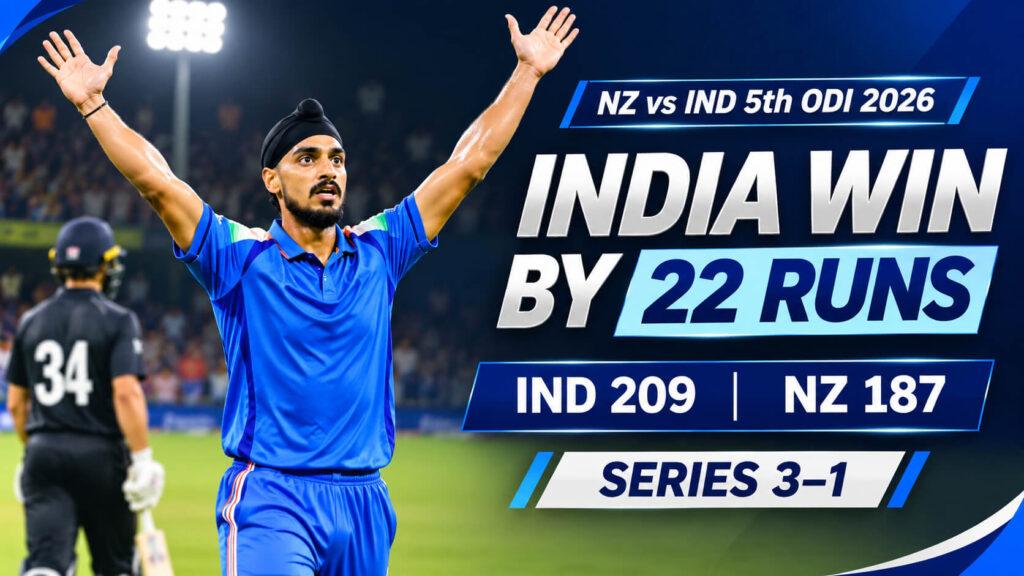
NZ vs IND 5th ODI 2026: India turned a modest 209 into a decisive series-clinching score, bowling New Zealand out for 187 to win by 22 runs at Bay Oval. Arshdeep Singh’s superb 3/30, supported by timely wickets from Mohammed Siraj, Axar Patel and the rest of the attack, secured a 3–1 ODI series victory.
New Zealand won the toss and chose to field · Target: 210 · Fifth ODI of five
NZ vs IND 5th ODI 2026: Match Statistics and Charts
The following charts use the published final scorecard and innings powerplay breakdowns. The phase charts are actual innings-phase totals and calculated run rates, not estimates of individual overs.
Runs by Innings Phase
India: 37 runs / 3 wickets · NZ: 41 runs / 1 wicket
India: 146 runs / 5 wickets · NZ: 114 runs / 5 wickets
India: 26 runs / 2 wickets (2.1 ov) · NZ: 32 runs / 4 wickets (8.1 ov)
Scoring Rate by Phase (Runs per Over)
India’s final phase covers 2.1 overs; New Zealand’s covers 8.1 overs. Unequal durations explain the late India spike.
Highest Individual Scores
Leading Wicket-Takers
NZ vs IND 5th ODI 2026 Match Highlights
- Result: India 209 all out (42.1 overs) defeated New Zealand 187 all out (48.1 overs) by 22 runs.
- Arshdeep’s decisive spell: 10 overs, two maidens, 30 runs and three wickets; he also scored 14 from four deliveries.
- India’s recovery: Axar Patel made 46 from 55 balls and Ishan Kishan contributed 46 from 58 balls after early losses.
- Siraj’s comeback: Mohammed Siraj dismissed Tim Seifert and Finn Allen in his first match of the ODI series.
- Captaincy and support: Shreyas Iyer relied extensively on pace, while ODI debutant Yash Thakur and Auqib Nabi took one wicket each.
- Series: India finished 3–1, with the third ODI washed out without a result.
How India Defended 209 to Win the Fifth ODI
The last ODI in Mount Maunganui looked like an opportunity for New Zealand to level the series. India had been bowled out for 209 in just 42.1 overs, leaving a target of 210 with 50 overs available. In ordinary one-day conditions, a pursuit requiring just 4.20 runs per over would have looked manageable. The match changed once the Indian fast bowlers found movement and refused to let the hosts settle.
Shreyas Iyer’s bowling changes made the chase a contest of survival rather than simple arithmetic. Mohammed Siraj created the first opening; Arshdeep Singh attacked the stumps, used the short ball effectively and returned to take wickets when partnerships threatened. Yash Thakur, Auqib Nabi and Naman Dhir also contributed a wicket each, ensuring that no single bowler had to shoulder the entire defence.
New Zealand’s batting was repeatedly interrupted just as it appeared stable. Will Young and Nick Kelly moved the score to 64 before the second wicket, but successive dismissals prevented a meaningful acceleration. At 119/6, the equation was still achievable on paper, yet the hosts had lost most of their recognised batting. The captain, Mitchell Santner, brought late resistance, but India retained enough control to finish 22 runs ahead.
Arshdeep Singh’s 3/30: The Defining Performance
Arshdeep’s match contribution came at both ends of the contest. With the bat, he struck two sixes in a four-ball 14 to stretch India’s total beyond 200. With the ball, he delivered his full quota for 30 runs, including two maiden overs and three wickets. His economy rate of 3.00 was comfortably better than New Zealand’s overall run rate and crucial to forcing riskier shots from the home batters.
His first major strike removed Will Young for 22, ending a stand that had given New Zealand a platform. Nick Kelly then played on for 24, and Kristian Clarke was caught behind for 16 when India needed to break the lower-order resistance. Arshdeep’s ability to vary length while preserving movement gave Iyer a wicket-taking option in several different stages of the innings.
Mohammed Siraj Removes Seifert and Allen
Siraj returned to the ODI side for the series finale and quickly demonstrated why his experience was valuable. He dismissed Tim Seifert for 14, the opening wicket of New Zealand’s reply. Later, with India seeking to tighten its grip, he bowled Finn Allen for one to reduce New Zealand to 83/4 in the 22nd over.
Siraj’s figures of 2/50 from ten overs do not fully reflect his tactical value. He made early breakthroughs, combined with Arshdeep to sustain pressure, and helped ensure the asking rate became secondary to preserving wickets. The two frontline seamers finished with five wickets between them.
Yash Thakur’s ODI Debut and the Supporting Attack
Yash Thakur made his ODI debut in a match that demanded composure from every bowler. He finished with 1/38 in ten overs, removing Dean Foxcroft for 31 just after Auqib Nabi had dismissed Michael Bracewell for 19. Those two wickets fell with New Zealand on 119, making it much harder for the hosts to rebuild.
Thakur’s three no-balls were a blemish in an otherwise useful spell, but he continued to contribute under pressure. Nabi’s 1/37 from ten overs provided control at the opposite end. Naman Dhir then dismissed Santner for 24, breaking a seventh-wicket partnership that had briefly revived New Zealand’s hopes.
India’s Batting: From 34/3 to a Defendable 209
India’s top order struggled to turn starts into a substantial total. Rohit Sharma fell for seven, Virat Kohli made five, and Ruturaj Gaikwad departed for 18. At 34/3 in the ninth over, New Zealand’s decision to bowl first looked justified. The pitch did not offer easy timing, and the hosts kept the ball in areas that made attacking shots difficult.
Shreyas Iyer and Axar Patel restored some stability. Iyer made 22 from 26 balls before being removed by Blair Tickner, leaving the side on 86/4. Axar’s 46 from 55 balls was a decisive innings because he combined strike rotation with five fours and a six. Promoted up the order, he ensured India did not surrender its final seven wickets in another rapid collapse.
Axar Patel and Ishan Kishan Share Top-Scoring Honours
Axar’s innings was built on judgement of length and selective boundary hitting rather than constant aggression. Ishan Kishan, in contrast, provided a longer middle-order presence, scoring 46 from 58 balls with three fours and two sixes. Even when wickets fell around him, Kishan kept India moving toward a total that offered its bowlers some room to attack.
Naman Dhir added 22 from 31 balls, while Mohammed Siraj finished unbeaten on 14 from 20. Arshdeep’s brief assault included two sixes, one of the most valuable late contributions in the context of the result. India had lost nine wickets for 183; the final pair pushed the total to 209. New Zealand eventually fell 22 short, illustrating how important those closing runs became.
Santner and Duffy Lead the New Zealand Bowling
Mitchell Santner took 3/47 in his ten overs, dismissing Naman Dhir, Auqib Nabi and Yash Thakur. Jacob Duffy also claimed three wickets, though he conceded 60 runs in 8.1 overs. Matthew Fisher’s 2/28 included the key early dismissals of Rohit Sharma and Virat Kohli. Michael Bracewell’s economical 1/35 from ten overs added pressure through the middle phase.
The figures showed that New Zealand’s bowlers had produced enough chances to restrict India further. The difference was India’s lower-order contribution and the effectiveness of its bowlers under lights. Those elements converted a below-par-looking score into a match-winning one.
NZ vs IND 5th ODI 2026 Full Scorecard
India Batting Scorecard — 209 All Out (42.1 Overs)
| Batter | Dismissal | R | B | 4s | 6s | SR |
|---|---|---|---|---|---|---|
| Rohit Sharma | c Foxcroft b Fisher | 7 | 13 | 1 | 0 | 53.84 |
| Ruturaj Gaikwad | c Seifert b Duffy | 18 | 27 | 3 | 0 | 66.66 |
| Virat Kohli | c Seifert b Fisher | 5 | 7 | 0 | 0 | 71.42 |
| Shreyas Iyer (c) | c Fisher b Tickner | 22 | 26 | 3 | 0 | 84.61 |
| Axar Patel | c Young b Bracewell | 46 | 55 | 5 | 1 | 83.63 |
| Ishan Kishan (wk) | c Fisher b Duffy | 46 | 58 | 3 | 2 | 79.31 |
| Naman Dhir | c Kelly b Santner | 22 | 31 | 2 | 0 | 70.96 |
| Auqib Nabi | c Allen b Santner | 5 | 9 | 1 | 0 | 55.55 |
| Yash Thakur | c Seifert b Santner | 0 | 4 | 0 | 0 | 0.00 |
| Mohammed Siraj | not out | 14 | 20 | 1 | 1 | 70.00 |
| Arshdeep Singh | b Duffy | 14 | 4 | 0 | 2 | 350.00 |
| Extras | 10 (7 wides, 1 no-ball, 2 leg-byes) | |||||
| Total | 209 all out in 42.1 overs | |||||
India fall of wickets: 1–23 (Rohit, 5.3), 2–33 (Kohli, 7.3), 3–34 (Gaikwad, 8.1), 4–86 (Iyer, 17.2), 5–121 (Axar, 24.6), 6–160 (Dhir, 33.2), 7–166 (Auqib Nabi, 35.2), 8–166 (Yash Thakur, 35.6), 9–183 (Ishan Kishan, 40.3), 10–209 (Arshdeep, 42.1).
New Zealand Bowling Scorecard
| Bowler | O | M | R | W | Econ |
|---|---|---|---|---|---|
| Jacob Duffy | 8.1 | 1 | 60 | 3 | 7.34 |
| Matthew Fisher | 7 | 1 | 28 | 2 | 4.00 |
| Kristian Clarke | 2 | 0 | 13 | 0 | 6.50 |
| Blair Tickner | 5 | 1 | 24 | 1 | 4.80 |
| Mitchell Santner | 10 | 1 | 47 | 3 | 4.70 |
| Michael Bracewell | 10 | 0 | 35 | 1 | 3.50 |
New Zealand Batting Scorecard — 187 All Out (48.1 Overs)
| Batter | Dismissal | R | B | 4s | 6s | SR |
|---|---|---|---|---|---|---|
| Will Young | c Gaikwad b Arshdeep | 22 | 42 | 3 | 0 | 52.38 |
| Tim Seifert (wk) | c Yash Thakur b Siraj | 14 | 21 | 2 | 0 | 66.66 |
| Nick Kelly | b Arshdeep | 24 | 45 | 2 | 0 | 53.33 |
| Dean Foxcroft | b Yash Thakur | 31 | 42 | 5 | 0 | 73.80 |
| Finn Allen | b Siraj | 1 | 5 | 0 | 0 | 20.00 |
| Michael Bracewell | c Naman Dhir b Auqib Nabi | 19 | 33 | 2 | 0 | 57.57 |
| Mitchell Santner (c) | c Arshdeep b Naman Dhir | 24 | 31 | 1 | 2 | 77.41 |
| Kristian Clarke | c Ishan Kishan b Arshdeep | 16 | 35 | 1 | 0 | 45.71 |
| Blair Tickner | st Ishan Kishan b Axar Patel | 14 | 20 | 1 | 0 | 70.00 |
| Jacob Duffy | c Kohli b Axar Patel | 9 | 12 | 1 | 0 | 75.00 |
| Matthew Fisher | not out | 3 | 6 | 0 | 0 | 50.00 |
| Extras | 10 (7 wides, 3 no-balls) | |||||
| Total | 187 all out in 48.1 overs | |||||
New Zealand fall of wickets: 1–26 (Seifert, 5.3), 2–64 (Young, 16.3), 3–82 (Kelly, 20.4), 4–83 (Allen, 21.3), 5–119 (Bracewell, 30.6), 6–119 (Foxcroft, 31.1), 7–158 (Santner, 40.4), 8–161 (Clarke, 42.4), 9–181 (Duffy, 46.2), 10–187 (Tickner, 48.1).
India Bowling Scorecard
| Bowler | O | M | R | W | Econ |
|---|---|---|---|---|---|
| Arshdeep Singh | 10 | 2 | 30 | 3 | 3.00 |
| Mohammed Siraj | 10 | 1 | 50 | 2 | 5.00 |
| Auqib Nabi | 10 | 1 | 37 | 1 | 3.70 |
| Yash Thakur | 10 | 0 | 38 | 1 | 3.80 |
| Axar Patel | 6.1 | 0 | 28 | 2 | 4.54 |
| Naman Dhir | 2 | 0 | 4 | 1 | 2.00 |
Five Turning Points in the NZ vs IND 5th ODI
- India 34/3 after 8.1 overs: Fisher and Duffy eliminated three of India’s first four batters, placing the middle order under immediate pressure.
- The Axar–Iyer repair work: India advanced from 34/3 to 86/4 as the pair stabilised the innings and kept the total within reach.
- India’s last-wicket 26 runs: The score grew from 183/9 to 209 all out thanks to the resistance from Siraj and Arshdeep.
- New Zealand slide from 64/1 to 119/6: Arshdeep, Siraj, Nabi and Thakur dismantled a chase that had looked controlled.
- Clarke’s dismissal at 161/8: Arshdeep’s final wicket left New Zealand relying on the tail. Axar subsequently took the last two wickets to seal the win.
Bay Oval Pitch Report: Why Was 209 Enough?
The fifth ODI showed how a surface can become far more demanding once the new ball moves sideways and the batting side starts losing wickets. At Bay Oval, India’s total of 209 did not guarantee a victory, yet the seamers used their lengths and the changing evening conditions to make fluent strokeplay difficult. Four of India’s first ten wickets had fallen before the 18th over; New Zealand, despite more time to bat, could not sustain long enough partnerships.
The home side required only 210 to win but ultimately scored at 3.88 runs per over. India’s bowlers conceded few easy scoring sequences, and the increasing pressure was reflected in wickets rather than a rising required run rate alone. The match was another reminder that ODI targets must be assessed alongside pitch behaviour and batting resources, not solely by the number on the scoreboard.
For an earlier look at the surface and pre-match conditions, see KhelKhabri’s NZ vs IND 5th ODI pitch report and Bay Oval preview.
India vs New Zealand ODI Series 2026: All Five Results
| Match | Date | Venue | Result |
|---|---|---|---|
| 1st ODI | 4 Nov | Auckland | India won by 5 wickets (DLS) |
| 2nd ODI | 7 Nov | Wellington | India won by 4 runs (DLS) |
| 3rd ODI | 10 Nov | Hamilton | No result |
| 4th ODI | 13 Nov | Mount Maunganui | New Zealand won by 244 runs |
| 5th ODI | 15 Nov | Mount Maunganui | India won by 22 runs |
| Series | India won 3–1 (one no result) | ||
Why the 3–1 Series Win Matters for India
This victory was India’s first away ODI series win under head coach Gautam Gambhir, but its significance goes beyond a single milestone. India had suffered a heavy 244-run defeat in the previous ODI and faced another batting collapse in the decider. Rather than requiring a dominant total, the visitors recovered through middle-order contributions and then backed a below-average score with disciplined bowling.
The series also demonstrated the value of depth. Gurnoor Brar, who did not play the fifth ODI, finished as Player of the Series with nine wickets. Arshdeep and Siraj led the final-match defence, while Axar contributed with both disciplines. Debutant Thakur and the less-experienced Nabi were entrusted with ten overs each, gaining meaningful exposure in a pressured away setting.
Player of the Match and Player of the Series
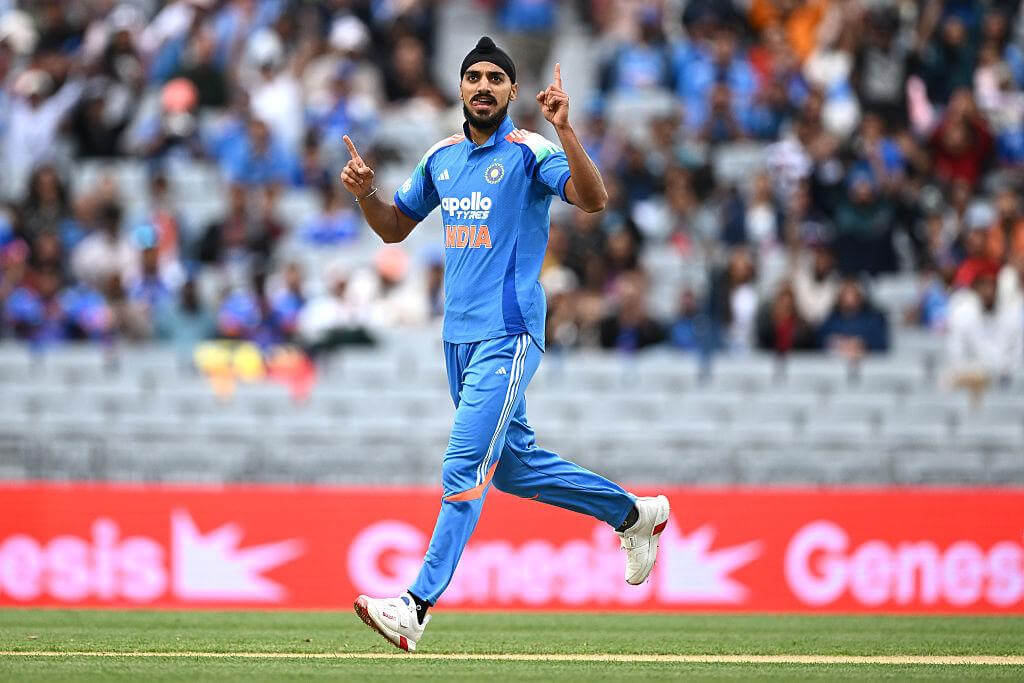
Arshdeep Singh
His explosive late runs and disciplined seam bowling turned India’s 209 into a successful defence. Arshdeep finished with an economy rate of just 3.00.
Gurnoor Brar
Though unavailable for the fifth ODI due to Test preparations, Brar’s earlier wicket-taking impact across the series earned him the award.
NZ vs IND 5th ODI 2026 FAQs
Who won the India vs New Zealand 5th ODI 2026?
India beat New Zealand by 22 runs on November 15, 2026, at Bay Oval, Mount Maunganui, and clinched the five-match ODI series 3–1.
What was the final score of the NZ vs IND 5th ODI?
India scored 209 all out in 42.1 overs. New Zealand replied with 187 all out in 48.1 overs while chasing 210.
Who was Player of the Match?
Arshdeep Singh won the award for scoring 14 runs off four balls and taking three wickets for 30 runs in ten overs.
Who scored the most runs in the fifth ODI?
India’s Axar Patel and Ishan Kishan jointly top-scored with 46 runs each. Dean Foxcroft made New Zealand’s highest score of 31.
Who was Player of the Series in India vs New Zealand 2026?
Indian fast bowler Gurnoor Brar was named Player of the Series after taking nine wickets.
Who took the most wickets in the fifth ODI?
Arshdeep Singh, Mitchell Santner and Jacob Duffy took three wickets each. Arshdeep returned the most economical three-wicket haul of the match at 3/30.
Final Verdict: India’s Bowling Seals a Memorable Away Series Win
The fifth ODI was not an exhibition of high scoring; it was a demonstration of how disciplined bowling, adaptable captaincy and valuable lower-order runs can decide a tight contest. India were 34/3, recovered to 209 and then attacked a target New Zealand might have expected to chase. Arshdeep’s 3/30 stood out, but wickets from Siraj, Axar, Nabi, Thakur and Dhir ensured the effort remained collective.
The 22-run result settled the series 3–1 and gave India a hard-earned overseas success under Gautam Gambhir. For New Zealand, the lesson was the cost of losing wickets in clusters even while the required run rate remained manageable. For India, the decisive takeaway was the attack’s ability to deliver a winning performance when the batters could not put up a large total.
Tags: NZ vs IND, India vs New Zealand, 5th ODI 2026, Arshdeep Singh, Mohammed Siraj, Axar Patel, Ishan Kishan, ODI Scorecard, Bay Oval, Cricket News, India Cricket Team, Shreyas Iyer.