

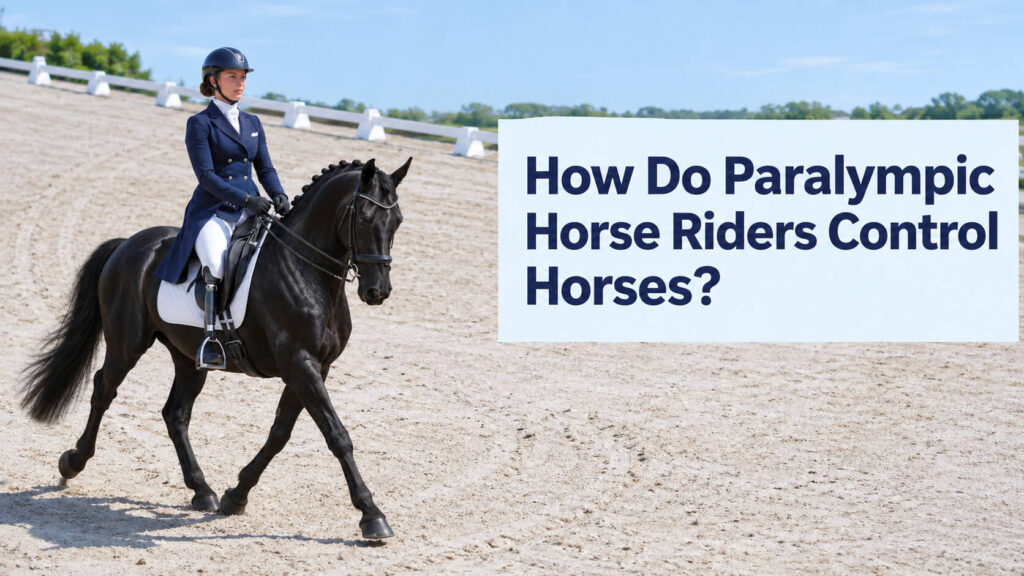
Discover how subtle pressure, weight changes, voice cues and specially adapted riding aids turn a complex dressage test into a coordinated performance.
How do Paralympic horse riders control horses? They communicate through an individually trained combination of reins, seat and weight shifts, available leg movements, quiet voice cues and approved adaptive equipment. A rider who cannot use conventional leg pressure may teach the horse to respond to a light tap from a riding whip or to a particular word. Another rider may use specially shaped reins and extremely small movements of the upper body to guide changes of direction and speed.
The important point is that Para dressage does not depend on one universal technique. Each horse learns a set of clear, consistent signals that its rider can deliver safely and accurately. This is why the best performances often look almost effortless even though they require years of training, balance, timing and communication.
Paralympic horse riders are in active control of their horses. Adaptive aids do not steer the horse automatically; they help the athlete communicate instructions. The horse is trained to understand those specific instructions, while competition rules determine which aids each athlete may use.
How Does a Paralympic Rider Actually Control a Horse?
In Olympic and Paralympic dressage, the horse does not simply memorize a routine and perform it independently. It responds moment by moment to the athlete. A cue to move forward might be followed by a separate cue to turn, a different one to shorten the stride, and another to halt at an exact arena marker.
Traditional dressage often uses the combined influence of legs, hands and seat. Para dressage keeps the same central principle—clear communication—but allows qualifying athletes to use alternative signals when an impairment affects conventional riding aids. A horse may respond to a light rein contact, a shifting pelvis, a controlled sound or a touch from a compensating aid.
Successful control is not about force. Clear timing matters: an athlete asks for a movement, the horse responds, and the athlete softens or changes the aid to acknowledge the correct response. This creates a conversation rather than a constant stream of pressure.
A simplified sequence showing the feedback loop between a Para dressage rider and a trained horse. This is a teaching diagram, not a statistical chart.
The process repeats throughout a dressage test; the horse and rider continually adjust to each other.
The 7 Main Ways Paralympic Horse Riders Control Horses
Para equestrian athletes do not all use seven techniques at once. The mix depends on their functional abilities, the horse’s training and the athlete’s approved equipment. These are the main communication methods spectators are likely to see.
1. Reins and adapted hand contact
Reins transmit subtle information from an athlete’s hands to the horse through the bridle. A rider can use carefully timed contact to influence direction, balance and the shape of a movement. In well-trained dressage, the intention is light, elastic contact rather than pulling the horse around a corner.
Athletes with limited grip or hand movement may use looped or ladder reins, elastic inserts, a connecting rein bar or another permitted configuration. These can help keep the connection steady or make the reins easier to hold. The specific arrangement must be permitted under the relevant rules and athlete classification.
2. Seat pressure and weight shifts
Many trained horses notice small changes in the rider’s pelvis, posture and distribution of weight. An athlete who can control their trunk may subtly rebalance the horse before a transition, turn or halt. For some riders, these signals are especially important because conventional leg aids are limited.
Weight aids are individual, not a simple rule such as “lean left to turn left.” Correct dressage riding emphasizes centered balance and coordinated signals. A pronounced lean could unbalance the horse, while a small change in seat contact may be enough when the pair has trained together.
3. Voice commands and familiar sounds
Some athletes train their horses to recognize a short spoken word, click or specific sound. A quiet cue can ask the horse to walk forward, begin trotting, change tempo or come back to a slower pace. Voice can replace or supplement a physical signal that the rider cannot use reliably.
Competition rule: FEI Para dressage rules permit moderate voice aids for Grades I, II and III during tests, but prohibit voice aids for Grades IV and V during the execution of their tests. Therefore, voice is an important real-life technique but not a universal competition aid for every Paralympic grade.
4. Available leg and foot signals
Not every Para dressage athlete has limited leg function. Some riders can use leg pressure normally; others use one leg, a smaller range of motion, or a different location for the cue. The horse’s responses are developed around what the athlete can consistently control.
Even where leg function is limited, the athlete may still communicate through other parts of the body. What matters is the quality of the trained signal, not whether it looks identical to the method used by another rider.
5. Dressage whips as compensating aids
A dressage whip can serve as a light substitute for a leg cue. A trained horse may learn that a particular tap means to move forward or become more active. In this context the whip functions as a communication aid, not an invitation to strike or frighten the horse.
Rules distinguish standard equipment from aids that require individual authorization. The type, number and use of whips must comply with the applicable competition regulations. Horse welfare remains essential: a calm, willing response is the goal.
6. Adapted saddles, handholds and stirrups
Stability allows a rider to give more accurate signals. Depending on their needs and approvals, athletes may use a modified saddle, a permitted handhold, adjusted stirrups or limited support features. These adaptations can help maintain a secure and functional position so that the rider can focus on timing and balance.
Such equipment is not an automated control system and must not prevent a safe dismount or release in an emergency. It exists to support the athlete’s ability to ride, with the horse’s comfort and safety considered alongside the athlete’s requirements.
7. A consistent horse–rider training language
The seventh technique is less visible but arguably the most important: repetition and trust. One rider might use a tiny sound instead of leg pressure; another might use a particular rein and seat combination. Training teaches the horse precisely what each signal means.
A reliable partnership develops when the rider gives consistent instructions and the horse learns that a correct response is followed by clarity and release. Because horses have distinct temperaments and movement patterns, the final communication system is tailored to the individual pair.
These are examples rather than universal commands. The exact meaning is taught to each horse.
How Are Horses Trained to Understand Alternative Riding Cues?
Para dressage horses are not born knowing how a rider will communicate. They are gradually trained to recognize reliable cues, often starting with familiar dressage signals before an athlete and trainer establish suitable alternatives. For example, if a horse normally responds to a gentle leg squeeze, the training team may pair that signal with a distinct sound or light tap. With consistent practice, the horse learns the new association.
The process also teaches the horse to stay relaxed when an athlete moves differently from what the horse first encountered in conventional riding. A rider with an involuntary movement needs a horse that can distinguish an accidental change in body position from an intentional instruction.
Training includes transitions, circles, straight lines, halts, turns and the movements required in the athlete’s competition grade. Coaches may work from the ground while a training rider helps confirm the horse understands each aid. The Para athlete then develops the partnership through repeated sessions.
The International Equestrian Federation’s explanation of Para dressage communication describes how horses adapt to individualized vocal cues, changes of seat and compensating equipment. It emphasizes that understanding between horse and athlete comes from specific training rather than instinct alone.
Example: Teaching a horse to move forward without a leg squeeze
- A trainer introduces a clear alternative cue, such as a soft sound or light tap.
- The horse is helped to connect that cue with the already-understood request to move forward.
- When the horse responds correctly, the aid is softened and the response is reinforced.
- The athlete practices the cue consistently until it works during normal riding and in a dressage test.
This is an illustration of a training principle, not a do-it-yourself prescription. Changes to equipment, riding position or cue training should be overseen by an appropriately qualified coach and carried out with suitable safeguards.
Does Horse Control Change Across Paralympic Grades I–V?
Yes, but grade is not a ranking of riding talent. The five Para dressage grades are classification categories reflecting how an eligible impairment affects the athlete’s ability to ride. Each grade has different test requirements. A Grade I rider can be an exceptional athlete even though their compulsory movements differ from those of Grade V.
In the standard FEI tests, Grade I riders perform walk movements; Grades II and III perform walk and trot; and Grades IV and V include walk, trot and canter, with progressively more advanced technical requirements. Specific freestyle requirements may differ from the standard tests.
The filled blocks show which basic gaits appear in the standard FEI grade tests. They do not measure ability, difficulty percentages or performance.
Note: Grade IV includes lateral work in trot; Grade V also includes lateral work in canter in the official test description. Freestyle variations are not represented in this chart.
| Grade | Basic movements in standard tests | What viewers may notice |
|---|---|---|
| I | Walk | Precision of lines, transitions and rhythm at walk |
| II | Walk and trot | Control through changes of gait |
| III | Walk and trot | Refined accuracy and changes of tempo |
| IV | Walk, trot, lateral work in trot and canter | More complex combinations and lateral movements |
| V | Walk, trot, lateral work and canter including lateral work | Advanced precision across multiple movement types |
Readers who want the full competition structure can explore our complete Para equestrian rules, grading and scoring guide, including how the performances are assessed.
How Do Visually Impaired Paralympic Riders Navigate the Arena?
Some Para dressage riders have eligible visual impairments rather than, or alongside, mobility limitations. They still control the horse through trained riding aids, but finding exact positions in the arena can require additional support.
With appropriate authorization, callers identify arena letters so a rider can judge their location. Approved electronic systems may perform a similar positioning function. This is different from an outside coach issuing instructions to steer the horse: the athlete remains responsible for making riding decisions and delivering the cues.
Knowing the arena layout is especially important because a dressage movement may need to begin at a precise letter. Riders practice their routes and the timing of each movement repeatedly, using consistent information to stay accurate.
Real Examples of Para Dressage Horse Control
Natasha Baker: Riding with trained voice cues
British Paralympic champion Natasha Baker has spoken about relying on vocal communication because she cannot use conventional leg aids. Her horses learn the meanings of subtle sounds and short commands. This is a practical example of a familiar dressage instruction being taught through an alternative communication channel.
Laurentia Tan: Sensitive rein and seat contact
Singapore’s Paralympic medallist Laurentia Tan has described using customized looped reins and carefully felt seat information to communicate with her horses. Her experience illustrates why no single adaptation suits every athlete: equipment and technique are fitted to the individual’s needs.
Both examples are described in the FEI’s reporting on Para dressage training. Their methods may differ, but each depends on precise, gentle signals and a horse trained to understand them.
Are Adaptive Riding Aids Safe and Fair?
Approved compensating aids are intended to offset the effects of an athlete’s impairment, not to deliver an unfair competitive advantage. Para dressage rules distinguish between generally permitted equipment and aids that require a documented, athlete-specific approval. The exact permissions depend on the type of aid and the athlete’s classification.
Good equipment must fit both horse and rider, preserve appropriate contact and allow a safe release if the rider loses balance or needs to dismount. Riders, coaches and officials also monitor the horse’s comfort, responsiveness and welfare.
The International Paralympic Committee’s Para equestrian overview confirms that athletes can use adapted reins, connecting rein bars and other aids to support communication. It also explains how riders compete within classification grades and how performance is evaluated.
What Do Dressage Judges Look For?
Judges assess the accuracy and quality of the movements, the horse’s rhythm and balance, the consistency of contact, straightness, suppleness and the harmony of the pair. They do not award extra marks simply because an athlete uses a particular adapted cue. The aim is to produce fluent, controlled movement within the requirements of the test.
That is what makes Para dressage an especially interesting sport to watch. A slight adjustment of the rein or seat can produce a clear change in the horse’s movement, while the most skillful riders make that communication difficult to notice.
Common Misunderstandings About Paralympic Horse Riding
“The horse performs everything by itself.”
No. Dressage horses are trained partners, not self-driving athletes. During a test the rider still asks for movements, makes corrections and maintains the horse’s rhythm, balance and direction.
“All Para riders use voice commands.”
No. Some communicate primarily through reins, seat and available leg movements. Voice aids are also restricted by grade under FEI competition rules.
“Adaptive equipment makes riding easy.”
No. Equipment can improve safety or make a cue possible, but it cannot replace technique, decision-making, consistency or a well-trained partnership.
Frequently Asked Questions
How do Paralympic horse riders control horses without using their legs?
They may use trained voice commands, subtle seat changes, adjusted reins or permitted compensating aids such as a light whip cue. The methods depend on the athlete’s functional abilities and the horse’s training.
Can Paralympic riders talk to their horses during competition?
Under the FEI Para dressage rules cited here, Grades I–III may use voice aids in moderation during their tests. Grades IV–V may not use voice aids while executing the test.
Do Paralympic riders use special reins?
Some do. Looped, ladder-style or otherwise permitted adapted reins can help riders maintain contact when grip, arm function or coordination differs from conventional riding.
Can a rider with a visual impairment compete in Para dressage?
Yes, if they meet the sport’s eligibility criteria. Approved callers or electronic positioning aids may help them identify arena letters; the rider still guides the horse.
Does the Paralympic horse jump obstacles?
No. The Paralympic equestrian discipline is Para dressage, where pairs perform defined movements in an arena rather than jumping fences.
What is a compensating aid in Para equestrian sport?
It is a permitted adaptation that enables an athlete to communicate, maintain an effective riding position or participate safely when conventional equipment or signals are affected by an impairment.
Are Para dressage horses specially trained?
Yes. They learn to recognize the specific cues their rider can deliver, including alternative signals where needed. They are also trained to stay balanced, attentive and relaxed throughout competition movements.
What is the difference between Para dressage Grades I and V?
Grades reflect classification and the functional impact of impairment, not how talented an athlete is. Standard Grade I tests feature walk movements, while Grade V tests include walk, trot, canter and additional lateral work.
Paralympic horse riding is powered by communication, not automatic equipment. Whether a rider uses a quiet sound, an adapted rein, a seat adjustment or a light touch, the goal is the same: to give a clear signal and receive a smooth response. The result is a partnership in which the horse and athlete work together with remarkable precision.