

Paralympic equestrian history is a story of changing rules, extraordinary partnerships, new global champions and the growing status of Para dressage. Follow every Summer Games milestone from Atlanta 1996 to the planned Los Angeles 2028 competition.
Paralympic equestrian history reached a turning point at Atlanta 1996, when Para dressage entered the regular Summer Paralympic programme. Since then, riders and horses have performed precise dressage tests in Sydney, Athens, Beijing, London, Rio de Janeiro, Tokyo and Paris. Los Angeles 2028 is set to become the next chapter.
What began as a relatively small international competition has developed into a highly technical championship in which riders are classified according to eligible impairments, but judged on the quality of their horsemanship. The sport is about timing, training, harmony and consistency, not simply completing a sequence of movements.
How Did Paralympic Equestrian Begin?
Competitive riding for people with disabilities developed from recreational and therapeutic riding programmes. Dressage competitions were established in Great Britain and Scandinavia during the 1970s, giving athletes opportunities to demonstrate technical riding skills in formal tests. The growing movement needed consistent classification, qualified judging and international competition structures.
There is an important historical distinction in the official record. The International Paralympic Committee’s sports history also records equestrian medal events at the 1984 Stoke Mandeville and New York Paralympics, with the equestrian competition held in Texas. However, the sport did not stay on the programme in 1988 or 1992. Atlanta 1996 is therefore recognised as the beginning of the sport’s continuous modern Paralympic presence, not necessarily its very first appearance in every historical archive.
That distinction matters when reading older medal tables or searching for the first Paralympic equestrian event. Most modern Para dressage histories and Games timelines begin in Atlanta because it marked the launch of an enduring sport programme.
Paralympic Equestrian Timeline: Atlanta 1996 to LA 2028
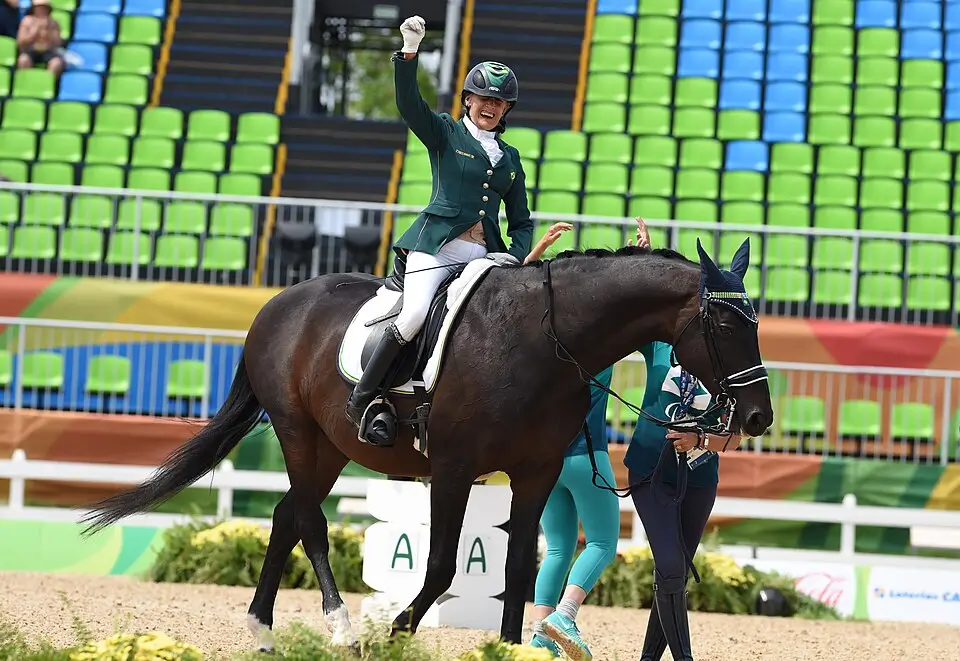
The following history follows each edition in chronological order. Completed Games are described as historical results; Los Angeles 2028 is clearly identified as a future event.
Para dressage enters the permanent Games programme
The Georgia International Horse Park hosted 61 riders from 16 nations. They competed across four grades in nine medal events, including individual, freestyle-style and team competitions. Riders used horses supplied for the Games rather than bringing the carefully matched competition partners that are familiar today.
Great Britain topped the equestrian medal table with three gold medals and won the team event. American rider Vicki Sweigart, Norway’s Anne Cecilie Ore and Britain’s Joanna Jackson were among the athletes who won two individual golds. The Games established a standard-setting platform for international Para dressage.
Historical figures: 61 riders • 16 nations • 9 events
Lee Pearson announces a new era
Sydney welcomed 72 athletes from 24 nations, an increase in the international field just four years after Atlanta. Borrowed horses remained the norm, requiring riders to build an effective partnership in a relatively short period.
Great Britain’s Lee Pearson made a remarkable Paralympic debut, earning three gold medals across his competitions, including the team event. His performances helped make him one of the defining figures of Para dressage for the next two decades. Sydney demonstrated that the sport could sustain a larger, more internationally diverse field.
Historical figures: 72 riders • 24 nations • 9 events
Riders compete with their own horses
Athens introduced a transformational change: riders could compete with their own horses. Long-term horse–rider combinations could now arrive at the Games with established communication, shared training and routines developed over months or years.
This marked an important step in the professional development of Para dressage. High-level dressage depends on subtle signals and mutual trust. The ability to bring a familiar horse helped athletes demonstrate the full quality of their preparation. The IPC results archive records 69 competitors representing 29 nations in nine medal events.
Historical figures: 69 riders • 29 nations • 9 events
Five competitive classes and wider recognition
After Para dressage moved under the governance of the International Equestrian Federation (FEI) in 2006, Beijing 2008 represented another significant stage in its technical development. There were five competition classes under the system then in use: Ia, Ib, II, III and IV.
The expanded structure meant 11 medal events rather than the nine contested at the previous three Games. A total of 73 riders from 28 nations participated. Great Britain headed the medal table with five golds, while athletes from Germany, South Africa and Canada also became champions.
Historical figures: 73 riders • 28 nations • 11 events
A home crowd and a breakthrough spectacle
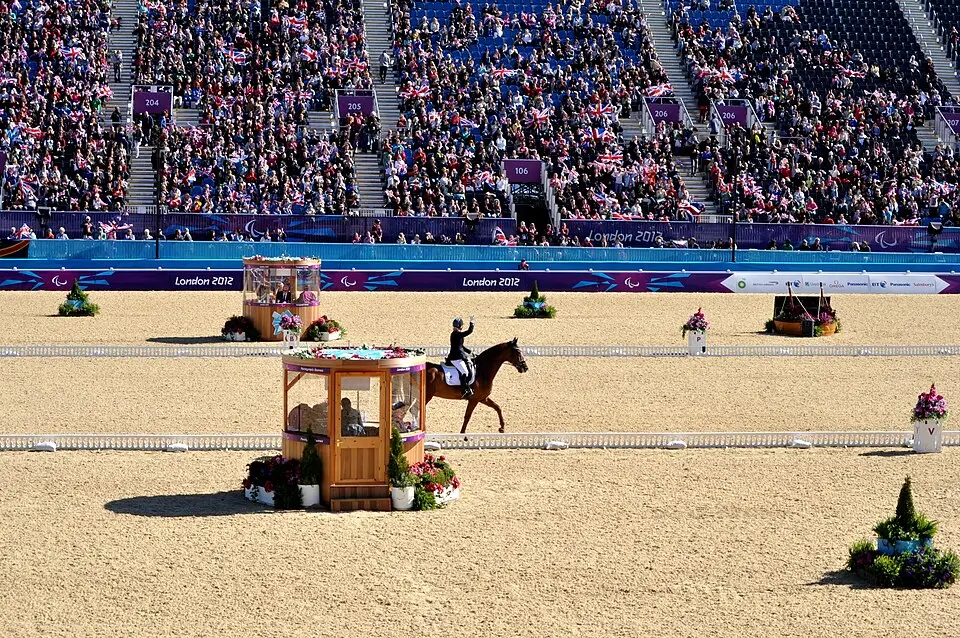
The historic setting of Greenwich Park brought Para dressage to a broad audience at the London Paralympics. With 78 riders from 27 nations and 11 medal events, the sport combined elite technical competition with a particularly memorable atmosphere for the host country’s athletes.
Sophie Christiansen won both of her individual Grade Ia titles and contributed to Great Britain’s team victory. Natasha Baker also became a double individual gold medallist, while other champions included Australia’s Joann Formosa and Belgium’s Michèle George. London helped establish Para dressage as compelling spectator sport, with its own recognisable stars and rivalries.
Historical figures: 78 riders • 27 nations • 11 events
Great Britain’s golden run reaches a high point
The Rio Games featured 76 competitors from 29 countries and continued the 11-event programme. Great Britain delivered a remarkable overall performance with seven equestrian golds, including the team title, reflecting a deeply established high-performance system.
Competition nevertheless became increasingly international. Riders from the Netherlands, Austria, Norway and Belgium also claimed golds, with strong performances emerging from several established European Para dressage programmes. Rio reinforced a key lesson: the established leaders could still be challenged on any test by carefully prepared international combinations.
Historical figures: 76 riders • 29 nations • 11 events
Resilience under pandemic conditions
Although officially called Tokyo 2020, the Summer Paralympics took place in 2021 because of the COVID-19 pandemic. The Para equestrian competition was held in August 2021 with 77 athletes from 27 nations.
Without the normal experience of large spectator crowds, the performances still demonstrated exceptional preparation and rider–horse communication. Britain finished first in the Para equestrian medal table with three golds, closely followed by challengers including the Netherlands, Belgium, the United States and Denmark. Tokyo also highlighted the sport’s growing competitive depth.
Historical figures: 77 riders • 27 nations • 11 events
Versailles hosts a change at the top
The Château de Versailles provided a striking backdrop for Para dressage at Paris 2024. The IPC records 76 participants from 30 countries, the broadest national representation in the continuous Games programme to that point, with 11 medal events.
For the first time in this modern sequence, the United States finished first in the equestrian gold-medal standings, winning five golds. Fiona Howard and Rebecca Hart were among the American champions, while Latvia’s Rihards Snikus achieved breakthrough gold-medal success. The results illustrated how the competitive landscape had evolved beyond long-standing British dominance.
Historical figures: 76 riders • 30 nations • 11 events
Santa Anita Park prepares for the next chapter
LA 2028 is scheduled to host Paralympic Para dressage at Santa Anita Park in Arcadia, California. The Paralympic Games are planned for 15–27 August 2028, and the approved Para equestrian programme includes 11 medal events: five individual championships, five freestyle championships and one team championship.
The athlete quota is 78 places, but those places are not the same as confirmed starters. The final field, medal winners and detailed competitive outcomes will not be known until qualification and the Games themselves. For athletes, LA 2028 presents a new opportunity to build on the standards set from Atlanta to Paris.
Planned: 11 medal events • 78 athlete quota places • venue Santa Anita Park
Paralympic Equestrian Statistics: What Has Changed Since 1996?
The story is not a simple year-on-year rise. Participation fluctuated as qualification systems, Games quotas and national representation changed. Even so, the comparison between the first continuous edition and Paris 2024 shows a much wider international footprint and a more developed medal programme.
| Games | Host city | Riders | Nations | Medal events |
|---|---|---|---|---|
| 1996 | Atlanta | 61 | 16 | 9 |
| 2000 | Sydney | 72 | 24 | 9 |
| 2004 | Athens | 69 | 29 | 9 |
| 2008 | Beijing | 73 | 28 | 11 |
| 2012 | London | 78 | 27 | 11 |
| 2016 | Rio | 76 | 29 | 11 |
| 2020* | Tokyo | 77 | 27 | 11 |
| 2024 | Paris | 76 | 30 | 11 |
Data note: These figures use the International Paralympic Committee’s historical results archive. Tokyo 2020 occurred in 2021. The table excludes LA 2028 because its 78 places are a quota rather than final participation.
Participating countries at each Games
Number of national Paralympic committees represented in Para equestrian.
* Tokyo 2020 took place in 2021. Figures represent actual event participation, not athlete quota places. Source: International Paralympic Committee results archives.
Country participation rose from 16 in Atlanta 1996 to 30 in Paris 2024. That does not mean every edition grew: for example, Sydney recorded 24 nations, Athens 29 and London 27. The long-term trend is toward broader representation even while the size of the field remains controlled.
How many riders competed?
Actual riders listed in the IPC event results archives.
* Tokyo 2020 took place in 2021. Figures represent actual event participation, not athlete quota places. Source: International Paralympic Committee results archives.
Actual rider participation has stayed in a relatively narrow range after Sydney. The growth of the sport should therefore be measured by more than simply the number of athletes at one Games. Training pathways, quality of horses, classification systems, national programmes and medal competition have all developed.
Medal events: 1996–2024
The event programme expanded from nine to 11 medal events in 2008.
* Tokyo 2020 took place in 2021. Figures represent actual event participation, not athlete quota places. Source: International Paralympic Committee results archives.
One particularly clear structural change occurred in 2008, when the medal-event total increased from nine to 11. That 11-event format continued through Paris 2024 and is planned again for LA 2028. The increase reflected five individual competition classes, each with championship and freestyle medals, plus one open team event.
Legendary Paralympic Equestrian Riders Who Shaped the Sport
Results tables are useful, but the sport’s history also lives through the combinations that changed expectations. Riders did not achieve their success alone: each performance depended on a trained horse, skilled support staff and years of adapting techniques to an individual athlete’s needs.
Lee Pearson — Great Britain
Pearson’s three golds on his Sydney 2000 debut made him an immediate star. His long Paralympic career became a reference point for consistency, technical accuracy and the evolution of elite Para dressage.
Sophie Christiansen — Great Britain
Christiansen helped define London’s home-Games success in 2012, winning Grade Ia championship and freestyle gold as well as contributing to the British team title.
Natasha Baker — Great Britain
Baker captured two individual golds at London 2012 and continued competing at the highest level, illustrating how top riders build sustained success through changing horses and competition cycles.
Rebecca Hart — United States
Hart won the Grade III championship title at Paris 2024. Her victory helped symbolise the shift toward a more contested international medal table and a strong American performance in Versailles.
Fiona Howard — United States
Howard’s breakthrough Paris 2024 campaign in Grade II contributed to the United States finishing first in the sport’s gold-medal standings at that edition.
Rihards Snikus — Latvia
After silver-medal success at Tokyo 2020, Snikus captured Grade I gold in Paris. His achievements show the possibilities for nations outside the traditional leading teams.
How Para Dressage Rules and Classification Evolved
The basic aim of the sport has remained remarkably consistent: a rider guides a horse through prescribed dressage movements and is assessed on quality, precision and harmony. What changed is the detail of how athletes are grouped, how tests are organised and how eligible adaptive aids support fair competition.
From four grades to five
Atlanta 1996 used four grades, I–IV. Beijing 2008 had five competitive classes, then called Ia, Ib, II, III and IV. Today’s classification uses Grades I–V, broadly grouping athletes with eligible physical or vision impairments according to their functional profile for the sport. Grade is not a medal ranking or a direct measure of riding talent: each grade has appropriate test requirements and its own elite competition.
Championship, freestyle and team tests
Riders perform a prescribed sequence of dressage movements, judged for correct execution, accuracy and quality.
Riders perform choreographed movements to music within the technical requirements of their grade.
A national team combines scores from eligible athletes in the competition format set by the applicable rules.
Competition rules also allow approved compensating aids for eligible riders, depending on assessment and the relevant regulations. Such aids do not replace horsemanship; they are designed to help athletes communicate effectively with their horses. For a practical explanation of the techniques, see KhelKhabri’s article on how Paralympic horse riders control their horses.
Readers who want to understand the competition structure, scoring and grades in more detail can explore our Para equestrian rules and classification guide. Together, these topics explain why a Grade I test and a Grade V test look different while still requiring elite athletic skill.
Why the Horse–Rider Partnership Is Central to Paralympic History
The transition from borrowed horses in 1996 and 2000 to personally selected horses in 2004 represents much more than a logistical change. In dressage, riders and horses use an extremely refined communication system. Small changes in rein contact, balance and permitted compensating aids can affect a movement’s timing or quality.
By bringing a long-term equine partner, a rider can train progressively for specific movements, manage the horse’s physical condition and develop reliable routines. Success also requires coaches, grooms, veterinarians and officials who understand both athlete accessibility and equine welfare.
This is one reason the story of Para dressage should not be told only through medal counts. Atlanta’s borrowed-horse era, Athens’ horse-ownership milestone and the modern carefully managed horse–rider partnerships each reveal a different stage in the sport’s professional development.
How the Global Balance of Power Has Shifted
Great Britain led the Para equestrian gold-medal standings at every Summer Games from Atlanta 1996 through Tokyo 2020. The depth of its rider development programme produced champions over several generations and contributed to repeated team success.
Paris 2024 marked a notable break with that pattern: the United States topped the gold table with five wins, followed by the Netherlands with two and Latvia and Belgium with two apiece. Britain won medals but no golds in Para equestrian at Paris. This is a useful sign of increasing international competitiveness rather than proof that any nation’s future results are guaranteed.
LA 2028 Para Equestrian: What Is Confirmed and What Is Still Ahead?
The upcoming Los Angeles Paralympics are scheduled for 15–27 August 2028, with Para equestrian competition planned at Santa Anita Park in Arcadia, California. The venue is a historic horse-racing site that will be adapted to stage elite equestrian sport. The choice places horse sport at an established Southern California equine facility.
The approved programme is set to contain 11 medal events: five individual championships, five individual freestyle championships and one team event. An athlete quota of 78 places has been announced. Those numbers describe the current plan and should not be reported as confirmed final participation.
What fans should watch on the road to Los Angeles
Qualifying competitions will determine which nations and combinations earn places. Changes to classification or technical rules may also affect preparation. The central questions will be whether Paris 2024’s champions can defend their positions, which rising riders will emerge, and how national teams adapt to a new competition cycle.
The most useful approach is to separate confirmed arrangements—the approved sport, planned event structure and announced venue—from predictions about athletes, medals or final starting lists. Until qualification and entries are complete, claims about who will compete remain provisional.
Frequently Asked Questions About Paralympic Equestrian History
When did equestrian become a regular Paralympic sport?
Para dressage joined the continuous Summer Paralympic programme at Atlanta 1996 and has appeared at every Summer Games since. The IPC also records earlier equestrian medal events in 1984, but the sport was absent from the intervening 1988 and 1992 programmes.
How many riders competed at Atlanta 1996?
The IPC’s Atlanta 1996 equestrian archive records 61 competitors from 16 countries across nine medal events.
When could Paralympic riders first bring their own horses?
Athens 2004 was the first edition in the regular modern programme that allowed riders to compete with their own horses. The Atlanta and Sydney competitions used borrowed horses.
What is the difference between Para equestrian and Para dressage?
Para equestrian is the broader term used for equestrian sport involving athletes with eligible impairments. Para dressage is the discipline contested at the Summer Paralympic Games, involving prescribed and freestyle dressage tests.
How many Para dressage medals are awarded at the Paralympics?
The Games programme from Beijing 2008 through Paris 2024 consisted of 11 medal events: five championship tests, five freestyle tests and one team event. The same total is planned for LA 2028.
Which country led the Para equestrian medal table at Paris 2024?
The United States ranked first by gold medals with five, ahead of the Netherlands, Belgium and Latvia in the IPC’s Para equestrian results.
Where will Para equestrian take place at LA 2028?
Santa Anita Park in Arcadia, California, is the announced venue for the Los Angeles 2028 Paralympic Para equestrian events.
Is Tokyo 2020 part of the 2020 or 2021 timeline?
It retains the official name Tokyo 2020, but the Games and Para equestrian competitions actually took place in 2021 after pandemic-related postponement.
How can I check official Para equestrian history and results?
The International Paralympic Committee’s Para equestrian information hub provides sport history, competition information and pathways to historical Games results.
Conclusion: A Sport Built on Partnership and Progress
From the borrowed horses of Atlanta 1996 to the Paris 2024 medal breakthroughs, the evolution of Paralympic equestrian sport has been shaped by stronger athlete–horse partnerships, fairer competition structures, technical development and increasingly international rivalries.
LA 2028 is the next milestone, not a completed chapter. Its planned 11-event programme at Santa Anita Park will offer a new generation the opportunity to continue a history built by pioneers, repeat champions and rising nations alike. That makes Paralympic equestrian history more than a timeline of Games: it is the story of how horsemanship earned a lasting place on the world sporting stage.