

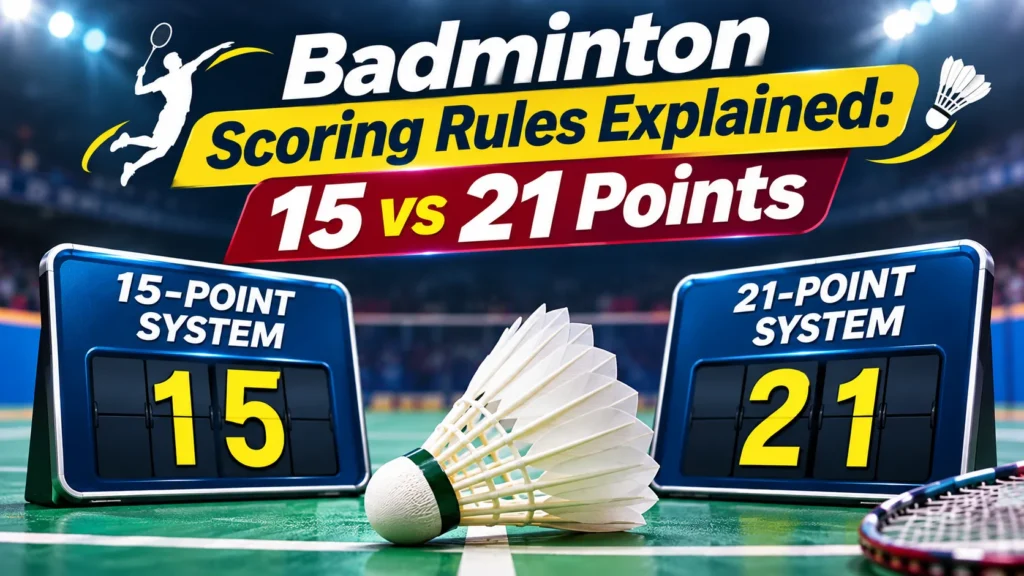
Badminton scoring rules are changing, and the timing matters. The familiar international game to 21 points is still the standard for most BWF events in November 2026. However, the Badminton World Federation has approved a new best-of-three format to 15 points from 4 January 2027. Indian domestic tournaments began switching earlier, in July 2026.
Quick answer: Both systems award one point for every rally, and a match is usually best of three games. Under 21-point scoring, a game needs 21 points and a two-point lead, with a cap at 30. Under the new 15-point system, the target falls to 15, with a two-point lead from 14-all and a cap at 21.
This guide shows when each system applies, how to read a close score, who serves, and why the change matters. It is written for Indian fans, new players, coaches and parents who want the rules without guesswork.
Badminton Scoring Rules in 2026: Which Format Applies?
The biggest mistake is to say that every badminton match moved to 15 points in 2026. That is not what the international timetable says. BWF members approved the change at their annual general meeting on 25 April 2026. The world governing body’s new standard starts on 4 January 2027 for BWF-sanctioned international events.
Until that date, the usual international match follows the 3 × 21 format. Players try to win two games, and each game normally ends when a side reaches 21 while holding the required lead. An event that has formally adopted an approved alternative may use different rules, so the event prospectus always matters.
India has moved sooner. The Badminton Association of India announced the 3 × 15 system for major domestic competitions from July 2026. The first scheduled event under the wider domestic rollout was the All India Senior Ranking Tournament in Ernakulam, held from 7 to 14 July. The change covers ranking competitions, zonal events and national championships across age groups.
This creates a short transition period. A player may compete in a domestic Indian event to 15 points but still play a BWF international match to 21 points during the same season. Neither scoreboard is necessarily wrong. They may simply belong to different competitions.
| Competition or period | Main scoring format | What readers should know |
|---|---|---|
| BWF international events in 2026 | Best of 3 to 21 | Standard format before the global change |
| Major BAI domestic events from July 2026 | Best of 3 to 15 | India began early preparation |
| BWF international events from 4 January 2027 | Best of 3 to 15 | New approved international standard |
| Clubs and other events | Check event rules | Approved alternative formats may apply |
The key is to check the tournament and date before comparing results. A 15–13 game in one event can be a completed game, while 15–13 in a standard 21-point contest means play must continue.
How Does the Traditional 21-Point System Work?
Under 21-point rally scoring, the side that wins a rally earns one point. It makes no difference who served that rally. This is called rally-point scoring, and it applies to singles and doubles. The winner of the rally also gets the next serve.
A game usually ends at 21, but the score is not always exactly 21–something. If the players reach 20–20, one side must move two points ahead. A score of 21–20 is not enough. A score of 22–20 is enough, because the winner leads by two.
At 29–29, there is a final limit. Whoever scores the 30th point wins the game 30–29. The contest cannot continue to 31 or 32. This prevents a very close game from running without an endpoint.
| Score | Has the 21-point game ended? | Reason |
|---|---|---|
| 21–16 | Yes | Winner reached 21 with a clear lead |
| 21–20 | No | Only one point separates the sides |
| 22–20 | Yes | Two-point advantage after 20-all |
| 25–24 | No | Still only one point ahead |
| 30–29 | Yes | The 30-point cap decides the game |
A match is normally best of three games. Winning 21–18, 18–21, 21–17 means the player wins the first and third games and therefore takes the match 2–1. There is no need to count the total points from all three games to decide the match winner.
If Player A wins the first two games, the match is over. A third game is only played when both sides have won one game. That simple rule is the same in the new 15-point format.
Why was 21-point scoring familiar for so long?
International badminton adopted the 21-point rally format in 2006. Before then, versions of the game used different point targets and a system in which only the serving side could normally score. The 2006 change made every rally count on the scoreboard. The forthcoming change reduces the game target but keeps that rally-scoring principle.
How Does the New 15-Point Scoring System Work?
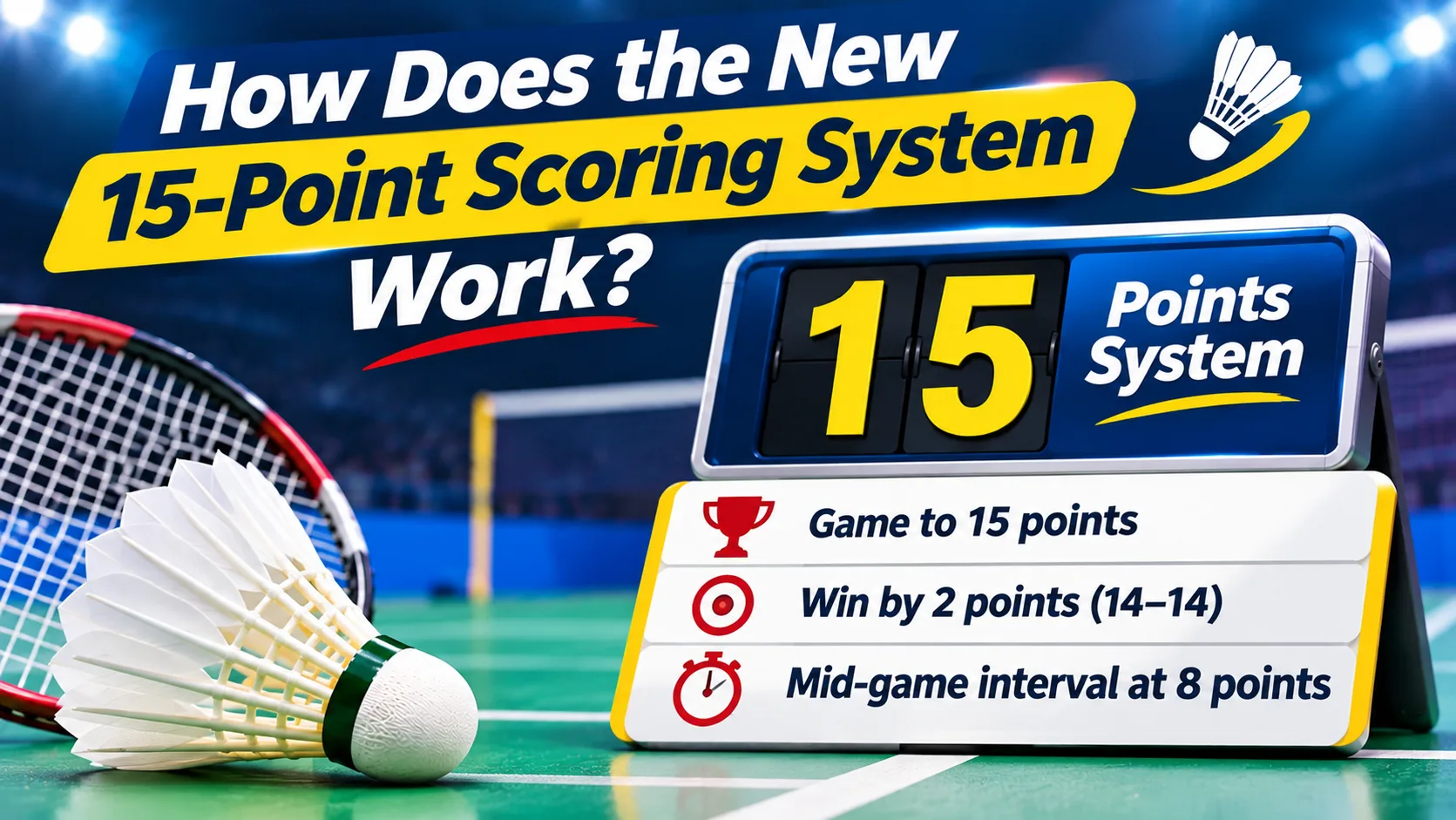
The modern 15-point format is not just a game stopped early at 15. It has its own close-game rules, interval point and final cap. Each rally still gives a point to the winner. A player or pair still needs two games to win a best-of-three match.
In an ordinary game, the first side to 15 wins, as long as it leads by at least two. If the score reaches 14–14, the next point alone is not enough. The sides keep playing until someone leads by two, subject to the limit at 21.
For example, 16–14 is a valid result because one side has opened a two-point gap. So is 18–16. But 15–14 does not end the game. If a contest reaches 20–20, the very next rally determines the winner at 21–20. This is the new maximum score.
| Score | Has the 15-point game ended? | Reason |
|---|---|---|
| 15–9 | Yes | Target reached with a two-point lead |
| 15–14 | No | Must lead by two after 14-all |
| 16–14 | Yes | Two clear points |
| 20–19 | No | One point separates the players |
| 21–20 | Yes | Final point at the 21-point cap |
In India, this system is particularly important for junior and domestic players. A player who starts slowly has fewer points before the game target arrives. That does not make a comeback impossible; it means the score reaches the key stages sooner.
The new rule should not be confused with the older 15-point system used before 2006. Back then, much of badminton followed side-out scoring, where only a serving side could add points. The modern 3 × 15 format still scores every rally, even when the receiver wins it. These are different systems despite sharing the number 15.
15 vs 21 Points: A Simple Side-by-Side Comparison
The table below contains the differences most viewers need during a live match. The game target and close-score cap are the largest changes, but breaks and the deciding-game change of ends also move earlier.
| Rule | 3 × 21 format | 3 × 15 format |
|---|---|---|
| Points usually needed for a game | 21 | 15 |
| Match winner | First to two games | First to two games |
| Rally winner scores a point | Yes | Yes |
| Two-point rule starts | 20–20 | 14–14 |
| Last possible game score | 30–29 | 21–20 |
| Mid-game interval | Leader reaches 11 | Leader reaches 8 |
| Change of ends in third game | Leader reaches 11 | Leader reaches 8 |
| Between-game interval | Up to 120 seconds | Up to 120 seconds |
There are six fewer points in the normal target: 15 instead of 21. That is about 29% fewer target points. It does not prove that every match will be 29% shorter. A long rally, a tight deuce, injuries, challenges and the number of games can all change the actual playing time.
Normal game-winning target
This chart compares rulebook targets, not measured match durations.
Now picture two players tied at 14–14. In the 21-point system, the game is far from its normal target. In the 15-point system, they are in an extended ending and each rally could help create a winning two-point gap. That one example explains why the same scoreboard can create very different pressure.
Singles and Doubles: Who Scores and Who Serves?
The scoring target does not change between men’s singles, women’s singles, men’s doubles, women’s doubles and mixed doubles within the same event format. The main extra task in doubles is remembering which player serves and from which court.
In singles, the server begins from the right service court when that server’s score is even: 0, 2, 4 and so on. When the server’s score is odd, the serve comes from the left service court: 1, 3, 5 and so on. The shuttle travels diagonally into the correct receiving service court.
If the server wins the rally, that player scores and serves again from the opposite service court. If the receiver wins, the receiver gains the point and becomes the next server. For a beginner, the easiest method is to check the new server’s score before deciding right or left.
In doubles, the team that wins the rally gains the point and takes or keeps the serve. The serving team uses its score to determine the correct service court. Partners change service courts when they win a rally while their own side is serving; they do not swap merely because they have won a rally while receiving.
| Serving side’s score | Correct service court | Simple example |
|---|---|---|
| Even: 0, 2, 4, 6 | Right | Server’s score is 8: serve right |
| Odd: 1, 3, 5, 7 | Left | Server’s score is 9: serve left |
A team does not get two consecutive serves just because it has two players. Modern doubles uses one service turn at a time under rally scoring. If the receiving side wins a rally, it gains the serve and a point.
Court lines still matter. A serve must land inside the diagonally opposite receiving box, and singles and doubles use different side boundaries. The scoring change does not make a wide or short serve legal.
Intervals, Change of Ends, Faults and Lets
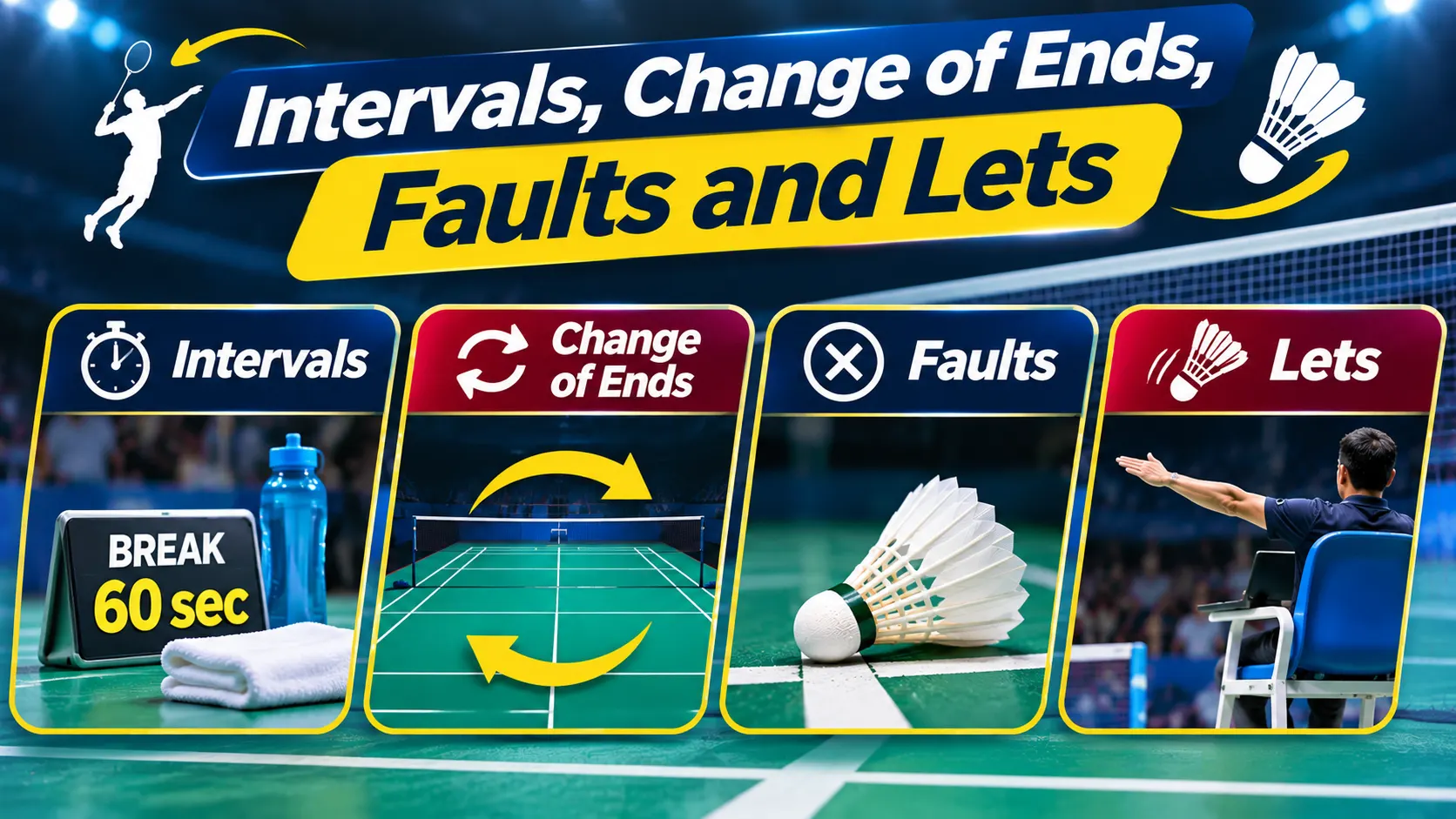
A scoreboard is not only about points. Players also need to know when to pause and when to switch sides. Under 21-point rules, an interval of up to 60 seconds is allowed when the leader first reaches 11 points in a game. Under the new 15-point format, that trigger moves to 8 points.
There is an interval of up to 120 seconds between games in either format. Players change ends after the first game and again before the third game when a third is needed. In that deciding game, they also change ends partway through: at 11 in the 21-point system or at 8 in the 15-point system.
These arrangements help balance conditions such as light and drift inside a venue. When a change of ends is missed, officials correct it once the shuttle is no longer in play. Points already scored are not erased simply because the players switched late.
A fault normally costs the offending side the rally. Common examples include hitting the shuttle out, failing to get it over the net, or committing a service fault. Since both scoring systems award a point on each completed rally, that point goes to the opponent.
A let is different. It means the rally is cancelled and replayed, with no point awarded for that interrupted rally. The original server serves again. A serve that merely brushes the net and lands correctly does not automatically become a let. For practical examples and the official situations in which a rally is replayed, read our guide to what is a let in badminton.
| Situation | Scoring result | What happens next |
|---|---|---|
| Shuttle lands inside valid court | Rally winner gets one point | Winner serves next |
| Shuttle lands out | Opponent gets one point | Opponent serves next |
| Fault is called | Other side gets one point | Follow the new score and serve |
| Let is called | No point for interrupted rally | Same player repeats the serve |
The definition of a fault or let is not changed simply because an event switches from 21 to 15 points. That is useful for new players: learn one consistent set of rally principles, then learn the correct score limits for the competition.
Why Did Badminton Move Toward 15 Points?
BWF members voted for 3 × 15 in April 2026 after years of debate and testing. The stated aim was to make the contest more predictable for tournament scheduling and easier to follow as a fast-moving broadcast sport, while reducing some of the physical load on players and officials.
Supporters expect shorter games to create more important early rallies. With fewer points before the normal target, a player who wins the first few exchanges may gain an advantage sooner. Organisers also hope that more consistent match lengths will help them plan courts and television coverage.
But the argument is not one-sided. Some players and observers worry that a shorter game gives less time for long comebacks or for a player to settle into the match. A player who is usually stronger later in a game may need to attack the opening stages more carefully. Those are plausible tactical effects, not a guarantee about who wins.
The rule change also does not mean every rally becomes shorter. Two defensive players can still trade long clears and lifts. A powerful doubles pair can still finish a point quickly. The rules alter when games finish, not the basic physical skills needed to win each exchange.
For Indian fans, the key change is already visible at home. BAI’s 2026 domestic adoption gives players, coaches and officials practice before the international switch. A junior player can learn how to handle 14–14 now, rather than meeting that new pressure for the first time on a larger international stage.
The official member-association announcement from Badminton Europe on the approved 3 × 15 change confirms the global start date of 4 January 2027. It is a useful reference when tournament posters or social posts use the phrase “new scoring rules” without saying when they apply.
What should players practise differently?
A practical training session can use three short exercises. First, start games at 0–0 and focus on the first eight points. Second, set a practice scoreboard at 14–14, so both players must earn a two-point lead. Third, rehearse the final cap by starting at 20–20 and treating the next rally as decisive.
These are coaching examples, not official training requirements. They help players learn the new pressure points without pretending that tactics from the 21-point era no longer work. Good movement, reliable serves, clear calls and smart shot choices still matter.
Frequently Asked Questions About Badminton Scoring Rules
1. Is badminton played to 15 or 21 points in 2026?
Both formats can appear in 2026. Standard BWF international matches remain 21-point games until the global switch on 4 January 2027. Major BAI domestic competitions began using the 15-point format from July 2026.
2. What happens at 14–14 in 15-point badminton?
The game does not end at 15–14. A player or pair must gain a two-point advantage, such as 16–14 or 17–15. If the score reaches 20–20, the next point wins 21–20.
3. What happens at 20–20 under the 21-point rules?
The sides keep playing until one leads by two points, such as 22–20. At 29–29, the 30th point decides the game. Therefore 30–29 is the maximum result.
4. Is the new 15-point format the same as the old 15-point system?
No. The earlier format used side-out scoring, meaning only the serving side could normally score. The approved modern 3 × 15 format uses rally scoring, so either side receives a point when it wins a rally.
5. Do singles and doubles use different point targets?
Not within the same tournament format. Both normally use the same game target and two-point rule. Doubles has additional service-order rules because each side has two partners.
6. When does the new badminton scoring rule start worldwide?
The BWF’s new 3 × 15 international standard takes effect on 4 January 2027. Some countries, including India, introduced the format earlier in domestic events. Always check the competition rules before assuming a match is to 15.
Final Takeaway: Check the Tournament, Then Count Every Rally
The simplest way to remember the new badminton scoring rules is this: every rally still produces a point, and most matches are still best of three games. What changes is the game target. The established 21-point format has a two-point rule from 20–20 and a cap at 30; the new 15-point format uses 14–14 and caps the game at 21.
For Indian fans in November 2026, the event name and date are essential. Major domestic tournaments have moved to 15, while the BWF international standard changes on 4 January 2027. Check the event’s own regulations before you argue about whether a game should have ended.
A player does not need to memorise every law at once. Learn the point target, the two-point rule, the cap, and the right-or-left serving rule first. With those basics clear, a close badminton match becomes much easier to follow and enjoy.