

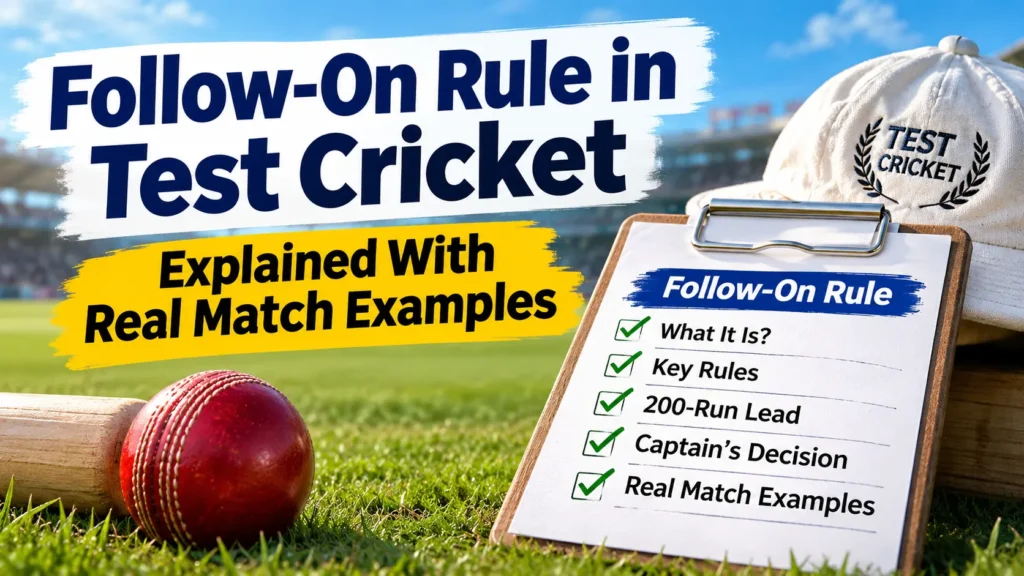
The follow-on rule in cricket allows the team batting first to ask the opposition to bat again immediately when it has built a sufficiently large first-innings lead. In a five-day Test, that minimum lead is 200 runs. The decision belongs to the captain of the team batting first; it is an option, not an automatic rule.
What Is the Follow-On Rule in Cricket?
The follow-on is a playing provision used in multi-innings cricket, most visibly in Test matches. Normally, the two teams take their innings in an alternating order: Team A bats, Team B bats, Team A bats again and Team B completes the match. If the team batting first gains the required lead, its captain may change that sequence by asking the opposition to bat its second innings immediately.
For example, imagine Team A scores 480 in its first innings and Team B is dismissed for 250. Team A leads by 230 runs, which is more than the 200-run threshold for a five-day Test. Team A can now enforce the follow-on. Instead of Team A beginning its second innings, Team B must bat again.
This does not mean Team A has already won. The side following on still has an opportunity to score enough runs to make the match competitive or even take the lead. Depending on the second-innings total, the team that enforced the follow-on may need to bat again and chase a target. The follow-on changes the order of innings; it does not decide the result by itself.
The provision is designed to give the team with a substantial first-innings advantage the option of keeping the opposition under pressure. It can save time and create an opportunity to win by an innings. However, it also means the team that has just bowled must return to the field immediately instead of taking its turn to bat and receiving the usual interval before bowling again.
When Can a Team Enforce the Follow-On?
The required lead depends on the scheduled length of the match. Under the standard follow-on law, the side batting first must be ahead by at least the relevant number of runs after the first innings. A five-day Test uses a 200-run threshold. Shorter two-innings matches use lower margins.
| Scheduled Match Length | Minimum First-Innings Lead | Common Context |
|---|---|---|
| Five days or more | 200 runs | Standard five-day Test |
| Three or four days | 150 runs | Shorter multi-day matches |
| Two days | 100 runs | Two-day two-innings match |
| One day | 75 runs | One-day two-innings match |
These are the standard thresholds in the playing law. A competition may publish its own playing conditions, so teams and officials must apply the regulations governing that particular match. For a conventional five-day men’s Test, the familiar figure is 200 runs.
Run thresholds shown as a comparison of the standard match-duration requirements.
Does the 200-run lead make the follow-on compulsory?
No. Reaching the threshold gives the captain the right to enforce the follow-on, but it does not force the captain to use it. A side can have a lead of 250, 300 or even more runs and still decide to bat again. The captain must weigh the match situation, the condition of the pitch, the workload of the bowlers and the time remaining. If the captain chooses to enforce the follow-on, the opposing captain and the umpires must be notified; once that notification is made, the decision cannot be withdrawn.
What if the first day is completely lost?
The law also deals with a match in which no play takes place on the first scheduled day. In that situation, the required lead is calculated using the number of days remaining when play begins. The day on which play first starts counts as a whole day for this purpose, regardless of the time at which it begins. Therefore, if an entire first day of a five-day match is lost and play starts on day two, the match has four playing days remaining and the standard four-day threshold is 150 runs. If even one over has started on day one after the call of play, the first day is treated as having had play.
How Does the Follow-On Work? A Simple Score Example

The easiest way to understand the rule is to follow the innings sequence. Assume Team A bats first and makes 500. Team B is then dismissed for 280. Team A has a first-innings lead of 220 runs, so it is eligible to enforce the follow-on in a five-day Test.
Suppose Team B scores 190 in its second innings. Its combined total is 470, which is still 30 runs short of Team A’s first-innings score of 500. Team A wins by an innings and 30 runs. It does not need to bat again because Team B has not erased the original deficit.
Now change the example. If Team B scores 260 in its second innings, its match aggregate becomes 540. Team A’s overall lead is no longer enough to win by an innings. Team A must bat in the fourth innings and chase a target of 41 runs (540 minus 500, plus one to win). This illustrates why enforcing the follow-on can still lead to a fourth innings for the team that chose it.
| Team B Second-Innings Score | Team B Match Aggregate | Position for Team A |
|---|---|---|
| 190 | 470 | Team A wins by an innings and 30 runs |
| 230 | 510 | Team A needs 11 to win |
| 260 | 540 | Team A needs 41 to win |
| 300 | 580 | Team A needs 81 to win |
The examples assume Team A made 500 and Team B made 280 in the first innings. They are arithmetic illustrations of the innings sequence, not match predictions.
Why Do Captains Enforce or Decline the Follow-On?
A captain’s decision is a tactical judgement rather than an automatic response to the scoreboard. A large lead may make the follow-on attractive, but the captain also has to consider whether the bowling attack can immediately deliver another long spell. A team that has spent two days in the field may have fast bowlers who need recovery time. Batting again can let them rest while the lead grows.
Reasons to enforce the follow-on
- Time pressure: If rain or lost playing time has reduced the available overs, sending the opposition back in can allow the bowling side to use more of the remaining match time to take 10 wickets instead of spending it on another batting innings.
- Bowling momentum: If the bowlers have dismissed the opposition quickly and are fresh, the captain may want to maintain pressure rather than interrupt the rhythm.
- Pitch conditions: If the surface is expected to deteriorate, the captain may prefer to bowl while conditions are favourable to the attack.
- Opportunity for an innings win: If the opposition is still far behind after its second innings, the leading team may win without batting again.
- Match control: Keeping the opposition batting can reduce its opportunity to recover through a long rest and a fresh start.
Reasons to bat again instead
- Rest for bowlers: Fast bowlers may need recovery after a heavy workload, particularly in hot conditions or after a long first innings.
- Build a bigger lead: Another batting innings can push the target beyond the opposition’s realistic reach and reduce the risk of a difficult fourth-innings chase.
- Pitch may improve: Some surfaces become easier for batting as the match progresses or after the pitch has settled, making it useful to bat again before bowling later.
- Protect against a long resistance: If the opposition has capable batters, the captain may not want to give them a chance to bat for two long innings while the bowlers become tired.
- Weather and time balance: A captain may judge that a larger lead is safer if there is enough time left, while a follow-on could be more attractive when the match is running out of time.
There is no universal answer. Two captains with the same first-innings lead may make different choices because the pitch, weather, player fitness and match context are rarely identical.
Real Match Examples: Famous Follow-On Stories

Winning after being asked to follow on is exceptionally rare in Test cricket. It has happened in four recorded Test matches: England won twice, while India and New Zealand each won once. These matches demonstrate that a follow-on creates pressure, but it does not remove the possibility of a comeback.
England vs Australia, Sydney, 1894
Australia made 586 in the first innings, with Syd Gregory scoring 201 and George Giffen making 161. England replied with 325 and were asked to bat again, 261 runs behind. England then produced 437 in the follow-on innings, including 117 from A.W. Ward. Australia were dismissed for 166 while chasing 177, and England won by 10 runs. It was the first Test victory by a side that had been forced to follow on.
England vs Australia, Headingley, 1981
Australia declared at 401 for nine, with John Dyson scoring 102 and captain Kim Hughes making 89. England were bowled out for 174 and followed on 227 runs behind. At 105 for five in the second innings, England still looked in serious trouble. Ian Botham then made an unbeaten 149, supported by Graham Dilley’s 56, to take England to 356. Australia needed 130 but were dismissed for 111. Bob Willis took eight for 43, and England won by 18 runs in one of the most celebrated Ashes Tests.
India vs Australia, Kolkata, 2001
Australia scored 445 in the first innings, led by Steve Waugh’s 110. India were dismissed for 171, leaving a deficit of 274, and Steve Waugh enforced the follow-on. VVS Laxman produced 281 and Rahul Dravid scored 180, sharing a 376-run fifth-wicket partnership. India declared at 657 for seven, setting Australia a target of 384. Harbhajan Singh took six for 73 in the second innings as Australia were bowled out for 212. India won by 171 runs at Eden Gardens, ending Australia’s 16-Test winning streak.
New Zealand vs England, Wellington, 2023
England declared at 435 for eight and dismissed New Zealand for 209, taking a first-innings lead of 226. Ben Stokes enforced the follow-on. New Zealand responded with 483, built around Kane Williamson’s 132 and a major contribution from the lower order. England were set 258 to win but were bowled out for 256. Neil Wagner took the final wicket, and New Zealand won by one run. It was the fourth recorded Test victory by a side following on, and the first since India’s Kolkata win in 2001.
| Year | Match | First-Innings Deficit | Result After Follow-On |
|---|---|---|---|
| 1894 | England vs Australia, Sydney | 261 runs | England won by 10 runs |
| 1981 | England vs Australia, Headingley | 227 runs | England won by 18 runs |
| 2001 | India vs Australia, Kolkata | 274 runs | India won by 171 runs |
| 2023 | New Zealand vs England, Wellington | 226 runs | New Zealand won by 1 run |
These four results are memorable because the side that enforced the follow-on had been in a position of control. The comeback team had to bat for a long time, build a substantial second-innings total and then take wickets under pressure. These examples show that the follow-on is a tactical choice, not a guarantee of victory.
Recent Test Context and What the Rule Means for a Match
The follow-on is not only a historical talking point. It remains relevant whenever a team builds a large first-innings lead. In the New Zealand vs India first Test at Wellington in November 2026, New Zealand made 368 and India replied with 720 for nine declared, taking a lead of 352. India enforced the follow-on, but New Zealand batted out the remaining time at 239 for five after 120 overs and secured a draw. The example shows that even a lead far above 200 does not guarantee an innings victory.
That match also demonstrates why the pitch and time available matter. New Zealand’s batters concentrated on occupying the crease, while India’s bowlers needed five more wickets before the match ended. The follow-on gave India an opportunity to push for a win, but New Zealand’s resistance and the limited time remaining shaped the final result. Read the New Zealand vs India 1st Test 2026 match report for the scorecard and day-by-day context.
For the formal wording, the ICC’s explanation of Men’s Test Match Clause 14 sets out the lead thresholds, notification requirement and treatment of a lost first day. Those details matter because the captain’s decision must follow the playing conditions rather than assumptions based only on the scoreboard.
Frequently Asked Questions About the Follow-On
What is the follow-on rule in Test cricket?
It allows the team batting first to ask the opposition to bat its second innings immediately if it has the required first-innings lead. In a standard five-day Test, that lead must be at least 200 runs.
Is the follow-on compulsory after a 200-run lead?
No. The captain of the team batting first can choose whether to enforce it or bat again. The rule gives the team an option, not an obligation.
Can a team enforce the follow-on with a 150-run lead?
Not in a standard five-day Test. A 150-run lead is the standard threshold for a match scheduled for three or four days, subject to the applicable playing conditions.
Who decides whether the follow-on is enforced?
The captain of the team that batted first and has the qualifying lead makes the decision. The captain must notify the opposing captain and the umpires, and the decision cannot be changed after notification.
Has a team ever won after following on?
Yes. The four famous Test instances are England in 1894 and 1981, India in 2001 and New Zealand in 2023. India beat Australia by 171 runs at Eden Gardens in 2001.
Why do captains sometimes refuse to enforce the follow-on?
They may want to rest their bowlers, build a larger lead, assess the pitch or reduce the risk of a long opposition innings. The decision depends on the match situation and time remaining.
Conclusion
The follow-on rule in cricket adds an important tactical choice to Test matches. A 200-run lead in a five-day Test gives the team batting first the option to send the opposition in again, but the captain must decide whether immediate pressure is worth the workload and risk. The rule can create an innings victory, yet famous comebacks in Sydney, Headingley, Kolkata and Wellington show that no lead makes the result certain.
Understanding the threshold, innings order and captain’s decision makes Test cricket easier to follow. When a team reaches the required lead, look beyond the score: consider the pitch, bowling workload, weather and time left before judging whether enforcing the follow-on is the right move.