

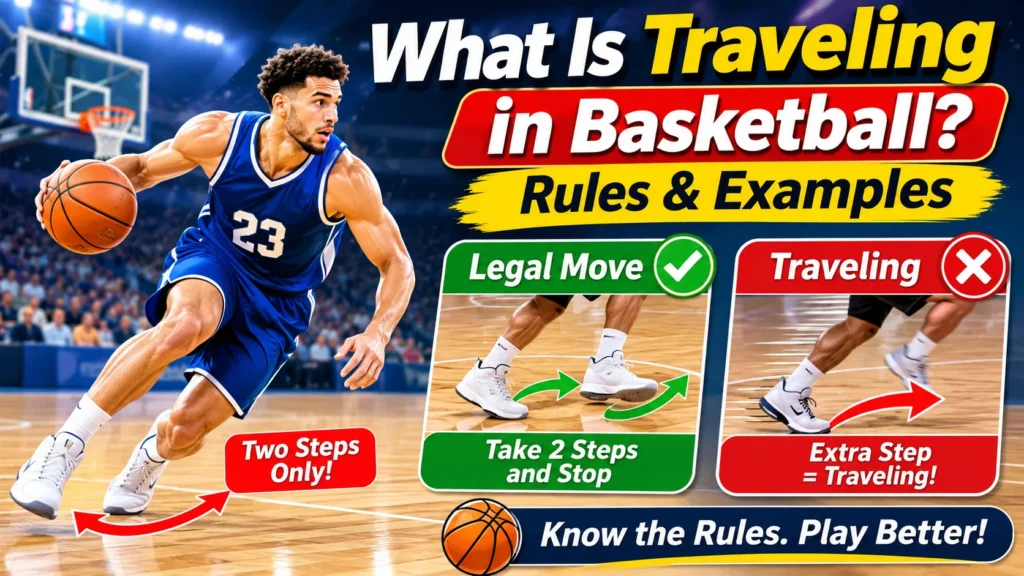
Learn what a travelling call means, when two steps are legal, how the pivot foot works and why a smooth-looking move can still be a violation.
Traveling in basketball happens when a player moves one or both feet in a way the rules do not allow while holding the ball. A moving player may generally take two steps after gaining control to stop, pass or shoot. A stationary player can pivot, but cannot move the pivot foot illegally. The exact moment of control matters.
This guide follows international FIBA basketball rules, the main reference for standard five-a-side basketball in India. It then explains relevant NBA wording. The rules were checked on 23 November 2026, using the FIBA 2026 rules that took effect on 1 October 2026, plus the NBA official rulebook.
Traveling in Basketball: Meaning and the Basic Rule
Traveling is a violation, not a personal foul. It involves illegal footwork by a player holding a live ball. Examples include taking an extra step after ending a dribble, shifting an established pivot foot before beginning a dribble or jumping and coming back to the floor with the ball when the movement rules do not allow it.
A legal dribble is different. While the ball is being dribbled properly, a player can run, change speed and cross the court. There is no fixed step limit for the ordinary movement between bounces. The restrictions become important when the player receives the ball, pauses with it or brings the dribble to an end.
In FIBA’s Official Basketball Rules 2026, Article 25, the focus is on the movement of the feet while the ball is held. This is more precise than saying that every player may take “only two steps.” A player who stays in place can pivot repeatedly without taking illegal steps, and a moving player has to begin the count at the proper instant.
How Many Steps Can You Take Without Traveling?
A player catching the ball while moving, or completing a dribble while moving, may normally use two steps to come to a stop, pass or shoot. The first step is the first foot contact after gaining control of the ball. The second happens when the other foot contacts the floor or both feet land together after that first step.
That means the number of visible footsteps is not enough to judge a play. If a foot is already touching the floor when the player gains control, that contact can be described as a “zero step.” The next new foot contact is step one. The contact after that is step two. A further step while still holding the ball is usually illegal.
For example, a guard gathers the ball with the left foot already on the floor. The right foot then lands, followed by the left. If the guard shoots before making another illegal foot contact, that can be a legal finish. If the right foot lands again with the ball still held, the extra contact may make it traveling.
One detail matters when a player plans to start a dribble instead of shoot or pass. FIBA says that a moving player who has received the ball must release it to begin a dribble before the second step. A player who has stopped and established a pivot foot must release the ball before lifting that foot to start the dribble.
Is taking three steps always traveling?
Not every sequence that looks like three movements is illegal. A foot on the court at the moment of control can be the zero step rather than step one. Also, players may move their feet freely while a legal dribble is still in progress. What matters is the counted sequence after control, not how many times a shoe appears to touch the floor in a slow-motion clip.
Pivot Foot Rules: What a Stationary Player Can Do
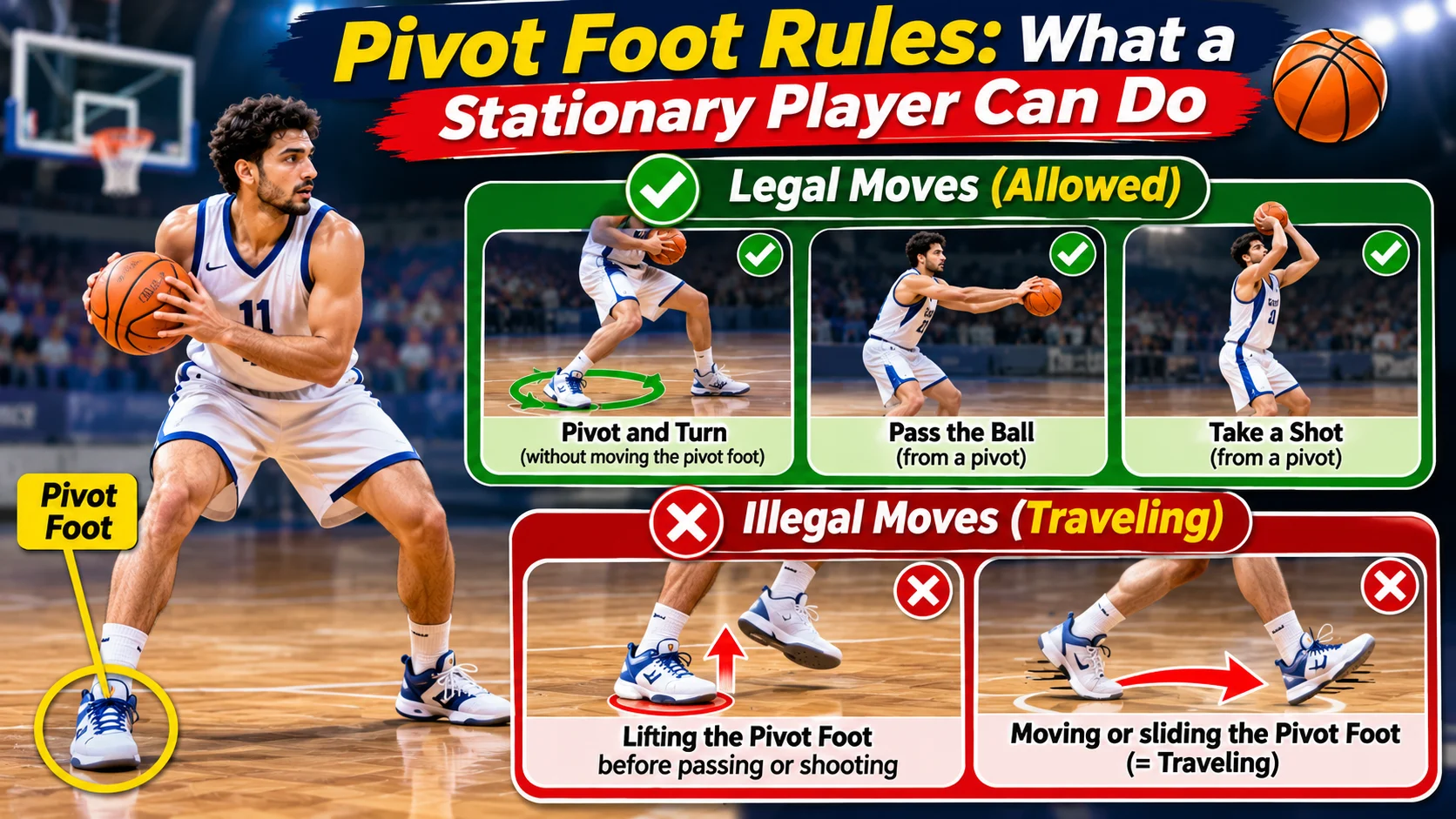
Suppose you catch a pass and stop with both feet on the floor. You may turn to face the basket, protect the ball or look for a teammate. To do this legally, one foot remains your pivot foot. The other foot can step forward, backward or sideways as often as needed, provided the pivot stays at its point of contact.
When both feet are down at the catch, the moment you lift one foot, the other normally becomes the pivot. You cannot simply change your mind and switch pivot feet. A small slide, shuffle or repositioning of the pivot foot can be enough for a travel call, even if your upper body looks steady.
Can you lift the pivot foot?
Yes, for some actions. You may lift the pivot foot to pass or shoot, as long as the ball leaves your hands before that foot returns to the floor. You may not lift the pivot foot first and then release the ball to begin a new dribble. This difference is one of the easiest ways to recognise a traveling violation.
| Pivot-foot action | Legal? | Reason |
|---|---|---|
| Turn on one planted pivot foot | Yes | Other foot moves, pivot stays in place |
| Lift pivot to shoot, release before landing | Yes | Ball leaves the hands in time |
| Lift pivot before releasing ball to dribble | No | Illegal dribble start |
| Slide established pivot while holding ball | No | Pivot loses its fixed position |
| Jump and land with the ball still held | Usually no | Ball must be released before prohibited return |
Gather Step, Zero Step and Jump Stop Explained
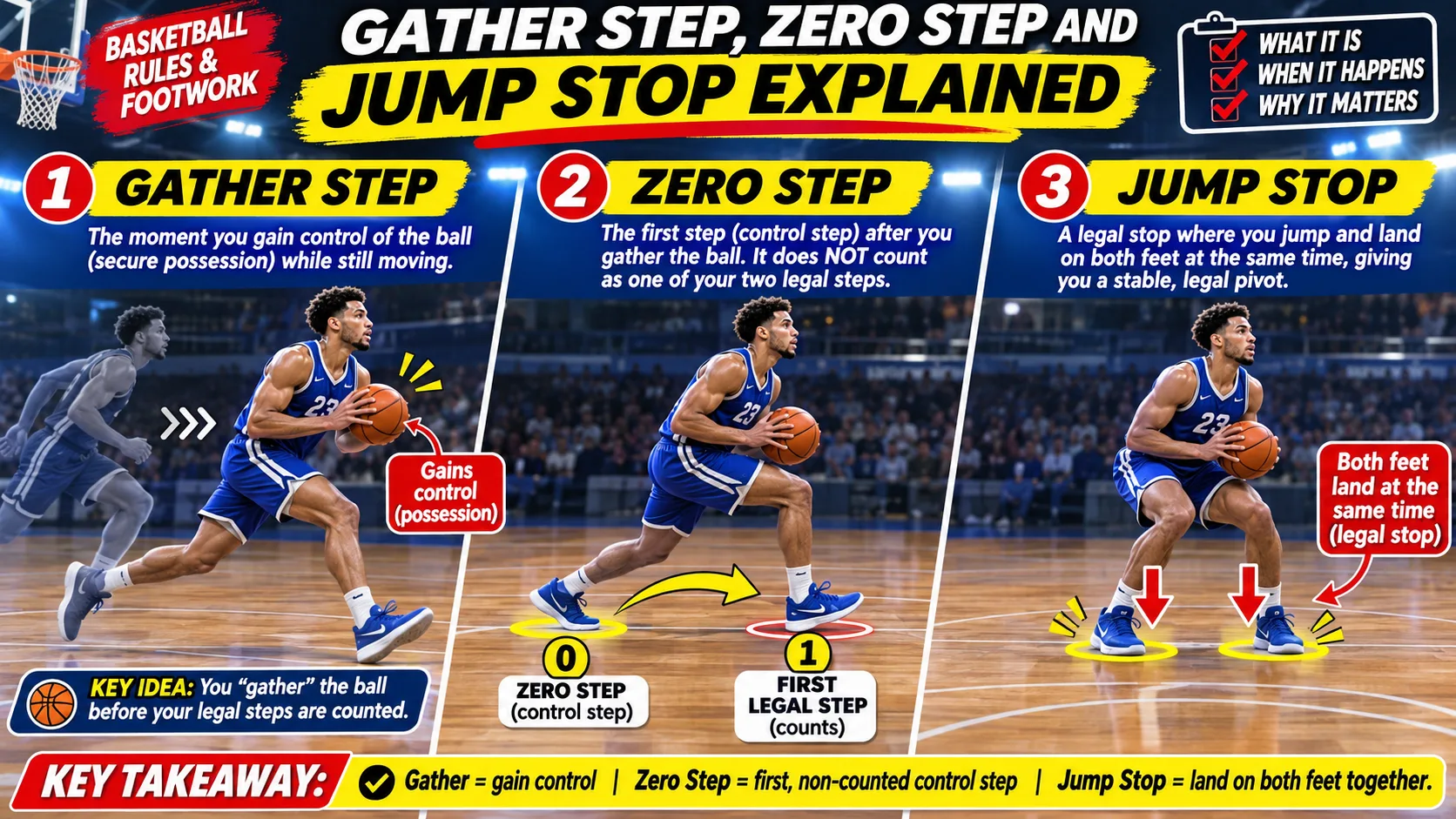
The gather is the moment a moving player has enough control to hold, pass or shoot the ball. The NBA defines this moment expressly in its rulebook. FIBA uses the phrase “gaining control of the ball” to determine when the allowed steps begin. Both systems allow important forms of two-step movement, but exact foot contacts still decide the call.
Fans often call a foot that is already down at the moment of control the zero step. That description can be useful, but it is not a bonus step awarded at any time. It is a way of locating control before the first counted foot contact. If the ball was already controlled before a foot landed, that landing may be step one rather than step zero.
Why does the Euro step look unusual?
In a Euro step, a driving player gathers and uses two permitted steps, usually in different directions, to evade a defender. Moving sideways does not automatically make the play illegal. It becomes a travel if the player adds an unlawful foot contact or breaks the applicable pivot rules. A smooth change of direction and good timing can make the move difficult to defend.
What is a legal jump stop?
A jump stop lets a player land and balance after moving with the ball. Under FIBA rules, the exact landing pattern is important. A player who jumps off one foot on the first step and lands on both feet together for the second step cannot then pivot using either foot. If a foot leaves the floor after that stop, the ball must be released before that foot returns.
By contrast, a player who stops on the first step with both feet simultaneously on the floor may be able to choose a pivot foot. Coaches therefore teach players to notice whether the two-foot landing is their first or second counted step. The same pose can have different outcomes because the events before it were different.
Traveling in Basketball: 10 Real-Game Examples
The following teaching examples describe typical situations rather than claims about specific professional matches. In a real game, officials judge the precise moment of control and the foot contacts. A small difference in timing can change the ruling.
| Example | Situation | Likely call |
|---|---|---|
| 1 | Player ends a dribble, takes two legal steps, then shoots | Legal |
| 2 | Player gathers, takes three counted steps and still holds the ball | Travel |
| 3 | Player turns repeatedly while the pivot foot stays planted | Legal |
| 4 | Player raises the pivot foot, then starts a dribble | Travel |
| 5 | Player lifts pivot to pass and releases before landing | Legal |
| 6 | Player hops onto the same foot consecutively after gathering | Travel |
| 7 | Player falls and slides while holding the ball, without rolling or standing | Legal in FIBA |
| 8 | Player rolls over while holding the ball on the floor | Travel in FIBA |
| 9 | Player legally dribbles several steps between bounces | Legal |
| 10 | Player jump-stops on step two, pivots and keeps the ball | Travel |
Example: The extra step after a layup pickup
An attacker comes down the right side of the lane. They pick up the ball, land on the left foot for step one and the right foot for step two. Instead of releasing a shot, they take another left-foot landing. That added step is illegal. The defender earns possession for their team even without touching the ball.
Example: Falling without traveling
A player loses balance, falls and slides on the court while holding the ball. Under FIBA rules, the slide by itself is not automatically traveling. But rolling over or trying to stand up while still holding the ball is a violation. A smart player who falls can instead look for an immediate pass to a teammate.
FIBA vs NBA Traveling Rules: What Changes in 2026?
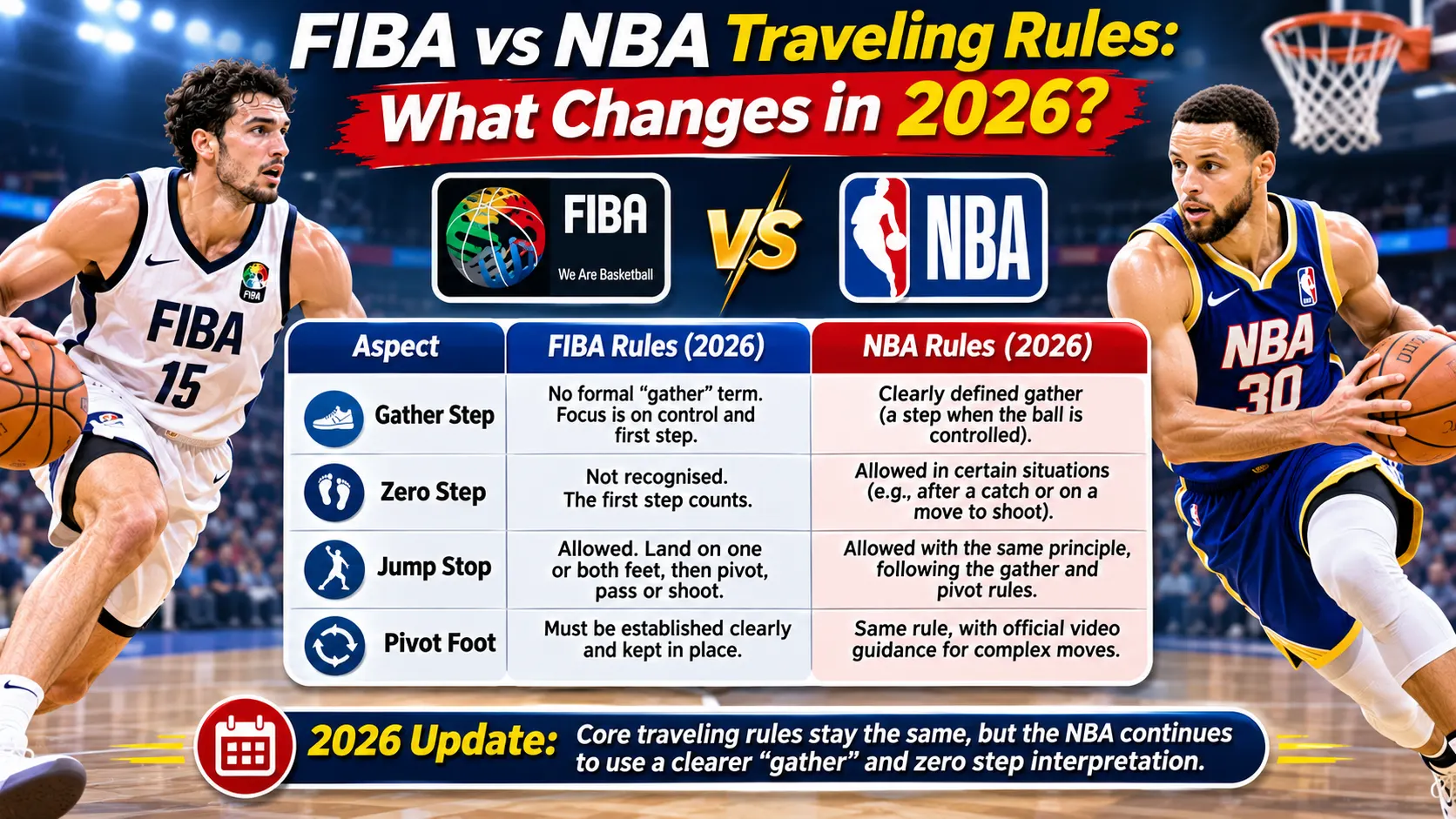
For Indian schools, clubs and many organised competitions, FIBA is the clearest international reference. NBA games follow their own rulebook. The basic ideas are similar: legal pivoting, regulated steps after control and a turnover for illegal movement. The terms and some special cases are not identical, so a clip from one competition should not be used as the sole guide for another.
FIBA’s 2026 rules came into force on 1 October 2026. Article 25 lays out the two-step sequence and explains what happens when both feet land together, when a player pivots and when a player falls. The NBA’s Rule 10, Section XIII sets out its traveling provisions, while Rule 4 defines the gather more explicitly.
| Question | FIBA (2026) | NBA |
|---|---|---|
| Two steps after control while moving? | Generally allowed | Generally allowed |
| How is first step counted? | First foot contact after gaining control | First foot contact after the gather |
| Can a planted pivot foot slide? | No | No |
| Can pivot lift to shoot? | Yes, release before it returns | Yes, release before it returns |
| Is a gather defined separately? | Rule uses gaining control | Yes, detailed gather definition |
| Who gets the ball after a travel? | Opponents, throw-in | Opponents, throw-in |
The differences may sound technical, yet they matter when watching close plays. An NBA referee asks precisely when the gather occurred, using the league’s definition. A FIBA referee identifies when the player gained control and applies Article 25. The best beginner habit is to learn the correct rulebook for the match rather than copying a viral video’s claim that every third-looking step is illegal.
Players training in India can study the general game structure in our basketball rules for beginners guide, then return to this article for a closer look at footwork and traveling calls. The broader guide also explains fouls, possession and timing rules, which often appear in the same sequence of play.
What Happens After a Traveling Violation?
When a referee calls traveling, play stops. The team that committed the violation loses possession, and the opponents are awarded a throw-in from the location specified by the governing rules. Under FIBA’s general violation rule, that is normally the place nearest the infraction, not directly behind the backboard.
Traveling does not normally award free throws or add a personal foul to the player’s record. The key cost is the lost attacking chance. A team might lose a fast break, a close-range finish or a late-game possession because one player picked up the ball too soon.
Traveling vs double dribble vs carrying
These calls are easy to mix up because all three can involve awkward ball handling. Traveling concerns illegal foot movement while holding the ball. A double dribble generally happens when a player finishes one dribble and then improperly starts another. Carrying occurs when the player lets the ball come to rest in a way that interrupts a legal dribble and then continues.
| Violation | What goes wrong? | Easy clue |
|---|---|---|
| Traveling | Illegal foot movement while holding ball | Extra step or shifted pivot |
| Double dribble | Improper second dribble | Stops, then bounces again |
| Carrying | Improper pause or support of ball during dribble | Hand under ball, pause, continue |
How to Avoid Traveling: Simple Footwork Drills
The best way to prevent traveling is to practise when to gather, not just how to move fast. Many beginners watch their hands and forget the location of their feet. Train slowly at first, then add speed and a defender. A coach or teammate watching from the side can give useful feedback about the first counted step.
Drill one: Catch, pause and pivot
Stand near the free-throw line while a partner passes to you. Catch with both feet on the court, choose a pivot foot and say its name aloud. Turn toward the basket and toward each sideline without letting the chosen foot slide. Repeat with the other foot. This teaches balance and makes the pivot rule easier to remember under pressure.
Drill two: Dribble, gather, two steps and shoot
Begin a few metres from the basket. Take controlled dribbles, collect the ball and use two clear steps into a layup. Have a partner call “control,” “one” and “two” in time with the action. After several clean attempts, approach from the opposite side. The goal is not to rush but to make every foot contact easy to identify.
Drill three: Pass before the foot returns
Catch the ball, establish a pivot and lift that pivot foot as if preparing to shoot. Pass to a partner before the lifted foot touches the floor again. Then practise beginning a dribble by releasing the ball before the pivot rises. These two actions teach an important difference: the same lifting motion can be legal for a pass but illegal when starting a dribble too late.
When learning the basketball traveling rules, players should practise the first-step and second-step landing patterns separately. Stop the drill if a player loses track of which foot touched the floor when gaining control of the ball. It is better to repeat a short, correct movement than to develop a bad habit that could lead to traveling violations and turnovers during a match.
Frequently Asked Questions About Traveling in Basketball
1. What is traveling in basketball in simple words?
Traveling means moving your feet illegally while holding the basketball. An extra step after control or an illegal change of pivot foot can result in the referee giving the ball to the other team.
2. Can you take two steps in basketball without dribbling?
Yes, a moving player may usually take two permitted steps after gaining control to stop, pass or shoot. The timing of control matters, and starting a new dribble has its own release requirements.
3. Is a gather step the same as a third step?
No. A foot already on the floor at the moment of control may be described as a zero step. The first counted step happens at the next foot contact after control, so a gather is not an automatic extra step.
4. Can a player jump and land with the basketball?
Normally, a player who jumps after establishing a pivot must release the ball before returning to the floor. Certain two-foot jump-stop landings are permitted, but what happens next depends on which step the landing represents.
5. Is traveling a foul or a violation?
Traveling is a violation, not a personal foul. The usual penalty is loss of possession and a throw-in for the opposing team, rather than free throws or an added personal foul.
6. Are the NBA and FIBA traveling rules identical?
They share the main ideas of allowed steps and legal pivoting, but the wording and some detailed applications differ. For games in India that use FIBA rules, follow FIBA Article 25 instead of assuming every NBA example applies exactly.
Final takeaway: Understanding traveling in basketball starts with one question: when did the player gain control of the ball? Count the feet from that moment, identify the pivot, and check the release. Practise those details and it becomes easier to play confidently, recognise correct calls and explain the game to new fans.