

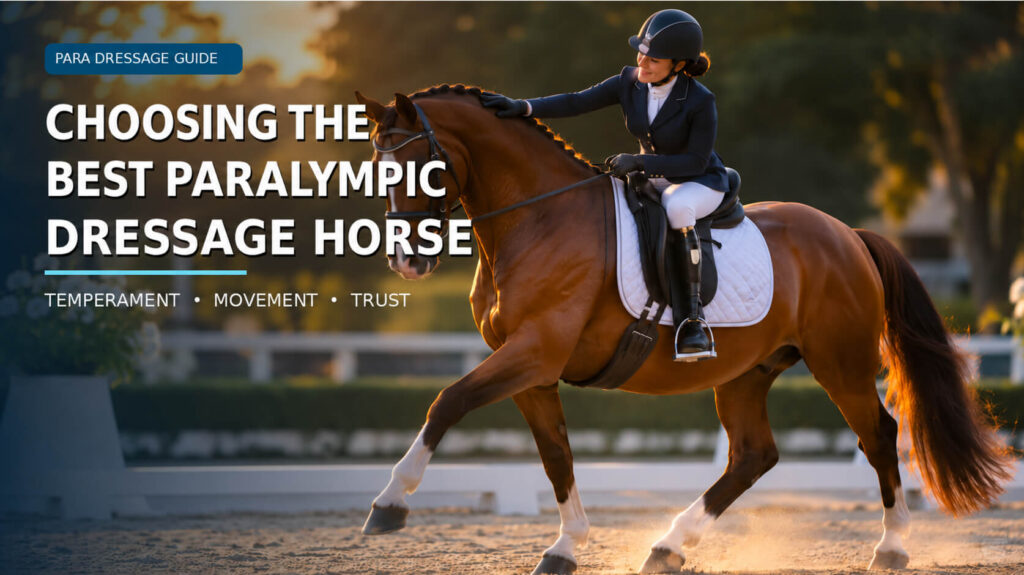
In Para dressage, the finest horse is not necessarily the tallest, the most expensive or the one with the biggest movement. It is the horse that can perform accurately, comfortably and confidently with a particular rider.
A Paralympic dressage test can look almost effortless. A horse walks into the arena, maintains its rhythm, turns precisely at the markers and responds to signals that spectators may barely notice. Behind those few minutes lie years of training, careful horse care and an extraordinary partnership between two athletes.
So, what makes a great Paralympic dressage horse? The answer combines a trustworthy temperament, sound movement, good balance, trainability, physical comfort and an exceptional match with the rider. The horse must possess genuine sporting ability while adapting to the communication methods and support needs of its partner. No single breed, height or personality can guarantee that combination.
Why the Right Horse Matters So Much in Para Dressage
Para dressage is a competitive equestrian discipline in which athletes with eligible impairments perform prescribed dressage tests. Riders are grouped into five competition grades according to how their impairment affects riding activities. Judges assess movement, accuracy, rhythm, balance and harmony between horse and rider.
The horse’s role is especially significant because riders may communicate differently. One rider may use conventional leg signals; another may rely more on weight shifts, rein contact, voice where permitted or approved compensating aids. The horse must learn what those signals mean and answer them reliably without becoming tense or confused.
This is not simply about finding an unusually quiet horse. The highest-level para-dressage competitors need athletic movement and precise responses just as other dressage riders do. The difference is that those qualities must work for the individual rider’s body, balance, strength and communication style. The FEI’s explanation of Para Dressage communication emphasizes the individual training that makes those partnerships possible.
The 9 Essential Qualities of a Great Paralympic Dressage Horse
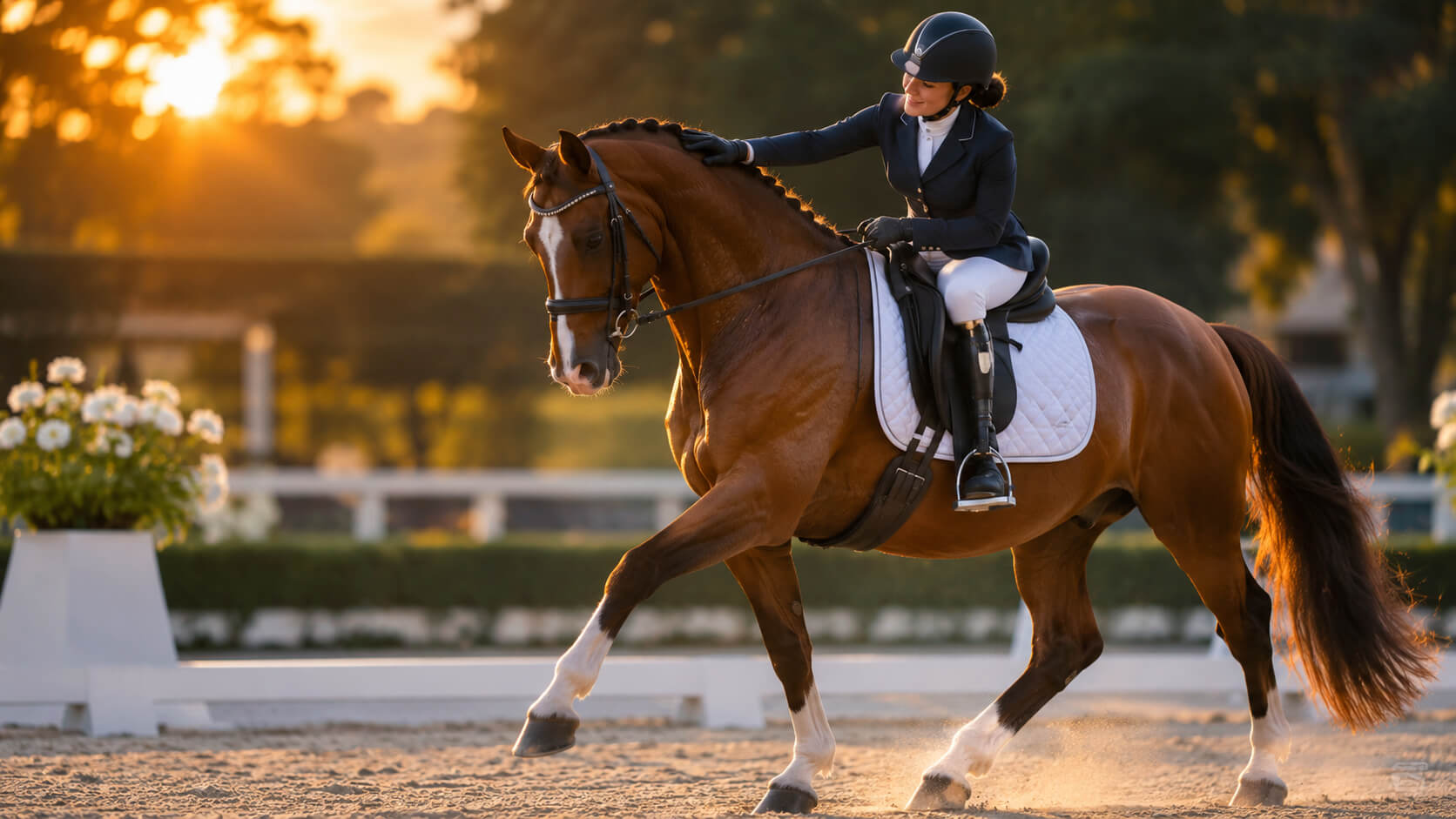
Visual Guide — 9 Qualities, 3 Foundations
A successful partnership requires all three foundations. These are categories, not a numerical ranking of horses.
1. A calm, confident and trustworthy temperament
An excellent para-dressage horse should be attentive without being overly reactive. It must cope with arena decorations, applause, unfamiliar surfaces, photographers, judges and other horses while continuing to listen to its rider. A calm temperament protects both performance and rider safety.
Calm does not mean dull or unwilling. A horse that ignores every instruction can be just as difficult to ride as one that overreacts. The ideal partner is mentally settled, curious enough to learn and responsive enough to carry out accurate movements. Confidence is often more valuable than mere stillness.
Trainers look at behaviour throughout the day, not only during a polished demonstration. Does the horse stand quietly during mounting? Can it wait at the halt? How does it react when the rider’s balance changes or a noise occurs nearby? Does it recover promptly after a surprise? Those observations reveal more than a dramatic first impression.
2. A regular, comfortable and expressive walk
A correct walk has four distinct beats and an even rhythm. In Grade I, where the competition emphasizes walk work, the quality of this gait is particularly important. Judges can notice hurried steps, uneven timing, loss of activity or tension through the body.
A spectacular trot does not compensate for a poor walk. The horse needs to step forward freely, remain balanced in turns and maintain a clear rhythm in transitions. Equally important, the rider must feel secure enough to guide the movement without being unsettled by each stride.
For many partnerships, the best walk is not the biggest possible stride. It is a naturally regular, ground-covering walk that the rider can control consistently, including when shortening the steps, lengthening them or riding accurate shapes.
3. Natural balance and a movement the rider can comfortably follow
Balance allows a horse to turn, slow down, move forward and change direction without falling onto the forehand or losing its rhythm. A well-balanced horse is easier to guide through a sequence of movements, particularly when the rider cannot use conventional aids in the usual way.
The horse’s movement must also suit the rider. A huge, bouncy trot may look spectacular from the stands but be difficult for an athlete with limited trunk stability to absorb. A more comfortable trot with good regularity, freedom and engagement can produce a more harmonious performance.
Natural balance should not be confused with stiffness. A good dressage horse remains supple through the back and joints, accepts appropriate contact and can develop strength through progressive, humane training. Movement quality and the rider’s comfort need to be assessed together.
4. Willingness to respond to subtle and consistent signals
Some para-dressage athletes have limited use of one or both legs, reduced hand function or different postural control. Their horses may therefore learn an individualized language of rein signals, seat and weight changes, voice where allowed, or approved compensating aids.
The best horse is neither so sensitive that it reacts unpredictably nor so unresponsive that it requires repeated strong instructions. It should distinguish deliberate cues from incidental movement, wait for clarification and offer the requested response without resistance.
For example, a rider who cannot give a conventional leg aid might use an approved alternative to request forward movement. A capable horse learns that signal through repeated, carefully timed training. The objective is understanding, not stronger pressure.
5. Soundness, stamina and physical durability
A horse must be physically capable of the job expected of it. Sound movement, healthy feet, appropriate muscling, good saddle fit and the absence of unmanaged pain are essential. Veterinary evaluation matters before purchase or lease and throughout a competition career.
Daily management contributes to long-term performance. Balanced feeding, turnout, appropriate exercise, hoof care, dental care, veterinary attention and sufficient recovery all support the horse’s welfare. A horse that appears willing should not be assumed to be comfortable if its gait, posture or behaviour changes.
Fitness also needs to match the grade-specific demands. Walk-focused tests require sustained rhythm and self-carriage; more advanced tests may add technically demanding trot, canter and lateral work. Training should build strength gradually, with workloads adjusted to the individual horse.
6. Patience with the rider’s positioning and adaptive equipment
Depending on their classification and approved needs, riders may use modified reins, adaptations to the saddle, leg supports or other compensating aids. The horse should be introduced gradually to the equipment and the way it affects the rider’s position or signals.
Mounting and dismounting can also require additional planning. A suitable horse must be comfortable with the designated mounting arrangements and with trained assistants working nearby. Consistent handling procedures are important; a horse should never be forced to tolerate distressing equipment or unsafe situations.
Crucially, permitted aids are regulated. A rider cannot simply add any device because it appears helpful. Coaches must check the relevant classification documentation and current competition rules, while ensuring the horse can move freely and comfortably.
7. Trainability, intelligence and a strong work ethic
A horse may have excellent natural movement but still be a poor match if it becomes frustrated by repetition or takes a long time to understand new signals. Trainability is the capacity to learn, retain instructions and cooperate consistently with fair, progressive schooling.
The most successful horses develop reliable basics before complicated movements are added. Straightness, rhythm, halt transitions, balanced circles and responsiveness to the chosen aids matter more than rushing toward advanced exercises. Horses should be rewarded for correct attempts and given time to process unfamiliar tasks.
The rider, coach, groom and any supporting trainer need to give compatible instructions. Mixed messages can make even a talented horse seem uncooperative. Good training produces a confident partner that knows what to expect rather than an animal relying on guesswork.
8. Confidence in unfamiliar competition environments
A horse might be impeccable at home yet become distracted in a large championship arena. Flags, grandstands, transport, loudspeakers, flowers and new footing can all change the experience. A top-level horse must learn to remain rideable even when the surroundings are exciting.
This confidence is developed through thoughtful exposure. Trainers can begin with low-pressure outings, gradually introduce new venues and preserve familiar warm-up routines. Signs of stress should be addressed rather than treated as disobedience.
At the 2026 FEI Para Dressage World Championship in Aachen, Rixt van der Horst rode Eisma’s Royal Fonq N.O.P. to Grade III individual gold with 77.534%. The horse was initially excited by the atmosphere but settled into the test. It illustrates the value of a horse that can regain focus, not merely one that never notices its surroundings.
9. Genuine trust and compatibility with one particular rider
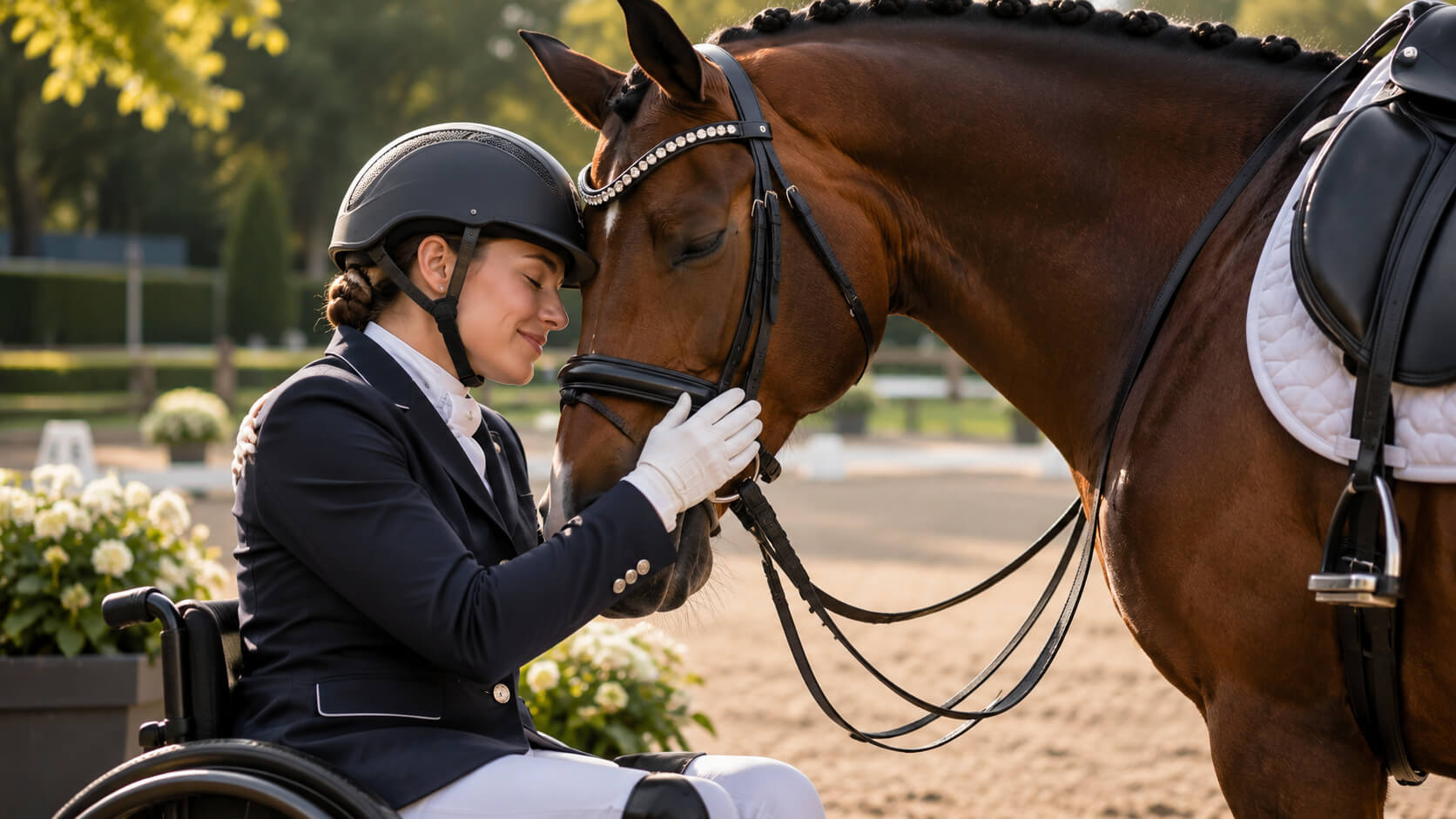
The most important quality may not belong to the horse alone. It belongs to the partnership. Two excellent athletes do not automatically make an excellent combination; their rhythm, balance, personalities, communication and expectations must suit one another.
A horse that feels secure with one rider may find another rider’s movement confusing at first. Equally, an athlete may feel confident on a compact, quiet-moving horse but insecure on a more powerful mount. Successful matching means considering the horse and human together rather than judging either in isolation.
Trust grows through consistent care, patient schooling and many small successful experiences. The horse learns to recognize the rider’s intentions. The rider learns the horse’s reactions and limits. In the arena, that familiarity makes difficult movements appear quiet and effortless.
How the Ideal Horse Changes Across Grades I–V
There is no universal formula because the technical tests and riders’ functional needs differ. A horse perfectly suited to one athlete might not be appropriate for another athlete in the same grade. The following comparisons describe common priorities, not fixed breed or purchase requirements.
| Competition grade | Typical movement demands | Qualities to prioritize in a match |
|---|---|---|
| Grade I | Predominantly walk movements | An excellent four-beat walk, steadiness, clear responses and exceptional suitability for the rider |
| Grade II | Walk and trot work | A dependable walk, comfortable trot, balance and reliable transitions |
| Grade III | Walk and trot in prescribed tests, with some freestyle canter possibilities | Regular movement, suppleness, controlled energy and accurate changes of direction |
| Grade IV | Walk, trot, canter and more complex work | Athletic paces, self-carriage, precision, comfort and confidence under pressure |
| Grade V | More advanced combinations of walk, trot, canter and lateral work | Greater technical training, expressive but controllable movement and sustained balance |
Chart 1 — Which Movements Matter in Each Grade?
This quick visual shows typical movements used in current grade-specific tests. The precise prescribed movements are defined by the published FEI test.
| Grade | Walk | Trot | Canter | Lateral work |
|---|---|---|---|---|
| I | ✓ | — | — | — |
| II | ✓ | ✓ | — | — |
| III | ✓ | ✓ | Freestyle* | — |
| IV | ✓ | ✓ | ✓ | ✓ |
| V | ✓ | ✓ | ✓ | ✓ |
Grade I riders do not need an unathletic horse. Their walk work can be highly demanding because small changes in rhythm, contact and accuracy remain visible throughout the test. Similarly, a Grade V rider does not necessarily need the most powerful horse available; the movement still has to be manageable and harmonious.
For the next major Paralympic competition, explore the LA 2028 Para Equestrian events and qualification guide to understand the route from international performance to Paralympic selection.
Chart 2 — Dressage Arena Size by Grade
The larger arena has 50% more surface area. The bar lengths represent the actual arena areas, not differences in rider ability.
Does Breed, Height or Age Determine the Best Horse?
Warmbloods are common at elite international dressage competitions because many have been bred for athletic movement and trainability. However, the breed name does not guarantee a steady mind or a suitable gait for a particular athlete. Other breeds and crosses can be excellent partners when they meet the sporting demands.
Height must be considered in practical terms. A tall horse may have lovely movement yet present challenges with mounting, balance or handling. A smaller horse may be easier to manage but must still have enough ability for the intended tests. Body shape, back width, gait mechanics and saddle compatibility can matter more than a number measured in hands.
Age is equally individual. A younger horse may offer years of future potential but need more training and exposure. An older, experienced horse might provide invaluable confidence, provided veterinary assessment confirms it is fit for the expected workload. There is no single perfect age for every para-dressage partnership.
How Coaches Match a Horse to a Para Dressage Rider
A careful match usually begins with the rider’s needs rather than a sales video. Coaches consider balance, available aids, mobility, mounting arrangements, the intended classification grade and the athlete’s current skill. They then evaluate how the horse moves and responds with that particular athlete.
A sensible assessment includes ground handling, a controlled first ride, transitions, circles, halts, rein responses and the rider’s confidence. The horse should be observed both when relaxed and when exposed to normal distractions. A trained coach can determine whether the horse is suitable for a longer trial.
| What to test | What a good match looks like | Potential concern |
|---|---|---|
| Mounting and standing | Horse waits calmly and follows a safe routine | Moving away, tension or discomfort |
| Walk and transitions | Even rhythm and prompt, clear responses | Rushing, irregularity or repeated confusion |
| Rider balance | Rider feels secure and follows the motion | Excessive bounce or unstable positioning |
| Adaptive aids | Horse accepts approved equipment and trained cues | Fear, resistance or unclear responses |
| New environment | Horse stays manageable and recovers focus | Persistent distress or unpredictable reactions |
| Physical comfort | Sound movement and suitable tack | Pain signs, lameness or poor saddle fit |
One trial rarely tells the whole story. Repeated sessions, professional veterinary checks and—where practical—a supervised visit to a different arena or small competition provide a more realistic picture. The right decision may be to keep searching, even when a horse is talented and attractive.
Visual Guide — A Thoughtful Horse-Matching Process
Good selection is a process, not a one-ride verdict.
Training a Para Dressage Horse: Building a Shared Language
For a practical explanation of how horses learn alternative signals, read how Paralympic riders control their horses, including the role of reins, weight changes, voice and approved compensating aids.
Begin with ordinary dressage foundations
Good para-dressage training is built on the same humane fundamentals as other dressage: regular paces, steady rhythm, suppleness, balanced transitions, willingness to move forward and understanding of the reins. A horse needs these basics before learning specialized cues.
Introduce the rider’s individual communication system
A coach may first teach alternative responses during groundwork or under another skilled rider, then transfer the cues to the para athlete in a controlled setting. This requires care and clarity. A new signal should always mean the same thing, and the horse should be allowed enough time to understand it.
Develop precision without losing relaxation
Once the communication is dependable, training can focus on accurate arena figures, transitions and test movements. Success is measured not by how forcefully the horse responds but by how quietly and reliably it completes the task. Short, productive sessions are often more useful than repeated drilling.
Prepare for the entire competition experience
The horse must be comfortable with transport, handling, grooming, warm-up routines, tack and unusual sights. Those skills should be developed progressively. Competition preparation also includes safeguarding the athlete during mounting and ensuring that permitted aids are correctly recorded and fitted.
Protect the horse’s mental and physical welfare
A balanced routine may include turnout, rest days, light hacking, varied exercise, grooming and human interaction. Training plans should be adapted to the horse’s age, health, temperament and competitive schedule. Continued performance depends on preserving the animal’s willingness and well-being.
What Recent Championship Partnerships Teach Us
Paralympic equestrian sport has been shaped by remarkable partnerships since its Atlanta 1996 debut. This history of Paralympic equestrian competition traces that development through Paris 2024 and toward Los Angeles 2028.
Results are impressive, but the stories behind them show why there is more to success than a beautiful gait. At Aachen in August 2026, Kate Shoemaker and Vianne scored 80.460% in the Grade IV team test as the United States won the FEI Para Dressage World Championship team title. Their precision shows the value of athletic ability combined with partnership and preparation.
At the same championships, Marie Vonderheyden and Fan Tastico H won the Grade I individual title with 76.709%. That result is a reminder that walk-focused grades are serious elite sport. Heidemarie Dresing and Poesie 143 scored 75.483% for Grade II gold despite a spook early in their test, demonstrating how a partnership can recover and return to harmony.
A different lesson comes from British Grade IV athlete Nicola Naylor and Humberto L. Their story, published by the FEI in July 2026, describes a talented horse whose confidence needed patient development. His successful international career grew from an approach that valued reassurance and gradual trust as much as ability.
| Partnership | Competition or story | Lesson illustrated |
|---|---|---|
| Kate Shoemaker and Vianne | Aachen 2026, 80.460% Grade IV team test | Technical quality and consistent execution |
| Marie Vonderheyden and Fan Tastico H | Aachen 2026, Grade I individual gold | Elite precision in a walk-focused grade |
| Heidemarie Dresing and Poesie 143 | Aachen 2026, Grade II individual gold | Recovering focus after a distraction |
| Nicola Naylor and Humberto L | FEI profile, July 2026 | Confidence can be developed with patience |
These examples do not establish that one horse type is superior. They show different qualities succeeding in different riders, grades and competitive situations.
Chart 3 — Aachen 2026: Grade III Freestyle Podium
Three rider–horse combinations in the same Grade III Freestyle event, 23 August 2026. The percentages are official final scores.
Horse Welfare Is Part of Great Performance
The horse is an athlete, not simply a means of carrying a rider. Its comfort, health and emotional state influence every test. Tension may appear as resistance, a shortened stride, an irregular rhythm or difficulty maintaining contact. When behaviour changes, the first response should include checking for discomfort rather than assuming deliberate disobedience.
Responsible programmes monitor workload, veterinary health, feet, nutrition, saddle fit, travel stress and recovery. Equipment should be safe, correctly fitted and appropriate to both horse and rider. Training methods should promote confidence and willing movement, not exhaustion or fear.
A high mark does not excuse poor welfare. The most admirable partnership is one in which the horse can work willingly, remain physically sound and enjoy a sustainable career. A horse that is comfortable and secure has a better foundation for the precision judges want to see.
Common Mistakes When Choosing a Para Dressage Horse
Choosing the biggest movement. Exceptional extension or a dramatic trot may impress in a video, but the rider may struggle to sit securely or influence the rhythm. Comfortable, regular movement is often more useful than spectacle.
Assuming an older or quieter horse needs no training. A calm horse may still need to learn a new rider’s signals, arena work and adaptive equipment. Temperament is only the starting point.
Buying before observing the horse away from home. A familiar environment can hide problems with travel, crowds and change. A supervised trial in more than one setting can reveal whether confidence is genuine.
Ignoring rider-specific ergonomics. The horse’s width, movement, tack, mounting needs and the rider’s physical control all affect compatibility. An ideal-looking horse may simply not feel right beneath a particular athlete.
Prioritizing competition results over welfare. Previous scores are useful context, but the horse’s current health, training and sustainable workload deserve equal attention.
Frequently Asked Questions
What is the most important quality in a Paralympic dressage horse?
A trustworthy temperament combined with a suitable match for the rider is fundamental. The horse also needs correct, comfortable movement and enough athletic ability for the relevant grade. No one quality can replace soundness, safe handling or a reliable partnership.
Does a para-dressage horse need to be a particular breed?
No. Warmbloods are common in elite dressage, but a horse is judged by its abilities and performance rather than breed alone. Soundness, temperament, movement, training and compatibility with the athlete are more meaningful considerations.
Why is the walk so important for Grade I horses?
Grade I competition emphasizes walk movements. Judges can assess the purity of the four-beat rhythm, accuracy, balance, activity and connection throughout the test. A regular walk is therefore essential rather than merely a warm-up gait.
Can a horse learn to respond without ordinary leg aids?
Yes. Horses can be trained to recognize individualized cues involving the seat, reins, voice where permitted or approved compensating aids. The precise method depends on the rider’s needs and the applicable rules. Training should be consistent, gradual and supervised by qualified professionals.
Are older horses better than younger horses?
Not automatically. An experienced horse may be reliable and confident, while a younger horse may have long-term athletic potential. Current health, fitness, training and the ability to support the specific rider matter more than age alone.
Is a calm horse enough for Paralympic competition?
No. The horse also needs correct paces, balance, responsiveness, technical training and sufficient physical fitness. A horse that stays relaxed but cannot perform the prescribed movements accurately will still struggle to score well.
How long does it take to create a strong horse-rider partnership?
There is no fixed timetable. Some combinations settle quickly, while others need many months of systematic work to establish reliable signals and confidence. The complexity of the rider’s needs, the horse’s prior training and the quality of coaching all affect progress.
Final Thoughts: The Best Horse Is the Right Partner
A great Paralympic dressage horse is both a talented athlete and a dependable teammate. It moves with regularity, learns carefully, stays balanced under pressure and responds to the rider’s distinctive language. It is physically comfortable, mentally secure and supported by thoughtful care.
But the defining quality is the partnership. A horse becomes exceptional for para dressage when its abilities fit the person in the saddle and both learn to trust one another. When that happens, even a demanding championship test can look beautifully simple—one horse, one rider and a shared understanding expressed through movement.