

Tennis is a racket sport played by two opponents in singles or by two teams of two in doubles. The aim is to hit the ball over the net and into the opponent’s court so that the opponent cannot make a valid return. To enjoy a match or begin playing, you need to understand the court lines, serve, rally, scoring system, faults and tie-breaks.
This guide explains the game in clear steps, with measurement tables, scoring examples and practical tips. It focuses on the standard format; local leagues and tournaments may announce approved alternative scoring methods.
What Is Tennis and How Is It Played?
Tennis is played on a rectangular court divided into two halves by a net. Players use a strung racket to hit a hollow felt-covered ball. A point begins with a serve. The receiver attempts to return it, and the rally continues as each side sends the ball back across the net.
A player wins a point when the opponent fails to make a good return. This can happen when the ball bounces twice before it is returned, lands outside the correct court, or a player commits another point-ending fault. A shot that touches a boundary line is considered in.
The sport has two main formats. Singles has one player on each side, while doubles has two players on each side. The scoring structure is generally the same, although some events use shorter sets, no-ad games or a match tie-break instead of a full deciding set.
The four stages of a tennis match
Remember this order: points make games, games make sets, and sets decide the match. Once this structure is clear, scoreboards and match commentary become much easier to follow.
Tennis Court Dimensions, Lines and Equipment
A standard tennis court is 78 feet (23.77 metres) long. Its width depends on the format: singles uses the inner sidelines and measures 27 feet (8.23 metres) wide, while doubles uses the full court width of 36 feet (10.97 metres).
| Measurement | Standard dimension | Where it applies |
|---|---|---|
| Court length | 78 ft (23.77 m) | Singles and doubles |
| Singles court width | 27 ft (8.23 m) | Singles |
| Doubles court width | 36 ft (10.97 m) | Doubles |
| Net height at posts | 3 ft 6 in (1.07 m) | At the net posts |
| Net height at centre | 3 ft (0.914 m) | At the centre strap |
Tennis Court Width: Singles vs Doubles
Court width in feet (ft). Doubles uses the full width, including the side alleys.
Important court lines
- Baseline: The line at the back of each side. The server must remain behind it when serving.
- Singles sideline: The inner side boundary used in singles matches.
- Doubles sideline: The outer side boundary used in doubles matches.
- Service line: The line that marks the back of each service box.
- Centre service line: Divides the service area into right and left boxes.
- Centre mark: A small mark in the middle of the baseline that helps define the server’s position.
The service boxes sit close to the net. A legal serve must land in the box diagonally opposite the server. During a singles rally, the doubles alley is out; during a doubles rally, the alley is part of the court. For more sports news, please see Khelkhabri.
Common tennis court surfaces
Professional tennis is played on several surfaces. Grass courts generally produce a quicker game and a lower bounce. Clay courts tend to slow the ball and create a higher bounce, often leading to longer rallies. Hard courts provide a firm, relatively consistent surface, although speed and bounce vary by court construction and conditions.
Beginners do not need specialist equipment to start. A suitable racket, tennis balls, comfortable sports clothing and court shoes are enough for basic practice. Choose a racket that feels manageable in weight and grip size; control is more useful than trying to hit every ball with maximum power. For more information, visit cricket betting ID.
Tennis Scoring System: Points, Games, Sets and Matches
The traditional tennis scoring system uses the terms Love, 15, 30 and 40 instead of counting each point as zero, one, two and three. The server’s score is announced first. A standard game is won by reaching at least four points and leading by two.
| Points won in the game | Score called | Simple meaning |
|---|---|---|
| 0 | Love | No points won |
| 1 | 15 | First point |
| 2 | 30 | Second point |
| 3 | 40 | Third point |
| 4 | Game | Only if the player leads by two |
What do deuce and advantage mean?
If both players reach 40-40, the score is called deuce. A player must then win two consecutive points to take the game under the traditional advantage system. The first point after deuce gives that player an advantage. If the same player wins the next point, the game ends. If the opponent wins it, the score returns to deuce.
For example, imagine the score is deuce. Player A wins the next rally, so the score becomes advantage A. If Player B wins the following rally, the score goes back to deuce. This can happen several times before one player wins two points in a row.
Some competitions use no-ad scoring. In that format, a deciding point is played at deuce, and the receiver chooses the side from which to receive. Always check the event rules because the scoring format may differ.
How does a player win a set?
In a standard tie-break set, the first player or team to win six games with a lead of at least two games wins the set. Scores such as 6-0, 6-2 and 6-4 are straightforward set wins. If the score reaches 6-5, another game is played. At 6-6, a tie-break is used in this format.
| Set score | Typical outcome |
|---|---|
| 6-0 | Set won |
| 6-3 | Set won |
| 6-4 | Set won |
| 6-5 | Set continues |
| 7-5 | Set won by two games |
| 7-6 | Set won after a tie-break |
Not every event uses exactly the same deciding-set format. Some competitions use a final-set tie-break, while others may use a match tie-break or another approved format announced before play.
How many sets win a tennis match?
Matches are commonly played as best of three or best of five sets. In best of three, the first player to win two sets wins the match. In best of five, three sets are required. Tournament rules determine which format is used, and formats can vary by competition and draw.
Serving Rules: Starting Every Point Correctly

The serve starts each point. The server stands behind the baseline, between the imaginary extensions of the centre mark and sideline, and hits the ball before it touches the ground. The serve must travel over the net and land in the diagonally opposite service box.
The first serve of each standard game is delivered from the server’s right half of the court. The server then alternates between the right and left sides after every point. At the beginning of the next game, the other player or team serves.
First serve and second serve
A player normally has two attempts to make a valid serve. If the first attempt is a fault, the player serves again from the same half of the court. If the second attempt is also a fault, it is a double fault, and the receiver wins the point.
A serve is a fault if it lands outside the correct service box, fails to cross the net correctly, or the server commits a foot fault. Missing the ball while attempting to hit it is also a service fault. A player may toss the ball and decide not to hit it, then catch it or let it bounce without that alone counting as a fault.
What is a foot fault?
A foot fault occurs when the server breaks the serving-position rules during the service motion. The server must not touch the baseline or the court with either foot before striking the ball, and must not step outside the permitted imaginary extensions. A serve can land in the box and still be a fault if the server commits a foot fault.
What is a let serve?
A service let is called when the serve touches the net, strap or band and otherwise lands in the correct service box. The serve is replayed and does not count as one of the two faults. A let may also be called if the server serves before the receiver is ready. Event-specific no-let formats can exist, so players should follow the competition regulations.
| Serving term | Meaning | Result |
|---|---|---|
| First-serve fault | The first serve is not valid | Second serve allowed |
| Double fault | Both serve attempts are faults | Receiver wins the point |
| Foot fault | Server breaks foot-position rules | Serve counts as a fault |
| Service let | Serve touches net but is otherwise good | Serve is replayed |
Rally Rules, Faults and How Points Are Won
After a legal serve lands in the correct service box, the receiver must let it bounce before returning it. Once the serve has been returned, either player can hit the ball before or after one bounce, provided the shot is otherwise legal. A player loses the point if they fail to return the ball before it bounces twice.
The ball is considered in if any part of it touches a boundary line. A shot that lands completely beyond the correct court boundaries is out. In singles, the doubles alley is outside the playing area; in doubles, it is included.
Common ways to lose a point
- Failing to return the ball before its second bounce.
- Hitting the ball into the net or outside the correct court.
- Serving two consecutive faults.
- Touching the net, net post, strap or opponent’s court while the ball is in play.
- Deliberately carrying or catching the ball on the racket, or deliberately hitting it more than once.
- Allowing the ball in play to touch the player’s body or clothing.
- Hitting the ball before it has passed over the net to the player’s side.
There are important details behind these rules. For example, a player may hit a ball around the outside of a net post if it lands in the correct court. A ball may also touch the net during a rally and still be a good return if it passes over and lands in the correct court. These are different from a serve that touches the net and lands in, which is normally a service let under standard rules.
What happens if a ball touches the line?
A line is part of the court it marks. Therefore, a ball touching even the outer edge of a relevant line is in. Players should make line calls carefully in recreational matches and use an umpire or approved electronic line-calling system where provided in competition.
Singles and Doubles: Key Differences
Singles and doubles use the same basic point, game and set structure, but the number of players and court boundaries differ. Singles is one against one. Doubles is two against two, with partners sharing court coverage and following a fixed service and receiving order during each set.
| Feature | Singles | Doubles |
|---|---|---|
| Players | 2 total | 4 total |
| Players per side | 1 | 2 |
| Court width | 27 ft (8.23 m) | 36 ft (10.97 m) |
| Side alleys | Out | In |
| Serving rotation | Players alternate games | Four players rotate service games |
| Receiving positions | One receiver | Partners choose receiving sides at the start of the set |
In doubles, each team decides which partner serves first in the set. The opposing team also decides which player receives the first point from each side. The receiving order remains fixed for that set, while either partner may hit the ball after the serve has been returned. Partners should communicate clearly to avoid collisions and missed shots. For more guidance,read this beginner’s guide to tennis rules and scoring.
Tie-Break Rules and Match Formats
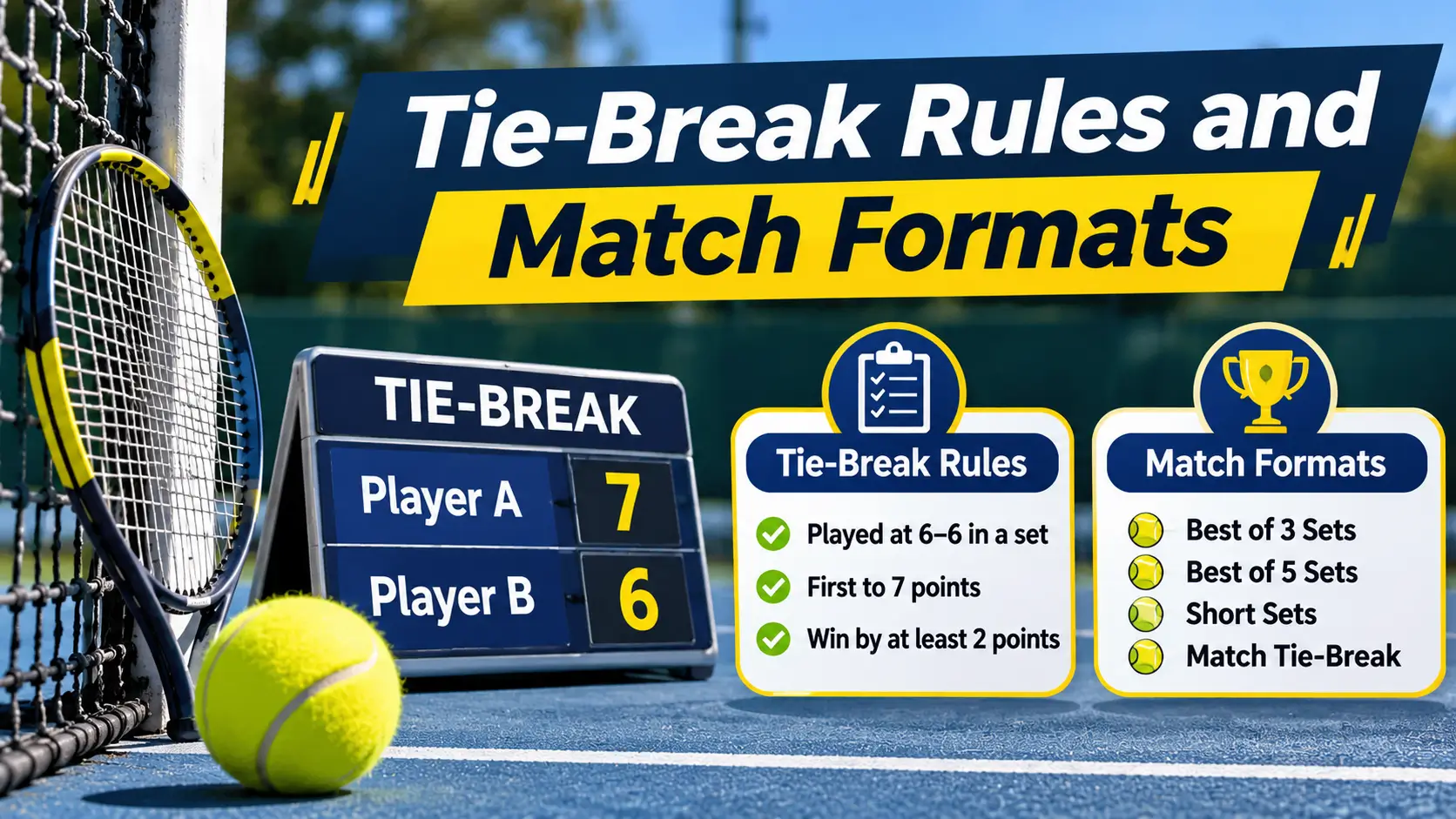
A tie-break is a special game used to decide a set when the score reaches 6-6 in a standard tie-break set. Unlike a regular game, points are counted as 0, 1, 2, 3 and so on. The first player or team to reach seven points with a margin of at least two wins the tie-break and the set.
If the tie-break reaches 6-6, play continues until one side leads by two points. For example, a score of 8-6 or 10-8 wins, while 7-6 does not end the tie-break.
Tie-break serving order
The player whose turn it is to serve starts the tie-break with one point from the right side. The opponent serves the next two points, beginning from the left side. After that, players take turns serving two consecutive points each until the tie-break ends. Players change ends after every six points.
Match tie-break
Some tournaments use a match tie-break instead of playing a full deciding set. Under the common 10-point format, the first player or team to reach ten points with a two-point lead wins the match tie-break. This is not universal: the event regulations specify whether it is used and at which stage.
Beginner Tips, Common Questions and Final Checklist
New players can learn the game faster by practising control and consistency before trying advanced shots. Start with short rallies from near the service line, then move towards the baseline as your timing improves. Practise serving from both sides and say the score before each point to become comfortable with the scoring sequence.
- Learn the court: Identify the baseline, singles sidelines, doubles sidelines and service boxes before starting.
- Use a comfortable grip: Choose a racket grip that feels secure without squeezing too tightly.
- Focus on footwork: Small adjustment steps help you reach the ball and stay balanced.
- Practise the serve: Work on a repeatable toss and a legal contact point before adding speed.
- Call the score clearly: Announce the server’s score first and confirm the score if there is confusion.
- Respect the opponent: Make honest line calls, avoid distractions and wait until the receiver is ready.
For readers who want to explore tennis match markets as a separate topic, the site’s tennis betting guide covers betting-related terminology. Betting is not part of the rules of tennis, and this article is intended to explain how the sport is played.
Frequently Asked Questions
What are the basic rules of tennis?
Players hit the ball over the net into the opponent’s court and try to make a return the opponent cannot legally play. The ball may bounce only once before it is returned, and boundary lines count as part of the court.
How many points are needed to win a tennis game?
A player usually needs four points and a two-point lead to win a standard game. If the score reaches deuce at 40-40, the player must win two consecutive points under advantage scoring.
What does Love mean in tennis?
Love means zero points. The standard sequence is Love, 15, 30 and 40, with the server’s score announced first.
How many sets are needed to win a tennis match?
In a best-of-three match, a player needs two sets. In a best-of-five match, a player needs three sets. The tournament decides which match format is used.
Is a tennis ball in if it touches the line?
Yes. A ball that touches a relevant boundary line is considered in because the line forms part of the court it marks.
What is a double fault in tennis?
A double fault happens when a server commits a fault on both serving attempts for the same point. The receiver wins that point.
Conclusion
Learning the basics makes tennis easier to follow and more enjoyable to play. Start by understanding the court boundaries, the diagonal serve, the one-bounce rule and the sequence of points, games and sets. Then practise deuce, advantage and tie-break situations until the score feels natural.
These Tennis Rules provide a strong foundation for beginners, although tournament formats may include approved variations. Before a competitive match, check the event regulations and consult the official rulebook if a situation is unclear. With regular practice and a clear understanding of the game, new players can build confidence, improve their skills and enjoy every match. For more sports guides, explainers and updates, visit Khelkhabri.